What is one to do? If you ignore the burner and don't light a joss stick is that a sign of disrespect? But if you're seen burning joss sticks, does that mark you as an irreverent Buddhist?
Damned if you do and damned if you don't.
What is one to do? If you ignore the burner and don't light a joss stick is that a sign of disrespect? But if you're seen burning joss sticks, does that mark you as an irreverent Buddhist?
Damned if you do and damned if you don't.
"The danger was that the system was fundamentally unstable. Almost overnight it could go from working well to collapsing. If any one of the Asian countries piling up dollars (and most were doing so) began to suspect that any other was about to unload them, all the countries would have an incentive to sell dollars as fast as possible, before they got stuck with worthless currency."Even Princeton economist Paul Krugman has expressed puzzlement over why the Bush administration went into panic mode over the economy so quickly and without much warning a week and a half ago. And where did the number of $700 billion come from?
James Fallows, "Countdown to a Meltdown",
Atlantic Monthly, July 2005
[H]ere is what really mattered about that June day in 2001: from that point on the U.S. government had less money to work with than it had under the previous eight presidents. Through four decades and through administrations as diverse as Lyndon Johnson's and Ronald Reagan's, federal tax revenue had stayed within a fairly narrow band. The tax cuts of 2001 pushed it out of that safety zone, reducing it to its lowest level as a share of the economy in the modern era.What followed were escalating U.S. trade deficits... a "plummeting" U.S. dollar ... hugely increasing U.S. budget deficits... and inappropriately low interest rates... a "jobless recovery"... and "the evaporation of personal savings."
Americans saved about eight percent of their disposable income through the 1950s and 1960s, slightly more in the 1970s and 1980s, slightly less and then a lot less in the 1990s. At the beginning of this century they were saving, on average, just about nothing.In Fallows' own version of Looking Backward, Fallows then projected an "oil shock" followed by loss of confidence on the part of foreign countries in the value of the dollar. What he predicted is what we're seeing right now, before our eyes:The possible reasons for this failure to save — credit-card debt? a false sense of wealth thanks to the real-estate bubble? stagnant real earnings for much of the population?—mattered less than the results. The country needed money to run its government, and Americans themselves weren't about to provide it. This is where the final, secret element of the gun-cocking process came into play: the unspoken deal with China.
The terms of the deal are obvious in retrospect. Even at the time, economists discussed the arrangement endlessly in their journals. The oddity was that so few politicians picked up on what they said. The heart of the matter, as we now know, was this simple equation: each time Congress raised benefits, reduced taxes, or encouraged more borrowing by consumers, it shifted part of the U.S. manufacturing base to China.
As the dollar headed down, assets denominated in dollars suddenly looked like losers. Most Americans had no choice but to stay in the dollar economyFallows issued a second, even more explicit warning, in the January 2008 issue. As he explained:( their houses were priced in dollars, as were their savings and their paychecks), but those who had a choice unloaded their dollar holdings fast.
The people with choices were the very richest Americans, and foreigners of every sort. The two kinds of assets they least wanted to hold were shares in U.S.-based companies, since the plummeting dollar would wipe out any conceivable market gains, and dollar-based bonds, including U.S. Treasury debt.
Thus we had twin, reinforcing panics: a sudden decline in share prices plus a sudden sell off of bonds and Treasury holdings. The T-note sell off forced interest rates up, which forced stock prices further down, and the race to the bottom was on.
Through the quarter-century in which China has been opening to world trade, Chinese leaders have deliberately held down living standards for their own people and propped them up in the United States. This is the real meaning of the vast trade surplus—$1.4 trillion and counting, going up by about $1 billion per day—that the Chinese government has mostly parked in U.S. Treasury notes. In effect, every person in the (rich) United States has over the past 10 years or so borrowed about $4,000 from someone in the (poor) People’s Republic of China. Like so many imbalances in economics, this one can’t go on indefinitely, and therefore won’t. But the way it ends—suddenly versus gradually, for predictable reasons versus during a panic—will make an enormous difference to the U.S. and Chinese economies over the next few years, to say nothing of bystanders in Europe and elsewhere.Remember, this was written nine months ago, when the Bush administration was assuring everyone that things were hunky-dory and, indeed, the only economic need on the horizon was to make permanent the Bush tax cuts for the wealthy -- just as John McCain urges now.
* * *
Neither government likes to draw attention to this arrangement, because it has been so convenient on both sides. For China, it has helped the regime guide development in the way it would like—and keep the domestic economy’s growth rate from crossing the thin line that separates “unbelievably fast” from “uncontrollably inflationary.” For America, it has meant cheaper iPods, lower interest rates, reduced mortgage payments, a lighter tax burden. But because of political tensions in both countries, and because of the huge and growing size of the imbalance, the arrangement now shows signs of cracking apart.
In the past six months, relative nobodies in China’s establishment were able to cause brief panics in the foreign-exchange markets merely by hinting that China might stop supplying so much money to the United States. In August, an economic researcher named He Fan, who works at the Chinese Academy of Social Sciences and did part of his doctoral research at Harvard, suggested in an op-ed piece in China Daily that if the U.S. dollar kept collapsing in value, China might move some of its holdings into stronger currencies. This was presented not as a threat but as a statement of the obvious, like saying that during a market panic, lots of people sell. The column quickly provoked alarmist stories in Europe and America suggesting that China was considering the “nuclear option”—unloading its dollars.Again, speaking for ourselves, we don't know for a fact that China -- or Japan for that matter, or the Arab Emirates, or Russia or any other creditor nations holding dollar-denominated U.S. Treasury bills -- actually has threatened the "nuclear option." But, clearly, something quite sudden spooked the Treasury Secretary. And the scary scenarios James Fallows has been trying to warn us about are shockingly similar to the sort of thing we're witnessing now.
WASHINGTON — The day began with an agreement that Washington hoped would end the financial crisis that has gripped the nation. It dissolved into a verbal brawl in the Cabinet Room of the White House, urgent warnings from the president and pleas from a Treasury secretary who knelt before the House speaker and appealed for her support.Our favorite quote? It's one for ages:
* * *
It was an implosion that spilled out from behind closed doors into public view in a way rarely seen in Washington.
* * *“We’re in a serious economic crisis,” Mr. Bush told reporters as the meeting began shortly before 4 p.m. in the Cabinet Room, adding, “My hope is we can reach an agreement very shortly.”
But once the doors closed, the smooth-talking House Republican leader, John A. Boehner of Ohio, surprised many in the room by declaring that his caucus could not support the plan to allow the government to buy distressed mortgage assets from ailing financial companies.
Mr. Boehner pressed an alternative that involved a smaller role for the government, and Mr. McCain, whose support of the deal is critical if fellow Republicans are to sign on, declined to take a stand.
The talks broke up in angry recriminations, according to accounts provided by a participant and others who were briefed on the session, and were followed by dueling news conferences and interviews rife with partisan finger-pointing.
In the Roosevelt Room after the session, the Treasury secretary, Henry M. Paulson Jr., literally bent down on one knee as he pleaded with Nancy Pelosi, the House Speaker, not to “blow it up” by withdrawing her party’s support for the package over what Ms. Pelosi derided as a Republican betrayal.
“I didn’t know you were Catholic,” Ms. Pelosi said, a wry reference to Mr. Paulson’s kneeling, according to someone who observed the exchange. She went on: “It’s not me blowing this up, it’s the Republicans.”
Mr. Paulson sighed. “I know. I know.”
“If money isn’t loosened up, this sucker could go down,” President Bush declared Thursday as he watched the $700 billion bailout package fall apart before his eyes, according to one person in the room.There is more... a lot more, and it's shocking.
China and Iraq have signed a $3 billion deal revising an earlier agreement for China's biggest oil company to help develop the Ahdab oil field, an official at the Iraq's Oil Ministry said Thursday.
The deal, restoring a project canceled after the 2003 U.S.-led invasion of Iraq, was signed late Wednesday by Chinese officials and Iraqi Oil Minister Hussain al-Shahristani.
 BBC:
The spectacular farewell in front of a packed house of more than 90,000 at the Bird's Nest stadium is set to last three hours and will include fireworks displays at 18 locations across Beijing.Kung Fu? How much more light hearted can you get?
The organisers have promised a more light-hearted show than the opening ceremony, which focused heavily on Chinese history.
* * *
The closing show will also feature a duet by Chinese folk singer Song Zuying and Spanish tenor Placido Domingo, along with a performance by a 350-strong kung-fu group.
 We were startled to recognize a person we know in a photo of the protestors in this week's anti-CNN demonstration in downtown Chicago. You might have missed the news. There has been no national news coverage of it.
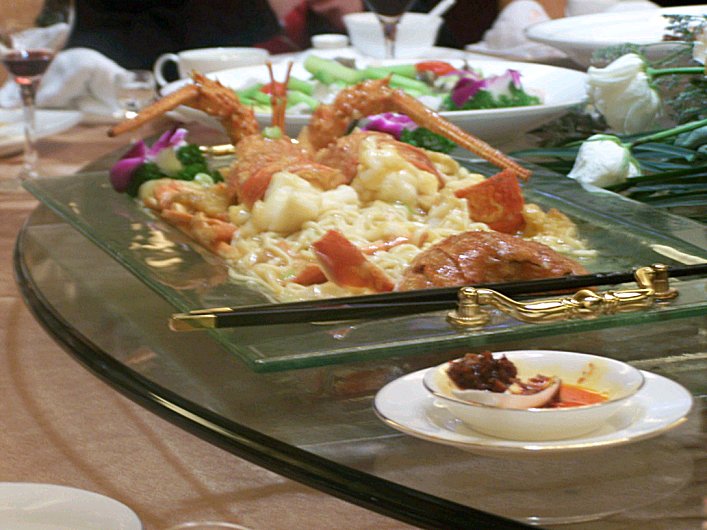 "Everything that walks, crawls, flies, or swims is edible."
"making a rancid and consummately undemocratic point -- that to criticize the President or to hold him to account for his illegal conduct is tantamount to treason... a despicable equivalency which [Bush administration officials] have been peddling for years, ever since John Ashcroft in December, 2001 warned the Senate that questioning the Administration was the same as aiding our enemies."Something seems to have gone very wrong in America over the last few years and it is most clearly seen when one has returned expecting to find something else. If pressed, we would date the decline in our democratic self-governance to the jingoistic run-up to the Iraq war. It's something that leads this traveler to suspect that as a people we Americans have become more like the rest of the world, more like the Chinese, than we can bring ourselves to admit.
There is a growing sense of American responsibility for what our politicians, specifically our President, Vice President and our Congress have done not only to Iraq, but to our own American credibility, financial solvency, and to our preferred image of ourselves as the most law-abiding and simultaneously the most free country on earth.It is strangely disquieting to return from China and realize that here, just as there, ordinary people no longer are taking responsibility for fixing the mess their government has made. The mess we have made by electing the present government.
* * *
Leaving Iraq does nothing to solve the primary problem that plagues our national policy and financial stability. * * * The system that allows boutique wars of choice to be pursued at the whim of the President and his advisors is still in place. The government media system that manufactures lies, reports those lies to the people, and then charges truthtellers with being traitors and terrorists, is still in place in America. It is hard to believe, but this system is even more robust than it was three years ago.
* * *
Instead of fixing Iraq, we ought to focus on fixing our own country.
* * * The [Founding Fathers] fully expected that our government would not be completely guided nor constrained by the Constitution. They fully expected that our government would become corrupted, arbitrary, militaristic and unaccountable to the people. Ben Franklin famously warned moments after signing the constitution when asked by a lady on the street "What have you given us, sir?" He answered, "A Republic, if you can keep it."
* * *
Fixing Iraq is actually far easier for us than recovering our own innocence. But I believe that if we remember that we ARE the people, and that we only suffer the government that we ourselves consent to suffer, we can indeed fix the mess we have made, and certainly prevent future such disasters in our foreign policy. At least, I hope so.