Sunday, January 15, 2006

How To Celebrate MLK Day

"King's widow, Coretta Scott King, says that the day was always intended as a one of activism that mirrored her husband's life during the Civil Rights movement, rather than just an empty celebration."
There is no well settled national custom for how to celebrate Martin Luther King Day, other than not delivering the mail. Some devote the day to public service. Most probably don't. Some take the day off. Others go to work as usual. Some parade. Most don't.

This Monday, probably the best way to commemorate the life and courage of Rev. King is to exercise your brain by tuning in to C-Span at 11 am Central time (noon Eastern) to watch the live speech from Constitution Hall of former Vice-president Al Gore.
In a major address slated for delivery Monday in Washington, the former Vice President is expected to argue that the Bush administration has created a "Constitutional crisis" by acting without the authorization of the Congress and the courts to spy on Americans and otherwise abuse basic liberties.
Georgia conservative Bob Barr, a former congressman, will introduce him. The event is sponsored by the non-partisan Liberty Coalition. The issue is the most important constitutional crisis confronting the nation since the Montgomery Bus Boycott.

Saturday, January 14, 2006

Civics Lesson

"All correct answers automatically disqualify entrants for a job in the George Bush administration."
------
While, in the compelling view of the Pensacola News Journal, Sam Alito and the Senate Judiciary Committee were making a bad joke of the Supreme Court judicial confirmation process this week, the Florida blog Sticks O' Fire was bringing us news about the people responsible for putting those jokers where they are today.

It's us! No wonder the new blog on the block, ...Because Everyone Else Has One, finds it so "effin' depressing."

The Florida State Bar recently commissioned a survey of Floridians and found "Only 59 percent of Florida adults surveyed ... could name the three branches of government." Barely 46 percent knew the meaning of "separation of powers" and only 61 percent knows what "checks and balances" refers to.

The reason, so the bar association suggests, is that so few schools in Florida teach civics any more. In 2004, the Florida Law Related Education Assn. surveyed 13 school districts in the state. It found:
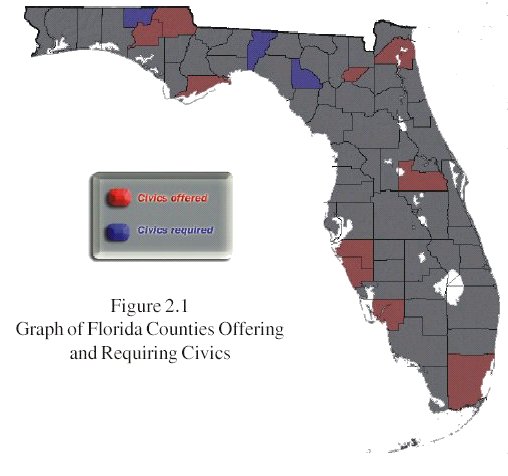
"Less than 10 percent of Florida's 67 counties require the teaching of civics in middle school. High school students are required only to take a one-semester government course, usually in senior year... ."
Barely more even offer civics as an elective, as the map below illustrates. Schools aren't the only ones falling down on the job, though. The mainstream media doesn't help much, either.

Consider this: Last week also was supposed to be the culmination of the Association's annual "We The People" event. It was scheduled for yesterday, January 13, at the Ivanhoe Plaza Hotel in Orlando.

This is a kind of mock congressional confirmation hearing where students compete to really answer serious constitutional law questions. The same kind of questions Judge Alito artfully dodged all week.

Did the Orlando contest take place? Was it postponed? Is it still going on? Who won? What did they have to say?

There doesn't seem to be any news source in Florida that can tell us (although they all have room for today's horoscope and basketball scores.) So let's indulge and compete against ourselves.

The "We The People" contest involves posing several questions to student teams. The questions are tougher than they look. And, unlike Sam Alito, participants actually have to answer them to win.

Below are two of the contest questions. How would you answer them?
1. What is the difference between a government with a constitution and a constitutional government?

2. What is the rule of law and why is it important in a constitutional government?
Caution: All correct answers automatically disqualify entrants for a job in the George Bush administration. Incorrect, disingenuous, or evasive answers win an appointment to the U.S. Supreme Court.

Friday, January 13, 2006

More on the Baker Tornado

WEAR-TV reports this evening:
"All told, 16 kids and one adult sought out medical attention, but none required transport to the hospital. The school, on the other hand will need a lot of patching up. Part of the roof was torn off the secondary wing."

Tornado News

Radar photo courtesy of The Weather Channel

The phones were buzzing late this morning with reports -- now confirmed by eyewitnesses -- that a tornado damaged the elementary/middle school in Baker, Florida. Baker is in Okaloosa County.

The second grade classroom suffered the worst hit, witnesses say. At least fourteen second graders are said to have suffered injuries, but all are believed at this time to be minor.

No local news stations or newspapers have as yet reported the matter.

Update - 3 pm

USA Today has the news, too.

Thursday, January 12, 2006

The War on Cankerism

The U.S. Dept. of Agriculture's citrus canker program, under which hundreds of thousands of over a million perfectly healthy trees were needlessly tortured and condemned to death, is being abandoned.

According to state officials, this means Florida Government will have to stop cutting down perfectly healthy trees that belong to others:
The state will continue to cut down infected trees... but it will stop destroying those within 1,900 feet of an infected tree, which under current law are considered 'exposed.'
Citrus industry spokesmen are blaming hurricanes for spreading canker too wide and far. But Andrew Myers, chief counsel for Broward County, says that's "disingenuous... and blatantly false." He adds:
"Any effort to effectively address the citrus canker issue was undermined by shoddy science and bureaucratic incompetence. It is unfortunate that the constitutional rights of so many Floridians were senselessly trampled."
As for the governor, Jeb Bush says he's "troubled" by the failure of this ill-conceived and badly executed program. Here's an idea: why not simply declare victory and leave?

Bad Birthday

Gitmo is now 4 years old.
  • Number of prisoners transported to Guantanamo: 750
  • Number of Gitmo prisoners convicted of a crime: 0
  • Number of prisoners released without charges: 180
  • Number "transported to the custody of other countries" (i.e. tortured by proxy): 76
  • Number of prisoners presently on hunger strike and being fed by tube: 32
Read more: Guantanamo Detaineees: 4 Years Without Justice.

And, A Peak Behind the Curtain at Gitmo.

Wednesday, January 11, 2006

Beach Rhythms Returning

"There are a lot of other people besides me who walk the beach and look at the sand and watch the trucks going by. They can see what the danger is. If they get involved and speak up then we have a chance to keep the beach as beautiful as it is now."
-- Anne Sanborn, July 2001
Wednesday's Pensacola News Journal prominently features an article about red clay concerns on Pensacola Beach. This provides yet another welcome sign that the familiar rhythms of life on Pensacola Beach are returning to normal at long last, nearly a year and a half after Hurricane Ivan.

Just as the usually gentle Gulf waves ebb and flow along Florida's barrier islands -- each wave, having spent itself, supplanted by another as surely as that one in its turn will be replaced by a newer wave -- so, too, do the generations of beach residents who care deeply about Pensacola Beach easily flow from one into the next.

Today's story is that Victoria Clarkin, the president of the Pensacola Beach Preservation and Historic Society, is said to be following "dump trucks as far as Navarre, documenting the hauling" of material off the beach. Reporter Lynette Wilson's treatment leaves a few gaps in the story that may mystify some readers.

Most will understand that Ms. Clarkin suspects something may be fouling the famous "sugar white sands." But it isn't clear whether she's worried the sand is being removed by road crews building a four-lane Via De Luna, or red clay is being left in place, or even that trucks are accidentally importing the clay. Quite possibly, all the above.

It's hard to know because the newspaper gives Ms. Clarkin too little space to explain the basis of her suspicions.
It is clear, however, that her volunteer efforts are vital. Escambia County environmental services director Keith Wilkins is quoted in the article as saying:
"We appreciate the residents watching. We rely on the citizens to keep an eye out. We have 12 enforcement officers and no inspectors."
No inspectors? That will come as a shock to some. Yet, thus it always has been.

Long-time residents of Pensacola Beach may be forgiven their sense of deja vu. Today, the sand monitor is Victoria Clarkin. Yesterday -- or, to be more precise, from 1998 to 2001 -- it was Anne Sanborn.

National reporter Kelly Greene even did a front-page feature for the Wall Street Journal about Anne in July, 2001. The title was, "Gray Area: If Sand on Strand Isn't White, Ms. Sanborn Is Livid." The subhead read: "She Patrols for Discolorations And Reports Them; Builders And Some Others See Red."

After the article appeared, Anne was interviewed about it for the (now defunct) pbrla.com web site. Here is an excerpt:
Anne said she and several friends had been informally patrolling the beach for nearly three years, alert to any red clay or discolored fill dirt being trucked onto the island. Their efforts started in earnest after they discovered the Santa Rosa Island Authority was overlooking sand mixed with red clay, rocks, dirt and "brown sand" trucked to a Gulfside dune rebuilding site.

Now, Anne says, the cadre of volunteers keeps a watchful eye for all sources of sand defilement, from road repair materials to new building construction.

Why worry over the color the sand?

"Because I like white sand," she states flatly. "It's one of the things that attracted me to Pensacola Beach and I know it attracts many other people. The AAA Travel guide even mentions the unique white color in the first sentence of their section about Pensacola Beach."
As it happens, Anne, then age 75, moved from the beach soon after to be nearer her children and grandchildren. When asked if she had any advice for those who were staying behind, this is what she said:
"All I can say is keep up the good work. There are a lot of other people besides me who walk the beach and look at the sand and watch the trucks going by. They can see what the danger is. If they get involved and speak up then we have a chance to keep the beach as beautiful as it is now."
And so the beach goes on into a long future, we can hope. Victoria Clarkin has answered Anne Sanborn's call to "get involved" and "speak out" to preserve the best of Pensacola Beach. Let's hope more of the next generation of beach residents will do the same.

Trigger Happy

You may remember the national news story that broke here in Pensacola just before Hurricane Ivan swamped everything but storm stories. Even the National Enquirer covered the incident, we're told.

In many publications and blogs of the time, the headline writers just couldn't resist: "Dog Shoots Man."
"On Sept. 6, 2004, [Allen] Bradford was holding two puppies, trying to shoot them in the head, when one wiggled, sending a bullet into Bradford's wrist. Bradford had shot and killed three puppies before he was wounded himself."
The puppy walked on a plea of self-defense. The "perp" as they say on Law and Order, turned out to be a grown adult who was trying to kill him.

Today's PNJ writes the end of the story (we hope): "Jerry Allan Bradford, 38, pleaded no contest to three counts of killing an animal and was sentenced to one year on probation, court records show. Three additional charges of cruelty to animals were dismissed."

Employees at the Escambia County Animal Shelter tell us today that the puppy, whom they named "Trigger," was adopted shortly after the incident and is believed to be well and happy.

That would make him him "Trigger Happy," if we were the kind who would write a headline like that.

Tuesday, January 10, 2006

Speaking the Language

Today's Washington Post has more on Jill Carroll -- and, as a possibly inadvertent aside, the chronically sad state of Western journalism in Iraq:
With violence roiling Iraq, a sizable number of foreign reporters largely restrict themselves to armored cars shuttling between hotels and the American-controlled Green Zone. They cover American officials and the isolated authorities of the U.S.-backed Iraqi government.
This, emphatically, has not been the case with Ms. Carroll's coverage:
Unlike most Western reporters in Baghdad, Carroll spoke Arabic well enough to easily talk to ordinary Iraqi people and interview Iraqi officials. She had picked up the language while working as a business reporter in Jordan... .

"In this poorly understood region, where so much is at stake, important stories are lost everyday because the foreign press corps doesn't speak Arabic," Carroll [once] wrote. "Journalism is a public service and readers are best-served if I and the people I am writing about speak the same language."

Although things may be slowly improving, at least with newspaper coverage, it is still true that one of the many subjects badly covered by American journalists in Iraq remains their own poor communication skills. As Tom Engelhardt wrote recently:
American reporters may be almost as crippled by not being Arabic-speakers as by the dangers of Iraq. It remains an amazing fact that an American occupation which began largely without Arabic-speakers... has since been covered in our press mainly by reporters who can't communicate directly with the people they're covering.
Can you imagine what press coverage of Pensacola would be like if "most" reporters here didn't speak English, talked mainly to military base officers, and "largely restricted themselves" to a room at the Motel 6?

Monday, January 09, 2006

Reporting the Unreported

Today, the Christian Science Monitor went public with news that one of its reporters in Iraq, Jill Carroll, was abducted in Baghdad late Friday (Saturday morning local Mideast time). This gives the green light to a long line of U.S. media outlets and bloggers (yes, this one among them) who for several days had been observing a voluntary embargo on publishing the identity of the kidnapped reporter.

The embargo is said to have been requested by Reporters Without Borders. It was claimed that not publishing Ms. Carroll's name would aid them in negotiating her early release. No one wants anything to interfere with any prospect for saving Jill Carroll, so of course the vast majority of U.S. news outlets remained mum.

Ms. Carroll's sister has a blog, written out of Washington D.C. that also went dark. All that remains of Lady of Arabia, for now, is a Google cache.

Jill Carroll once wrote an affecting article about how she rebounded from a layoff by the financially troubled Wall Street Journal to become a freelance reporter in Baghdad. Although she doesn't say as much, the reader can't help but conclude that Carroll is a very courageous reporter, indeed.

Her last report was published on Thursday, the day before her translator was shot and she was abducted en route to an interview through a dangerous Baghdad neighborhood. Her final report of 2005 noted that things were deteriorating badly in Baghdad:
"Iraqis are saying that 'The purple finger isn't paying off,' in reference to the indelible ink left on a voter's finger."
There might be no reason to question the judgment of U.S. news editors who honored the blackout, except for the curious fact as Editor & Publisher notes that "Numerous foreign news outlets and several leading wire services disclosed the incident -- and in a few cases, the reporter's name." Most who did so published her name on the very day of her kidnapping -- and some of them every day thereafter.

One was USA Today, which pulled the story a few hours later. Readers of the popular blog Eschaton, after a couple of false starts, figured out Ms. Caroll's name on their own Saturday, as you can see by tracking through their 95 comments that afternoon. As Atrios noted when he started the thread, "There aren't exactly an infinite number of female American journalists in Iraq."

Others who openly reported Ms. Carroll's name were mostly newspaper and radio sources throughout Europe and Asia. Several of the latter were easily heard on shortwave right here in Pensacola as well as across the U.S.

Whatever protection anonymity might have provided Ms. Carroll while in the hands of her captors -- and it's not clear why there would be any -- it surely was lost long before today. Most of Europe and much of Asia knew her identity. Only Americans remained blacked out.

Is there a lesson for us in all of this -- or for the journalists upon whom we rely to publish the reality of our shrinking world? It's becoming conceivable that before we realize what's happened, we in the U.S. might not be allowed to say.

Further Amplification Dept.

Speaking of violent acts against journalists, the UK Guardian reports, "American troops in Baghdad yesterday blasted their way into the home of an Iraqi journalist working for the Guardian and Channel 4, firing bullets into the bedroom where he was sleeping with his wife and children." There's more....

The Ages of Man

Prize-winning columnist Donald Kaul, now retired and having turned 71, asks 'What is the best of the "four stages of age"?' (Hint: It's not "You're looking great.")

Sunday, January 08, 2006

Sex and the Single Web Surfer

"An economist is a man who states the obvious in terms of the incomprehensible."
It's January. Do you know what that means, students? That's right! It's Annual Academic Meeting Time!

From Archeologists to Zoologists at schools from Adelphi to Yuba College, underpaid teachers hoping to bulk up their tenure applications are gathering in drafty Holiday Inns and down-at-the-heels Sheratons across the nation to share the fruits of their lonely labors in the vineyards of Academe.

Not least among these is the American Economics Association. Gathering in Boston last week, this brainy group received several hundred heavily-footnoted papers -- the more footnotes, the better, don't ya' know -- in the never-ending quest by practitioners of "the dismal science" to reduce the complexities of human behavior to one unified, bloodless mathematical equation.

This year, no academic paper is likely to be of less importance, or more stimulating, than "What Makes You Click: An Empirical Analysis of Online Dating," by Gunter J. Hitsch and Ali Hortacsu (Univ. of Chicago) and Dan Ariely (Massachusetts Institute of Technology). The entire thing is available on-line here in pdf format, complete with 51 pages, 23 footnotes, 11 charts and graphs, and seven tables.

To research on-line dating habits from an economists' point of view, the authors used "a novel data set obtained from a major online dating service." This enabled the trained economists to identify "mate preferences" and "match outcomes" of men and women who are looking for each other via the Internet.

All of this is economics professor talk for 'we spied on your on-line dating messages and intercepted your emails to each other.' Taking a leaf from George Bush's playbook, they confess to conducting warrantless searches of Internet dating line customers in two American cities, San Diego and Boston.

You think having President Bush monitor your phone calls is bad? Imagine this:
"At each moment in time, we know which profile [dating service users] browse, whether they view a specified photograph, and whether they send or reply to a letter from another user. We also have some limited information on the contents of the e-mails exchanged; in particular, we know whether the users exchanged phone numbers or e-mail addresses."
To this 'data set' the authors then applied -- we're not making this up -- a mathematical equation for determining the "latent utility of man, m, from e-mailing woman, w, related to the eventual utility from forming some sort of match." Or, as we used to say in the olden days before the Internet, they went looking for good pick-up lines.

For those of you who want to try this at home, here's the economic equation for whether you're likely to get laid:
Umw = x'wa + | xw - xm | - ' + B + xw - xm | - Y
+ N/k;l=1 {dmk = uk and dwl = vl ¢ ±kl} . 8 + cm + ²mw .
Really. That's it. The empirical mathematical formula for catching a mate on the Internet.

For the mathematically impaired, the authors do offer a narrative summary of their findings, cushioned in advance with a warning so as not to shock you too much:
"Many readers will find some of our results sobering. Our fate in love and marriage seems to be driven by factors such as looks, height, weight, and income, that are hard or impossible to change."
What else could they have expected? Preferences in breakfast cereals? Paper or plastic users?

There are several equally compelling conclusions these august academic economists reach. They hardly qualify as earth-shattering, however. Among these --
  • "Men appear much more receptive to first-contact e-mails than women." Translation: Men are hornier than women.
  • Women are browsed more often, and receive more first contact e-mails and e-mails containing a phone number or e-mail address than men." Translation: Ditto.
  • Men who "indicate a preference for casual sex are contacted less often than men who state that they are hoping to start a long term relationship. Women, on the other hand, are not negatively affected by such indications." Translation: Men are such pigs.
  • Women prefer tall, rich, well educated men. Men will 'date' any size of woman no matter how short, poor or stupid she may be. Translation: Ditto.
  • "Women seem to have a strong preference for men with equivalent education levels and higher incomes in a mate." Men, on the other hand, will date anything that doesn't have scales and slither through the grass. Translation: Ditto, again.
  • "About 3.5% of dating web site users declare their annual income to be above $200,000, whereas the [general census population] samples contain 0.0% of the population." Translation: Men are such liars.
After thoroughly studying this latest empirical analysis of on-line dating, you might be uncertain whether any of the economists' findings can help your particular situation. Yes, one can:
"Blonde women have a slight improvement in their online 'success' [in attracting men] while women with gray or 'salt and pepper' hair suffer a sizable penalty. ... For women, 'long straight hair' leads to a slight improvement in outcomes, while short hair styles are associated with a moderate decrease in outcomes."
So, there you have it. Real college-trained economists who spy on on-line dating service users conclude: Guys, you really are pigs. And, gals, don't cut your hair. Dye it blonde.

And, be sure to lose those scales and stop slithering through the grass.

Saturday, January 07, 2006

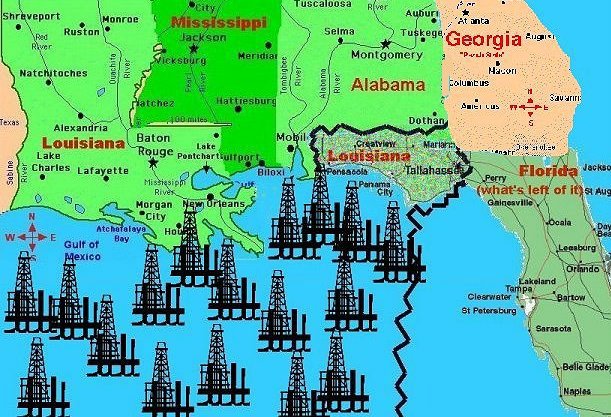
George Bush Geography

Feds Give Control of Florida Waters to Louisiana

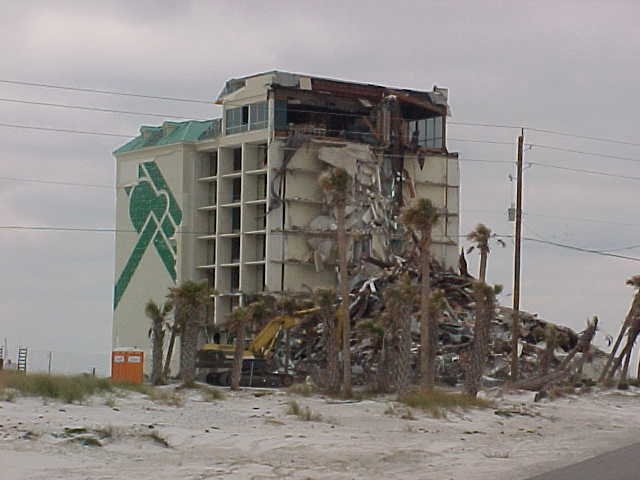
We're Not Expert Photographers, but....

... we did stay in the Pensacola Beach Holiday Inn last night.

Friday, January 06, 2006

Unbuckling the Bible Belt

"Religious freedom and separation of church and state also are among the top issues in Pensacola, which Watson described as the 'buckle of the Bible belt.'"
Although things are changing ever so slowly, Pensacola still deserves its reputation for being a hotbed cold freezer of neo-con politics. As Adam Smith of the St. Petersburg Times put it during the last presidential election, "To call Escambia County a Republican stronghold is like calling Tiger Woods a decent golfer."

Somehow, though, a few liberals now and again manage to slip past the armed guards at the county border. One of them is Susan Watson. We mention her because she was one of the lead plaintiffs in the Florida voucher case of Bush v. Holmes.

Ms. Watson is no stranger to education issues or to the struggle to protect American civil rights. She first came to public attention when she took on the charlatan Hal Mason, who was once elected as an Escambia County school board member but then died in office.

For a thankfully short time, Mason virtually held the county's public school system hostage to his peculiar Know Nothing-like ideology, all the while refusing to disclose what, exactly, he'd been doing in California for a lengthy period of ten to twenty years that left a large, mysterious blank space on his resume. Mason's downfall can be traced largely to the courageous fight Susan Watson waged, almost single-handedly, against the nutty faction that dominated local school board politics a few years ago.

When interviewed by the St. Petersburg Times last summer, Ms. Watson explained that she had decided to challenge the state voucher system in Bush v. Holmes because "I don't want my tax dollars being thrown into the garbage, being thrown into schools that we don't monitor or test."

Her three children are, or soon will be, graduates of Pensacola High School. The oldest now attends the University of Chicago.

That's not the whole story, however. Susan Watson also has been a very active P.T.A. member. A few years ago, she became a founding officer of the "Panhandle Chapter" of the American Civil Liberties Union. Last summer, she was appointed "the ACLU's first full time director of Northwest Florida."

More recently, she's been making common cause with former conservative Georgia congressman Bob Barr and libertarian minister Chuck Baldwin against the more egregious aspects of the U.S. Patriot Act.

Pensacola still may be the 'buckle of the Bible Belt," but Susan Watson is valiantly working to set us free.