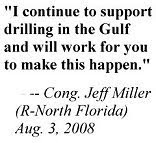
"There will not be any oil spills affecting Florida beaches."
-- MMS, June 2001, Palm Beach Post (Sept. 10, 2001, page 1A)
One month ago today BP's Deepwater Horizon oil platform caught fire. We first took notice on this blog when the platform sank on April 22, Earth Day -- which just happened to be the one-year anniversary of the "drill, baby, drill" proposal Republicans unveiled in the Florida legislature.
Nice timing, G.O.P. Step forward, please, to receive your comeuppance.
2. Local TV Oil-Cast.
Oil slick predictions by local TV weathermen -- not the most reliable source we can imagine -- are leaving heads spinning in our household. At 10 pm last night, WEAR-TV's weatherman wore a long face as he dolefully told viewers it looked very much as if wind and water currents would be pushing the oil slick north and thus closer to Pensacola over the next forty-eight hours.
On line, however, a completely different weather-person offers a completely different oil-cast: "Over the next forty-eight hours we do not expect the oil to move toward the north." There is something to the overnight revised forecast. NOAA's Mobile, Alabama, regional weather station is predicting mostly south- to south-east winds through the weekend.
Now, we understand why WEAR-TV stopped uploading their full, unedited news broadcasts to their web site. It was simply too embarrassing.
Though the winds may be favorable, the WAVCIS map at LSU's Coastal Studies Institute (screenshot, above) shows an animation that brings the oil slick ever closer to Pensacola Beach over the next forty-eight hours.
3. Sizing Up the Leak.
McClatchey News reports that at yesterday's hearings by a House subcommittee headed by Rep. Ed Markey (D-MA), a string of scientists, one after the other, scoffed at BP's estimate that about 5,000 barrels of oil are leaking every day. Kate Sheppard, the reliable environmental reporter for Mother Jones Magazine, was live twittering the hearing yesterday. Check her highly compressed summaries of each of the scientific witnesses.
Science News reports that one engineering professor, Purdue University's Steven Wereley, told the subcommittee "that his calculations of two leaks that are on videos BP released on Tuesday showed 70,000 barrels from one leak and 25,000 from the other."
He said the margin of error was about 20 percent, making the spill between 76,000 and 104,000 barrels a day. However, Wereley said he'd need to see videos that showed the flow over a longer period to get a better calculation of the mix of oil and gas from the wellhead."At least four other independent engineers," Science News added, "have pegged the figure at between 25,000 and 100,000 barrels a day. Prof. Wereley testified that all of the estimates from outside the industry “are considerably higher than BP’s” and "there's a good overlap between the outsider estimates.”
This would suggest BP’s number is an outlier, said subcommittee chairman Ed Markey (Dem.-Mass.). It is, Wereley assured him.4. Laying Low.
As Marisa Taylor and Renee Schoof were reporting for McClatchy News yesterday, BP has been deliberately withholding facts about the spill from scientists as well as the government -- "and government lets it." They quote Toby Odone, a BP spokesman, as claiming that the company has been sharing data only with "legitimate interested parties." But --
When asked whether the information can be released publicly, he responded, "Why would one do it? Any parties with a legitimate interest can have access to it."Click here, or on the graphic above left, to see the proposed reorganization chart.

The reorganization is long, long overdue.
7. MMS in Pensacola.
As residents of Pensacola may remember, MMS is the agency which back in 2001 was telling everyone from school children at "Susan Whitehurst's language arts class at Woodlawn Beach Middle School" to David Struhs, secretary of the Florida Department of Environmental Regulation, "There will not be any oil spills affecting Florida beaches."
That's a direct quote from a September 10, 2001, Palm Beach Post article by reporter Mary Ellen Klas (now behind a subscription wall):
Drilling rigs are carefully monitored for pollution, [MMS] said. Plants and animals disturbed by the development of oil and gas platforms, in time, "will be the same as they were before." Besides, humans always cause "some unavoidable harm to some groups of animals and plants," like insects smashed "by the simple act of walking down a sidewalk."In the article, "MMS and the industry" were as one in articulating a unified response to all concerns about the risks of oil pollution. No surprise, there. In 2001, both MMS and the Interior department were "headed by former executives in the oil and gas industry."
This response infuriated environmentalists.
"We realize we can't depend on the MMS to express the true hazards of drilling," said Enid Sisskin, a biologist and spokeswoman for Gulf Coast Environmental Defense, a Pensacola-based opponent of drilling off the Panhandle. "They don't even pretend to be neutral.
They argue that the discharge is so diluted when it is dumped into the gulf that the toxins do no harm.Under former president George W. Bush, the MMS agency only grew worse. It became a grotesque nest of "sleeze, sex, cocaine and... billions in lost revenues" to the U.S. treasury. Even before that, however, local environmentalists like Enid Sisskin were warning --
They also point to their safety record and advancements on drilling techniques that have resulted in a blowout rate - the uncontrolled flow of oil or gas - of only one in every 1,000 well starts since 1996.
If a spill were to reach our sugar white beaches, within a few months to 2 years after cleanup, although disturbed beach configuration would adjust to approximately predisturbance conditions, some oil that penetrated to depths beneath the reach of the cleanup methods would persist in beach sands and could be released periodically when storms and high tides resuspend or flush through beach sediments. During hot, sunny days, tarballs buried near the surface of the beach sand could liquefy and cause a seep to the sand surface.In the Palm Beach Post article, MMS critics were very detailed -- and, as it turns out, prescient -- in their warnings:
A gas well blowout can devastate bottom habitat and produce a wide area of toxic conditions within the water column," the EPA wrote in its comments on the proposed sale of Lease 181.It's been nine years since those warnings were issued out of Pensacola by Enid, among others. They were right. MMS and the entire oil industry was wrong.
* * *
Another issue complicates natural gas drilling. Discoveries off the coast of Mobile, Ala., indicate that the same formation that extends to Florida contains sour gas, or hydrogen sulfite, which is corrosive and very poisonous, said Klaus Gohrbandt, a retired petroleum geologist living in Pensacola. Rig workers must wear gas masks and the hydrogen sulfite is removed at the processing plant before the natural gas is shipped to the transmission line, he said.
Little known about that depth
Finally, environmentalists note that little is known about marine conditions below depths of 8,000 feet or what impact the release of oil and gas will have in this intensely cold, high pressure environment.
Scientists have discovered unique plants and animals, such as the tube worm, living near seeps in the oil and gas formations deep under water. Recent research has also determined that the deep waters of the gulf are also home to hundreds of endangered sperm whales.
The risks of drilling in this unknown frontier are twofold. With giant offshore wells pumping more that 200,000 barrels of oil a day in depths of more than 1,000 feet, the MMS predicts that a well blowout "could easily turn out to be a potential show stopper ... if the industry and MMS do not come together as a whole to prevent such an incident."
The industry has a plan in place for an oil spill but even federal regulators working for the MMS admit they don't really know how quickly the industry can respond, how fast it can stop the well flow and what the environmental impact might be.
And now, BP wants to treat them as people who are not "legitimate interested parties?" MMS is not the only entity that needs serious overhauling.