Showing posts with label MMS. Show all posts

Thursday, May 27, 2010

Thrombosis Thursday May 27 BP Oil Spill Update

"[T]his is really an art, not a science."
-- Richard Harris, NPR

1. Free Beach.

As in past years, gay and lesbian visitors have begun arriving at Pensacola Beach for the Memorial Day weekend. This morning a couple of dozen tents were going up mainly along the undeveloped stretch of county beach about a mile east of Portofino.

Farther east at "Opal Beach" -- so christened by Gulf Islands National Seashore officials after the 1995 hurricane -- only a couple of tents and perhaps a dozen beach-goers were in evidence. A park official told us he suspects prospective visitors are being scared off by the official NPS sign at the roadway entrance that announces an $8 daily visitor fee.

"Actually, we're not charging this weekend," he said. "It's free. But a lot of the gay people don't know it. They just see the sign and turn around to leave."

2. Top Kill Reports Mixed and Contradictory.

We are in the midst of a "crucial stage" in the BP oil spill catastrophe, the UK Guardian reported overnight. Even into the early morning hours, what little BP was saying about the "Top Kill" attempt to give BP's oil well a heart attack was that they were seeing mostly drilling mud. Some suggested that wasn't good; it meant the mud wasn't sinking as deeply as hoped.

At mid-morning, however, the Wall Street Journal was reporting "U.S. Coast Guard Admiral Thad Allen, who is overseeing the disaster response in the Gulf of Mexico, said the company's "top kill" maneuver had successfully prevented oil and gas leaking from the well." The Los Angeles Times is reporting the same news, adding "Engineers plan to begin pumping in cement and then will seal the well."

The reports are sketchy and incomplete, and at least when it comes to the Wall Street Journal, focused on the minute-by-minute stock price of BP. That, alone, is reason enough to withhold faith in the reports.

NPR at noon Eastern Time still was reporting that U.S. Coast Guard Adm. Thad Allen is saying it's "too early" to determine if the leak has been stopped or even ameliorated.

3. Sick People.

WWL-TV in Orleans reports seven contamination clean-up volunteers were hospitalized last night. They reportedly are suffering from severe headaches, owing to direct contact with the oil or breathing its fumes.

London's Daily Mail claims the U.S. Coast Guard also has ordered all commercial ships to leave the site of the Deepwater Horizon oil spill so crew members can be checked "as a precaution." The newspaper says, "Four crew members from three vessels were hospitalised after reporting nausea, dizziness, headaches and chest pains."

4. Dead Sea Life.

From Reuters News Service:
More than 300 sea birds, nearly 200 turtles and 19 dolphins have been found dead along the U.S. Gulf Coast during the first five weeks of BP's huge oil spill off Louisiana, wildlife officials reported on Monday.
5. Animal Life Missing from the Gulf.

Kate Sheppard, who has been doing a tremendous job reporting from Louisiana for Mother Jones Magazine, had a great catch yesterday:
There's mounting evidence that federal regulators at the Minerals Management Service were paying zero attention to the oil industry, particularly when it came to authorizing oil spill response plans. Case in point: BP's Oil Spill Response Plan for the Gulf of Mexico lists sea lions, seals, sea otters, walruses in its evaluation of how a spill might affect local wildlife. The problem? None of these critters live in the Gulf.
That's true, of course. We haven't seen a sea lion or walrus since we last visited the Oregon coast. But there is a sea otter trapped inside a glass cage at the Gulfarium in Ft. Walton Beach. They have some performing seals, too.

Here's hoping that's not where we'll have to go to see the only dolphins left along the Gulf Coast.

6. Another Oil Well Leaking.

BBC reports an on-going oil drilling emergency in the North Atlantic, almost 200 miles miles west of Bergen, Norway. Heavy drilling mud is being used there, as well, to stop the leakage.
Under the Norwegian platform, the BOP, or blow-out preventer, is acting as a barrier if the pressure continues to build. But the other barrier, drilling 'mud', has not proved effective in containing the Gullfaks well.

That may have changed on Wednesday morning. Statoil, Norways' state-owned oil company, has been pumping drilling mud into the well since the incident began, in an attempt to reach a point where it caps the pressure.

A spokesman for Statoil, Gisle Johansen, said today that the point has been reached where "loss of mud into the formation has stopped and we do not have to pump additional mud into the well. This is positive information and tells us that the pressure situation in the well is more stable".

However, he said: "We still don't have the necessary safety barriers in place".

The next stage is to cement a plug into the well, said the spokesman. That work has yet to start, and will take several days.

7. Obama's Katrina?

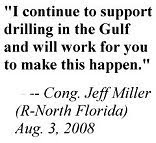
The usual assortment of partisan hacks has been trying for over a month to tag BP's oil spill as "Obama's Katrina." While the Obama administration surely could have done some things better, it's as plain as the oil glop on the wings of Louisiana's coastal birds that if there are any politicians to be blamed, they are the greed- and power-driven nasties like former vice-president Dick Cheney and the pathetic "drill, baby, drill" sycophants like our own congressman, Jeff "Oil Spill" Miller.

Today's New York Times, however, is running a thought-provoking series of short opinion pieces from respectable thinkers about the blame question. ["Is It Obama's Oil Spill, Now?"]
Definitely worth a read.

Blaming politicians may be fun, but Glenn Greenwald expresses a view that the question posed should be seen in a broader context, raising the more fundamental question of 'What do we Americans expect of any president, and what do those expectations say about us?'
[T]here is little the White House can actually do to stop a massive underwater oil spill, and expectations that he do more are largely unreasonable.

But that does not mean that the president will be immune from political damage from this incident, nor does it mean that he should be immune.

Our political culture is shaped by what the Cato Institute’s Gene Healy has called “The Cult of the Presidency.” White House aides perpetuate the mythology that presidents are paternal, virtually omnipotent figures who will protect us from harm and, in the broadest sense, ensure that justice is done.
* * *
As more and more Americans come to understand the true magnitude of the oil spill disaster, it will matter little that President Obama was not at fault.

Far more significant will be the perception that he failed to “protect” us from this threat, a potentially devastating belief in a society where “protecting us from harm” has come to be seen as the president’s overarching responsibility (far higher than what the Constitution actually describes as the prime presidential duty: “to preserve, protect and defend the Constitution”).

Put simply, unless the oil spill is brought under control quickly, Obama as the holder of centralized political power is likely to be blamed for these failures whether or not that blame is fair.

8. Obama's MMS Director Out.

Reliable new reports late this morning from NPR and ProPublica say Elizabeth Birnbaum has been fired as MMS director. [Update: Interior Secretary Salazar predictably claims Birnbaum "resigned today on her own terms and on her own volition."]
Birnbaum has only been head of the agency since July 2009 — less time than her boss, Ken Salazar, has been secretary of the Interior Department, which oversees MMS. We’ve put in a call to MMS to confirm these reports.
Unlike the execrable associate director of MMS, Chris Oynes -- who suddenly "retired" under a cloud after a decade mismanaging oil and gas leases in the Gulf of Mexico -- Birnbaum wasn't suspected of being too close to the oil industry. Instead, as it seems to us, she simply knew too little and was not a strong enough manager to handle the snake pit that MMS has become.

One thing is certain: Birnbaum won't be the only Interior Department official to be canned.

Tuesday, May 25, 2010

Louisiana MMS: 'A Culture of Corruption'

Buried on page A-16 of today's Times is an investigative news item by Ian Urbina claiming that an inspector general's report into misconduct by Minerals Management Service (MMS) had been transmitted to the Secretary of the Interior, Ken Salazar. The report focuses on employees at the Lake Charles, Louisiana, MMS regional office -- the one which would have had the most direct conduct with BP oil industry officials and the Deepwater Horizon well.

As Urbina wrote, the report initially was "provided to The New York Times by a person familiar with the investigation who is not authorized to speak to reporters." And, it's a humdinger. What it describes is a culture of corruption, favoritism for the oil industry, and thorough incompetence.

As introductory materials in the report explain, "all of the conduct chronicled in this report occurred prior to 2007." The investigation had its origins in a whistle-blower's letter sent to the U.S. Attorney's office in Louisiana. The U.S.A. referred the matter to the I.G. for investigation.

Times reporter Ian Urbina describes one of the many deeply disturbing findings: "Federal regulators responsible for oversight of drilling in the Gulf of Mexico allowed industry officials several years ago to fill in their own inspection reports in pencil — and then turned them over to the regulators, who traced over them in pen before submitting the reports to the agency." (emphasis added)

Other activities of MMS personnel at Lake Charles included:
  • Inspectors accepting "meals, tickets to sporting events and gifts" from "at least one oil company while they were overseeing the industry."
  • In mid-2008, "a minerals agency employee conducted four inspections on drilling platforms when he was also negotiating a job with the drilling company, a cover letter to the report said."
  • An MMS inspector from the Lake Charles office "admitted to investigators that he had used crystal methamphetamine, an illegal drug..." and is believed to have been under the influence of drugs while conducting an oil rig inspection.
  • Employees from the Lake Charles office "repeatedly accepted gifts, including hunting and fishing trips from the Island Operating Company, an oil and gas company working on oil platforms... ."
  • At least two Lake Charles MMS employees "admitted... using illegal drugs during their employment."
  • Seven or more inspectors who are "cited in the report as having been involved in inappropriate or illegal activities were still employed by the agency when the report was completed in March."
The full IG report now has gone viral. It's available on Scribd and ABC-News and probably elsewhere.
minor edit 5-25 pm

Thursday, May 20, 2010

Oil-A-Versary: Thursday BP Oil Spill Update

"There will not be any oil spills affecting Florida beaches."
-- MMS, June 2001, Palm Beach Post (Sept. 10, 2001, page 1A)

1. Happy Oil-a-versary.

One month ago today BP's Deepwater Horizon oil platform caught fire. We first took notice on this blog when the platform sank on April 22, Earth Day -- which just happened to be the one-year anniversary of the "drill, baby, drill" proposal Republicans unveiled in the Florida legislature.

Nice timing, G.O.P. Step forward, please, to receive your comeuppance.

2. Local TV Oil-Cast.

Oil slick predictions by local TV weathermen -- not the most reliable source we can imagine -- are leaving heads spinning in our household. At 10 pm last night, WEAR-TV's weatherman wore a long face as he dolefully told viewers it looked very much as if wind and water currents would be pushing the oil slick north and thus closer to Pensacola over the next forty-eight hours.

On line, however, a completely different weather-person offers a completely different oil-cast: "Over the next forty-eight hours we do not expect the oil to move toward the north." There is something to the overnight revised forecast. NOAA's Mobile, Alabama, regional weather station is predicting mostly south- to south-east winds through the weekend.

Now, we understand why WEAR-TV stopped uploading their full, unedited news broadcasts to their web site. It was simply too embarrassing.

Though the winds may be favorable, the WAVCIS map at LSU's Coastal Studies Institute (screenshot, above) shows an animation that brings the oil slick ever closer to Pensacola Beach over the next forty-eight hours.

3. Sizing Up the Leak.

McClatchey News reports that at yesterday's hearings by a House subcommittee headed by Rep. Ed Markey (D-MA), a string of scientists, one after the other, scoffed at BP's estimate that about 5,000 barrels of oil are leaking every day. Kate Sheppard, the reliable environmental reporter for Mother Jones Magazine, was live twittering the hearing yesterday. Check her highly compressed summaries of each of the scientific witnesses.

Science News reports that one engineering professor, Purdue University's Steven Wereley, told the subcommittee "that his calculations of two leaks that are on videos BP released on Tuesday showed 70,000 barrels from one leak and 25,000 from the other."
He said the margin of error was about 20 percent, making the spill between 76,000 and 104,000 barrels a day. However, Wereley said he'd need to see videos that showed the flow over a longer period to get a better calculation of the mix of oil and gas from the wellhead.
"At least four other independent engineers," Science News added, "have pegged the figure at between 25,000 and 100,000 barrels a day. Prof. Wereley testified that all of the estimates from outside the industry “are considerably higher than BP’s” and "there's a good overlap between the outsider estimates.”
This would suggest BP’s number is an outlier, said subcommittee chairman Ed Markey (Dem.-Mass.). It is, Wereley assured him.
4. Laying Low.

As Marisa Taylor and Renee Schoof were reporting for McClatchy News yesterday, BP has been deliberately withholding facts about the spill from scientists as well as the government -- "and government lets it." They quote Toby Odone, a BP spokesman, as claiming that the company has been sharing data only with "legitimate interested parties." But --
When asked whether the information can be released publicly, he responded, "Why would one do it? Any parties with a legitimate interest can have access to it."
Click here, or on the graphic above left, to see the proposed reorganization chart.

The reorganization is long, long overdue.

7. MMS in Pensacola.

As residents of Pensacola may remember, MMS is the agency which back in 2001 was telling everyone from school children at "Susan Whitehurst's language arts class at Woodlawn Beach Middle School" to David Struhs, secretary of the Florida Department of Environmental Regulation, "There will not be any oil spills affecting Florida beaches."

That's a direct quote from a September 10, 2001, Palm Beach Post article by reporter Mary Ellen Klas (now behind a subscription wall):
Drilling rigs are carefully monitored for pollution, [MMS] said. Plants and animals disturbed by the development of oil and gas platforms, in time, "will be the same as they were before." Besides, humans always cause "some unavoidable harm to some groups of animals and plants," like insects smashed "by the simple act of walking down a sidewalk."

This response infuriated environmentalists.

"We realize we can't depend on the MMS to express the true hazards of drilling," said Enid Sisskin, a biologist and spokeswoman for Gulf Coast Environmental Defense, a Pensacola-based opponent of drilling off the Panhandle. "They don't even pretend to be neutral.
In the article, "MMS and the industry" were as one in articulating a unified response to all concerns about the risks of oil pollution. No surprise, there. In 2001, both MMS and the Interior department were "headed by former executives in the oil and gas industry."
They argue that the discharge is so diluted when it is dumped into the gulf that the toxins do no harm.

They also point to their safety record and advancements on drilling techniques that have resulted in a blowout rate - the uncontrolled flow of oil or gas - of only one in every 1,000 well starts since 1996.
Under former president George W. Bush, the MMS agency only grew worse. It became a grotesque nest of "sleeze, sex, cocaine and... billions in lost revenues" to the U.S. treasury. Even before that, however, local environmentalists like Enid Sisskin were warning --
If a spill were to reach our sugar white beaches, within a few months to 2 years after cleanup, although disturbed beach configuration would adjust to approximately predisturbance conditions, some oil that penetrated to depths beneath the reach of the cleanup methods would persist in beach sands and could be released periodically when storms and high tides resuspend or flush through beach sediments. During hot, sunny days, tarballs buried near the surface of the beach sand could liquefy and cause a seep to the sand surface.
In the Palm Beach Post article, MMS critics were very detailed -- and, as it turns out, prescient -- in their warnings:
A gas well blowout can devastate bottom habitat and produce a wide area of toxic conditions within the water column," the EPA wrote in its comments on the proposed sale of Lease 181.
* * *
Another issue complicates natural gas drilling. Discoveries off the coast of Mobile, Ala., indicate that the same formation that extends to Florida contains sour gas, or hydrogen sulfite, which is corrosive and very poisonous, said Klaus Gohrbandt, a retired petroleum geologist living in Pensacola. Rig workers must wear gas masks and the hydrogen sulfite is removed at the processing plant before the natural gas is shipped to the transmission line, he said.

Little known about that depth

Finally, environmentalists note that little is known about marine conditions below depths of 8,000 feet or what impact the release of oil and gas will have in this intensely cold, high pressure environment.

Scientists have discovered unique plants and animals, such as the tube worm, living near seeps in the oil and gas formations deep under water. Recent research has also determined that the deep waters of the gulf are also home to hundreds of endangered sperm whales.

The risks of drilling in this unknown frontier are twofold. With giant offshore wells pumping more that 200,000 barrels of oil a day in depths of more than 1,000 feet, the MMS predicts that a well blowout "could easily turn out to be a potential show stopper ... if the industry and MMS do not come together as a whole to prevent such an incident."

The industry has a plan in place for an oil spill but even federal regulators working for the MMS admit they don't really know how quickly the industry can respond, how fast it can stop the well flow and what the environmental impact might be.
It's been nine years since those warnings were issued out of Pensacola by Enid, among others. They were right. MMS and the entire oil industry was wrong.

And now, BP wants to treat them as people who are not "legitimate interested parties?" MMS is not the only entity that needs serious overhauling.

Sunday, May 02, 2010

Sunday Morning BP Oil Spill Update

1. Oil River to Arrive in Florida This Week

Yesterday, officials were predicting the eastern edge of the BP oil spill would arrive in Florida tomorrow. Today, the News Journal reports that "Florida Department of Environmental Protection Secretary Michael Sole said Saturday that the slick will likely not hit Florida's coast until Tuesday or Wednesday." Or maybe not, the paper admits. "Those estimates could change depending on wind and currents in the Gulf of Mexico."

Is there any doubt no one knows when, how, or what is really going on?

2. New York Car Bomb Eclipses BP Oil Spill.

The big news today, of course, isn't about the Gulf Coast and the floating oil monster headed our way. It's about the car bomb that emptied Times Square last night.

This is a useful heads-up for coastal residents. The time is fast approaching when it won't be "Gone but not forgotten" but the reverse: "Forgotten but not gone."

That's what to expect in a week or two as what passes these days for the U.S. News Machine tires of the BP oil spill... all the dead fish and animals... the stinky air.... the foul water.... all the discouraged people... and just quietly slips out the door and moves on.

3. Early Warning.

Some of the more well informed reporting on the causes of the leak and the negligence of the oil company, however, is coming out of Great Britain. The London Times is reporting that BP was warned of rig fault 10 years ago":
BP faces fresh questions over the cause of the Gulf of Mexico oil spill after it emerged that problems with the type of equipment that led to the disaster were first reported a decade ago.

In June 2000, the oil giant issued a "notice of default" to Transocean, the operator of the rig that blew up last month. The dispute was over problems with a blowout preventer, a set of iron slabs that should close out-of-control wells. It failed on the Gulf of Mexico rig, triggering the explosion and oil spill.

Transocean acknowledged at the time that the preventer did "not work exactly right". The rig in question, the Discover Enterprise, was unable to operate for extended periods while the problem was fixed.

4. Lasting Effects.

The U.K. Guardian -- formerly known as the Manchester Guardian -- explains why the BP oil spill will live on... and on... and on, even as the corporate news cycle leaves us behind:
Crews have struggled for days without success to activate the well's underwater shut-off valve using remotely operated vehicles. They also are drilling a relief well in hopes of injecting mud and concrete to seal off the leak, but that could take three months.

The prospect of oil pouring into the gulf for such a period could have horrifying effects on wildlife, added [Liverpool University Prof. Chris] Frid. "That part of the gulf's coastline consists of a sedimentary shore with lots of muddy inlets. The oil will penetrate into the mud, and because it contains no oxygen the oil will not biodegrade. For generations, any disturbance of the sediment will bring oil back to the surface and that will happen over a very large area." [emphasis added]
5. The Stink of Oil.

The U. S. Environmental Protection Agency has fired up a new web site dedicated to reporting air quality along the Gulf Coast. Chief concerns are "particulate matter" like smoke in the air, ozone levels, and what the scientists call "volatile organic compounds." That's what the rest of know as "really bad smells."

6. Prize Winner.

As we mentioned last night, Mineral Management Services, the U.S. Interior Department agency in charge of promoting approving and inspecting deep water oil wells in the Gulf of Mexico, postponed this year's 'Safety Awards Luncheon' scheduled for Monday in Houston.

Turns out, last year's winner was BP Corp.'s chief executive officer Daryl Luoma. He couldn't be present this year, but he should'a been a shoe-in to repeat BP's triumph. Last year, MMS handed Luoma the award for his "innovative and visionary approach" to something called "extended-reach drilling technology."

How much more 'extended' can your drilling 'reach' be than sending an oil slick the size of France all the way to Pensacola Beach?

Saturday, May 01, 2010

Saturday Morning Oil Spill Update

1. Worse Case Spill.

A discouraging AP report by Seth Borenstein suggests if you sat down and modeled a "worst case" kind of oil spill, the BP Deepwater Horizon would be it:
Experts tick off the essentials: A relentless flow of oil from under the sea; a type of crude that mixes easily with water; a resultant gooey mixture that is hard to burn and even harder to clean; water that's home to vulnerable spawning grounds for new life; and a coastline with difficult-to-scrub marshlands.Gulf Coast experts have always talked about "the potential for a bad one," said Wes Tunnell, coastal ecology and oil spill expert at Texas A&M University-Corpus Christi.

"And this is the bad one. This is just a biggie that finally happened."
* * *
The first analysis of oil spill samples showed it contains asphalt-like substances that make a major sticky mess, he said. This is because the oil is older than most oil in the region and is very dense.

This oil also emulsifies well, [LSU Professor Ed] Overton said. Emulsification is when oil and water mix thoroughly together, like a shampoo, which is mostly water, said Penn State engineering professor Anil Kulkarni.

It "makes a thick gooey chocolate mousse type of mix," Kulkarni said.

And once it becomes that kind of mix, it no longer evaporates as quickly as regular oil, doesn't rinse off as easily, can't be eaten by oil-munching microbes as easily, and doesn't burn as well, experts said.

That type of mixture essentially removes all the best oil clean-up weapons, Overton and others said.
If that weren't enough, it's now spawning season for fish and time for marshland plants to fragment, bud, and otherwise reproduce; the windy weather and strong currents offshore have been unfavorable; the river of oil will overwhelm many marshlands that are harder to clean than sandy beaches; and, of course, a new hurricane season is looming.

On this last point, LSU professor Ed Overton says, "A hurricane is Mother Nature's vacuum cleaner. Normally it cleans things up. But that's not a solution with a continuing spill."

2. Who Could Have Predicted?

We commented the other day about all the similarities between BP's Deepwater Horizon oil leak and the oil platform disaster last year in Australia's Timor Sea.

Turns out, the Wall Street Journal has identified yet another. Both oil platform explosions occurred about the same time Halliburton Corp. -- Dick Cheney's old outfit -- was finishing up a deep water well process called "cementing."
An oil-drilling procedure called cementing is coming under scrutiny as a possible cause of the explosion on the Deepwater Horizon rig in the Gulf of Mexico that has led to one of the biggest oil spills in U.S. history, drilling experts said Thursday.

The process is supposed to prevent oil and natural gas from escaping by filling gaps between the outside of the well pipe and the inside of the hole bored into the ocean floor. Cement, pumped down the well from the drilling rig, is also used to plug wells after they have been abandoned or when drilling has finished but production hasn't begun.In the case of the Deepwater Horizon, workers had finished pumping cement to fill the space between the pipe and the sides of the hole and had begun temporarily plugging the well with cement; it isn't known whether they had completed the plugging process before the blast.

Regulators have previously identified problems in the cementing process as a leading cause of well blowouts, in which oil and natural gas surge out of a well with explosive force. When cement develops cracks or doesn't set properly, oil and gas can escape, ultimately flowing out of control. The gas is highly combustible and prone to ignite, as it appears to have done aboard the Deepwater Horizon, which was leased by BP PLC, the British oil giant.
* * *
Houston-based Halliburton is the largest company in the global cementing business, which accounted for $1.7 billion, or about 11%, of the company's revenue in 2009,
3. Come Monday.

The Pensacola News Journal reports the river of oil from BP's Deepwater Horizon well is expected to reach Pensacola as early as Monday. Also from the Pensacola News Journal, Escambia County Commissioners have come up with what they call a "plan" to seal off Pensacola Bay's East Pass.

It looks to us more like a Hail Mary pass:
The plan is to use about 30,000 feet of boom — now at Pensacola Naval Air Station, a staging area for oil company BP's response to the slick — and BP's resources to set up a "V-shaped" barrier across East Pensacola Pass to catch the oil.* * *
The hope is that the floating pools of oil coming into the pass will funnel into the center point of the "V," where there will be a "skimmer" or collection area where the oil can be removed, Turpin said.
On its web site, the News Journal is running a suspiciously cheesy-looking map showing a large, red-colored "V" superimposed on what seems to be an old NOAA satellite photo of the East Pass into Pensacola Bay. (Click here or on the image to the left). Better than nothing, perhaps, but if that's all the local governments have, good luck to us.

4. Boom-Boom.


As the Mobile Register reported late last night, typically --
About 1 foot of the boom sits above the surface. Waves taller than that can lap over a boom, something that had been reported Friday off the coast of Louisiana.
The tides will be over 1 foot on Monday, but moderate after that. However, Weather Underground (working as everyone does from NOAA data) is forecasting vigorous seas of 5 to 9 feet through Monday. it will be subsiding to a "light chop" of 2 to 3 feet by Wednesday. Wavefinder more or less agrees.

The nefarious thing, of course, is that no one can forecast the seas for the next three months, which Senator Bill Nelson identifies as the time it will take to drill a new hole and seal off the leaking Deepwater Horizon leak. And that assumes the wellhead doesn't blow.

Bring on the booms, but no one should expect them to be more than a band-aid on the bleeding rivers of oil.

5. Bumper Sticker Politicians.

Speaking of tides, J. Earle Bowden, justly known as the "Father of Gulf Islands National Seashore," understandably takes just about every politician in Florida to the woodshed -- along with President Obama -- for promoting an "oily future" for our "vulnerable Florida beaches" and "potentially shattering the state's mostly clean tourism economy."

Obama he derides as "Mr. Green, playing into the political intrigue, throwing proponents a bone, echoing McCain's willingness to pollute coastal waters to help wean America from its Mideastern obsession." Coming in for a double dose of venom are Governor Charlie Crist, Congressman Jeff ("Mr. Oil Spill") Miller, and those "South Florida politicians who seek to please the Big Oil lobby."

Bowden rants:
I cannot believe insensitive politicians, including Rep. Jeff Miller and U.S. Senate aspirant Charlie Crist, buying John McCain's "Drill, Baby! Drill!" desperation pitch before his campaign for the presidency was shipwrecked on the tides of Obamadom.
Oddly, it's becoming almost impossible to find anyone here in Tea Party country who will admit to having joined in that "drill, baby, drill" chorus. Just yesterday, we found ourselves being passed by a pickup truck that was sporting a "drill, baby, drill" bumper sticker, half-torn off.

We take that as sign that very soon now, all the oily politicians and their Tea Party supporters will be madly trying to erase their despicable records.

Reality is so unfair to right-wingers.

6. Blame Game.

It appears no one -- not BP, not escambia County, not even the federal government -- knows what the hell to do about the river of oil flowing over the Gulf Coast for what may be several months. So, instead of sucking their fingers, federal officials have begun pointing them at BP Corp., and corporate officials are quietly trying to stick them in the eye of federal government's MMS.

The New York Times headline captures the finger-pointing: "BP Is Criticized Over Oil Spill, but U.S. Missed Chances to Act."

At the heart of the story is BP's February, 2009 application to commence drilling at the Deepwater Horizon site. The multi-page application is here in pdf format. Below are some tantalizing excerpts we captured on the screen. Click on each image to read the original.

BP doesn't have a Deepwater Horizon "blowout scenario plan"

But BP does claim to have the "capability to respond" to the "worse-case scenario"


It looks like there's plenty of blame to go around:

U. S. Mineral Management Services "required" to "inspect" and ensure "compliance"


If BP's word can be trusted -- no sure thing -- the well also complied with Louisiana and Mississippi state law:

The Deepwater Horizon purportedly complied with Louisiana legal requirements:


And with Mississippi Law: