Friday, March 03, 2006

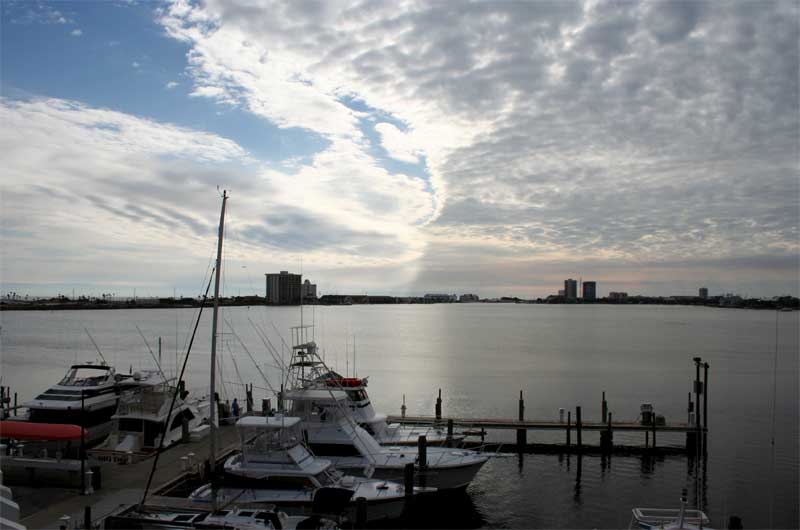
My pew


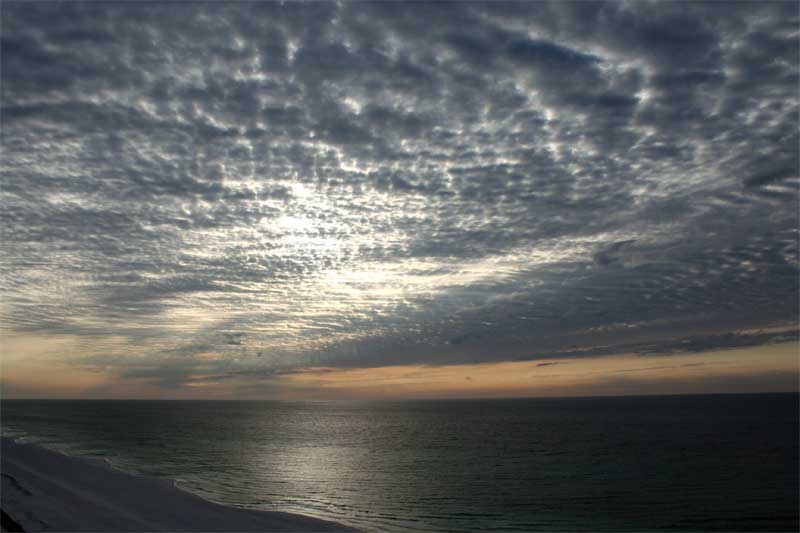
"If I were called in to construct a religion, I should make use of water"

-- Phillip Larkin (1922 - 1985)

Monday, February 27, 2006

Weekend of parades


Wow! Who knew a weekend of parades could be so exhausting! And I wasn't even drinking! The big question now is, "What do people do with twenty pounds of Mardi Gras beads and 18 Moon Pies?" Perhaps I overdid, this being my first ever Mardi Gras celebration, but what an education and what a lot of fun memories.

My favorite moments were those I captured of wide-eyed children and patient pets, but next best were the smiles of all the people who had a long-overdue opportunity to forget the devastation of the past year and a half.

Will I celebrate Mardi Gras differently next year? You betcha! I'm only going to catch 17 Moon Pies!

Saturday, February 25, 2006

Krewe of Lafitte parade in Pensacola

My first Mardi Gras parade! Thanks so much to the Krewe of Lafitte for hosting this super Mardi Gras event. It was definitely fun for the whole family.

I caught a ton of beads, some mini Moon Pies, and all I had to flash was a smile. Of course I screamed out a lung and can't talk today, but I'm ready for the next parade!


Wow! I wasn't expecting floats this big and elaborate here in Pensacola!


"Woo hooo! Over here, guys!"


Tiny screamer with her first beads of the night!


I've got a lovely bunch of coconuts!


Oh look! It's Puff, the Magic Dragon!


Ruh roh. Looks like this guy has figured out what the Queens have in mind for their drones.

Friday, February 24, 2006

Skywatching


At last the fog is gone and I can go back to skywatching!

Wednesday, February 22, 2006

National Museum of Naval Aviation

What can you do on rainy days when you live in Pensacola Beach -- and just happen to have company? It is an excellent opportunity to tear yourself away from the beach and head to the National Museum of Naval Aviation at the Pensacola Naval Air Station (NAS).

The Museum is a great place to take the whole family and, incredibly, admission is free (though donations are greatly appreciated). There are approximately 150 restored aircraft in this beautiful, spacious museum which represent the Navy, Marine Corps and Coast Guard.

Among other things, you will find a large collection of aircraft carrier models, a simulator, cockpit trainers, displays of actual fight logs and other memorabilia, a control car for the K-series of U.S. Navy airships, an NC-4 flying boat, and a Flying Tigers exhibit.

The Museum's Cubi Bar Cafe, which cannot be missed, duplicates the bar area of the famous Cubi Point Officer's Club in Subic Bay, Phillipines. For almost 40 years, the Cubi Bar (an acronym for Constuction Unit Battalion One), was a major source of entertainment for the Navy and Marine Corps squadrons as they passed into the Western Pacific.

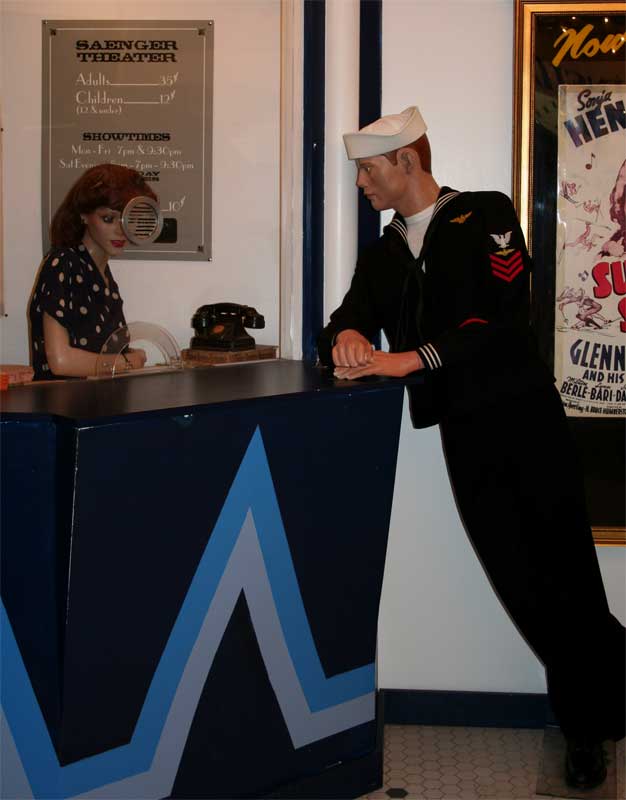
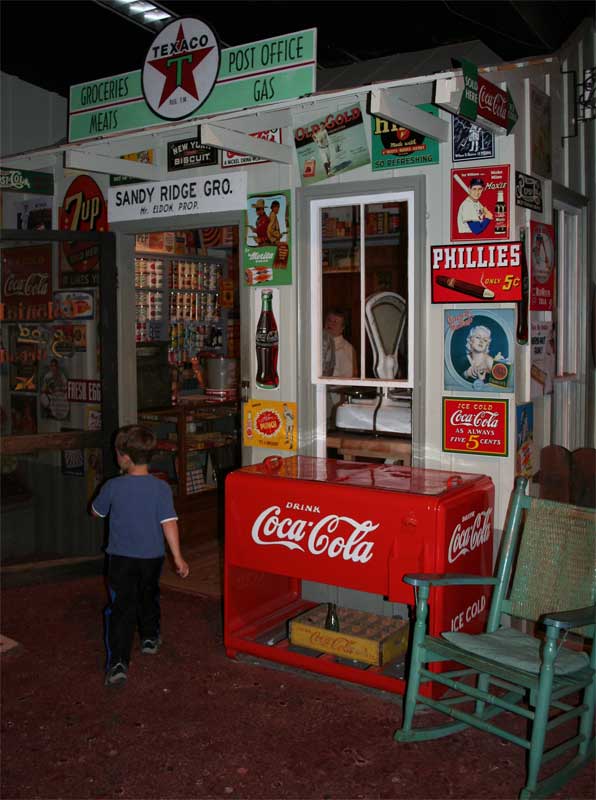
Another must-see at the Museum -- and one of my favorites -- is the recreation of a downtown street in Pensacola, circa 1043, which is located on the second floor. Below are photos I took this week.


This recreation of the entrance to Saenger Theatre, circa 1943, shows that one thing has never changed -- girls still love a guy in uniform. Unfortunately what has changed is the price of a ticket! Then: 35 cents; now: $7.50.


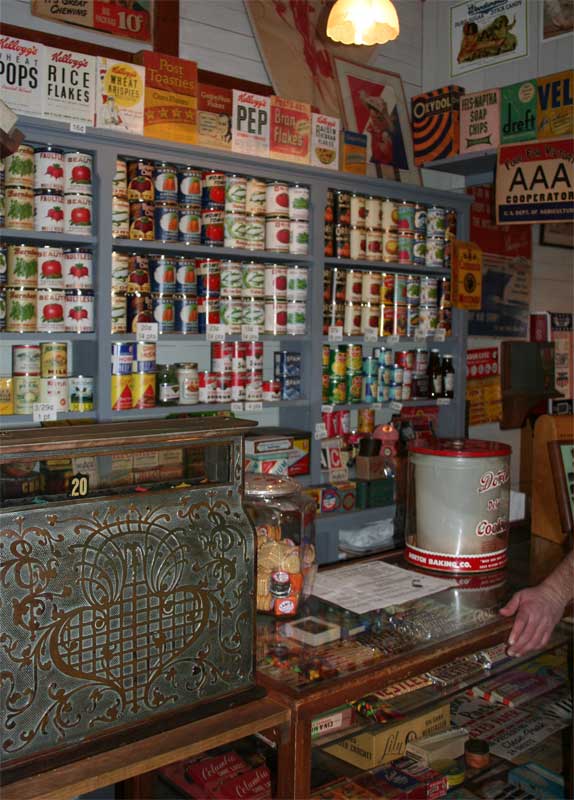
Where on earth did they find all the 'vintage' canned goods to stock this grocery store?


Don't you love the old cash register? All the good candy is under the counter. Don't miss the Three Musketeers, Snickers, and Hershey bars.


The old L & L Pawn Shop gave servicemen a discount and no interest for the first 30 days!


Take your parents to see this recreation of a mid-1940's kitchen. It will spark great memories for them and even create some for you.


This kitchen sink looks just like the one I remember in my grandmother's kitchen -- without all that fried food smell.

Monday, February 20, 2006

The winter sky


"The sky. Every hour of the day it’s different. It’s fluid, graceful, elegant. Any time you look at it, it’s restorative. And it doesn’t demand anything from you."

-- A.M. Holmes

Sunday, February 19, 2006

Hey Y'all, Part Deux


I am the more conservative, ever-optimistic, Rebecca-of-Sunnybrook-Farm'ish, comic relief of the duo, a/k/a Barrier Island Girl.

I am more phlogger than blogger, which means the majority of my posts will be photos (though I must admit I bought a whip in Texas once).

Afraid I may cause some embarrassing blunder that results in a loss of readership during the blogmaster's absence, I'm sending my first post straight to the dogs. Now I can relax and enjoy the experience.

Saturday, February 18, 2006

Guests Arriving


The Beach Blogger will be going out of town for a while. In his absence, a couple of Northwest Florida bloggers (with terrific blogs of their own) have agreed to stop by and check on the place from time to time, read your comments, and make sure no one is quail hunting on the property without a license.

Stop by when you can and cheer them on.

Writer's Conference


The 3rd Annual Emerald Coast Writer's Conference will be held in Ft. Walton Beach March 23-25. Registration is still open. The keynote speaker is Phillip Margolin, Portland (Or.) criminal defense attorney and a popular mystery writer.

Smile! You're on Traffic-Cam!


No one can get a live operator anymore. Pretty soon we won't be able to get arrested by a live cop, either.

Gulf Breeze is joining a number of other Florida cities who've installed traffic cameras designed to capture and convict speeding motorists, Tampa Bay Online reported this week. The weekly Gulf Breeze News covered the same news.

City officials have strategically positioned the cameras at Highway 98 and Daniels Road. There, in Gulf Breeze Proper, demented traffic engineers designed one of the most confusing intersections in Western Civilization. Daniels Road interesects the main drag on a diagonal line from southwest to Northeast, while nearby Gulf Breeze High School's parking lot exits intersect the main drag from west to east.

If the camera catches someone running a red, the City plans to mail the offending motorist a $100 citation. It then becomes the motorist's burden to prove he's not guilty.

In addition to reporting the move, the Gulf Breeze News ran a sidebar of man-in-the-street interviews. The question: "What’s your opinion on traffic cameras in Gulf Breeze?"

Answers more or less range from "Whaaa?" to "I hope they ship 'em to Cuba and hold 'em without trial, too."

In other words, no one interviewed seems to object. But the whole man-in-the-street schtick sure does look familiar to us.

Wednesday, February 15, 2006

There Will Always Be a New Orleans

There will always be a New Orleans. Maybe. At least, we hope so.

A Katrina evacuee, now safely back home after endless weeks in the Pensacola area, sends us this link to a slide show of a Mardi Gras parade through the French Quarter. He says, "It was very cold by New Orleans standards yet the crowds were bigger than I've ever seen. It was a ball."

Sunday, February 12, 2006

Burning Furniture To Stay Warm

Oklahoma Land Rush, 1893

"More than one-sixth of the land proposed for sale, 55,862 acres, is in the Southeast although the majority of the nation's public land is in the West."

-- Columbus (Ga.) Ledger-Enquirer

Having ruined the federal government's financial health in just three budget years, setting us on course for $2.58 trillion dollars in budget deficits over the next three years, George Bush now has decided to throw the nation's furniture into the furnace to keep warm.

As U.S. Rep. Mark Udall (D-Co.) remarked to the Denver Post, that’s "like selling your homestead to pay your credit cards.”

Bush didn't mention this in his State of Union address, but tucked away in his FY 2007 budget request was an administration proposal to sell off over 300,000 public forest lands managed by the U.S. Forest Service. The Bureau of Land Management also will be selling 125,000 acres or more.

The breadth of the $1 billion land sale is unprecedented. The federal government hasn't sold off so much public lands at once since the Cherokee Outlet Land Rush of 1893.

The ostensible reason for the sale is to "help pay for rural schools and roads, making up for a federal subsidy that has been eliminated from President Bush's 2007 budget," according to Los Angeles Times reporter Janet Wilson. Historically, the federal government has made annual payments in lieu of real estate taxes to rural areas where the tax base is diminished by the presence of large national forests, parks, military bases, and other U.S. land holdings.
Bush intends to eliminate those subsidies forever. Proceeds from the proposed forest land sales would partially and temporarily cushion the blow while he is in office.

As David Albersworth of the Wilderness Society told the New York Times, however, in reality the Bush plan is nothing more than "a billion-dollar boondoggle to privatize treasured public lands to pay for 'tax cuts to the rich.'"

The New York Times has a state by state breakdown of the proposed land sales. Not surprisingly, it shows Western states will suffer the greatest aggregate losses in public lands, according to the Seattle Times.

The Columbus, Georgia, Ledger-Enquirer points out, however, that while "the Southeast has the lowest percentage of public forest land in the country" it will take "the biggest hit proportionally" from Bush's proposal. "More than one-sixth of the land proposed for sale, 55,862 acres, is in the Southeast although the majority of the nation's public land is in the West."
On the auction block, among others, are nearly 1,800 acres in central Mississippi's Bienville National Forest. Ironically, the same week Bush was proposing to sell off Bienville forests, the State of Mississippi was celebrating Arbor Day and worrying about reforestation in the wake of Hurricane Katrina. In Alabama, the U.S. Forest Service would sell 3,220 acres from the Bankhead, Conecuh and Talladega national forests. Less than 1,000 acres of national forest land in brother Jeb's Florida will be up for sale.

David Albersworth of the Wilderness Society told the New York Times the plan at bottom is "a billion-dollar boondoggle to privatize treasured public lands to pay for 'tax cuts to the rich.'"

The Southern Evironmental Law Center agrees. In a news release, the SELC maintains --

[S]elling off America’s natural heritage is not the way to fund government services. This move would set a dangerous precedent for years to come. It’s a reversal from the agency’s long-standing effort to add to the national forest system by acquiring important tracts that serve an ecological or recreational purpose. Particularly in the South, where the population is growing, along with the demand for outdoor recreation of all kinds, we need more national forest lands, not less.

* * *
These public lands belong to all citizens, and to all future generations. The Bush Administration ought not to be putting the public’s land up for sale to meet its budgetary obligations.

There are several signs the administration's proposal was thrown together and stuffed in the budget at the last minute. Even now, the Bureau of Land Management cannot say how many acres it will auction off or where they are located. The U.S. Forest Service is unable to provide on its web site more than four 'sample maps' of a few of the areas proposed for sale. And the administration says it can't publish formal notice in the Federal Register until the end of the month at the earliest.

Even the Cato Institute apparently hasn't had time to receive G.O.P. talking points. One of the Institute's callow ideologues by the name of Jerry Taylor, an under-educated Poli Sci major with a B.A. from Iowa who heads their "natural resources" department and claims to be an "expert", automatically spoke up in favor of the Bush proposal. Under it, he said, "Private property will end up in the possession of those who value it the most."

What's that again, Jerry? A national forest? Private property? What do you suppose they're putting in the Kool-Aid at the Cato Institute?

Saturday, February 11, 2006

Corps Truths

The U.S. Office of Management and Budget recently created a new web site called ExpectMore.gov that rates all federal programs on a 2-category scale of "effective" or "not performing." Readers will be shocked -- shocked! -- to learn that three Corps of Engineers programs very familiar to Gulf Coast residents are rated "not performing."

Here they are along with what GAO has to say about them --
  • Coastal Storm Damage Reduction:
    Purpose: The program aims to protect lives and reduce damages resulting from hurricanes and storms. The Army Corps of Engineers partners with coastal communities to share the cost of placing sand on beaches or building structures such as jetties or groins. Most projects involve regular, recurring sand placement for up to 50 years.

    Rating: Not Performing
    * The program lacks necessary information on its success in reducing damages from hurricanes and storms in communities where the Corps has built projects or placed sand on beaches. Additional funding may be needed to collect such performance information for completed projects. At this time only anecdotal evidence is available on the program's success.
    * The Administration does not support Federal funding for long-term beach renourishment (for up to 50 years); it supports a scaled back Federal role instead. The Administration supports Federal funding for the initial placement of sand on beaches after which states and local communities would finance the long-term, periodic beach renourishment.
    * Greater coordination may be needed between the Army Corps of Engineers and other Federal, state and local entities to help prevent unwise future development in coastal communities, including those where the Corps has partnered to provide long-term beach renourishment.
  • Flood Damage Reduction
    Purpose: This program aims to reduce flood damage by constructing levees, floodwalls and other structural and non-structural projects. The Corps of Engineers shares the cost of these projects with states and local communities. The Corps also assists states in floodplain management and maintains large federally owned dams and levees.

    Rating: Not Performing
    * The program lacks information on how completed flood damage reduction projects help reduce the Nation's overall flood damages on an annual or long-term basis. The Corps can estimate, however, the economic and environmental return from flood projects under design or construction, and these estimates are used to set funding priorities for the program's budget each year.
    * Greater coordination is needed among this program, FEMA mitigation programs, the National Flood Insurance Program and states and local communities that set floodplain management policies. The lack of coordination between these entities can result in increased or unaddressed risk to communities in flood hazard areas.
    * The program's state and local partners often do not make citizens sufficiently aware of their actual flood risks by publicizing regional flood plain management plans to reduce the impact of future flood events in the project area. Anecdotal evidence also indicates that state and local partners may not be properly maintaining completed flood projects to ensure the level of protection over time.
  • Coastal Zone Management Act Programs
    Purpose: This program uses federal-state partnerships to manage natural, cultural, and economic resources in coastal areas. States with approved coastal zone management plans receive funding in support of wise planning and resource use. The program also provides funding to support research and education at protected estuarine areas.

    Rating: Not Performing
    * The program lacks long-term and annual performance measures and is not able to demonstrate consistent program effectiveness. The program has developed and made some progress implementing adequate performance measures.
    * Federal approval of state coastal management plans helps to ensure that local and state level decisions are consistent with national concerns. Outside studies of the program's effectiveness have found that the state programs are implementing the stated objectives of the Coastal Zone Management Act, and states have seen improvement in many aspects of management of their coastlines.

Friday, February 10, 2006

Dissing The Donald

Mark Singer has an amusing entry in the New Yorker's "Dept. of Amplification" section. It's too delicious to excerpt.

Just read it.

Fewer Rentals, Higher Rents

Lesley Conn's top-of-the-front-page headline article, FEMA To Charge for Trailers is good news for some 2,000-plus people still homeless nearly 17 months after Hurricane Ivan, even though the agenc hasn't yet set rents.

Pensacola continues to feel the effects of Hurricanes Ivan, Dennis, and Katrina. One of Conn's sources says "about 1,000 rental units in the market that were reasonably priced units that are not coming back." Another reports some apartment buildings are converting to condominiums or selling out to nearby businesses. As a ride around town shows, there also are many multi-family dwellings that still have not been repaired.

Living in a FEMA trailer is no picnic, but it's better than the street.