Showing posts with label law. Show all posts
Showing posts with label law. Show all posts
Saturday, August 23, 2008
Quiere un Restaurante, Gente?
Cancun's goes on the virtual auction block in September, says the Gulf Breeze News.


Monday, April 07, 2008
You're in a Bully's Hands with Allstate
"[C]laims organization... revolve[s] around two axes -- standardizing claims awards across the board; and stopping policyholders from hiring lawyers."The highly respected reporter Paige St. John, in Sunday's Sarasota Herald Tribune, boils down some 12,000 pages of previously-secret documents from the vaults of Allstate Insurance Co. to discover "how the nation's second-largest insurer systematically cut payments" to those covered by insurance "as a way to boost profits."
-- Allstate Insurance Co., PowerPoint training slide
 First, the company eliminated much of the discretion of on-site adjusters.
Second, using its own adaptations of computer software known as "Colossus" the company lowered authorized "average payouts for bodily injuries" by "more than 20 percent." This, we are told, was "a big step" toward reaching a consultant company's stated "goal of establishing a new fair market value" for injuries.
Third, Allstate pressured claimants "to accept quick settlements without the help of lawyers." If a policyholder was so bold as to hire a lawyer or hold out for more, Allstate would coach its own lawyers "to refuse to negotiate and to drag out litigation."
Allstate, here, is talking about hurting its own customers who have been paying premiums to the company for auto and property insurance, including hurricane wind insurance. As one lawyer with extensive knowledge of Allstate's abusive policies explains:
"When you look at it from the policyholders' point of view, here you are, your home is flattened. They come to you and offer [a low settlement] to you within the first 180 days.... [when they know] that financial pressure in that first 180 days would be at its greatest." * * *Internal company documents also make it clear that Florida was an early and profitable testing ground for Allstate's new strategy:"They won't walk away happy. They'll just walk away. A lot of them won't understand how badly they've been abused."
"Florida East and Florida West are getting phenomenal, never-seen-before results in terms of loss/cost management," a 1997 Allstate newsletter declared. Allstate today pays less than most other auto insurers in Florida for accident injuries, averaging $16,884 per claim in early 2007 compared with an $18,105 average for the industry.There's no real surprise here for anyone who has ever had a close look into the small, dark heart of Allstate Insurance Company. What is surprising is how blatant the company and its industry consultant, McKinsey & Co., can be when they think no one is looking:
In PowerPoint presentations and discussion papers drawn up for Allstate executives, McKinsey used "boxing gloves" to characterize how Allstate should treat policyholders who balk at settlements. For customers who hired lawyers, McKinsey urged, "align alligators," adding these instructions: "sit and wait."In effect, says former Allstate lawyer Robert Healy, who's now in private practice in Tampa, Allstate has become "a bully in the market." That would be the market for justice.
* * *
PowerPoint slides show the McKinsey consultants also advised Allstate to convince policyholders they did not need lawyers, and then to target those who disregarded that advice for denials, delays and litigation.
To be sure, "Allstate has been sanctioned by regulators in at least two states." And some policyholders have won "bad faith" claims "forcing it into confidential settlements and large jury verdicts."
However, explains St. John, courts too often have generously ordered verdicts to be cut to a fraction of what juries awarded. By that means, Allstate has managed to keep the lion's share of its gains from bullying customers.
Allstate's incentives to keep the system have proven larger.The insurance company's trove of secret documents became publicly available only after a Florida appeals court ruled that "state regulators have the right to ban Allstate from writing new policies" if it doesn't turn over evidence of internal policy-making demanded by "state investigators."
Since changing the way it regards claims, the company has reported the largest profits of its 77-year history. It had a record profit of $4.9 billion in 2006. In 2007, it reported a $4.6 billion profit.
What do you want to bet that even now a few hundred million dollars of those skyrocketing profits are being used to buy lobbyists and legislators in Tallahassee, to be sure that Allstate never again is compelled to wash its dirty linen in public? Keep your eye on the current legislative session.
Dept. of Amplification
Friday, March 28, 2008
The Clerk's Tale

"[T]here are people of such disposition that, when they have taken a certain course, they cannot stop, but just as if they were bound to a stake, they will not slacken from that first purpose."We happened to be visiting with a Pensacola court clerk for Escambia County's civil division yesterday. She mentioned another aspect of the mortgage crisis that hasn't received much, if any, attention locally.-- Chaucer, The Clerk's Tale (Part four)
Throughout the large office in which she was standing we could see stacks and stacks of unfiled manilla folders -- on the floor, on desk tops, leaning against the walls, piled precariously on chairs and on top of cabinets. We counted six of them four feet high or more and gave up after counting another seven smaller piles. Every one of them brought by mortgage lenders or whoever wound up at the bottom of the mortgage derivative "shitpile" as Atrios inelegantly, but accurately, puts it.
"Falling behind in the filing?" we asked.
The number of mortgage foreclosure cases being filed has "tripled the caseload in the last six months," she explained. "But because of the state budget cuts we're under a hiring freeze. We're doing the best we can."
Paul Krugman has a piece in today's New York Times assessing the policy proposal advanced by the three presidential candidates to address the mortgage crisis. It's the same crisis that's flooding our courts right now. Here's a short version of what each candidate proposes:
- McCain: Do nothing. "Deregulation and tax cuts cure all ills."
- Clinton: Rescue individual homeowners by creating "a modern version of the Home Owners’ Loan Corporation, the New Deal institution that acquired the mortgages of people whose homes were worth less than their debts, then reduced payments to a level the homeowners could afford."
- Obama: "Broader financial regulation" of currently unregulated investment banks plus 'nudging' "private lenders into restructuring mortgages" rather than create (or recreate) a government agency to do it.
Like the Marquis in Chaucer's tale, "They will not slacken from that first purpose."
Wednesday, March 26, 2008
Tort Story
Florida playwright and novelist Bobby Cramer, who blogs at Bark Bark Woof Woof, apparently ran into "an elderly gentleman in a 2007 Infiniti" when the old man "made a left turn directly in front of me at an intersection." Bobby's okay. The elderly man is okay, too. But the Mustang is in critical condition.
Bobby writes:
Unfamiliar with the streets and signs, he suddenly found himself in the center of town, going the wrong way on a one-way street in heavy noontime traffic. Frantically looking all around, he tried to inch into the intersection so he could angle onto a two-way street, but in the process he "T-boned" another car -- in slow motion.
Our friend says he stopped immediately. Inexplicably, a large crowd gathered around both vehicles immediately. Our friend quickly exited his rental car and tried to make his way through the gaggle of gawkers to the other car, hoping to find the other driver wasn't hurt (he wasn't). As he pushed his way through the bystanders, one after another stopped him.
"I can get you a good lawyer," one fellow told him urgently.
"Me too, " said another. "I know where you can buy the best lawyer in town."
A third man grabbed our friend's elbow. "Hey, buddy," he said. "I can buy you a judge."
Bobby writes:
Fortunately it happened in the middle of downtown Coral Gables and within five minutes there were three police cruisers and fire rescue on the scene.That little detail brings to mind the story of a Yankee friend of ours who had a similar accident a few years ago. He was in New Orleans on business, driving a rental car.
Unfamiliar with the streets and signs, he suddenly found himself in the center of town, going the wrong way on a one-way street in heavy noontime traffic. Frantically looking all around, he tried to inch into the intersection so he could angle onto a two-way street, but in the process he "T-boned" another car -- in slow motion.
Our friend says he stopped immediately. Inexplicably, a large crowd gathered around both vehicles immediately. Our friend quickly exited his rental car and tried to make his way through the gaggle of gawkers to the other car, hoping to find the other driver wasn't hurt (he wasn't). As he pushed his way through the bystanders, one after another stopped him.
"I can get you a good lawyer," one fellow told him urgently.
"Me too, " said another. "I know where you can buy the best lawyer in town."
A third man grabbed our friend's elbow. "Hey, buddy," he said. "I can buy you a judge."
Thursday, December 13, 2007
The Coming Tempest
Until 1968 -- 1968!! -- when a new one was adopted, Section 24 of the Constitution of Florida prohibited "forever" --Let me not to the marriage of true minds
Admit impediments, love is not love
Which alters when it alteration finds,
Or bends with the remover to remove.
O no, it is an ever-fixed mark
That looks on tempests and is never shaken;
-- Wm. Shakespeare, Sonnet 116
All marriages between a white person and a negro, or between a white person and a person of negro descent to the fourth generation... .Now, the knuckle-draggers want to do it all over again to some other people. What is it, exactly, that turns some folk so nasty when they see someone who has found love in this life?
Sunday, October 21, 2007
Citizens on the Tornado Scene
The Insurance Journal reports:
Citizens Property Insurance Corp. opened a mobile claims center in Pensacola today to help policyholders with property damaged by tornadoes that ripped through the area, a Citizens official said.All claims will be denied on the grounds it was "ripping" and not "wind" that did the damage. Three years from now the Florida Supreme Court will agree. "Insurance companies always are reasonable," the court opinion will say. "They are our friends. But ripping is a distinctly different risk than wind. The homeowners should have purchased ripping insurance."
* * *
The center is located at Pensacola's Cordova Mall on North Ninth Avenue.
Wednesday, August 16, 2006
Mississippi Flooding

"The Mississippi case underscores something that Florida legislators should understand: by abrogating Florida's Valued Policy Law, they have created a huge disincentive to evacuate as a storm approaches, and thus have put tens of thousands of lives at risk."There isn't much of a surprise in yesterday's Mississippi federal court ruling that Bill and Julie Leonard's Nationwide Insurance Co. policy, properly interpreted and applied to the facts of their case, excludes damage caused exclusively by flooding waters in Hurricane Ivan.
That's the bad news for home owners. The good news is the emphasis belongs on the word "exclusive."
The full text of Judge L.T. Sentner Jr.'s legal opinion in Leonard vs. Nationwide is available in pdf format here.
Today, Nationwide is crowing that it has scored a knock-out punch against all of its Mississippi customers. "We are very pleased that the court ruled in our favor and upheld the long-standing flood exclusion language which is foundational to traditional homeowner policies across the country," Nationwide says in a press release.
Insurance industry flak-catchers claim to be equally thrilled:
"In the insurance coverage debate over wind vs. water, Judge Senter’s ruling has taken much of the wind, literally and figuratively out of the plaintiff attorney’s argument," said Ernie Csiszar, president and CEO of the Property Casualty Insurers Association of America (PCI). "Judge Senter has made it very clear that the flood exclusion applies to storm surge."Not so fast. It seems the Leonards' lawyer, Dickie Scruggs, says he's happy, too. Speaking of the Leonards, Scruggs told a South Mississippi television station, "The judge ruled in favor of this family."
So who's right? The Jackson (MS) Clarion Ledger comes close to nailing it down today when it editorializes, "The ruling... is a total victory for neither side... ."
The court's opinion is only 13 pages long. Most of it is very fact-specific. As the Mississippi Press is reporting:
The Leonards, who live two blocks north of the Mississippi Sound, said Katrina caused approximately $130,253 in total damages. They said $47,365 in damage was caused by wind. Citing that storm surge caused the rest of the damage, Nationwide paid the couple only $1,661.Following a complete court trial, the judge ordered the insurer to pay the Leonards another $1,228.
If you analyze your court decisions using only dollar signs, that sure looks like the Leonards lost. But there is more to the court decision than just money.
The outcome of this case turned on the particular facts of the Leonards' purchase of a standard homeowner's policy and two legal principles of ordinary contract law which Judge Sentner applied. It's how the judge applied those principles that explains why attorney Scruggs can see some advantage for future cases, if not this one.
Insurance Agent Negligence?
As for how the Leonards found themselves without a flood insurance policy in the first place, it seems their insurance agent likely advised against buying it. At trial, however, the judge says the Leonards failed to introduce any evidence about whether that advice was, in effect, professionally negligent. As the court opinion states:
There is no evidence in the record to establish the standard of care applicable to an insurance agent who is asked about the advisability of purchasing flood insurance. Absent proof of this standard of care, there is insufficient evidence to support a finding that [the agent] Fletcher's statements to Paul Leonard indicating that he (Leonard) did not need to purchase a flood insurance policy breached a standard of care that governed Fletcher’s conduct as an insurance agent in these particular circumstances.It's unlikely Dicky Scruggs will make the same mistake twice. He already has on file two to three thousand other lawsuits-to-follow in the wake of Hurricane Katrina -- including one for Republican U.S. Senator Trent Lott, a frequent critic of plaintiffs' lawsuits when they're brought by someone other than himself. Where the facts show another customer was left uninsured against flood damage because an insurance agent gave bad advice, the results of future trials could be dramatically different.
Contract Law Principles
As for the two principles of insurance contract law that were determinative of the Leonards' claim against Nationwide Insurance Co., these are unremarkable rules of law that have come down to us over the centuries as familiar legal principles of the common law. What's new is their application to hurricanes:
- When a property insurance policy contract explicitly excludes coverage for damage caused by a flood, a clear expression of that exclusion is lawful and the courts will enforce it as to all damage caused exclusively by flooding water. (Score one for the insurance industry.)
- However, when the insurance contract covers windstorms but paradoxically purports to exclude damage caused by a combination of wind and water during a windstorm, the policy exclusion becomes "ambiguous." Then, the court will reinterpret the policy "reasonably" to mean that the insurance company must cover that portion of combined damage during a windstorm which is attributable to the effects of wind, as shown by the evidence. As the Judge wrote:
"The most reasonable interpretation for these conflicting policy provisions is that this policy provides coverage for windstorm damage, in accordance with its terms, and that coverage is not negated merely because an excluded peril (in this case storm surge flooding) occurs at or near the same time."
(Score one for the homeowners.)
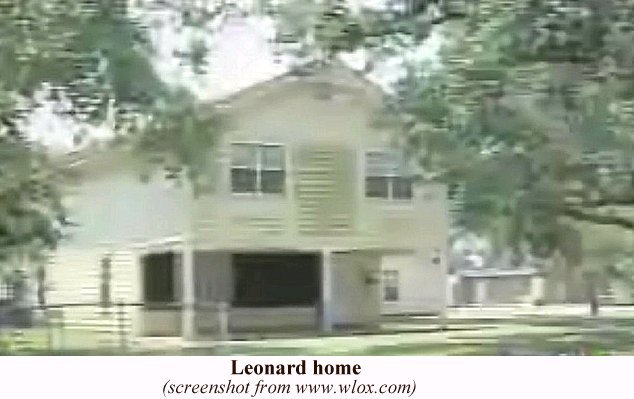 In the end, the Leonard decision stands for the proposition that under insurance contracts like those written in Mississippi, a windstorm insurer remains liable for windstorm damage even if it occurs in combination with flooding, but it is not liable for damage caused only by flooding.
That's essentially the same rule we live with in Florida.
The real winners of the Mississippi ruling may be all the expert witnesses who can now look forward to decades of steady income. With a premium placed on admissible court evidence about concurrent causes, they'll be busy offering opinion testimony for years about what their post-storm analysis shows in one case after another: which wall studs were wrecked by water and which were destroyed by wind, how far open a door was torn by wind and the extent to which that same door was opened wider by water, etc., etc., etc.
Unintended Consequences
One consequence of the Mississippi ruling doubtless is that more people than ever before who live within reach of hurricanes will buy flood insurance to supplement their wind coverage. That's good.
But another is that the disincentive for Mississippi homeowners to evacuate in advance of a storm has been greatly increased. That is very bad, indeed.
The artificial wind-versus-water distinction insurance companies write into their policies actually puts more lives at risk. Consider the predicament of every Floridian whose home is destroyed in a hurricane. Before July 2005, state-regulated windstorm carriers in this state were required by the century-old Valued Policy Law to pay policy limits when a home was totalled by a hurricane, even if there was evidence of a concurrent cause like flooding water. Having paid the homeowner, a windstorm company then could seek "contribution" (in effect, partial reimbursement) from any flood carrier for such damage as could be shown attributable to water.
Under the Valued Policy Law, there was no economic reason for a Floridian to stay at home if a hurricane threatened his house. Insurance claims were settled quickly and all the nasty expert witness fights over concurrent causes in Florida were left for the insurance companies to thrash out among themselves after the consumer was paid.
Insurance companies are good at thrashing out that kind of stuff between themselves. They do it all the time. Most also have on retainer a huge stable of experts accustomed to parsing causes in retrospect and testifying to whatever opinions the employing company may require.
Following the Florida state legislature's contemptible abrogation of the Value Policy Law last year, however, we're now in the same fix as Mississippians. It's the homeowner who has to come up with hard, admissible evidence in every "concurrent cause" case.
That means one of two things: either hire an expert witness after the storm to come up with an educated guess (called "opinion evidence") about what was damaged by which cause; or rely on eyewitness testimony to the sequence, cause, timing, and extent of destruction. Expert witnesses don't come cheap. After a large storm they may not come quickly, either, at least not for your average homeowner.
Consequently, the Mississippi case underscores something that Florida legislators should understand: by abrogating Florida's Value Policy Law in 2005 they created a huge disincentive to evacuate as a storm approaches.
Thus, the legislators who voted to amend the Valued Policy Law have put tens of thousands of lives at risk. It's the same disincentive now facing Mississippi residents as they consider, after the evidence-intensive Leonard ruling, what to do when the next hurricane heads their way.
Faced with a need to produce specific proof because insurance companies these days can be counted on to treat their customers like the enemy, a lot of people in Florida and Mississippi are likely to stay put in their homes and videotape the storm damage as it happens, rather than figure out afterwards how to find and pay for an expert witness.
Some of them may die, sad to say. Then, the insurance industry can produce more press releases boasting how they took the wind right of the sails of those customers, too.
Monday, November 14, 2005
'Slow Rolling' in Mississippi
Does this sound familiar, Floridians? From the Dallas Morning News:
"I evacuated to higher ground just a couple of blacks away," he says. "I actually saw my house ripped apart by wind. Three hours later, the flooding water moved what was left off the foundation. Now, the insurance company is saying it was all flood damage, no wind. They've refused to pay more than two thousand dollars."
One wonders what he would think to learn that his insurance company probably is making money off his misery. According to the Dallas newspaper:
"Nobody has gotten anything," Mr. LePage said as he watched workers carry out once-beloved items from his home. "We're totally dissatisfied with the progress on the insurance. Anything to keep from paying."Dicky Scrubbs, the Mississippi lawyer representing thousands of Katrina claimants, told the Morning News, "The delays are no accident. Insurers are practicing a technique known as 'slow rolling,' procrastinating in making payments in hopes that claimants grow tired, desolate and more likely to accept what is offered."
Nearly three months after Katrina, frustrations are mounting for residents whose homes and possessions were laid waste by the storm. Like the LePages, most want to get on with their lives, but they've had difficulty reaching anything more than a recording at their insurance companies. They've had trouble getting meetings with adjusters, and they've yet to see money paid out on claims.
Many believe the insurance companies are quibbling over damage claims that should be paid, and lawsuits are mounting as a result.
"Here we are still waiting," said Mr. LePage's daughter Laura Ann, whose New Orleans East home was flooded with about three feet of water. "You can't do anything. You're just on hold, really."
"They do this limbo thing. Let it cool down, let these people get desperate. These people have no jobs, no insurance," said Mr. Scruggs, who is fighting his own battle with insurers over the loss of his Mississippi home to Katrina. "The insurance companies vacillate on making any commitment at all, hoping it'll all die down and the news channel will change subjects. This isn't their first rodeo."A Biloxi evacuee we've met, who is now living in Gulf Breeze, tells anyone who will listen that his insurance company is refusing to pay.
"I evacuated to higher ground just a couple of blacks away," he says. "I actually saw my house ripped apart by wind. Three hours later, the flooding water moved what was left off the foundation. Now, the insurance company is saying it was all flood damage, no wind. They've refused to pay more than two thousand dollars."
One wonders what he would think to learn that his insurance company probably is making money off his misery. According to the Dallas newspaper:
Douglas Heller, executive director of the National Flood Insurance Program, says delays actually make money for the insurance industry.To date, "only about 5,000 of the 225,000 possible claims have been settled for both Hurricane Katrina and Rita."
"A month long delay in claims for 50 destroyed homes could bring in more than $30,000 in investment income to the underwriter," he said. Also, the "longer the delay, the more likely homeowners will settle for less."
Sunday, September 18, 2005
Mississippi Beating
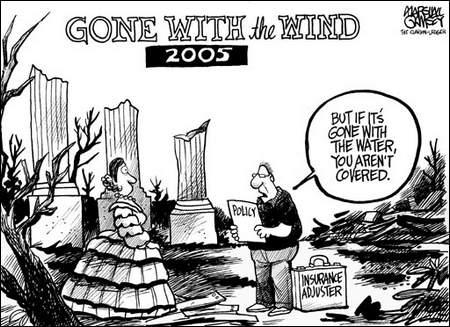 Credit: Marshall Ramsey, The Clarion Ledger
Hood has sued multiple property insurance companies, among them a line-up of the usual suspects like Farm Bureau, State Farm, Allstate, USAA, and Nationwide. (Meanwhile, Oxford private attorney Richard ('Dickie') Scruggs also says he is preparing to file "thousands of lawsuits" for individual clients with similar complaints.)
Hood's lawsuit raises five claims. In three of them, he alleges that insurance company attempts to avoid coverage under an asserted provision excluding 'flood' coverage are against public policy, unconscionable, and ambiguous. The fourth claim asserts that for years the defendants have sold policies in Mississippi coastal communities on the representation that they "specifically contemplate full and comprehensive hurricane coverage... ."
The fifth claim is in some ways the most novel, fact-specific, and urgent for it alleges that adjusters sent into Mississippi are:
"at present utilizing forms and other documents requiring policyholders to acknowledge and concede...disputed factual issues to the benefit of the defendants [insurance companies] and to the prejudice of the polciyholders."A current example of this is attached as "Exhibit A" to the attorney general's complaint. It's a form apparently presented to Mississippi policyholders which requires them to concede they suffered a "Flood loss."
Local editorialists around the state are coming down hard against Hood's lawsuit. The south Mississippi Sun Herald is particularly snarky, claiming the attorney general has gone "overboard," is 'not following the law,' and "is sending a dangerous signal to the entire private sector." Equally unimpressed are the Meridian Star and the Northeast Mississippi Daily Journal.
As it happens, Mississippi does not have a "value policy" statute, as Florida did until earlier this year and as other, many more progressive states still do. So far as the wind-vs-water issue is concerned, consequently, unlike the hundreds -- if not thousands -- of Ivan-related lawsuits in Florida, the Mississippi lawsuit appears to rest most heavily on what Hood alleges is the common law of the state of Mississippi. That, of course, has little if any relevance in Florida.
Insofar as Hood's suit depends on Mississippi common law, he may or may not be right. It will take extensive legal briefing, oral arguments, and no doubt years of appeals before anyone can be sure. But you can be sure right now of one thing: the Mississippi editorial writers don't have a clue what they're pontificating about.
Until the evidence is in and the law has been researched the newspaper chains in that state, and the few remaining independents, would better serve the public if they reserved judgment, did a more honest job of reporting the facts as Media Matters urges, and stopped jumping to judgment as fast as an old time Mississippi lynch mob.
Subscribe to:
Posts (Atom)