Tuesday, November 08, 2005

Beach BRAC?

"There's been a steadily increasing buildup in high-hazard areas, especially in the Gulf from Louisiana to Alabama. The federal and local governments don't have the ability to say no, even when the risks are so obvious."

-- David Conrad, quoted Sept. 7, 2005
Prof. Robert Young of West Carolina University, which is safely nestled in the western North Carolina highlands, will be testifying to a congressional subcommittee today about his proposal to create a "Shoreline Retreat Advisory Commission."

Prof. Young's "S.R.A.C." idea is modeled on the military's "Base Closing and Realignment Commission" (BRAC), the every-so-often commission created by Congress that gives heartburn to every community addicted to federal largesse from the Department of Defense. After years of politicized groveling for Defense Department pork, Congress finally stapled its own stomach in 1988 by passing off responsibility for efficient spending of federal defense base funds to an independent commission. As originally conceived, BRAC recommended to the Secretary of Defense which military bases are unnecessary and should be closed.

The system is not without its problems, as Air Force Col. Stephen Schwalby has written. Most recently, the base closing decisions have been re-politicized by subjecting them, anew, to congressional "oversight."

What does all of this have to do with America's beaches? Prof. Young is proposing to hobble the politically powerful beach-front development lobby by creating a similar independent commission that would determine which coastal areas are so vulnerable to flooding they should be weaned from the National Flood Insurance Program (NFIP).

Consistent with the Constitution and "property rights" advocates, Young would not prohibit development in those high-hazard communities. He simply would exclude them from receiving taxpayer subsidies in the form of federally subsidized flood insurance.

As an advance release described Young's prepared testimony, he argues:
"Continued federal disaster aid for rebuilding vulnerable coastal areas has cost taxpayers tens of billions of dollars in the last two years... . Irresponsible development of vulnerable coastal areas is becoming a burden on an already overburdened federal budget, as well as an environmental disaster.”
No more federal flood insurance subsidies would mean that in designated coastal areas, free market driven developers would be forced to depend on -- well, on the uninhibited free market. A capitalist's nightmare, for sure.

As Prof. Young told National Public Radio this morning, his proposal would lead to a graduated retreat from the most "dangerous, vulnerable" areas. Although he is quick to say it would not eliminate large coastal cities like Miami or Wilmington, Young's proposal is likely to bring dramatic changes even in the most vulernable spots there.

As New York Times science editor Cornelian Dean wrote two months ago, Prof. Young and other coastal morphology colleagues have been arguing against a "one size fits all" NFIP program for many years. Some beaches are more vulnerable than others. Some developments are better able to withstand storms than others. So when it comes to coastal development, they say, public policy should be based more closely on the detailed facts and findings pertaining to specific sites, including such things as the frequency of storms, the elevation of the landscape, the shape of the beach, the presence of guardian wetlands and natural dunes, etc. etc.

The notion of a gradual retreat from high hazard coastal areas, which has been kicking around academic and government policy circles for decades, finally entered the public consciousness in 1998 with the publication of Dean's fine book, Against The Tide. The old www.pbrla.com web site reviewed that book back when the idea of destroying island wetlands to build Portofino high rise buildings was just a gleam in Alan Levin's eye.

Now, even some politicians are getting the message. Last month on a visit to the Gulf Coast, Dean quoted a former Texas legislator who now expresses sorrow that he sponsored legislation that encouraged people to build developments in high hazard coastal plains:
A. R. Schwartz, a Democrat who for decades represented Galveston and much of the Texas coast in the State Legislature, said he now regretted some of the legislation he had pushed that subsidized development on the coast, particularly a measure that provides tax relief to insurance companies faced with wind damage claims.

Mr. Schwartz, whose constituents knew him as Babe, said that measure was "a terrible mistake - in my mind, as opposed to my heart, because the people need the insurance - because it has been an invitation for people to build homes on barrier islands and on peninsulas that are exposed to storms, at public expense."

"We are facing a crisis now because of that law I passed," said Mr. Schwartz, who now lives in Austin where he works as a lobbyist and lawyer.
Surely, Santa Rosa Island one day would fall under the microscope of such a S.R.A.C. commission as Prof. Young proposes. The signs are evident even now. On a visit to the Gulf Coast last month, Cornelia Dean ran into Riley Hoggard of the Gulf Islands National Park Service.

Riley's an old friend of Pensacola Beach residents. Lately, he and Park Service superintendent Jerry Eubanks have been agonizing over what to do about the seemingly permanent breach of the island between Pensacola Beach and Ft. Pickens. Knowledgeable informants tell us that the 300 feet-wide breach is exposed twice a day at high tide and at all times during even mild rain storms.

"It's time to consider replacing the road, possibly, for example, with a ferry service from the mainland," Hoggard told Dean.
But, as is the case on all the developed shoreline, abandoning infrastructure means lost revenue, in this case fees from a year-round campground. So Mr. Hoggard said there would be pressure to maintain the road, flooded yet again by pounding surf churned up by Hurricane Rita. "We can do that with our technology," he said. "But only for so long, and at a great price."
As the road to Ft. Pickens goes, so it seems, may go Pensacola Beach itself, sooner or later. The costs are skyrocketing for flood and wind insurance, storm proof construction, and the infrastructure needed to support it all. With or without Prof. Young's S.R.A.C., Pensacola Beach soon could be only for the super-wealthy.

There is an engineering solution to almost every problem. Figuring a way to build a new road to Ft. Pickens is no great trick, even if it has to be hung in the air. Residential and commercial beach development always will be technologically possible, too, just as it's always been possible to pave the entire nation with military bases from one end to the other, if we choose to do so.

The questions are "at what price?" Who should pay for it? And, is it worth it to those who are expected to pay for it?

Against the Tide (Book Review)

[The following book review was first published in the November, 1999 monthly newsletter of the Pensacola Beach Residents & Leaseholders Assn. This book has now been issued in paperback]
- - -
Since October 4, 1995, when the eye of Hurricane Opal rushed ashore just east of Pensacola Beach, the evidence has been mounting that Santa Rosa Island is in crisis.

As disastrous as the storm was, in her new book Against The Tide: The Battle for America’s Beaches, Cornelia Dean would not find grounds for thinking Opal caused an environmental crisis. She recognizes that hurricanes are Nature’s way of renewing barrier islands by bringing them new sand from off-shore and nudging them landward as the sea level rises.

The real crisis on this island, she likely would conclude, stems from the wave of SRIA-approved high rises like Santa Rosa Tower, Spring Hill Hotel, the Hampton Inn Tower Addition & Parking Garage, Mr. Levin’s Portofino Towers, and the proposed 80,000 square-foot county convention center to be located on the Surf & Sand cottages site, as the SRIA has proposed.
“Erosion does not threaten the beach per se. Left to confront a rising sea, a beach will simply move inland.”
– Against the Tide
Cornelia Dean, who is science editor of the New York Times, uses vivid anecdotes and real-life tales from around the nation to present a straight-forward and balanced account of similar crises facing all of America’s coastal communities.

The author, who is herself a barrier island resident on Cape Code, spends little time examining the North Florida area. Nevertheless, her book is a must-read for anyone who lives near Pensacola Beach or cares about its future. It distills in easily understood and compelling terms the latest research, thinking, successes, and failures of coastal geologists, engineers, meteorologists, economists, developers, residents, and governments as they grapple with increased tropical storm activity, rising sea levels, and over-development along the eroding shorelines of our coasts.

The book begins with the engrossing story of how Galveston’s city fathers, after the devastating hurricane of 1900, decided to try to hold back the sea. They elevated all 2,156 surviving buildings as much as twenty-two feet in the air, stuffed 15 million cubic yards of sand and mud beneath, and hunkered down behind a new concrete sea wall 3 miles long, 17 feet high, and 16 feet wide at its base.

It was claimed that this engineering feat, as much a marvel of its time as any high rise today, would save Galveston’s beach, then regarded as a prime tourist attraction. But after tens of millions of dollars and years of titanic toil, what actually happened was that beach erosion accelerated. Indeed, so thoroughly was Galveston’s beach destroyed by the act of trying to save it with a giant sea wall that, today, one of the city’s chief tourist attractions is said to be the museum and commemorative exhibits showing how everything went so very wrong.

Dan examines America’s beaches from many perspectives. First, she explores how natural processes created and shaped them over the eons. There is much here that fascinates, even for island residents who witness the daily changes of our own beach.

Second, Ms. Dean describes the migration of Americans to live on or near the beach. Truly, in recent years we have seen a tide of humanity rushing for the sea.

“Until this century few people lived near the beach,” she writes. “Today, the opposite pattern is well established. Almost half of all construction in the United States in the 1970s and 1980s took place in coastal areas, and demographers estimate that by the year 2000, 80 percent of all Americans will live within an hour’s drive of the coast. By 2010, the National Oceanographic and Atmospheric Administration says, population density along the ocean coasts will be almost four hundred people per square mile as against less than one hundred per square mile for the rest of the nation.”

At the top of Dean's list of reasons for beach development are the National Flood Insurance Program which began in 1968 and FEMA’s emergency services. “Until the advent of federal flood insurance, it was practically impossible to insure beachfront and nearby structures against flood damage,” she writes. “This meant, among other things, that most aspiring beachfront property owners had to pay cash for their property, because most bankers would not issue mortgages for structures they could not insure. It also meant that most houses on the beach were modest affairs. If they washed away, so be it.”

All that changed with the availability of federal flood insurance. In the view of some critics, Dean reports, the program created “a kind of moral hazard that exists when people are free to engage in dangerous behavior, like building on the beach, because they know they are protected from its consequences.”

In some ways, other facts Dean recites undercut this criticism. A surprisingly high number of flood plain dwellers remain uninsured. Instead, they apparently count on free emergency help from FEMA if disaster should ever strike. Furthermore, flood insurance regulations themselves have, as intended, substantially improved near-beach construction techniques and thus reduced the risk of loss. Many states are taking dramatic steps to price flood insurance more fairly. Few will consider it a bargain in the near future. FEMA itself has toughened regulations to exclude structures which repeatedly suffer large claims.
“Decisions to armor the coast are not decisions to save the beach – quite the contrary.”
– Against The Tide
The central meaning behind the title of the book can be found in Dean’s vivid description of the efforts people, businesses, and governments make, once they have settled in along the coast, to suppress the same natural forces that once shaped and protected the beaches. Coastal inhabitants themselves, she suggests, work “against the tide” by building groins, revetments, bulkheads, breakwaters, sea walls, and other coastal engineering devices. As in the case of Galveston, however, it turns out that armoring usually destroys the very thing that attracted people to the beach in the first place.

“By some estimates, almost 50 percent of the nation’s shoreline is armored with hard structures,” Dean tells us. After studying the effect of these structures in close detail over many decades, experts have concluded that “decisions to armor the coast are not decisions to save the beach – quite the contrary. They are decisions to sacrifice the beach, or a neighboring beach, for the sake of buildings.”

Ms. Dean is not unsympathetic to the dilemma confronting beach-front property owners. “Faced with the choice of saving building or beach, few are brave enough – or farsighted, benevolent, or rich enough – to choose beach. They want walls now. They will worry about the beach later.”

And so she traces the search by scientists and engineers to find softer engineering solutions such as beach scraping, man-made replacement dunes, renourishment projects, and a host of other imaginative techniques. So far, it seems, most have proven unsuitable or far too expensive.

“On the whole,” Dean writes after a riveting description of many coastal projects around the nation, “replenished beaches do not have a very good record of longevity. Measured in terms of dry beach, not a single replenishment project on the Atlantic north of Florida has lasted more than five years... .” Even when they survive for a time, “renourished beaches are rarely as satisfactory as the natural beaches they replace.” Like the steel-hard surface of Miami Beach, “they do not act, feel, or look like the beaches nature makes.”

This fascinating book identifies three basic approaches to solving the problem of coastal erosion: “Armor, beach nourishment, and retreat.” After studying the futile efforts of so many other beach communities around the nation, readers will be left in no doubt as to which approach the author would see as most likely to preserve our own Emerald Coast beaches.

By “retreat” she does not mean to imply a wholesale abandonment of coastal areas – an impracticality in any event. The data and examples she reviews, however, make a compelling case that barrier islands and coastal communities must find ways to scale back development to levels that are sustainable, prohibit excessive construction in high hazard areas, and preserve the natural defenses Nature supplies to defend against the tide.

It happens that one of the most important of these are island wetlands of the very kind that presently exist on the site of the Levin Towers project. As the author explains:
“One surprisingly effective tactic for strengthening barrier islands is to encourage the formation and growth of marshes on their inland sides. Once a marsh is established, even in a small area, its grasses will start to trap sediment that might otherwise end up in the middle of the sound or lagoon, and the more sediment is trapped, the more the marsh will expand. The result can be effective shore protection without any of the habitat or nutrient loss that occurs when people seal off the marsh shoreline with bulkheads.”
Another intriguing defense for barrier islands the book identifies is underwater sand pumping to form submerged feeder berms. This technique, which originated in Australia, has been tried only in a limited number of areas in the United States. The idea is to add sand not along the shore or beach itself, but rather offshore in submerged areas where observation discloses Nature “is most likely to build its own sandbar.”

As with other renourishment techniques, building an underwater “feeder” sand bar requires close study of each particular site’s water currents, existing sand transport patterns, and a host of other minute variables like wind speed, wave strength, ambient and water temperatures, sea grass bed patterns, sea bottom topography, and more. Ultimately, the success of every renourishment project depends heavily on proper scientific analysis in preparation for each site.

Overall, Against the Tide suggests there is room for habitation along the coast and on barrier islands. But we should not allow development to become so excessive that we destroy the very thing that brought us here

Monday, November 07, 2005

Dancing Grannies

The 'Dancing Grannies" actually exist! Why, we can't say. But Barrier Island Girl snapped the evidence at this weekend's Gulf Coast Arts Festival.

Betraying the Beaches


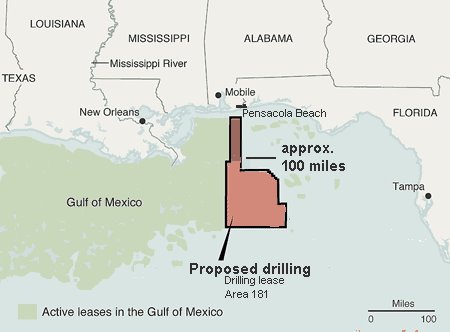
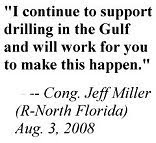
An Associated Press dispatch by long-time reporter Bill Kraczor today identifies incumbent congressman Jeff Miller (R-Chumukla) as favoring the Bush brothers' plan to allow oil and gas drilling off Pensacola Beach.

We've known this for some time, of course. All that's changed is that Miller's stupid alibi has fallen apart.

Jeff Miller's Northwest Florida congressional district includes beaches like those in Destin, Ft. Walton, Pensacola, Pensacola Beach, and Perdido Key. All are famed for their unique sugar white sands. The dangers to these beaches from drilling -- even if it were to be temporarily limited to no closer than a hundred miles offshore, as some claim -- have been thoroughly documented by multiple studies in the past. As a spokesman for Florida's Sierra Club chapter summarized four years ago (when Miller claimed to be against Gulf drilling), "More rigs mean more pipelines and tankers, and thus a higher risk to Florida and Alabama's coastal economies and fisheries."

Public opinion polls over the years have consistently shown local and visitors overwhelmingly oppose drilling in the eastern Gulf of Mexico. Even the pro-business Haas Center's confessedly unscientific poll of hand-picked "panelists" shows that, locally, twice as many oppose drilling as favor it.

Of course, anyone who resents recent price gouging by gas and oil companies might be selfish enough to trade a few tanks of slightly cheaper gas for their grandchildren's natural heritage. If anything, though, one of Hurricane Katrina's important lessons is that putting more drilling rigs and petroleum pipelines and oil tankers in the Gulf doesn't help to solve our domestic energy needs. At best, it buys only a few more months for suburban Hum-Vees -- in exchange for the decades-long risk of ruptured tankers, leaking pipelines, and storm-toppled drilling rigs fouling the unique beach environmment for generations to come.

So why would Congressman Jeff Miller betray his own consitutents by exposing Pensacola area beaches -- and the entire Panhandle tourist economy -- to ecological and economic disaster? Because he figures that he's a shoo-in for reelection.

That turns out to be a common characteritistic of nearly every Florida Republican who's been working to grease the political process for Chevron, Texaco, and other multi-national oil companies. As University of Central Florida political scientist Aubrey Jewett told Kraczor the other day, "Ironically, in most congressional races probably the majority of Republicans that might vote for this are reasonably safe."

That's not 'ironic.' That's hubris. Incumbent congressmen like Jeff Miller suppose they can ignore the public interest because their seats are "safe" and we'll vote for them no matter what they do or who they betray.

When you think about it, that's the best reason of all to vote Miller and his cohorts out of office.

Sunday, November 06, 2005

1984 2005

Bark Bark, Woof Woof explains.

A Military Wife's Life

In Confessions of a Military Wife, staff writer Alex Witchell provides a lengthy and engaging profile of Pensacola's prominent Navy wife and author Sarah Smiley for today's Sunday New York Times.
In "Shore Duty," the nationally syndicated newspaper and magazine column she writes weekly for two million readers about the trials, tribulations and joys of being a military wife, her vivid descriptions cover everything from discouraging mothers-in-law from horning in on homecomings after six months at sea (the men should "gently say, 'Mom . . . remember how I didn't take you to the senior prom?"') to urging young wives to join spouse club.

* * *
It is that wry take on the life of the military spouse (political correctness aside, we're talking wives here), one that questions the rules and regulations of the shadow military she embodies, that Smiley does best. Her writing is often funny and always humane, an unexpected voice in a world long defined by ironclad rules and abhorrence of emotion. And because this world is as regimented in its habits now as it was 40 or 50 years ago, it's also something of a time warp to read her musings on a domestic life that even the Beaver could recognize: think Erma Bombeck channeling "Catch-22."
Smiley has long had a self-syndicated column and her own web site. Now, she's written a book, Going Overboard: The Misadventures of a Military Wife , which CBS Television had optioned for what may become, as Witchell characterizes it, a "sitcom."

Let's hope the network makes much more out of it than that. Something, say, closer to Alan Ball's award-winning Six Feet Under -- or Witchell's own profile, which is packed with the same rich dichotomies and contradictions of a military wife's life that Smiley writes about so well in her column.

As Karen Houppert's new book also documents, it's not all fun and games; more like love-hate mixed with certainty-and-doubt, relief and dread.

Witchell writes:
Somewhere between her enforced military cheer and the recurring urge to smash it, Smiley retains a child's wish, as strong and steady as a heartbeat, that the military, in which she grew up, knows best. She wrestles with her fervent hopes that it will protect her and her family, even as she suspects it may not. Although she is not in the military, she is of it; it represents her entire life's experience, and she defends it as fiercely as she doubts it.
In one poignant and revealing passage, Witchell captures Smiley's complex and conflicted feelings about the Iraq war in a way that probably resonates with many civilians in America:
"When people are on CNN debating Bush's policies, that to me is very separate from what my husband's doing," she said. "I know that sounds naïve, but when your husband's in this, you don't think about politics because there's no choice. He's going. This is what he signed up for.

"I would probably say that I'm for the war in Iraq because I am pro-military," Smiley went on. "I'm for the war because we have people that we love, and friends that are over there, and it just feels wrong to be against it. But that's not to say I don't question why we still are there. Or what the connection is between Iraq and the war on terror."

She leaned forward, eager to make herself understood. "It's almost scary to me when I read things in the news and I start to question," she said. "Maybe it's even like being a Christian and questioning things in the Bible. You feel almost afraid because that's your faith. It's like that scary moment at church when you all of a sudden go, 'Huh, that doesn't make sense.' And you instantly feel shame, like 'Oh, no, what does this mean for me? I've based my whole world on this.' When I read things in the newspaper and I start to agree with the antiwar side, it feels like I'm going against something that's a part of me. So I turn it off and keep the politics separate because I'm in it right now."
Older readers may be reminded of increasing public attention to a similar bipolarity that afflicted the nation's families during the Vietnam War, when the draft made everyone's mother or spouse a 'military wife'. One we knew was famously apolitical -- until her son was killed, aftrer which she galvanized statewide opposition to the war with a newspaper ad memorializing every solder's death with a cross. Another was fiercely for the war -- until her son was passed over by the draft lottery and, as she put it, "my anti-war brain no longer overuled my heart."

There may be a correlation between increasing public attention to military families and public opposition to the war itself. The Pentagon prohibits direct polling among soldiers and restricts access to military base housing for opinion polling purpose. But we know Army recruitment is at its lowest level in decades and indirect opinion polls show anti-war sentiment has risen sharply among those with some connection to the military. Cindy Sheehan galvanized many other "golf star" military families to express their opposition to the war. Veterans groups that "Support the Troops, Oppose the Policy" seem to be springing up everywhere.

The anecdotal evidence is mounting that military wives increasingly find themselves opposed to the Bush administration's Iraq war policies, too, even as they support their spouses. Just today, National Public Radio's Weekend Edition - Sunday ran an extended piece on the discontent among military families.

Cindy Sheehan, NPR, Karen Houppert's book, Alex Witchell's profile of Sarah Smiley, Smiley's column itself -- and now a CBS "sitcom." When commercial TV enterainment producers finally enter the fray and pay attention to military wives, you know the ground has shifted.

Saturday, November 05, 2005

Florida's Friday Scandal Dump - Updated

It says a lot about their low regard for the people of Florida that Kevin MCarty, the state Insurance Division director, and his boss, state Chief Financial Officer Tom Gallagher, used the "Friday News Dump" to make public a government report that was completed ten months ago.
Late Friday, Florida state government officials used a tried-and-true political maneuver known as the "Friday news dump" to release the long-overdue "market audit" of Citizens Property Insurance. As Paige St. John reports:
A market conduct exam by state insurance regulators criticizes Citizens Property Insurance for failing to respond promptly to 2004 hurricane victims.
The review, conducted by the Office of Insurance Regulation, was released after business hours Friday, 10 months after the examination was conducted.
The idea behind an after-hours "Friday news dump" is that when a cunning politician has no choice but to release scandalous news that makes him look bad, he'll wait until late Friday afternoon. That way, a large share of the public is sure to miss it.

It'll be too late for TV evening news (and most experienced newspaper reporters) but early enough for the part-time weekend staff to faithfully photocopy it for the Saturday morning papers -- a notoriously low-readership day. By Monday, shrewd politicos hope, all will be forgotten.

Luckily for the people of Florida, reporter Paige St. John is like a Pinkerton detective. She never sleeps. In today's Gannett morning newspapers, she gives her readers a superbly crafted and balanced news article, along with important context -- which is all the more remarkable, this time, considering the lateness of the state's news dump and the shortness of the deadline she faced.

St. John cares.

By contrast, it says a lot about their low regard for the people of Florida that Kevin MCarty, the state Insurance Division director, and his boss, state Chief Financial Officer Tom Gallagher, used the "Friday News Dump" to make public a government report that was completed ten months ago.

Not surprisingly, the report reveals how embarassingly incompetent Citizens Property Insurance is -- and by implication how lax have been the state's chief financial and insurance regulators on whose watch Citizens Property has fallen apart. As St. John writes:
The [Insurance Division] report cites the case of a Hurricane Charley victim who waited 100 days for his adjuster to turn in a file to Citizens for payment. In another case, a Hurricane Ivan victim waited 124 days before an adjuster came to inspect damage.

In six out of 30 claims approved in areas of South Florida where there was little storm damage, auditors said the payments were questionable and should have been reviewed.

* * *
The review does not recommend fines against Citizens.

* * *
The Department of Financial Services' consumer services division fielded 9,744 complaints against Citizens from the 2004 storms, more than any other insurer. Those complaints triggered the market-conduct review.
Reporter St. John also mentions in some detail the travails of Pensacola resident Scott Wright. He filed three complaints "from September to December... each time to force Citizens to take action on his claim from Hurricane Ivan."
At first Wright could not reach the company's assigned adjuster. Later, he needed state help to get additional living expenses, and couldn't get anyone at Citizens to tell him the status of his claim.

Finally, the $10,000 check Citizens sent was, by Wright's calculation, $6,400 short. He found frequent math errors on Citizens' settlement statements.

Sound familiar? Wondering if your own experience is included in the report?

Well, you can't find out by reading the state's insurance report this weekend. The only thing the Division has posted on its web site is a plain vanilla press release that mentions no names and recites no facts.

There is one more thing -- at the end of the press release, there's a link to what the Insurance Division coyly calls "the final document." The link doesn't work. Try it yourself: http://www.floir.com/pdf/Citizens%20Property
%20Insurance%20Corp.pdf.

Maybe the faulty link will be fixed on some distant Friday evening after another ten or twelve months have gone by -- say, by the time Tom Gallagher winds up his campaign for Governor. In the meantime, we can only hope that Paige St. John keeps her Friday evenings free.

Update
Glad to report - As of late Saturday morning, the above link appears to be working for the first time.

Arts Festival Returns


In a welcome sign of continuing recovery, the Greater Gulf Coast Arts Festival returns to Pensacola this weekend. Last year, the festival was canceled in the wake of Hurricane Ivan.

Thursday, November 03, 2005

GOP: Religious Right 'Wacko'

"Simply put, we want to bring out the wackos to vote against something and make sure the rest of the public lets the whole thing slip past them."
-- GOP fund-raiser Michael Scanlon
Via Dave Johnson at Seeing the Forest we are directed to Salon.com (subscription required), where Michael Shearer reports on a rare glimpse inside the cynical skull of one of Tom Delay's closest pals: the Christian Right, this guy thinks, is merely a useful bunch of "wackos."

Johnson reports today:
Jack Abramoff and his former business partner Michael Scanlon... stand accused of exploiting Native American tribes to the tune of roughly $66 million, laundering that money into bank accounts they controlled and then using it to buy favors for powerful members of Congress and the executive branch.

But they sure did know how to play the game.

Consider one memo highlighted in a Capitol Hill hearing Wednesday that Scanlon, a former aide to Rep. Tom DeLay, R-Texas, sent... to describe ... the source code of recent Republican electoral victories: target religious conservatives, distract everyone else, and then railroad through complex initiatives.

"The wackos get their information through the Christian right, Christian radio, mail, the internet and telephone trees," Scanlon wrote in the memo, which was read into the public record at a hearing of the Senate Indian Affairs Committee. "Simply put, we want to bring out the wackos to vote against something and make sure the rest of the public lets the whole thing slip past them."
The committee hearings are being chaired by Arizona senator John McCain. He's taken on the impossible task of trying the peel back just one of the curtains draped over the criminal schemes of the Republican Party's main money man, Jack Abramoff. He can't get far because at the same time various federal prosecutors and grand juries are trying to put Abramoff and associates in prison for everything from bribery, extortion, racketeering, and perjury to murder.

The Abramoff story is no ordinary Washington scandal. As veteran journalist Robert Sheer wrote a few weeks ago, "[T]he defining case study on the deep corruption of the Bush administration and the GOP is emerging from the myriad investigations of well-connected Republican fundraiser and lobbyist Jack Abramoff."

Although the public's attention may be on Scooter Libby, intertwining probes of Bush buddy Jack Abramoff's multifarious misdeeds is far more likely to bring down a heap of Republican politicians. Long-time political reporter Elizabeth Drew explained why in the New York Review of Books (subscription required) early last Summer:
Abramoff's behavior is symptomatic of the unprecedented corruption — the intensified buying and selling of influence over legislation and federal policy — that has become endemic in Washington under a Republican Congress and White House. Corruption has always been present in Washington, but in recent years it has become more sophisticated, pervasive, and blatant than ever. A friend of mine who works closely with lobbyists says, "There are no restraints now; business groups and lobbyists are going crazy — they're in every room on Capitol Hill writing the legislation. You can't move on the Hill without giving money."
She wrote that before Abramoff was arrested for fraud, his partner was implicated in the gangland-style killing of South Florida gambling boat owner Konstantin Boulis, Tim Flanigan had to withdraw as deputy attorney general, and George W. Bush's chief of federal procurement was indicted.

A lot of Republicans in Washington may be corrupt. But they aren't all that stupid.

While we ordinary people watch Plamegate unfold, and the supporting chorus of religious 'wackos' gets energized over the Alito nomination, Republicans in the know are watching the Abramoff prosecutions.

Why? Because that's where their money has come from.

As former Minnesota congressman Vin Weber told the Washington Post last month, "The one [scandal] that people are most worried about is Abramoff, because it seems to have such long tentacles. This seems to be something that could spread almost anywhere. That has a lot of people worried."

edited title 11/4/05

Ashley Brown


Who says we don't got culture?

There was a day, just four or five years ago, when Gulf Breeze and Pensacola Beach residents could see the talented Ashley Brown sing and dance for free at Gulf Breeze High, Tiger Point's entertainment room, or just about any other venue that would have her.

Now you'll have to pay almost $200 a seat to see her in Beauty and the Beast. She's the new "Belle of Broadway."

Beach Photo Girl


Barrier Island Girl, formerly a regular humor columnist for the now-defunct pbrla.com, has other talents: beach photography.

Be sure to visit her new blog for more.

Bad Sex Book

The New Yorker's Lauren Collins this week has what you might call a delayed book review of the steamy potboiler, The Apprentice.

The novel was written in 1996 by the recently-indicted Dick Cheney aide, I. Lewis ("Scooter") Libby. Collins describes it as another "entry in the long and distinguished annals of the right-wing dirty novel... ."

The book was twenty years in the writing. But you can get the entire effect simply by skimming the review for adjectives: "...erotic ... quasi-political ... antique ... scatological... homoerotic ... incestuous... musty... depraved... boring... ."

"So," Collins asks, "how does Libby stack up against the competition? She explains:
This question was put to Nancy Sladek, the editor of Britain’s Literary Review, which, each year, holds a contest for bad sex writing in fiction. (In 1998, someone nominated the Starr Report.)

Sladek agreed to review a few passages from Libby. “That’s a bit depraved, isn’t it, this kind of thing about bears and young girls? That’s particularly nasty, and the other ones are just boring,” she said. “God, they’re an odd bunch, these Republicans.”

Unlike their American counterparts, she said, Tories haven’t taken much to sex writing. “They usually just get caught,” she said.

In Our Stars

"The fault, dear Brutus, is not in our stars,
but in ourselves, that we are underlings."
-- Shakespeare, Julius Caesar (Act I, Sc. 2)
Mars was at its closest to Earth on the night of October 29-30, passing 43.1 million miles from Earth around 10:25 p.m. CDT. For about two weeks ahead, Mars will continue to look just about as big and brilliant.

Wednesday, November 02, 2005

Phoning It In

Speaking of misguided votes on important issues, as we just were, incumbent state legislators -- who, being professionals, you'd think would be at least a little smarter than your average amateur juror -- have begun groveling before the voters to apologize for their votes in 2003 eliminating rate regulation of behemoth telephone monopolies like Bell South.

Jacksonville's Times-Union reporter J. Taylor Rushing has the story:
Nov. 1 was the trigger date for a 2003 state law that allowed a $344 million increase in basic local phone rates by Florida's major phone companies -- BellSouth, Sprint and Verizon. In Jacksonville that means BellSouth customers will see rates go up by $3.14 a month over the next three years.

It has been documented as the largest phone rate increase in Florida history. Under what legislators describe as a little-noticed clause in the law, phone companies also are now allowed to automatically increase their rates by up to 20 percent a year with no state regulation.

* * *
Phone companies largely pushed through the 2003 law on the argument that it would promote competition and lower prices. But state senate President Tom Lee, who studied earlier versions of the law for years, said that hasn't happened, and companies have actually pushed for federal laws to stifle competition.

* * *
Some legislators were frank Tuesday and said they didn't notice the deregulation clause.

"I really regret that I even voted for this," said Sen. Stephen Wise, R-Jacksonville. "That's one piece that I didn't realize until it was too late. I just never saw it."

If you don't like it, just turn to the 'competition' .... a Dixie Cup and a thread.

'Charnel House Charlie'

"Charnel House Charlie" Reaffirms the Culture of Death

Florida Attorney General, and would-be governor, Charlie Crist yesterday reaffirmed his commitment to a culture of death, by a divided vote of his brain, 7 to 5:
Florida should stick to allowing juries to recommend executions by a simple majority, not a unanimous vote, Attorney General Charlie Crist said Tuesday, urging legislators to reject the Florida Supreme Court's call to tweak the state's capital punishment laws in favor of unanimous juries.
Florida is the only state in the nation that kills convicted defendants on the recommendation of a bare majority of jurors.

headline edited 11-4-0