Monday, July 17, 2006

Putin His Foot In Mouth

You may have heard about the barbed exchange at the weekend press conference between George W. Bush and Russian president Vladimir Putin. The London Free Press reports --
Bush said he offered Putin some suggestions.

"I talked about my desire to promote institutional change in parts of the world like Iraq where there's a free press and free religion," Bush said at the news conference.

Putin, in reply, said: "We certainly would not want to have the same kind of democracy as they have in Iraq, I will tell you quite honestly." Bush's face reddened as he tried to laugh off the remark. "Just wait," he replied.
For Americans, it's humiliating enough to read about it. It's worse to see the entire room of reporters and diplomats erupting in laughter at Bush's stupidity.

Think Progress has the video.

Saturday, July 15, 2006

Fumbling Over Insurance

As of today, Citizens Property Insurance has stopped writing builder's risk insurance (sometimes known as "under construction" insurance) against wind damage suffered during construction.
The company said the decision to stop writing builders risk policies came after the Office of Insurance Regulation asked it to justify its authority for doing so.

News that Citizens was discontinuing builders risk policies has developers and insurance agents scrambling for a solution, since many banks will not loan money to development projects without the insurance.

* * *
Yesterday, the Florida subsidiary of Allstate Insurance announced its 'good hands' will be canceling another 120,000 customer policies just as soon as it can. But as Paige St. John points out:
Taxpayers could lend a hand to the pullout.

Lobbyist and former lawmaker Locke Burt has asked for a $25 million taxpayer-backed loan to let his Royal Palm Insurance assume more of Allstate's business.

Burt is taking advantage of a program he helped create two months ago - the Jacksonville insurance executive wrote the first draft of the legislation setting up Florida's $250 million insurer loan program.
* * *
Meanwhile, lawyers for and against homeowners were arguing earlier this week over the Mierzwa doctrine in the First District Court of Appeals, as St. John reported in the Pensacola News Journal.
It's the second wind-versus-flood insurance case to reach Florida's 1st District Court of Appeal. A three-judge panel has yet to rule on a similar appeal made in May by lawyers for Florida Farm Bureau Casualty.

In both cases, lawyers for hurricane victims argue Florida law requires insurers to pay policy limits for a home destroyed by wind, even if floods caused some or most of the damage. Panhandle victims of Hurricane Ivan figure in both cases.
The case is important to some 300 Pensacola area homeowners who are still trying to settle old Ivan insurance claims. But it means nothing for the future, thanks to the shameful decision of the 2005 Florida state legislature that eliminated the century-old Value Policy Law for all losses after mid-2005.

A month ago, the St. Petersburg Times asked of the four major-party candidates for governor this year,"Where are the bold solutions to the homeowners' insurance crisis?" Two of them have begun to answer the call, as a July 3 report in the Orlando Sentinel suggests. Or, he might have added, fire and police protection. The intriguing feature of Smith's plan is he would have the state insurance agency sell homeowners "up to $100,000 of wind damage and then would obtain coverage for the additional value of their property from private insurance carriers."

As for the Republican candidates, they're still stuck on the sidelines. Charlie Crist is busy ducking scurrilous implications of his single-man life style. Tom Gallagher is being kept busy arguing with individual voters over his miserable performance as state CFO. And, as the Associated Press is reporting, both are consumed with sparring over who is more anti-abortion, anti-gay, and more "Christian."

When it comes to property insurance, one of Gallagher's problems is that he's been the man in charge for eight years. So with any and every one of the small reforms he has proposed the question naturally arises, "Why didn't you do this when you had the chance?"

Gallagher's other problem is the company he keeps. "Upset about Allstate's raising of your insurance rates or, worse, dropping your coverage?" asks Orlando Sentinel columnist Scott Maxwell this week. "Well, Tom's intimately familiar with Allstate -- seeing as how one of his campaign leaders used to lobby for the company. You're in good hands with Tom."

Then there is the matter of Gallagher's ethics.

Charlie Crist is no better. His "boldest plan to date is a demand that insurers writing auto policies in Florida also provide homeowners' coverage," as the Sentinel reported several days ago. Even fellow Republicans deride the idea "as likely unconstitutional" and "ineffective."

None of the candidates has yet developed a compelling and comprehensive insurance reform plan, although Smith and Davis are farther along than their Republican counterparts. That, we think, largely can be attributed to the fact Smith and Davis are not glued to mindless ideologies that fly in the teeth of reality.

"Privatizing" hurricane insurance is no longer an option in Florida. As Allstate's scramble to leave the Florida catastrophe market illustrates, the private market simply doesn't want us. Even when some lesser company takes us on, they demand millions in taxpayer subsidies with no guarantee they'll be around when we need them.

That's not capitalism. That's a scam.

Rod Smith has the right idea. Hurricane insurance in Florida should be treated as a public utility or public safety service. What all the candidates need to do is figure out a way for the State of Florida to do what it's supposed to do: provide a public service not available at reasonable prices elsewhere.

One thing we haven't seen any candidate talk about is sharing the risk with the many other states that are in the same boat -- or soon will be. As Sentinel reporters wrote two weeks ago:
[O]ne of the few "solutions" all four candidates offer is a vow to lobby Congress for a national catastrophe fund, which could be used to help bail out states that suffer devastating natural disasters or terrorist attacks. But that's something every Florida governor has called for since Hurricane Andrew leveled much of Dade County in 1992, and it still hasn't happened.
If the current crop of Republicans in Republican-dominated Florida can't get the current crop of Republicans in Republican-dominated Washington D.C. to create a national solution, there's not much reason to pin our hopes on a new set of Republicans.

We need a solution now.

So, why not an Interstate Compact among all the coastal states, setting up a multi-state hurricane insurance pool? It works for the multi-state lottery (and a whole host of other, more serious cross-border problems).

It ought to be part of the solution as Allstate and other insurance companies continue to fumble us away.

Thursday, July 13, 2006

Another Harris Train Wreck

Hard to believe, unless you agree with our long-standing prediction, but Katherine Harris is having another train wreck.

It's not her first. It won't be her last.

If you want to know who's quitting, check the last new-hire list.

Wednesday, July 12, 2006

Terrorist Targets

The Department of Homeland Security has been busy publicly identifying potential terrorist targets across America.

Among the endangered sites which would be protected by the Bush Administration's proposed $32.1 billion HSD appropriation for next year are:
  • The Amish Popcorn Factory
  • Nix Check Cashing Centers
  • A bait and tackle shop somewhere
  • A "Mall at Sears"
  • An "Ice Cream Parlor"
  • A "Donut Shop, and
  • An "Anti-Cruelty Society” somewhere.
Feel safer now?

A few of the listed "terrorist targets" Homeland Security wants to guard vigilantly have names unique enough that we can picture them in our minds -- mostly because the pictures are easily available on the web. We've mixed them up a bit -- just to fool any jihadist readers on Pensacola Beach, Yemen, or wherever.

-------------------------

--------------------------

Tuesday, July 11, 2006

Devilish Insurance Hikes

"The devil made me do it."

Flip Wilson's character, Geraldine, always had the same lame excuse for her hair-brained excesses. "The devil made me do it," she would cry.

As the audience knew, however, the devil lay in the details; and those details inevitably showed that Geraldine, herself, was responsible. Blaming it on someone else was just a laughable distraction.

Geraldine popped into our thoughts last week as we were reading "State Farm Wants More" by Paige St. John and Scott Blake in the Gannett paper Florida Today. In May, State Farm Insurance Co. of Florida asked regulators to approve a 79 percent increase in annual property insurance premiums for homeowners. Now, it has announced it will be upping the request even more, claiming "its costs have risen significantly since the original request was made... ."

Nationwide Insurance Company of Florida, with its home address in Columbus, Ohio, is following the very same template as it seeks comparably higher premiums. To be sure, Nationwide claims it "has paid more than $1 billion in claims in Florida since 2004." But in the same period it also recorded record-high profits.

As St. John and Blake remind us, "[T]he Florida subsidiary's parent company, reported profits of $612 million last year, up 15 percent from 2004."

The claims of these insurance companies that reinsurance rate hikes require even higher hikes in Florida homeowner insurance are almost as silly as Geraldine blaming the devil. As St. John and Blake point out --
Both State Farm and Nationwide attempt to protect themselves from hurricane losses in Florida by buying their own catastrophe coverage to protect it from huge storm claims.

* * *
However, both State Farm and Nationwide seek to buy most of their reinsurance from their parent companies, at rates triple what they paid in 2004. If the year is without major storms, the national companies keep that as profit.
In other words, the devil made them them do it. State Farm of Florida has to hike rates because its parent corporation, State Farm headquartered in Indiana, is charging more. Nationwide of Florida has to increase rates because its Columbus, Ohio, parent is doing the same.

Companies like State Farm and Nationwide are using the artifice of splitting themselves into multiple personalities, known in the business world as "parent" and "wholly owned subsidiary" corporations. Then, one "personality" claims that the other personality is charging too much.

And, according to Florida Insurance Commissioner Kevin McCarty, there's nothing Florida regulators can do about it. The state doesn't "have regulatory authority over what these reinsurers charge." Moreover, it's a certainty that if Florida were to try for that kind of jurisdiction, the corporate parents would be screaming that their constitutional rights as "persons" with a "citizenship" located in another state have been violated.

Behavior like this gives credence to the theory of Canadian law professor Joel Bakan, which is expounded upon in the fascinating documentary titled The Corporation. A synopsis of the documentary's thesis is available in review form within the pages of The Economist:
It begins with a ... history of the company's legal form in America, noting the key 19th-century legal innovation that led to treating companies as persons under law. By bestowing on them the rights and protections that people enjoy, this legal innovation gave the company the freedom to flourish. So if the corporation is a person, ask the film's three Canadian co-creators, Mark Achbar, Joel Bakan and Jennifer Abbott, what sort of person is it?

The answer, elicited over two-and-a-half hours of interviews with left-wing intellectuals, right-wing captains of industry, economists, psychologists and philosophers, is that the corporation is a psychopath.
Bakan argues, with considerable logic and ample examples to back it up, that the status of "personhood" conferred by law on corporations is at war with legally-imposed obligation of corporations to maximize profits without regard to any other social, economic, personal, environmental, or other costs. In any other "person" whose rights are protected by the Constitution, the goal of maximizing wealth without regard, whatsoever, for others would be considered amoral.

That would be a person who, as Balkan wrote in his path-breaking book with the same title, is "singularly self-interested and unable to feel genuine concern for others in any context." In other words, a sociopath.

We have no doubt that because of the last two hurricane seasons and mounting evidence of climate change the "parent" corporation of State Farm can come up with numbers justifying some sort of increase in the cost of reinsurance. But triple? And, why hide the data from Florida regulators? Why allow the retention of excess profits after a year "without major storms?"

Bakan's thesis goes well beyond the misbehavior of insurance companies, of course. But the prescriptions he offers are for the most part easily within the reach of state legislatures and the national Congress, if only they had the will.

Some may find it hard to swallow Bakan's notion that "through their psychopathic pursuit of profit" corporations "make good people do bad things." If you're among the doubters, just try spanking State Farm, Inc. -- or sending it to jail -- the next time it misbehaves.

Monday, July 10, 2006

Billmon on "Inconvenient Al"

What makes Billmon so special is on display today in a thoughtful, erudite, disturbing, provocative, and entertaining review that sweeps across 4 million years from the first signs of hominid bi-pedalism to the "Age of Oprah" as he reviews the popular documentary "An Inconvenient Truth."

One Year Anniversary

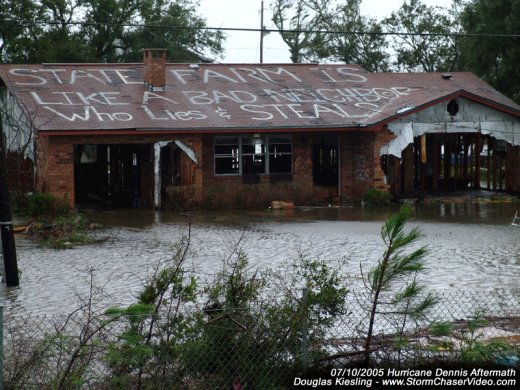
"State Farm House" courtesy of Douglas Keisling

Troy Moon remembers Hurricane Dennis today in the PNJ while local news sources are reporting that Mike Seidel of the Weather Channel will be broadcasting from Navarre Beach all day.

For those who want to relive the experience, check out "freelance storm-chasing photojournalist" Douglas Keisling's "Hurricane Dennis video blog page."

Sunday, July 09, 2006

Our Math-Impaired Media

New York Times:
MEXICO CITY, July 8 — While the announced winner of last Sunday's presidential election, Felipe Calderón, kept a low profile on Saturday, his leftist rival led a rally of at least 150,000 people, charged the polling had been marred by fraud and suggested there would be civil unrest without a vote-by-vote recount.
Washington Post:
On Saturday, he gave a mega-display of street power, drawing an estimated 280,000 people into the city center on a humid, drizzly afternoon, according to a Mexico City government estimate.
Los Angeles Times:
MEXICO CITY — About a quarter of a million people chanting "Fraud! Fraud!" jammed Mexico City's central square Saturday to back leftist presidential candidate Andres Manuel Lopez Obrador's bid to overturn his narrow electoral defeat with court appeals and mass marches.
Miami Herald:
At least 100,000 angry and vocal supporters had streamed into the square by midafternoon Saturday, some carrying signs that read, ''This is just the beginning'' and ''Vote by Vote,'' a reference to the candidate's demand for a complete recount of every single vote cast."
Houston Chronicle:
MEXICO CITY - At the behest of leftist candidate Andres Manuel Lopez Obrador, nearly 300,000 people packed the Mexican capital's sprawling central plaza Saturday, demanding a recount of the July 2 election that official results show he barely lost.
San Francisco Chronicle:
More than 100,000 of his supporters chanted "Fraud! Fraud! Fraud!" and waved the yellow flags of their Democratic Revolution Party, or PRD.
Boston Globe:
Local security officials estimated the crowd at 280,000.
And our favorite, proving the media can't even compute the media........

The Dallas Morning News:
MEXICO CITY – Tens of thousands of people jammed the city's main square Saturday in support of losing presidential candidate Andrés Manuel López Obrador, who called for people from around the country to converge on Mexico City in a massive "national march for democracy."

* * *
The city's Department of Public Safety estimated the turnout at 290,000 people. Media reports put it at 150,000.
Is it any wonder there is confusion over who really won the presidential elections of 2006 ... 2004 .... 2000?

Saturday, July 08, 2006

Snowballs in Pensacola

A few days ago someone named Nitpicker over at Daily Kos posted a big cheer for Northwest Florida congressional candidate Joe Roberts (D-Gulf Breeze).

Joe's a "fighter," he says. "A Marine who served in Vietnam and continued to serve in the National Guard until 2005 -- including an active duty stint in Operation Enduring Freedom... ." Having interviewed him and studied up on his issues, says Nitpicker, Joe Roberts embraces "a conservatism we can get behind."

Who's the "we" in that? Well, given the general sentiments of most Daily Kos subscribers, it's a good bet "we" doesn't mean Dick Cheney fans or Chevron stockholders.

It's certainly true that Roberts is no screaming liberal. As another Kos subscriber, by the name of sagra, pointed out the next day in comments to a follow-up article, here in Northwest Florida --
We have Eglin AFB, Pensacola NAS, and a lot of old military families who decided to retire where it's warm.

No real progressive has a snowball's chance in hell here. Electing a conservative who's not afraid to call Bush on his shit would be a dream come true.

What many seem to have forgotten is that it wasn't that long ago that another politician running for Congress was considered to have no better than a snowball's chance in hell. His name was Joe Scarborough. An inexperienced recent law school graduate, when Scarborough first decided to run he thought he would be up against a 16-year incumbent Democratic congressman, Earl Hutto, for a seat that a Republican had never won. Hutto unexpectedly retired, and Scarborough won in a landslide.

In short, lightning can strike. Even for snowballs.

One sure advantage Roberts has is his veteran status as a Marine, a Vietnam vet, and a long-time National Guard member. His opponent, Jeff Miller, never served in the military. He's just another "chickenhawk" who enthusiastically votes for wars so long as someone else fights them.

Nitpicker is urging individual on-line campaign donations to Roberts (with that cute 1 penny add-on to signal where it came from) through Act Blue or Joe Robert's own campaign web site.

But if you prefer the opposition, you can throw some money at these guys, who will surely be funnelling it to Roberts' opponent sooner or later.

Amplification Dept.

Why Now? has more about Joe Roberts.

Friday, July 07, 2006

Drilling Rigs Poll


Do you favor Congress' Gulf Drilling Bill?
Yes. It might save me a couple of bucks at the pump
No. Sooner or later it will be a disaster for our beaches
Don't know. I'm too stupid and lazy to read up about it
Free polls from Pollhost.com

Wednesday, July 05, 2006

Drilling Rigs - Part 3

"HR 4761 unnecessarily complicates the existing state role, in fact, and entangles the Governor and the state legislature of a coastal state in an onerous and time-consuming process that repeatedly imposes an unnecessarily high burden of proof, and very tight deadlines that are unlikely to be achievable, upon the Governor and state legislature of each state."
-- Enid Sisskin, Ph.D., June 14, 2006
Drilling Rigs - Part 3:
"Unmanageable, Ill-Conceived, and Unnecessary"


[Ed - Three weeks ago, Enid Sisskin of the Pensacola area testified before the U.S. Congressional committee that just voted, with plenty of help from Jeff Miller and other Republican and some Democratic congressmen, to expose Pensacola Beach to off-shore Gulf drilling. Here is the full text of her prepared testimony, re-formatted for the web.]

Enid Sisskin, PhD
Director, Gulf Coast Environmental Defense
Testimony Before the
Committee on Resources

United States House of Representatives
Hearing on H. R. 4761
June 14, 2006

Minerals Management Service and U.S. Environmental Protection Agency documents acknowledge that the Gulf Coast and the Gulf of Mexico are already experiencing severe environmental stress, and have been for a number of years. Large areas experience over-enrichment, low dissolved oxygen, toxin and pesticide contamination, shellfish ground closures, and wetland loss.

Degradation of water quality is expected to continue due to contamination by discharges and spills, due to eutrophication of waterbodies, and due to hydrologic modification. Contamination coming from point and nonpoint sources and accidental spills entering the water system from rural and urban sources can be both localized and pervasive.

Sixteen-hundred contaminants have been measured in the Gulf's waters by USEPA. These contaminants include hazardous and toxic wastes, petroleum and petroleum products, pesticides, synthetic organic compounds such as dioxin, and metal and inorganic chemicals such as cadmium and mercury. The USEPA goes even further, saying:
"Water quality is deteriorating, seagrass beds are dying, fish stocks are declining, the numbers of sea turtles, marine mammals, and coastal birds are decreasing and coastal wetlands and estuaries are disappearing."
Another report, this one by the Center for Health and Global Environment, in 1998, also said that the Gulf of Mexico is more stressed than previously thought, and the health of the people and the economy of the coastal communities are at risk.

These declines are for the most part, caused by humans. In Environmental Impact Statements for lease sales and drilling permits, the MMS and USEPA admit concern about the long-term and regional effects of some of the wastes that would be discharged into the Gulf of Mexico by drilling rigs.

In spite of some of the testimony you’ve heard, drilling, whether for oil or natural gas is a dirty, polluting business. Each rig discharges drilling muds and cuttings and produced water, as well as producing trash. Again, according to the environmental documents, these waste discharges could affect biological communities by smothering living organisms or through toxicity, causing slow growth, decreased species abundance, or altered reproduction.

Specifically, discharged muds have been found to cause heavy metal, mercury and cadmium, sediment contamination. Documented biological effects on benthic organisms from drilling discharges include elimination and inhibited growth of seagrasses, declined abundance in species, altered community structure, and decreased coral coverage. Localized effects on benthic marine organisms in proximity to OCS drilling sites have been measured, causing altered community structure, and changes in abundance lasting for ten years, or in some cases, permanently.

Fish, marine mammals, sea turtles, and coastal and marine birds will be expected to be impacted by the drilling discharges, pollutants and trash from OCS operations. Any pollution in the effluent could poison and kill or debilitate these organisms and adversely affect the food chains and other key elements of the Gulf ecosystem. In the case of endangered sea turtles, any loss of individuals could impact species survival, again according to the USEPA. In addition, the actual burial of pipelines would probably cause irreversible structural impacts on the seafloor, particularly in areas where hard substrates would be encountered.

The cumulative impacts of the discharged muds and cuttings on the live bottoms of the Eastern Gulf would add to long-term regional offshore water quality degradation. USEPA estimates the annual discharge of contaminants in drilling muds and cuttings over the entire northern Gulf to be 748,000 tons.

The regional impacts of the discharged drilling muds and cuttings are unknown. According to the EPA, averaging estimates on annual inputs, drilling muds and cuttings and produced water discharges from the entire OCS oil industry would contribute about 1.65 billion pounds per year and 44 million pounds per year of contaminants. According to the EPA, full determination of long-term impacts can not be calculated.

Another potential impact is from spills. There’s a new urban myth – that there have not been any spills from drilling rigs in years. Unfortunately, that’s just not true. Just a year ago, almost to the day, a 560 gallon spill from an Amerada Hess drilling platform washed up on the Breton National Wildlife Refuge oiling more than 800 pelicans in the rookery and killing almost 500 of them.

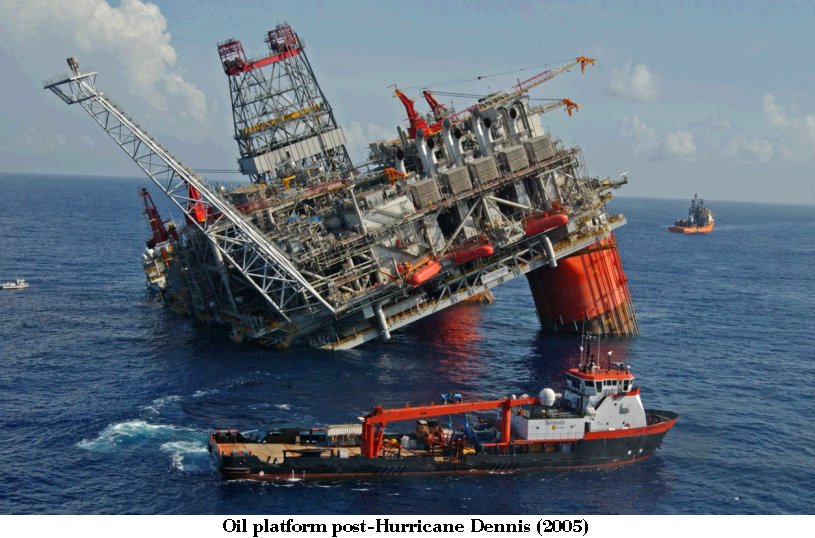
According to the MMS, due to Hurricanes Katrina and Rita, 113 drilling platforms were lost and 146 hurricane-related oil/condensate/chemical spills were reported, six of at least 1,000 barrels (42,000 gal) were identified, the largest being 3,625 barrels (152,250 gal). Based on historical spill events, it is expected that elevated concentrations of petroleum hydrocarbons measurable in the water column would be gone as early as 6 months after the spill event, but residual water quality effects could occur as long as two years after the spill.

If a spill were to reach our sugar white beaches, within a few months to 2 years after cleanup, although disturbed beach configuration would adjust to approximately predisturbance conditions, some oil that penetrated to depths beneath the reach of the cleanup methods would persist in beach sands and could be released periodically when storms and high tides resuspend or flush through beach sediments. During hot, sunny days, tarballs buried near the surface of the beach sand could liquefy and cause a seep to the sand surface.

Any further decrease in water quality, increase in trash, or oil spills will have catastrophic effects on our beaches and our economy, just recovering from the last two hurricane seasons. That’s why the Pensacola Beach Chamber of Commerce as well as 26 Florida cities and counties have all come out strongly against drilling. These cities and counties represent more than 8 million Floridians who are aware that our economy depends on a healthy environment.

The bill we are here to discuss will lead to significant adverse impacts to the coastal communities. For 25 years, the OCS Legislative Moratorium and the longstanding Presidential OCS Withdrawals, have protected the coasts. They represent a bipartisan, bicoastal consensus and provide the most important cornerstone of US coastal protection. The OCS Legislative Moratorium was once again included in the FY 07 White House Budget Document this January, continues to enjoy the support of the President, and was just sustained on the House floor last month.

HR 4761 would immediately rescind the Legislative OCS Moratorium nationwide, in all US coastal waters for both oil and gas drilling, and would reverse the Presidential OCS Withdrawals off of the Florida Gulf Coast. There is no justification, nor any public mandate, for this attack by HR 4761 on these popular protections for America's most sensitive coastal waters.

There is also no need to grant states any additional "veto authority" over the renewal of the Legislative OCS Moratorium each year beyond the clear existing ability that each state obviously already has to "opt-out" through the efforts of their own congressional delegation. The House delegation from any state could, right now, openly work to exempt their own state's coastline from continued protection in any given year.

HR 4761 permanently writes all Members of Congress out of the decision making process as to how, where, and when expanded offshore drilling takes place off of their state. HR 4761 unnecessarily complicates the existing state role, in fact, and entangles the Governor and the state legislature of a coastal state in an onerous and time-consuming process that repeatedly imposes an unnecessarily high burden of proof, and very tight deadlines that are unlikely to be achievable, upon the Governor and state legislature of each state.

State legislatures are not in session year-round in most states, making gaining concurrence at multiple junctures between a Governor and a state legislature unnecessarily complicated at best, and often virtually impossible. HR 4761 pits one state against adjacent states who may want to keep their coast and fisheries clean and unpolluted, and punishes states who choose to protect their coastal-dependent economies with continued legislative measures.

States rights are seriously eroded in other ways, as the siting of transportation corridors through state waters, for subsea pipelines or tankering of crude oil from offshore rigs, would be pre-empted by the federal government in provisions contained in HR 4761.

As previously stated, the EPA and MMS agree that coastal states that have long suffered damage to their coastal zone as a direct result of the adverse impacts of federal offshore oil and gas drilling have a legitimate right to receive a fair and equitable share of federal receipts derived from federal offshore lease bonus bids and rents and royalties. Scientific studies tell us that extraction of oil and gas has caused significant subsidence (sinking) of coastal wetlands along an extensive portion of the Gulf Coast. The oil industry has cut deep channels for pipelines and for drill barge and vessel access to wellheads and other petroleum facilities, while sequential tropical storms have further eroded important coastal wetlands by scouring out these dredged channels and thus made coastlines even more vulnerable to storm damage.

Money from the industrial activities that caused that damage should clearly be channeled to fix the damage; however, there is no legitimate justification for arbitrarily designing an allocation formula for directing federal OCS receipts to states in a manner that bribes states to accept new federal offshore drilling and more drilling closer to shore, or that punishes all states that make the legitimate choice to continue to protect their coasts from these same kinds of massive adverse impacts.

It is obvious that all federal OCS receipts directed to states and localities should be utilized to mitigate damage from OCS activities, not to construct additional damaging infrastructure to attract even more drilling or to build inappropriate and harmful projects that further degrade the coastal zone, so strong standards for the use of the money by states and localities is an absolute necessity, but is lacking in HR 4761.

What is being promoted as a new category of so-called "gas-only" offshore leasing is unmanageable and ill conceived, and HR 4761 grants undue discretion to the Secretary of the Interior in deciding what combination of gas and liquid gas condensate would be deemed a "gas-only" lease. To provide a Governor and a state legislature with only 180 days in which to react to an "accidental" discovery of crude oil on what was originally promoted as a natural gas lease, or else the "gas only" lease would automatically become an oil and gas lease, is simply not practical, when most state legislatures are not in session throughout the year.

Further, most of the adverse impacts of offshore gas drilling operations are virtually identical to offshore oil drilling operations, with the sole exception of the probability of creating a large oil spill. Liquid gas condensate is highly toxic to virtually all marine life on contact. Routine ocean dumping of spent drilling muds containing cadmium and mercury, random discharges of "produced waters" sometimes containing radium, and daily discharge of toxic hydrocarbons like benzene, toluene, and Polycyclic Aromatic Hydrocarbons (PAH compounds) occurs from either gas rigs or oil rigs.

The worst part of this it is unnecessary when there are faster, cheaper and cleaner alternatives. Our country contains less than 5% of the world’s gas and oil reserves and uses 25% of the world’s petroleum. We cannot drill our way to energy independence. It’s only through conservation, increased efficiency, and use of a combination of alternative, renewable energy sources that we’ll ever be self sufficient.

Unfortunately, the routine water and air pollution and potential damage from spills and accidents don’t respect state boundaries. The Gulf is already stressed, and bringing rigs up to a line or an arbitrary distance on a map won’t stop damage that will be caused by drilling to Florida’s coastal communities.

The forecasters are predicting another decade of active hurricane seasons and we on the Gulf Coast, as well as communities along the East Coast, can expect storms with potentially severe damage to our environment and economies. We certainly don’t need to add the pollution from oil and gas operations to compound what nature will send us.

Drilling Rigs - Part 2

"Eighty percent of the nation’s undiscovered, economically recoverable Outer Continental Shelf (OCS) gas is already available for leasing. Thus, a permanent protection for the coastal moratorium areas will leave the vast majority of the nation's OCS gas available to the industry."
-- Carolyn Esther McCormick, June 14 2006
Drilling Rigs - Part II:
"Invitation to Disaster"


[In the second half of her testimony, Carolyn Esther McCormick explains why H.R. 4761 is dangerous to local economies, risks disaster for coastal America, and is unneeded even in the present circumstance of escalating oil and gas prices.]

(Excerpt of)
Testimony of
Carolyn Esther McCormick
Managing Director, The Outer Banks Visitors Bureau,
Dare County Tourism Board, Manteo, North Carolina
Before the Committee on Resources, United Sates Congress
[edited and reformatted with subtitle guides for the web]


Lifting the OCS Moratorium will have damaging consequences for our beaches, for marine life and their habitat, and for the broader environment

1. Damage to Marine Life and habitat:

While there have been many advances in oil and gas recovery technologies in recent decades, many serious consequences still result from exploration and drilling for either oil or gas.

2. Seismic Surveying:

Marked changes in behavior in marine species in response to loud underwater noises in the ocean have been well documented. Seismic survey devices and military sonar's (which operate at a similar decibel level) have been implicated in numerous whale beaching and stranding incidents, one recently in Nags Head, North Carolina.

3. Onshore damage:

The onshore infrastructure associated with offshore oil or gas causes significant harm to the coastal zone. For example, OCS pipelines crossing coastal wetlands in the Gulf of Mexico are estimated to have destroyed more coastal salt marsh than can be found in the stretch of coastal land running from New Jersey through Maine.

4. Water pollution:

Drilling muds are used to lubricate drill bits, maintain downhole pressure, and serve other functions. Drill cuttings are pieces of rock ground by the bit and brought up from the well along with used mud. Massive amounts of waste muds and cuttings are generated by drilling operations. Most of this waste is dumped untreated into surrounding waters. Drilling muds contain toxic metals, including mercury and lead.

5. Air pollution:

Drilling an average exploration well for oil or gas generates some 50 tons of nitrogen oxides (NOx), 13 tons of carbon monoxide, 6 tons of sulfur dioxide, and 5 tons of volatile organic hydrocarbons. Each OCS platform generates more than 50 tons per year of NOx, 11 tons of carbon monoxide, 8 tons of sulfur dioxide and 38 tons of volatile organic hydrocarbons every year.

6. Oil spills:

If offshore areas are leased for gas exploration, there is a possibility that oil will be found. There were some 3 million gallons of oil spilled from OCS oil and gas operations in 73 incidents between 1980 and 1999. Oil is extremely toxic to a wide variety of marine species, and as noted by a recent National Academy of Sciences study, current cleanup methods are incapable of removing more than a small fraction of the oil spilled in marine waters.

It is important to note that, with the exception of oil spills, the environmental damages described above result from drilling or exploring for either oil or natural gas, so any suggestion that restricting leases to natural gas drilling only will not adequately reduce risk of environmental impacts.

Drilling in the Offshore Continent Shelf will have
damaging effects on local economies


The industrial character of offshore oil and gas development is often at odds with the existing economic base of the affected coastal communities, many of which rely on tourism, coastal recreation and fishing. In Dare Country, NC, the Outer Banks Visitors Bureau has been fighting efforts to lift the ban on coastal drilling precisely because it realizes what a crushing effect coastal drilling could have on the Outer Banks’ 640 million dollar tourist economy. If there's one spill or one disaster, the Outer Banks could be destroyed for a very long time.

The powerful hurricanes that battered the gulf coast have destroyed drilling platforms, underwater pipelines and coastal storage tanks, dumping millions of gallons of oil. Drilling in hurricane and storm plagued waters has proven to be disastrous.

In addition to potentially catastrophic effects on the tourism industry, drilling for gas and oil off our coasts could have significant negative impacts on commercial and recreational fishing, our fisheries, marsh lands, and marine habitat. Jobs and the environment are not mutually exclusive.

A balanced economy is based on a clean healthy marine environment and efforts need to be focused on restoring our marine environment and bringing back our fisheries.

Plenty of natural gas is already available
for lease and permitting


The majority of federal oil and gas resources are already available for development. According to the 2003 Energy Policy and Conservation Act (EPCA) report issued by the Department of the Interior, 85% of federal onshore oil resources and 88% of federal onshore natural gas resources (122.6 trillion cubic feet, or tcf) occurring on federal lands in Montana, Colorado, New Mexico, Utah and Wyoming are already available for leasing and development. Only 12% of federal onshore natural gas resources are off-limits to leasing. Eighty percent of the nation’s undiscovered, economically recoverable Outer Continental Shelf (OCS) gas is already available for leasing. Thus, a permanent protection for the coastal moratorium areas will leave the vast majority of the nation's OCS gas available to the industry.

In addition to availability for leasing, Bureau of Land Management (BLM) data indicates that the vast majority of federal lands currently under lease are not being developed. Of the more than 35,000,000 acres of public lands under lease, development is occurring or has occurred on approximately 12,000,000 acres. Drilling permit approvals on Western public lands by the BLM increased by 62 percent in 2004, to a record number of 6,052, while the number of new wells that were drilled declined by nearly 10 percent, to 2,702.

Based on this data, it is clear that the vast majority of federal oil and gas resources occurring on federal lands in the Rockies are available for development. In addition, most of the leased lands are not in development, and the BLM has issued thousands more drilling permits than the industry is actually able to drill. The oil and gas industry clearly has plenty of access to our public lands already; there is no reason to grant access to additional areas currently under moratorium for additional leasing.

There are smarter, less expensive, and faster solutions
for rising gasoline and natural gas prices


The United States consumes about 25% of the world’s energy. It is not likely that we can drill our way to energy independence. We must decrease our energy dependence by other means and invest more time and money into clean energy solutions.

A recent study by the Union of Concerned Scientists found that by getting 20% of our energy from clean sources like wind and solar by 2020 we can reduce natural gas consumption by 6% by year 2020. According to an April 2005 study by the American Council for and Energy Efficient Economy, if we use technology available today to make our homes, buildings, and industry more energy efficient, we can save up to 12.6% of the natural gas they project we would be using by 2020.

Studies have indicated that implementing these programs would create thousands of new jobs and save consumers hundreds of dollars a year in energy bills every year. Promoting renewable energy and efficiency would also encourage innovation and new technology, reduce pollution, and decrease our reliance on foreign sources of energy.

The public supports the ban
on drilling off our coasts


Concerns over environmental consequences of offshore oil and gas development have led
Congress to impose restrictions on OCS activities in sensitive areas off the nation’s coasts every year since 1981. These moratoria now protect the east and west coasts of the U.S. and most of the Eastern Gulf of Mexico. The moratoria reflect a clearly established consensus on the appropriateness of OCS activities in most areas of the country, and have been endorsed by an array of elected officials from all levels of government and diverse political persuasions, including former Presidents George H.W. Bush and Clinton, who are joined by our current President, George W. Bush.

Conclusion

All of America’s coastal communities are being pressured to put their vibrant economies, heritage, and environmental resources at risk when nothing is being done on a national scale to conserve resources and seek alternative energy sources for this generation and generations to come.

HR 4761 rescinds the entire congressional moratorium nationwide, permanently transfers authority over continued coastal protection away from the United States Congress and fragments the decision to coastal states on what is a National Public Policy Issue, and does this in a manner that makes the decision over where and when to drill offshore more readily influenced by the oil industry.

Back to Part 1

Forward to Part 3

Drilling Rigs - Part 1

"This current bill... would position each coastal state against their adjoining coastal states, as states become the object of fiscal coercion to convince them to sacrifice their coastal waters to drilling impacts. "
-- Carolyn Esther McCormick, June 14, 2006
-------------------
Drilling Rigs - Part I:
"Dividing the States of America"


[Ed - In the first half of her testimony, Carolyn Esther McCormick boils down to the essence the wide-ranging and complicated details of the full text of H.R. 4761. In the second part, she offers a synopsis of why those details spell disaster for coastal America.]

(Excerpt from)
Testimony of
Carolyn Esther McCormick
Managing Director, The Outer Banks Visitors Bureau,
Dare County Tourism Board, Manteo, North Carolina
Before the Committee on Resources, United Sates Congress
[edited and reformatted with subtitle guides for the web]

Mr. Chairman and members of the committee, good morning. My name is Carolyn Esther McCormick, and I am the Managing Director of the Outer Banks Visitors Bureau; Dare County Tourism Board, a North Carolina public authority. I am a resident of Nags Head, North Carolina; which is located along the Outer Banks and a mother of two girls. I am here today about preserving and continuing protection for America’s national treasures, our fragile economies, natural environment, fisheries and heritage for our children, our grand children and great grand children; and to voice concern over HR-4761.
* * *
Annually we welcome over 5 million visitors to our Nation’s seashore and National parks; our research indicates the main motivation for visitation is our natural, cultural and historic resources.

Tourism in America is a 1.3 trillion dollar industry with coastal communities representing over 700 billion dollars annually. Last year travel and tourism generated over 100 billion dollars in tax revenues for state, local and federal governments with 50% of leisure travelers this year making their vacation a “naturalistic trip”.

* * * [T]he House Resources Committee is today considering HR 4761, a complex offshore drilling bill that reverses ... current coastal protection, exempts various offshore activities from present environmental law, pre-empts longstanding state authority over subsea pipeline corridors in state waters, complicates efforts to repurchase non-producing federal offshore leases, and enables oil companies to avoid the cost of removing their drilling rigs at the end of production.

This current bill, HR 4761, would immediately lift all of the congressional offshore drilling prohibitions nationwide, and then would position each coastal state against their adjoining coastal states, as states become the object of fiscal coercion to convince them to sacrifice their coastal waters to drilling impacts. Other provisions of HR 4761 would immediately reverse presidential offshore drilling withdrawals in the Gulf of Mexico that were first put in place by former president George Herbert Walker Bush.

The bill would also greatly accelerate new offshore drilling off of Florida by requiring multiple lease offerings in the Lease Sale 181 area without the preparation of updated environmental studies. * * *

Oil and gas development is a dirty and destructive business that damages coastlines, harms ecosystems, and directly threatens our tourism, fishing and real estate economies. * * * The well documented socio-economic and environmental risks alone far outweigh the rewards and set the stage of a divided states of America.

Chairman Richard Pombo's, Committee on Resources, letter dated June 8, 2006, on the Hearing on HR 4761 ... states:
  • The Bill allows for coastal state self–determination and revenue sharing
  • Enhances the country’s ability to increase domestic production of oil and natural gas, alternative energy and minerals from the federal Outer Continental Shelf
  • Diminishes the amount of foreign–oil imports required to meet the nation’s energy needs
What HR 4761 does in reality [is this] --

Erases All Prior Coastal Protections

1. Immediately terminates the twenty-five year congressional moratorium that protects the entire US West Coast, all of the East Coast, and Florida’s Gulf Coast and Panhandle (section 15). This provision exposes all of the Florida Gulf Coast and Panhandle to near shore offshore oil and gas leasing, much closer to the coast than Lease Sale 181.

2. Longstanding pre-existing presidential Outer Continental Shelf withdrawals, first put in place by former President George H.W. Bush, extended in duration by President Bill Clinton until 2012, and located within the Gulf of Mexico are immediately revoked upon passage of this Act, Section 9, item (2). The 2007-2012 Outer Continental Shelf Leasing Program is amended by this act to include two sequential lease sales, in January 2007 and June of 2007, to occur in the Gulf of Mexico within the Lease Sale 181 area, without any updating of existing Environmental Impact Statement analyses, (Section 9, item 2).

Avoids Facts About Environmental Impact of Drilling

3. Makes an arbitrary finding, without any supporting scientific documentation of any kind, that gas drilling more than 25 miles offshore and oil drilling more than 50 miles offshore would not adversely affect resources near the coastline (Section 2, item 4).

Arbitrarily Re-draws State Boundaries

4. Formally establishes what it calls new “State Seaward Boundaries”, which are arbitrary extensions of onshore boundaries between coastal states that continue out into the ocean, applying lines that are deemed entirely inequitable by many shoreline states (section 4).

Allows Oil Drilling on "Gas Only" Leases

5. Grants to the Secretary of Interior unilateral jurisdiction over preparing final regulations enabling what the bill calls “natural gas only” leasing (section 5, items 2,3,4), but gives the Secretary the sole right to decide to instead grant oil companies the right to produce oil on these “gas only” leases unless the Governor and the legislature of the nearby adjoining state, or the Governor and state legislature of any neighboring coastal state within 50 miles of the lease, object within 180 days of being notified of the oil discovery (section 6, items 1,2).

6. Grants to the Secretary of Interior the right to arbitrarily approve production of a
mixture of natural gas liquids (liquid gas condensate) and gaseous natural gas when the
Secretary is considering a lease to be defined as a “gas only” lease (section 6, item 8).

Green-lights Oil Tankers, Barges, and Pipelines Everywhere

7. Grants to the owners of offshore leases in any region the right to transport produced
crude oil through the waters of the adjacent state, and through the waters of any neighboring states, unless the adjacent coastal state or the neighboring state objects to production of oil from such a “gas-only lease”. Since the bill does not specify transportation method, such pre-approved transport of crude oil could be either by tanker, barge, or subsea pipeline (section 6, Item 4).

Grants Multiple Drilling Leases

8. Allows the Secretary of Interior to issue more than one lease for a given offshore drilling tract, so that each lease may apply to a separate and distinct range of vertical depths, different horizontal surface areas, or a combination of the two (section 6, Item 1).

Forces Public Repayment of Driller's Lease Fees and Costs While Granting 30-Year Priority for Exchange of "Oil for Gas Leases"

9. Requires that an oil company holding any offshore “gas only” lease that may repurchased by the federal government at the request of the lessee because it is found to contain oil instead of, or in addition to, natural gas, and therefore does not qualify as a natural gas lease, must be repaid by the federal government for the original cost of the bonus bid paid for the lease, for lease rents, for seismic acquisition costs, and for drilling costs, and for other unidentified “reasonable expenses”. The Secretary of Interior shall recover from the adjacent state and from local governments any funds previously shared with them that were derived from the repurchased lease, if such payments were payable after the date of repurchase. The lessee of a repurchased gas lease can obtain a priority right to acquire a future oil and gas lease within 30 years after the repurchase (Section 6, item 7).

10. Oil company partnerships would be allowed to bid jointly on tracts in offshore regions
determined by the Secretary of Interior to be “frontier tracts” or which are what the bill
calls “high cost tracts” (section 6, item [r]).

Pays Revenues To Adjacent States and Non-Coastal Counties

11. A portion of federal receipts from lease tracts beyond 4 marine leagues and within 100
miles of any coastline that are available for leasing under the 2002-2007 Oil and Gas Leasing Program before adoption of this Act, and lease tracts beyond 4 marine leagues and within 100 miles from any coastline that were made available for leasing by this Act, as well as lease tracts located throughout the Alaska OCS region beyond 4 marine leagues and within 100 miles of any coastline - will be subject to a sharing of prescribed escalating percentages of OCS federal receipts according to an allocation formula specified in Section 7, (B).
  • A 75% share of federal receipts from tracts located within 4 marine leagues of any coastline shall be deposited into a separate account for subsequent allocation, Section 7, 4 (4).
  • For Bonus bids, 87.5 percent of the accrued federal revenues shall be conveyed to the adjacent state, and 6.25 percent shall be allocated to the federal Treasury, Section 7, (5) [i] and [ii].
  • For Royalties, 87.5 percent shall be allocated to the adjacent state or to any other producing state with a leased tract in its adjacent zone within 100 miles of its coastline that generated royalties during the fiscal year, except in the event that other producing states have a coastline point within 300 miles of any portion of the leased tract, the amount shall be distributed with one-third to the adjacent state and two-thirds to each producing state according to a formula inversely proportional to the distance between the nearest point on the coastline of the producing state and the geographic center of the leased tract, Section 7, (B) [i] through [iv].
12. For tracts partially or completely beyond 100 miles of the coastline, a separate escalating formula of deposits of federal receipts shall be followed (section 7 (c) (1) and (2)... .
  • [O]ne-third of the royalties shall be passed to the adjacent state - and two-thirds to each producing state - according to a formula inversely proportional to the distance between the nearest point on the coastline of the producing state and the geographic center of the leased tract, (section 7, (B) [i] to [iv].
  • Of these allocations, counties and county-equivalent political subdivisions shall receive 25 percent of the allocation based on the ratio of such coastal counties to the coastline miles of all coastal counties in the State.
  • Coastal counties without a coastline shall be considered to have 50 percent of the average shoreline miles of the coastal counties that do have shorelines.
  • Another 25 percent of the county allocation shall be based on the ratio of the county’s population to the coastal population of all counties in the state, 25 percent shall be allocated to counties with a coastal point within 300 miles of the leased tract - based on the county’s relative distance from the leased tract, (section 7, (2) (D).
  • And 25 percent of the allocation shall be based on the relative level of offshore oil and gas activities in the county compared to the level of oil and gas activities off of all counties in the state.
Requires No Accountability for Revenue Sharing Funds

13. Funds allocated to states and counties can be used for a broad and poorly defined array of purposes, and no standards are applied to ensure that the money is spent to restore damage caused by offshore oil and gas activities. Activities that further harm the coastal zone, including improvements to infrastructure associated with offshore energy production activities and any other purpose determined by state law can be funded with these allocations, and no accounting the federal government is required for any of these expenditures, except as otherwise required by law, Section 7, (3) [f].

14. The enactment of any future congressional legislative moratorium on expanded offshore oil and gas leasing will automatically prohibit any sharing of federal receipts from offshore drilling with the affected states or localities for the duration of any such restriction, (section 7, (3), [h]).

Expands Presidential Power to Deny State Petitions

15. The President is authorized by this bill to partially or completely revise or revoke any prior withdrawal made by the President under the authority of Section 9 (Section 9, [1]). Any such withdrawal requested by a state may be for a term not to exceed ten years, and the President is directed to accommodate competing interests and potential uses of the Outer Continental Shelf in considering whether or not to grant the withdrawal petition of any state (Section 9, [1]).

Grants Adjacent State Power Over Neighboring States; Allow Expedited Drilling

16. Governors of coastal states, with the concurrence of their state legislatures, may petition the Secretary of Interior to open any area adjacent to their state that is more than 25 miles from the coastline of any neighboring state for offshore gas leasing and related activities, or any area that is more than 50 miles from the coastline of any neighboring state for offshore oil and gas leasing and related activities, Section 9, item (3) (A). In analyzing the decision to lease an area under the terms of this provision, the Secretary of Interior needs only to prepare a cursory Environmental Assessment (EA) document, and is not required to prepare a full Environmental Impact Statement (EIS) as stipulated by the National Environmental Policy Act. Broad discretionary authority is granted to the Secretary of Interior with respect to the terms and conditions under which such offshore development will be allowed to occur, and, to expedite such new leasing, the Secretary of Interior is permitted to amend the current Five-Year Leasing Program to accommodate such new leasing unless less than 12 months remain in the current Five-Year Leasing Program, Section 9, item (3) (B) (C) (D).

Invalidates State Constitutions and State Laws; Require Repeated 10-Year State Moratoria

17. The Governor of a state, acting with the concurrence of its state legislature, may also petition that any area within 125 miles of the state’s coastline be withdrawn from leasing, for either oil or gas or both, but each state must submit separate petitions for distances within 50 miles of the coastline, with separate votes by the legislature each time, and must submit separate petitions for areas beyond 100 miles of the coastline, but not exceeding 125 miles of the coastline. The Secretary of Interior shall, within 90 days, prepare an Environmental Assessment to evaluate the effects of approving the state’s petition. The Secretary shall not approve a state’s petition for more than a total of ten years, but may approve such petitions repeatedly ad infinitum, in response to repeated requests from the state at appropriate intervals, Section 9, [h] (1) and (2).
Any state’s constitutional provision, or any state statute or state law, that has the effect of restricting either the Governor or the state legislature, or both, under this section, shall automatically forfeit for that state any sharing of federal Outer Continental Shelf receipts and simultaneously be prevented from exercising any state request for any withdrawal from leasing, for the duration of such state constitutional or state legislative action, Section 9, (B) [i].

Requires 75% Acreage to be Leased

18. The bill will require that seventy-five percent of the available un-leased acreage within each offshore planning area be offered in each Five-Year leasing Program, Section 10, item (1).

Allows Executive Power to Ignore All Other Laws

19. The bill authorizes the Secretary of Interior to consider and analyze leasing throughout the entire US Outer Continental Shelf without regard to any other law affecting such leasing. The bill elevates any military space-use conflicts to the President for resolution, if the Secretary of Interior is unable to resolve such conflicts with the Secretary of Defense, Section 10, item (1).

Bars States from Prohibiting Pipelines

20. If the governor of an affected coastal state requests in writing a modification of any proposed leasing action at least 15 days prior to the submission of the Five-Year Leasing Program to Congress, the Secretary of Interior shall reply to that Governor in writing, granting or denying such request, Section 10, item (2). The Secretary of Interior, at the beginning of the development of each Five-Year Leasing Program, provide each adjacent state with a current estimate of potential oil and gas resources off of that state, and with a best-efforts projection of the share of federal leasing receipts that state can expect to receive if it cooperated with federal offshore leasing plans off of its coastline, Section 19, item (2).

21. If a coastal state requests protection for its offshore waters, no subsea pipeline carrying oil or gas can be sited through the protected zone unless more than fifty percent of the production projected to be carried by the pipeline within its first ten years of operation is from that same state’s adjacent zone waters, Section 11, item (f)(1). No state may prohibit the construction of a subsea pipeline for natural gas through its adjacent waters. No state may object to a natural gas pipeline landing location on its coast unless it proposes two alternate pipeline landing locations on its own coastline, each located within 50 miles on either side of the proposed landing location, Section 11, item (2).

Exempts Oil Company Exploration and Drilling from Environmental Protection

22. Many damaging offshore oil and gas activities would be exempted from the need to prepare an Environmental Impact Statement (EIS) under NEPA, including the conduct of seismic airgun surveys, and individual lease sales would no longer require the preparation of an Environmental Impact Statement (EIS), as the generic Environmental Impact Statement prepared for each Five-Year Leasing Program would be deemed by this Act to be sufficient to comply with NEPA for all lease sales in the Program. No Environmental Impact Statement (EIS) would need to be prepared for a Plan of Exploration, and no EIS would be required for a Plan of Development after the first one is prepared for each area, Section 12, item (2)(A)(B)(C). A development and production plan may be submitted by a lessee that is deemed to cover more than one lease at a time. An exploration plan would be required to be reviewed by the Secretary of Interior within ten (10) days of submission, Section 19, (2)(B).

23. The Secretary of Interior is given the authority to review each development and production plan to ensure that it is consistent with all statutory and regulatory requirements applicable to the lease, Section 10, (e) (4). The language of the bill is not clear as to whether this provision exempts plans of development and production from the traditional federal “consistency determinations” customarily conducted by coastal states under the authority granted to them by the Coastal Zone Management Act, a critical opportunity for impacted states to participate in planning decisions affecting their coastline. The Federal Energy Regulatory Commission and the Department of Interior will decide between their two agencies which will prepare a single Environmental Impact Statement related to facilities for the transportation of natural gas, Section 10, (h).

Imposes Restrictions on Outer Shelf Revenues

24. The bill creates what is called a “Federal Energy Natural Resources Enhancement Fund Act of 2006”, derived from a share of federal Outer Continental Shelf receipts that can be utilized for a wide range of mitigations for damage done by offshore drilling and for natural resource restoration and enhancement uses, but not for land acquisition of any kind, Section 14, (5).

Allows "New Primacy" for Oil Drillers

25. The bill grants broad new primacy to the Department of Interior in use of the Outer Continental Shelf, and states that no federal agency may permit construction or operation of any facility, or designate or maintain any transportation corridor or operating area, on the Federal Outer Continental Shelf or in State waters, that will be incompatible with, in the view of the Secretary of Interior, oil and gas leasing and substantially full exploration and production of tracts that are geologically productive for oil or natural gas, Section 16 (a).

26. The bill grants the Secretary of Interior the authority to repurchase, or buy back, any offshore lease if the lessee requests such a repurchase and if the Secretary finds that such lease is qualified for such repurchase because a federal permit was denied (except denial under the Coastal Zone Management Act), or because a condition of approval was attached to a permit that was not mandated by federal statute. The bill establishes that the financial restitution that a lessee shall receive will be the amount that a lessee would receive in a restitution case for a material breach of contract. If the Secretary of Interior fails to make a final decision on a request by a lessee for a repurchase of a lease within 180 days of the request, a ten percent increase in the compensation due to the lessee will be added if the lease is ultimately repurchased, Section 17 (b)(1 through 6).

Allows "Off-site" Mitigation

27. The bill sets a precedent for allowing offsite environmental mitigation at a location away from the area impacted; see Section 18, if the Secretary of Interior believes that such mitigations generally achieve the purposes for which mitigation measures are put in place.

Permits Permanent Ex-Oil Rigs; Ignore State Preferences; Trade Leases

28. The Secretary of Interior would be instructed to issue regulations enabling the application of decommissioned oil rigs for offshore fish farms, artificial reefs, and other purposes, and all platforms would no longer need to be removed and the drilling site would no longer need to be restored at the end of the project’s economical life cycle, at the sole discretion of the Secretary of Interior, Section 10. A state may request to opt-out of this program of leaving decommissioned rigs in place onsite, but the Secretary of Interior may or may not honor the state’s request.

29. The existing requirement in the Omnibus Energy Act of 2005 to conduct a comprehensive seismic inventory of all Outer Continental Shelf waters would be rescinded, (section 22).

30. Certain undefined existing leases within 100 miles of California or Florida could be exchanged by the lessee, if the lessee so requests and if the Secretary of Interior agrees, for
a new oil and gas lease, any part of which is located between 100 and 125 miles of the coastline, and which is completely beyond 100 miles of the coastline, off of the same state, Section 27, (1).

31. Existing Coastal Impact Assistance is repealed, Section 28. 32.

Reduction of onshore leasing royalties collected for tar sands and oil shale may be enacted at the discretion of the Secretary of Interior to offer incentives the development of such resources, Section 29.
Back to Introduction

Forward to Part 2

Drilling Rigs: Introduction

Among those who oppose this bill are two citizens who know coastal communities well and have studied the details of H.R. 4761 -- Enid Sisskin of Pensacola, Fla. and Esther McCormick of Nags Head, N.C.
Last week, the U.S. House of Representatives passed H.R. 4761 (the "Deep Ocean Energy Resources Act"), which would expose virtually all of America's remaining scenic Atlantic, Pacific, and Gulf coastlines to oil and gas drilling.

The bill now goes to the U.S. Senate, where Florida Senator Bill Nelson has promised a filibuster to stop it. Senator Mel Martinez also says he will oppose the bill.

If, despite the senators' efforts, the bill should pass then huge drilling rigs the size of small cities will be permitted as close as 50 miles from Pensacola Beach. Pipelines and oil tankers could come even closer.

At that range, there is no practical barrier that would protect Pensacola Beach from multiple adverse environmental effects posed by the ordinary operation of drilling rigs, tankers, and piplines -- much less the risks of greater disasters brought on by hurricanes.

Among those who oppose this bill are two citizens who know coastal communities well and have studied the details of H.R. 4761 -- Enid Sisskin of Pensacola, Fla. and Esther McCormick of Nags Head, N.C. On June 14, they traveled to Washington and testified personally before the House Committee which was then considering the bill.

We are privileged to be able to bring you highlights from their prepared testimony, in three parts:

Saturday, July 01, 2006

Just Like Them

"I wanted to prove that Pensacola Beach was as good as places like Destin and Gulf Shores."
We're not at all sure what to make of all this.

The Pensacola News Journal today editorializes against the National Flood Insurance Program, flatly stating:
What needs to happen is a phased shutdown of the entire program.

* * *
Next should come a more aggressive attack on the "build-rebuild" cycle that has homes in risky, flood-prone areas going through repeated cycles of destruction and rebuilding, all subsidized by the taxpayer.
On the same day, the same newspaper is carrying a front-page banner headline touting developer Julian MacQueen's newly announced high rise plans. He's planning to build three new towers for Pensacola Beach, even before he finishes work on another one.

MacQueen says the high rises are going up because, "I wanted to prove that Pensacola Beach was as good as places like Destin and Gulf Shores."

What a relief! All along, we were afraid he just wanted to prove he could get rich off tax-payer subsidized beach renourishment and road widening projects.