Sunday, December 24, 2006

The Christmas 'Surge' Prayer


Formerly known as "The War Prayer" by Mark Twain.
It was a time of great and exalting excitement. The country was up in arms, the war was on, in every breast burned the holy fire of patriotism; the drums were beating, the bands playing, the toy pistols popping, the bunched firecrackers hissing and spluttering; on every hand and far down the receding and fading spread of roofs and balconies a fluttering wilderness of flags flashed in the sun; daily the young volunteers marched down the wide avenue gay and fine in their new uniforms, the proud fathers and mothers and sisters and sweethearts cheering them with voices choked with happy emotion as they swung by; nightly the packed mass meetings listened, panting, to patriot oratory which stirred the deepest deeps of their hearts, and which they interrupted at briefest intervals with cyclones of applause, the tears running down their cheeks the while; in the churches the pastors preached devotion to flag and country, and invoked the God of Battles beseeching His aid in our good cause in outpourings of fervid eloquence which moved every listener. It was indeed a glad and gracious time, and the half dozen rash spirits that ventured to disapprove of the war and cast a doubt upon its righteousness straightway got such a stern and angry warning that for their personal safety's sake they quickly shrank out of sight and offended no more in that way.

Sunday morning came -- next day the battalions would leave for the front; the church was filled; the volunteers were there, their young faces alight with martial dreams -- visions of the stern advance, the gathering momentum, the rushing charge, the flashing sabers, the flight of the foe, the tumult, the enveloping smoke, the fierce pursuit, the surrender! Then home from the war, bronzed heroes, welcomed, adored, submerged in golden seas of glory! With the volunteers sat their dear ones, proud, happy, and envied by the neighbors and friends who had no sons and brothers to send forth to the field of honor, there to win for the flag, or, failing, die the noblest of noble deaths. The service proceeded; a war chapter from the Old Testament was read; the first prayer was said; it was followed by an organ burst that shook the building, and with one impulse the house rose, with glowing eyes and beating hearts, and poured out that tremendous invocation

*God the all-terrible! Thou who ordainest! Thunder thy clarion and lightning thy sword!*

Then came the "long" prayer. None could remember the like of it for passionate pleading and moving and beautiful language. The burden of its supplication was, that an ever-merciful and benignant Father of us all would watch over our noble young soldiers, and aid, comfort, and encourage them in their patriotic work; bless them, shield them in the day of battle and the hour of peril, bear them in His mighty hand, make them strong and confident, invincible in the bloody onset; help them to crush the foe, grant to them and to their flag and country imperishable honor and glory --

An aged stranger entered and moved with slow and noiseless step up the main aisle, his eyes fixed upon the minister, his long body clothed in a robe that reached to his feet, his head bare, his white hair descending in a frothy cataract to his shoulders, his seamy face unnaturally pale, pale even to ghastliness. With all eyes following him and wondering, he made his silent way; without pausing, he ascended to the preacher's side and stood there waiting. With shut lids the preacher, unconscious of his presence, continued with his moving prayer, and at last finished it with the words, uttered in fervent appeal, "Bless our arms, grant us the victory, O Lord our God, Father and Protector of our land and flag!"

The stranger touched his arm, motioned him to step aside -- which the startled minister did -- and took his place. During some moments he surveyed the spellbound audience with solemn eyes, in which burned an uncanny light; then in a deep voice he said:

"I come from the Throne -- bearing a message from Almighty God!" The words smote the house with a shock; if the stranger perceived it he gave no attention. "He has heard the prayer of His servant your shepherd, and will grant it if such shall be your desire after I, His messenger, shall have explained to you its import -- that is to say, its full import. For it is like unto many of the prayers of men, in that it asks for more than he who utters it is aware of -- except he pause and think.

"God's servant and yours has prayed his prayer. Has he paused and taken thought? Is it one prayer? No, it is two -- one uttered, the other not. Both have reached the ear of Him Who heareth all supplications, the spoken and the unspoken. Ponder this -- keep it in mind. If you would beseech a blessing upon yourself, beware! lest without intent you invoke a curse upon a neighbor at the same time. If you pray for the blessing of rain upon your crop which needs it, by that act you are possibly praying for a curse upon some neighbor's crop which may not need rain and can be injured by it.

"You have heard your servant's prayer -- the uttered part of it. I am commissioned of God to put into words the other part of it -- that part which the pastor -- and also you in your hearts -- fervently prayed silently. And ignorantly and unthinkingly? God grant that it was so! You heard these words: 'Grant us the victory, O Lord our God!' That is sufficient. the *whole* of the uttered prayer is compact into those pregnant words. Elaborations were not necessary. When you have prayed for victory you have prayed for many unmentioned results which follow victory--*must* follow it, cannot help but follow it. Upon the listening spirit of God fell also the unspoken part of the prayer. He commandeth me to put it into words. Listen!

"O Lord our Father, our young patriots, idols of our hearts, go forth to battle -- be Thou near them! With them -- in spirit -- we also go forth from the sweet peace of our beloved firesides to smite the foe. O Lord our God, help us to tear their soldiers to bloody shreds with our shells; help us to cover their smiling fields with the pale forms of their patriot dead; help us to drown the thunder of the guns with the shrieks of their wounded, writhing in pain; help us to lay waste their humble homes with a hurricane of fire; help us to wring the hearts of their unoffending widows with unavailing grief; help us to turn them out roofless with little children to wander unfriended the wastes of their desolated land in rags and hunger and thirst, sports of the sun flames of summer and the icy winds of winter, broken in spirit, worn with travail, imploring Thee for the refuge of the grave and denied it -- for our sakes who adore Thee, Lord, blast their hopes, blight their lives, protract their bitter pilgrimage, make heavy their steps, water their way with their tears, stain the white snow with the blood of their wounded feet! We ask it, in the spirit of love, of Him Who is the Source of Love, and Who is the ever-faithful refuge and friend of all that are sore beset and seek His aid with humble and contrite hearts. Amen.

(*After a pause.*) "Ye have prayed it; if ye still desire it, speak! The messenger of the Most High waits!"

It was believed afterward that the man was a lunatic, because there was no sense in what he said.

Saturday, December 23, 2006

While You Were Shopping ...

While you and we were shopping yesterday the Bush administration attempted to assassinate the First Amendment:
HERE is the redacted version of a draft Op-Ed article we wrote for The Times, as blacked out by the Central Intelligence Agency’s Publication Review Board after the White House intervened in the normal prepublication review process and demanded substantial deletions. Agency officials told us that they had concluded on their own that the original draft included no classified material, but that they had to bow to the White House.
Who ever would have thought we'd see the day an American newspaper was forced by the Government to black-out expressed opinions like the one below?
Luckily, Brad DeLong rescued the First Amendment:
[H]ere is my guess as to how the full op-ed originally read...
Support the values our troops are fighting and dying for -- read what the Bush administration doesn't want your eyes to see.

Thursday, December 21, 2006

Gulf Golf

Glenn Griffith has an op-ed Viewpoint worth reading today. The more things change, the more they stay the (golf) course.

Wednesday, December 20, 2006

The Afghanistan Parallel

"President Bush said Tuesday that the United States should expand the size of its armed forces, acknowledging that the military had been strained by the wars in Iraq and Afghanistan and would need to grow to cope with what he suggested would be a long battle against Islamic extremism."
It's popular in some quarters to compare George Bush's disastrous Iraq war with the prolonged, and ultimately pointless tragedy, of the Vietnam War.

All such parallels are never exact. The people, circumstances, purposes, and consequences inevitably will differ to some extent. As in life itself, however, often one can find important lessons -- and grave warnings -- by studying history. As a popular quotation often attributed (without proof) to Mark Twain has it, "History doesn't repeat itself, but it often rhymes."

Here's another parallel to Iraq worth contemplating: "THE SOVIET EXPERIENCE IN AFGHANISTAN: RUSSIAN DOCUMENTS AND MEMOIRS":
The actual decision to invade was made in secret by a very small group of Politburo members, against the strong and openly expressed opposition of the military, and only then rubber-stamped by the other Politburo members.
* * *
The highest leadership was poorly informed about the strength of religious beliefs among the masses of the Afghan population. Political and military leaders were surprised to find that rather than being perceived as a progressive anti-imperialist force, the Afghanis as foreign invaders, and "infidels."
* * *
The initial mission... was soon expanded to combat, and kept growing over time. The Soviet reservists, who comprised the majority of the troops initially sent in, were pulled into full-scale combat operations against the rebels, while the regular Afghan army was often unreliable because of the desertions and lack of discipline.
* * *
The Soviet troops also suffered from the confusion about their goals—the initial official mission was to protect the PDPA regime; however, when the troops reached Kabul, their orders were to overthrow Amin and his regime. Then the mission was changed once again, but the leadership was not willing to admit that the Soviet troops were essentially fighting the Afghan civil war for the PDPA.
* * *
The realization that there could be no military solution to the conflict in Afghanistan came to the Soviet military leadership very early on. The issue of troop withdrawal and the search for a political solution was discussed as early as 1980, but no real steps in that direction were taken, and the Limited Contingent continued to fight in Afghanistan without a clearly defined objective.
* * *
[T]op Soviet military and political leadership held secret deliberations on the possibility of early withdrawal of Soviet forces from Afghanistan. Nevertheless, the first combat operations of the Soviet troops led to the change in the original mission of the Limited Contingent to include combat operations against the rebels.
On the same day Bush as much as admitted he lied during the Fall congressional campaign when claiming "we're winning," the International Crisis Group published a short paper intended to avoid the same order of mistakes made by 'beltway insiders' in the (former) Soviet Union.

The paper is titled, "After Baker-Hamilton: What to Do in Iraq." A brief summary is here. The full 44-page report (in PDF format) is here.

Nowhere does ICG recommend the Soviet-like approach of committing more troops. Instead, it calls for a "clean break" from Bush's failed policies, and offers a detailed 27-step "sustained multilateral diplomacy" campaign with the clear objective of achieving "an end-state for Iraq and the region that is no one’s first choice, but with which everyone can live."

Here's the rub:
There is abundant reason to question whether the Bush administration is capable of such a dramatic course change. But there is no reason to question why it ought to change direction, and what will happen if it does not.
The dimensions of the disaster that George W. Bush has brought upon America are nearly incalculable. If, as seems abundantly clear, he cannot alter course then he should be replaced, and the quicker the better.

Thursday, December 14, 2006

Quote of the Week

Rep. Charles Rangel, via Talking Points Memo:
“I never understand that question, you have a President that’s in deep shit. He got us into the war, and all the reasons he gave have been proven invalid, and the whole electorate was so pissed off that they got rid of anyone they could have, and then they ask, ‘What is the Democrats’ solution?’”

Wednesday, December 13, 2006

Convenient Meet-up Saturday

We've mentioned it before. In fact, we've raved about David Guggenheim's documentary -- often mistakenly called the 'Al Gore documentary' -- titled "An Inconvenient Truth."

Saturday, nearly 50 local residents -- one of them could be you -- have the chance to see the film for free by accepting one of three invitations to a Moveon.org meet-up in a private home of volunteer hosts here in Northwest Florida: Deborah Moore (Gulf Breeze), Robert N. Suberi (Orange Beach), or Susan (Destin).

The local "meet ups" are part of nearly 1,700 simultaneous showings in private homes taking place this weekend across the nation. Not only does it give you the chance to see a riveting, informative, and entertaining presentation about global warming, but you'll have the opportunity to make new friends who share similar concerns and values.

If you live somewhere other than Northwest Florida, you can cadge an invitation to a Saturday showing nearest your zip code by clicking here.

Tuesday, December 12, 2006

Florida in the Year 2060

A moderately sophisticated predictive study of what Florida is likely to look like in the year 2060 was released today by "1,000 Friends of Florida." The Miami Herald reports the study was conducted by the University of Florida's GeoPlan Center and underwritten by the St. Joe Company (which is busy developing the eastern Florida panhandle) and A. Duda and Sons, identified as "one of the state's biggest agribusinesses."

The full report (in pdf format) is here. An executive summary is here.

Some results of interest:
  • "Only the Panhandle would not be facing build-out in 50 years." That, and Miami-Dade County, which is trying to encourage fill-in development rather than continued sprawl.
  • Florida's statewide population essentially will double from the present 17.8 million to 35.8 million by 2060.
  • Nearly 7 million acres of agricultural or undeveloped land will be needed to accommodate the exploding population.
  • Except for small pockets in Northwest Florida, the state will become mostly one big, continuous city.
  • In the "worse case" senario, "this will leave conservation lands completed isolated, surrounded by a sea of urbanization."
  • Of the 67 counties in Florida, Santa Rosa (think Gulf Breeze, Milton, and Pace) is likely to be among the top 8 fastest-growing counties. If present population trends continue, it will expand from the Year 2000 Census of 117,743 to 704,149 -- becoming almost the same size as all of Jacksonville is today.
As the "1,000 Friends" report explains, its future projections are based on "four key assumptions."
  1. "Moderate" population projections by the Bureau of Economic and Business Research. (In other words, things could be a great deal more crowded.)
  2. The "gross urban density" of developed lands in every county "will remain the same." (That's about as likely as the number and height of Pensacola Beach condos remaining the same.)
  3. Newer residents will settle on lands "determined to be the most suitable using a set of eight criteria such as proximity to existing urban areas, road density, and absence of wetlands. (Again, as much a fantasy as Portofino's promise to restore the wetlands it destroyed and the wildlife it evicted.)
  4. No new conservation lands being set aside by the state over the next half century. (This one could be probable, if we keep electing politicians who've sold their souls to the developers.)
And that's before taking into account scientific projections of what will happen to Florida if we don't soon find a way to stem global warming.

It's curious, at best, that the "1,000 Friends" report makes no mention of rising sea levels when it peers half a century into the future. Just yesterday, scientists reported that the Arctic Ocean is likely to lose its year-round ice cap in only forty years, well before 2060.

As an older study commissioned by the Natural Resources Defense Council warned four years ago:
Florida’s valuable coastal property and key tourist resources will be damaged by the most obvious result of global warming: rising sea levels. In low-lying areas, anticipated sea level rise could force water to flow horizontally as much as 400 feet or more inland—flooding shoreline homes and hotels and eroding Florida’s famous beaches. Attempts to block rising seas through sea-wall projects and erosion control will be expensive and will almost certainly fail to protect undeveloped shoreline.
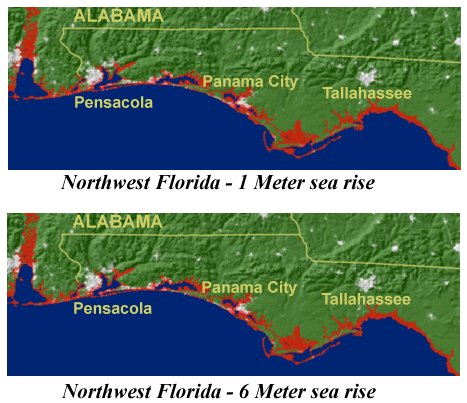
Scientists at the University of Arizona have been hard at work mapping likely changes in the U.S. (and Florida) coastline under a variety of scenarios ranging from a sea level rise of 1 to 6 meters. Free software to do your own modeling, wherever you live, is available here.

A more recent interactive map developed by NASA scientists and Google shows what would happen to Florida (or anywhere else on Earth) under a variety of climate change scenarios ranging from an average sea level rise of 1 to 14 meters. All you have to do is navigate to the part of Planet Earth you're interested in, input your preferred depth of disaster, and you'll get a result similar to this one, based on our own optimistic expectation of an average sea level rise of 3 meters.

Under even the mildest of scenarios, the millions who live in south Florida -- and, sorry to say, much of Pensacola Beach -- will need to learn how to live and work under water, as these static maps developed by scientists at the University of Arizona show: So if you're the optimistic type, as we are, there's good news as well as bad news in today's report by "1,000 Friends of Florida."

The good news is over-development of Florida likely won't happen quite like they predict. The bad news is that's because we'll all be up to our belly buttons in salt water.

Monday, December 11, 2006

DJJ's Proposed Juvenile "Call Center"

Late last week, we mentioned the backsliding plans of Florida's Department of Juvenile Justice to close the local Juvenile Screening and Detention Center, which serves both Escambia and Santa Rosa counties. Yesterday, the Pensacola News Journal editorialized against the proposal, too.

We saw the chief policy issue as implicating concerns about public safety, child care, and professionalism. Florida's Department of Juvenile Justice is poorly funded, field workers are struggling under massively increased caseloads, and DJJ administrators at the highest levels seem interested only in camouflaging that reality with cheap sloganeering and obfuscations.

The News Journal has a darker view. They see the problem as symptomatic of a broader range of problems facing state government that have been allowed to pile up over the past several years. Though his name wasn't explicitly mentioned, in effect the newspaper is saying that Jeb Bush's chickens are coming home to roost:
With health care for the physically and mentally disabled, the housing of mentally ill jail inmates, the handling of arrested juveniles, and maybe Medicaid in the near future -- years of policy development at the state level is coming to fruition with the state backing away from past responsibilities and dumping the problems on local governments, non-profit agencies or whoever else can be handed the ball.
No doubt, the governor and his supporters are sticking all the thumbs they can into the leaky dike that is state government. With a month before he leaves office and starts plotting a path to the White House, the last thing Jeb Bush needs is to have his 'privatization' programs exposed for the shams they are.

Thumbs in the dike, okay. What else can you expect from a politician? But imitating Microsoft?

Today, Local radio reports say DJJ remains adamant that it will "convert the [juvenile screening center] operation into a call center, where youngsters picked up by police will be screened by phone. "

Screening for mental health and public safety of children by telephone? Under DJJ's "call center" model a screener could be fifty, or a hundred, or even a thousand miles away from the juvenile who is being assessed for physical, mental, and emotional health, as well as suitability for pre-hearing release to a parent or guardian. Interviewers would have no eye contact with the youth, no body language to read, no visual (or odorous) clues at all to the mental and emotional state of the juvenile.

When was the last time a doctor or nurse who didn't know you personally was willing to diagnose you over the telephone? When was the last time a judge was prepared to grant bail to someone they hadn't even met based on a telephone conversation? When was the last time a lawyer or an accountant took your case without meeting you in person?

What DJJ is proposing isn't mental health or pre-release "screening." It's a telemarketing campaign.

And members of the public are the suckers. It's exactly like calling for help when your computer dies and getting a voice on the other end of the line that sounds like Gunga Din the water carrier.

If DJJ administrators are serious about "call center" screening for newly detained delinquent or runaway juveniles, they may as well go whole hog, like any other profit-hungry enterprise without a soul, and hire Bangladesh tele-technicians. They will work for pennies a day.

A Bangladeshi "call center" screener may not be able to assess troubled kids worth a damn, but on the fourth or fifth call he might be able to fix their computers.

Hurricane Bookies Set Odds for 2007

For the weather gamblers among us, Colorado State University's tropical odds-makers, Dr. Philip Klotzbach and Dr. William Gray, are out with their annual December over-and-under for 2007.

The hurricane bookies are calling for 14 named Atlantic basin tropical storms next year, half of them reaching hurricane strength. AP has distilled the numbers for us:
The 2007 Atlantic hurricane season should have above-average activity, with three major hurricanes and a good chance that at least one of them will make landfall, a top hurricane researcher said.
* * *
[T]here is a 64 percent chance of one of the major hurricanes -- with sustained winds of 111 miles per hour or greater -- coming ashore. The long-term average probability is 52 percent... ."
The academic bookmakers are red-faced but undaunted over missing two years in a row. They were badly under in 2005, predicting only 11 named storms (there were 28) and badly over for 2006 (17 named storms predicted, 9 developed). As Michael Christie of Reuters put it a couple of weeks ago, "The noted hurricane forecasting team led by Dr. William Gray at Colorado State University has not missed by this much in a long time."

Klotzbach says, 'Blame it on El Niño.' (Sounds like a rumba, doesn't it?)

Houston's Science Guy says, quite sensibly, "I wouldn't put too much stock in any of these forecasts."

Hey! It is a rumba!

"Blame It On El Niño"

Saturday, December 09, 2006

Juvenile Justice: Back to the Future

Is it or isn't it? Confusion reigns over whether the "Juvenile Assessment and Detention Center" for Escambia and Santa Rosa counties is open or closed.

Last week, it was closing. This week, it's open. Even the cops -- never mind your hairdresser -- don't know for sure.

The issue of the moment is whether sheriff deputies and policemen on the beat, or experts in juvenile behavior employed by the Department of Juvenile Justice, should bear primary responsibility for screening newly-detained juveniles for such matters as risks of flight, suicide, medical needs, home detention, secure lock-up.

Specially-trained DJJ workers have been doing it for at least the past decade. But a few weeks ago, the Juvenile Justice Department announced plans to scuttle the program and hand off responsibility to arresting officers.

Law enforcement officers were outraged.

Yesterday, a spokesman for the state Department of Juvenile Justice started furiously back-peddling. "We're just talking with local law enforcement and other community stakeholders about a positive solution," she told the Pensacola News Journal with less than complete candor.

Adds reporter Nicole Lozare:
That was news to local law enforcement officials later in the day, who have been scrambling all week to prepare for the closing and train their officers on the new intake procedure handed down by the state.
There are larger issues behind this latest flap. Over the past decade, a series of Florida Supreme Court decisions determined that under-age suspects taken into custody by law enforcement officers shouldn't be left to commit suicide or mysteriously die while in police custody. That left the Florida legislature with no alternative but to drag itself, kicking and screaming, into the Twentieth Century -- just in time for the beginning of the Twenty-first.

So in recent years Florida, in common with other states, required that juveniles arrested for anything from minor offenses like disturbing the peace or vandalism to major crimes must be screened within four hours by trained experts for the seriousness of the offense, past juvenile record, risk of flight, and mental stability. The overall screening process is designed to protect both the public and the lives of juvenile suspects. Or, in the words expressing the mission of the Department of Juvenile Justice, "to protect the public by reducing juvenile crime and delinquency in Florida."

Although DJJ claims it provides "strong prevention and early intervention services for at-risk youth and minor offenders," the reality is that the state's juvenile justice system is near the breaking point. The on-going PR war between Department and local enforcement agencies is only the latest symptom. The cruel death of Martin Lee Anderson at the hands and boots of deputy sheriffs manning a Bay County boot camp, is another.

The larger issue is that the state legislature has been short-changing the budget of the state's Department of Juvenile Justice for years. Over the past decade caseloads have exploded along with the state's growing population, but DJJ's budget hasn't grown apace. Field personnel have been cut. Salaries have stagnated. Caseloads doubled, and doubled again. Experienced personnel have left in disgust. More are headed for the door.

So, DJJ is starting to cheat. Two telling examples, among a host of others:
  • National quality standards for juvenile offender workers specify the maximum allowable caseload for a juvenile justice worker is about 30 cases per employee. That standard once was included in the Department's own manuals. When DJJ executives realized the press of work and lack of personnel was causing the average worker's caseload to double or even triple, they arbitrarily changed the "allowable" per-worker caseload, and then eliminated it altogether. Today, many juvenile probation officers in the local area carry caseloads ranging well over a hundred open cases.
  • DJJ requires its juvenile case workers to code their work hours into a state computer every week. When the rising workload started causing case workers to stay on the job 15 to 30 hours a week overtime, state officials simply re-programmed the payroll software to make it impossible for employees to log more than 40 hours a week on the job, even if they worked far more.
Management decisions like these don't solve problems. What they do is hide them. At the top, DJJ administrators are fighting a public relations war, not a battle against juvenile crime or for juvenile justice.

Back to the Future. If what it's doing in Northwest Florida is any indication of statewide trends, the Department of Juvenile Justice is back-sliding to where it was before Florida joined the Twentieth Century: untrained policemen stuck with newly arrested juveniles instead of continuing their patrols; often-troubled youths incarcerated without mental health screening; increased risk of suicide by juvenile offenders arrested on minor charges.

Everyone knows you get what you pay for in this life. If you want "protect the public by reducing juvenile crime and delinquency in Florida" then you have to pay for the service.

There is no reason why juvenile justice, or the sheriff's deputies and city policemen on the street, should be subsidizing Florida taxpayers. If a juvenile worker puts in forty hours a week, he ought to be paid for forty hours; if he works eighty hours, he ought to be paid for eighty hours. If proper caseload management requires twice as many juvenile justice employees as we have, then the legislature should appropriate the necessary funds to hire them.

Likewise, if we want our law enforcement officers to be out enforcing the law, then we shouldn't expect them to be babysitters.

Wednesday, December 06, 2006

Iraq Study Group Report

Executive Summary

Summary of 79 Recommendations

Full Report (pdf - 114 pp text plus appendixes).

As described by one wag, the ISG report is less a government study than an intervention. As reported in Forbes, Rep. Duncan Hunter (R-CA) said as much:
"Let's use this as a tool to advise the president, as all these recommendations that are coming to him from the Pentagon, from the Congress and from this study group."
Says White House PR-flack Tony Snow of the ISG report, "There's nothing surprising in it."

Indeed. Former Secretary of State Jim Baker probably best summed up where we are and where we have to go:
As Baker noted this morning in unveiling the findings, "there is no magic formula" that will convert Iraq into a qualified success story. Managing failure, preventing things from becoming worse and gradually turning around a bleak situation in the Middle East are the immediate challenges facing the president and the Democrats in Congress.

Monday, December 04, 2006

Liquor License Lottery Lament

It isn't going to make the history books, but nevertheless today is a watershed date for Santa Rosa County. The Florida Division of Alcoholic Beverages and Tobacco today announced 17 winners of liquor licenses in the lottery established after county residents voted to go from "dry" to "wet."

Supposedly, the lottery was random. The PNJ earlier reported that chances of being a winner in the liquor lottery were one in 291.

Tell that to the four of 17 winners who actually live in Santa Rosa county. Among other winners was "William McGuire Martin," a name familiar to Pensacola Beach residents. The Martin family needed another liquor license like Bush needs another war.

Regardless of the winners' identity, near the beach Gulf Breeze and Navarre at last will enjoy what their Santa Rosa Island neighbors one mile across the Sound have had for half a century. Over time, we expect the competition will have a salutary affect on entertainment establishments in both south Santa Rosa County and the beach communities.

A more pronounced change also can be envisioned in up-county places like Pace, Milton, Jay, and Munson. There, daily life will stay much the same, but with the added possibility of dining out somewhere other than a fast-food joint.

Judging from the experience of other states and communities that went from dry to wet, the entertainment and dining market will not change because of the availability of alcohol, per se. Booze, beer, and wine always have been available in Santa Rosa county, as news reports about the arrests of drunken preachers every now and then attest. A limited number of Navarre Beach restaurants enjoyed a 'grandfathered' license status as formerly located inside Escambia County; private 'key-club' operations were common; and law enforcement took a look-the-other-way attitude toward brown-bagging.

No, the reason life won't be quite the same is that with liquor-by-the-drink restaurants, bars, a nightclub or two, and maybe even a comedy club or live theater will be able to afford live musicians upscale facilities, and similar pleasures of modern life which eluded the good citizens of Santa Rosa county for the last century.

History's Judgment

UPDATED BELOW
From time to time a debate erupts in the blogosphere or among TV talking heads about how history will judge the Bush administration. The conventional wisdom is that it's too early to tell. Give it a hundred years or so.

We doubt that. History will have no judgments to make when even major architects of the Iraq war disaster, like Donald Rumsfeld, admit the whole mess was ill-conceived from the beginning and now are reduced to suggesting PR campaigns to "lower public expectations".

We'll be decades overcoming the blow-back, as you can figure out from an account in today's Los Angeles Times.
President Bush and his top advisors fanned out across the troubled Middle East over the last week to showcase their diplomatic initiatives to restore strained relationships with traditional allies and forge new ones with leaders in Iraq.

But instead of flaunting stronger ties and steadfast American influence, the president's journey found friends both old and new near a state of panic. Mideast leaders expressed soaring concern over upheavals across the region that the United States helped ignite through its invasion of Iraq and push for democracy — and fear that the Bush administration may make things worse.
Condoleeza Rice, Dick Cheney, and George W. Bush himself can't convince anyone they know what they're doing. Because they don't.

UPDATE
Dec. 4 pm

It seems that noted historian Eric Foner just yesterday tackled this very issue of Bush's likely standing in history. After comparing the current occupant of the White House with past tenants, his verdict:
It is impossible to say with certainty how Bush will be ranked in, say, 2050. But somehow, in his first six years in office he has managed to combine the lapses of leadership, misguided policies and abuse of power of his failed predecessors. I think there is no alternative but to rank him as the worst president in U.S. history.

Saturday, December 02, 2006

Winds of Change on Pensacola Beach

This year's just-ended hurricane season may have been exceedingly quiet, thank goodness, but the winds of political change are still blowing on Pensacola Beach. We expect a hurricane next year, politically speaking.

As the Gulf Breeze News and Pensacola News Journal reported recently, only one of five sitting members of the Santa Rosa Island Authority is returning next year. Gone are McGuire Martin, Bill Griffith, Thom Blas, and Jimmie Perkins.

As the saying goes, elections have consequences. On democracy-impaired Pensacola Beach, however, those elections are for distant county commissioners. Five of the six SRIA board members who administer Pensacola Beach are unelected appointees of county commissioners.

Two veteran board members remain: the one member elected by beach residents , Dr. Thomas Campanella, and Vernon Prather, who will continue serving as the appointee of county commissioner Kevin White.

Out With the Old

Martin and Griffith each enjoyed reigns longer than Caesar Augustus. Both were at various times controversial. Martin's attendance record was abysmal, except when an issue of direct interest to his pocketbook was on the agenda. Griffith was a steadfast promoter of beach tourism. He also frequently voted for high rise developments, until even he seemed appalled at how thoroughly the beach was being walled off from the public or cast into permanent shadows.

Blas and Perkins served four years. They first were appointed to the SRIA board by newly named Escambia County commissioners after the Cooking Pot Scandal erupted in 2002, resulting in the indictment and later convictions of four former Escambia County commissioners on criminal charges ranging from Open Meetings violations to bribery and corruption.

Blas served as chairman of the SRIA board this past year. Although he started out as something of a free market radical, which on Pensacola Beach translates as pro-development, over time he appeared to moderate his views. In the last two years he became something of a centrist on the board -- or at least not a sure vote for higher buildings, greater densities, and more ruinous fees and taxes.

Jimmy Perkins never really manifested much interest in the job. Early in his tenure, he told beach residents in an informal conversation late one evening that he had no sympathy for those who strive to preserve Pensacola Beach or its environment. Waving a hand toward the bright neon lights of a hotel and two restaurants across Via DeLuna from the SRIA building, he said, "The beach was ruined years ago by stuff like that."

In With the New

The newly appointed commissioners, who serve at the pleasure of county commissioners, include John Peacock (appointed by Mike Whitehead); Fred Gant (appointed by Marie Young); Kelly Robinson (appointed by newly elected county commissioner Gene Valentino); and Tammy Bohannon (named by newly elected Grover Robinson).

Rick Outzen of the Independent News recently remarked on his blog that "Peacock has already made it known that he wants to abolish the SRIA." Whitehead told the Pensacola News Journal that he replaced Griffith with Peacock because, "I wanted someone who reflects my opinions and my beliefs about where this community is headed... ."

That would be, if Whitehead gets his way, to hell in a hand basket.

Whitehead is pushing to abolish the SRIA and have county commissioners manage the beach. His vision calls for unrestrained development and maximum taxes and fees on beach residents and businesses.

The other new SRIA board members, Gant and Robinson, are unknown commodities at the moment. Tammy Bohannon is a long-time beach resident and businesswoman who often has been a voice for preserving the best of Pensacola Beach against unreasonable development and higher taxes and fees that would make the beach unaffordable for the general public.

Future Storm Warning

The first test for the new commissioners is likely to come soon after the New Year when SRIA general manager Buck Lee's contract comes up for renewal. Lee is unpopular with long-time SRIA staff members, beach businesses, and residents. Many have questioned his spending priorities, beginning with his ostentatious leasing of a bright yellow Hummer early in his tenure as the agency's top executive.

The Hummer is gone, now, but not the grandiose impulse that inspired Lee to lease it. Many say he has done nothing since to show he knows or cares how to efficiently administer the $6 million agency in the public's interest.

Buck Lee is at bottom just an under-educated county politician with no real expertise in anything related to municipal administration, finance and budgeting, tourist promotion and marketing, building standards enforcement, environmental protection, or anything else relevant to Pensacola Beach. What skills he has are limited to preserving his own job, even if that means betraying the board to whom he supposedly answers and the agency that he heads.

Ordinarily, the learning curve for new board members is six months or longer. New board members don't have the luxury of that much time. They're stepping into the middle of a windstorm over the future of Pensacola Beach. And they can't trust SRIA general manager Buck Lee to give them a fair and balanced orientation.

They'll have to act quickly, and rely on truly independent resources, to learn the complex history, past policy choices, and alternative future directions facing the Santa Rosa Island Authority. They can turn to no better resource for that than local attorney M.J. Menge, who has lived through and worked on almost every major issue involving Pensacola Beach in the past nearly four decades.

Thursday, November 30, 2006

'Heck of a Job' Maliki

NYTimes: President Bush today proclaimed Prime Minister Nuri Kamal al-Maliki "the right guy for Iraq... ."

Associated Press: "Thirty Iraqi lawmakers and five cabinet ministers loyal to anti-American cleric Muqtada al-Sadr said they were suspending participation in Parliament and the government to protest al-Maliki's decision to meet with Bush."

LA Times: "At least 215 people were killed in coordinated car bombings Thursday in a Shiite Muslim slum of Baghdad, a stronghold of anti-American cleric Muqtada Sadr and his Al Mahdi militia. Hundreds more died in days of reprisal attacks, as Shiite and Sunni militiamen pounded neighborhoods with mortar rounds and gunfire.

"As the toll grew, Iraqis on both sides of the sectarian divide directed their anger at the United States and demanded an immediate pullout. "

Al Jazeera: "There was a bigger meeting attended by Condoleezza Rice, the US secretary of state and national security adviser, and Jordan's prime minister, foreign minster and intelligence chief. Al Jazeera said the meeting discussed the Iraq issue at length, but it was not attended by al-Maliki."