Wednesday, October 19, 2005

Wilma A 'Monster' Cat 5 - Updated

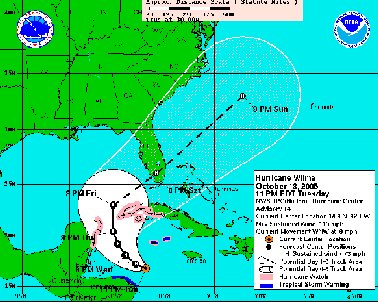
In a matter hours overnight, Hurricane Wilma climbed the Saffir-Simpson intensity scale from Category 1 to 5, the maximum. As of 5 am EDT, the National Hurricane Center was saying, "Wilma is near its maximum potential intensity and further strengthening is not anticipated."

The forecast track has again been nudged westward, but not significantly. NHC experts continue to forecast that once it enters the Gulf "weakening should begin" and the storm should turn east toward the Florida peninsula "with an increase in forward speed."

There is substantial uncertainty, however. As the Naples Daily News {free registration required) reports this morning, "Hurricane Wilma may hit Collier County directly as a Category 3 storm over the weekend. It also might miss the area by 300 miles."

5 am Update

The Pensacola News Journal's storm commentator, Derek Ortt, observes early this morning that:
"Wilma has become the most intense hurricane, ever. This will be confirmed after the season, pending a calibration of the data. Minimum pressure recorded by the aircraft was recently reported to be 884mb, 4mb lower than the minimum pressure recorded in Hurricane Gilbert."
He also advises that, "Residents of Pensacola should continue to monitor the progress of this, in case the track changes."

Tuesday, October 18, 2005

Wilma Rapidly Strengthening


As of 11 pm EDT Tuesday, Hurricane Wilma continued to "rapidly intensify" and the NHC was saying, "Wilma has developed the dreaded pinhole eye."

The hurricane reached Category 2 status late Tuesday evening. It is expected to strengthen further to Category 4 status some time in the next 24 hours "and it would not be a surprise to see it reach Category Five" before it tops out, the Hurricane Center says.

The NHC's now projects the storm is likely to swing a little west of earlier forecasts before being pushed back toward the Northeast:
"The new forecast track is adjusted somewhat to the left for the first 48 hours based on current position and motion... . It should be noted that the models do not completely agree... and these differences could make a significant difference in what parts of Florida Wilma will ultimately affect."
Earlier Tuesday evening, Derek Ortt wrote for the Pensacola News Journal:
"The all clear has not been given for Pensacola, especially with the track moving west of the forecast track. Right now, it appears as if high waves will be all that is seen, though residents should continue to closely monitor the progress of this dangerous hurricane in case the track shifts farther west than expected."
Locally, no one appears to be making any preparations yet. It's too early and as yet too uncertain that the storm will approach sufficiently close to the Northwest Florida panhandle. In public places, however, casual conversation inevitably touches on Wilma and the possibility, however remote, that the forecast path might -- just might -- change again in the next few days.

Really Bad Opera Notes

The great American composer John Adams started it all with plots ripped right out of today's headlines, like the instant classic Nixon in China and his new smash hit Doctor Atomic.

Now, as Jimmy Durante used to say, "everybody wants to get inna de act." According Sports Illustrated,"Nancy Kerrigan's 1994 knee-capping by an associate of rival Tonya Harding has been adapted for Nancy and Tonya: The Opera".

If you like that, you might love "Monica and Linda", a new operetta by Paul Nelson. The libretto is taken "from the actual transcript of the secret recordings which Linda Tripp made of her conversations with Monica Lewinsky."

Hurricane Wilma

Wilma is now officially a hurricane. The NHC reports:
A high likelihood of rapid strengthening is indicated...and it is likely that Wilma will be a major hurricane when it enters the southeastern Gulf of Mexico. As Wilma accelerates northeastward late in the forecast period...wind shear is forecast to increase...but there may not be enough of it to weaken Wilma very quickly.

There has been little change to the track forecast thinking.... as it progresses high pressure over the Gulf of Mexico is expected to weaken...allowing Wilma to move through the northwestern Caribbean and enter the southeastern Gulf of Mexico in about three days... [A]n acceleration northeastward is expected.

Headline Happenings Here


Weather
Wilma Wilder; Predictions Point To Peninsula
Wilma is expected to enter the Gulf as a Category 3 hurricane, then turn toward Florida.

Pensacola Area News

Florida

National
Think Tank Thumps Thinker For Thinking

Monday, October 17, 2005

Shorter Bark Bark, Woof Woof

Shorter Bark Bark, Woof Woof:
Unarmed Connecticut tourists may not survive a Florida vacation.

Related Articles
Calling All Tourists

Shoot First Law.org
Pistol Packin' Peaden

Visit Florida - If You Dare

Durrell Peaden's Legacy

The WHIG Players


Update: Explanation:
"At a rodeo one afternoon, a man in jeans, a cowboy
hat and sunglasses approached me."

-- Judy Miller, Oct. 16, 2005
Most of the commentary about yesterday's New York Times' coverage of the 'Treasongate/Valerie Plame' affair has centered on the narrower issues of journalism ethics, the freedom of reporters to report (or not), and what happens when editorial judgment winds up suppressing the news rather than publishing it.

Certainly, that's what concerns Jay Rosen and Vanity Fair editor James Wolcott, among others. It's even where Billmon is concentrating most of his early attention.

These issues are "narrow" only when compared to even weightier subjects many believe the Fitzgerald grand jury is now investigating: Whether a neocon cabal inside the Bush administration conspired to 'fix' intelligence, manufacture propaganda, and trash the reputations of anyone who tried to expose them -- all in service of committing the nation to a war against Iraq they'd already decided to wage.

Today, Bloomberg News lends support to that very real possibility. In a dispatch filed by Washington D.C. reporter Richard Keil it is said:
One lawyer intimately involved in the case, who like the others demanded anonymity, said one reason Fitzgerald was willing to send Miller to jail to compel testimony was because he was pursuing evidence the vice president may have been aware of the specifics of the anti-Wilson strategy.

And both U.S. District Court Judge Thomas Hogan and an appellate-court panel -- including David Tatel, a First Amendment advocate -- said they ruled in Fitzgerald's favor because of the gravity of the case.
If you've just returned from Planet Tralfamadore and can't figure out what all the fuss is about, New York Times columnist Frank Rich yesterday supplied a useful overview of the connections between the Valerie Plame affair, Vice president Cheney, and the neocon plot to wage war:
Mr. Wilson and his wife were trashed to protect that larger plot. *** Deep in a Wall Street Journal account of Judy Miller's grand jury appearance was this crucial sentence: 'Lawyers familiar with the investigation believe that at least part of the outcome likely hangs on the inner workings of what has been dubbed the White House Iraq Group.'

Very little has been written about the White House Iraq Group, or WHIG. Its inception in August 2002, seven months before the invasion of Iraq, was never announced. Only much later would a newspaper article or two mention it in passing, reporting that it had been set up by Andrew Card, the White House chief of staff. Its eight members included Mr. Rove, Mr. Libby, Condoleezza Rice and the spinmeisters Karen Hughes and Mary Matalin. Its mission: to market a war in Iraq.

Of course, the official Bush history would have us believe that in August 2002 no decision had yet been made on that war. Dates bracketing the formation of WHIG tell us otherwise. On July 23, 2002 - a week or two before WHIG first convened in earnest - a British official told his peers, as recorded in the now famous Downing Street memo, that the Bush administration was ensuring that "the intelligence and facts" about Iraq's W.M.D.'s "were being fixed around the policy" of going to war. And on Sept. 6, 2002 - just a few weeks after WHIG first convened - Mr. Card alluded to his group's existence by telling Elisabeth Bumiller of The New York Times that there was a plan afoot to sell a war against Saddam Hussein: "From a marketing point of view, you don't introduce new products in August."
Throughout the Fall of 2002 and the early months of 2003, administration officials including Condoleeza Rice, Dick Cheney, and Colin Powell used "doomsday imagery" and "nuclear rhetoric" to scare the public into supporting the war.
Along with mushroom clouds, uranium was another favored image ... "because anyone could see its connection to an atomic bomb." It appeared in a Bush radio address the weekend after the Rice-Cheney Sunday show blitz and would reach its apotheosis with the infamously fictional 16 words about "uranium from Africa" in Mr. Bush's January 2003 State of the Union address on the eve of war.

Throughout those crucial seven months between the creation of WHIG and the start of the American invasion of Iraq, there were indications that evidence of a Saddam nuclear program was fraudulent or nonexistent. Joseph Wilson's C.I.A. mission to Niger, in which he failed to find any evidence to back up uranium claims, took place nearly a year before the president's 16 words. But the truth never mattered. The Bush-Cheney product rolled out by Card, Rove, Libby & Company had been bought by Congress, the press and the public.

* * *
It was not until the war was supposedly over - with "Mission Accomplished," in May 2003 - that Mr. Wilson started to add his voice to those who were disputing the administration's uranium hype. Members of WHIG had a compelling motive to shut him down. In contrast to other skeptics, like Mohamed ElBaradei of the International Atomic Energy Agency (this year's Nobel Peace Prize winner), Mr. Wilson was an American diplomat; he had reported his findings in Niger to our own government. He was a dagger aimed at the heart of WHIG and its disinformation campaign. Exactly who tried to silence him and how is what Mr. Fitzgerald presumably will tell us.
Frank Rich is not being overly optimistic. He knows Fitzgerald is a courageous and intrepid prosecutor. And he, as so many others today, recognizes that the Bush administration's Iraq war not only arguably was illegal, but it was decidedly not in our nation's short- or long-term interests.

Still, there's nothing in Fitzgerald's biography to suggest he's Quixotic. Frank Rich doesn't expect that the grand jury will indict any WHIG members for their greater crimes, the ones that have led to the loss of nearly 2,000 American service men and women, untold others with serious injuries, not to mention the largely unmentioned civilian death toll.

Nailing the neocons for conspiracy to wage the Iraq war would be the equivalent of tilting at windmills. It's far more likely, if Fitzgerald's grand jury returns any indictments at all, they will be for a smaller part of the WHIG cabal's misdeeds: crimes that enabled the group to "trash the reputations of anyone who tried to expose them." That could include perjury, obstruction of justice, and violations of federal laws protecting the agents and secrets of our clendestine intelligence services.

Plenty of mobsters, like Al Capone, have been convicted of lesser crimes such as tax evasion instead of the multiple murders they are known to have committed. Lots of political crooks like Spiro Agnew have taken a fall for lesser charges as well. It was enough then.

It would be enough for the WHIG's as well.

Wilma Ties Storm Record - Updated


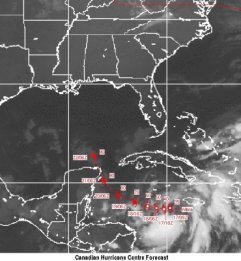
Canadian Hurricane Forecast Centre

The National Hurricane Center has dipped into its seasonal Storm Name Bag and pulled out the last one: Wilma.

This makes 21 Atlantic basin storms for 2005, tying the modern-day record set in 1933. There will be no medals awarded.

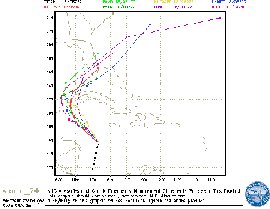
Wilma presently is near the Cayman Islands, drifting "south or southwest," the NHC says. Although forecast models differ greatly, the National Hurricane Center expects Wilma to turn north in the next few days, gather strength to hurricane status, and enter the southern Gulf of Mexico late this week.

After that, it's anyone's guess what comes next. Except for storm names. If there's to be another one, it will be called "Alpha."

Update

The St. Petersburg Times found a couple of hurricane experts who explain more coherently than the NHC's web site what to expect with Wilma -- and why we can't yet know for certain where the storm ultimate will make landfall:

Hurricane specialist Stacy Stewart said Wilma had shifted west of its previous path and could hit Mexico's Yucatan Peninsula. "At this time it doesn't appear it will be a major threat to the United States during the next five days," Stewart said.

But Wilma is then expected to re-emerge into the Gulf and could become a threat to the Southern U.S.

"Usually when a storm gets into the Gulf, it's going to hit somewhere. Where, that's too early to tell right now. Some models take it west, some take it north," said Larry Lahiff, a meteorologist at the hurricane center.

Sunday, October 16, 2005

Cowboy Hanging - Updated

Today, alleged reporter Judy Miller finally broke her silence about the Valerie Plame/Treasongate story and why she went to jail. She needn't have bothered, as it turns out.

Mark Kleiman observes Judy seems to have experienced a senior moment before the grand jury. In fact, she had quite a few of them, as Needlenose documents:
She is clearly describing (herself) obstructing justice, but in a way that will be hard to prove. Where there are notes that show she discussed the agent with Libby, she gives other reasons those notes might be there or "can't recall" why they are there. Where there are no notes it's "can't recall" and no useful information.
Maybe Miller suffers from dyslexia, Wonkette chuckles speculatively.

No, Steve Soto says, there's "evidence that Miller is lying even in what she is telling her own paper now, which explains why she is leaving the Times and would explain why the paper is now seemingly ending its relationship with her."

Judd, over at Think Progress has all the links and the most persuasive take on whether there's any meaning to all of this, other than more embarrassment for the New York Times.

In the meantime, we can't help but be captivated by Miller's grand jury testimony, as she describes it, about one meeting with Libby. She describes it at the very end of her essay:
"Mr. Fitzgerald also focused on the letter's closing lines. 'Out West, where you vacation, the aspens will already be turning,' Mr. Libby wrote. 'They turn in clusters, because their roots connect them.'

"How did I interpret that? Mr. Fitzgerald asked.

"In answer, I told the grand jury about my last encounter with Mr. Libby. It came in August 2003, shortly after I attended a conference on national security issues held in Aspen, Colo. After the conference, I traveled to Jackson Hole, Wyo. At a rodeo one afternoon, a man in jeans, a cowboy hat and sunglasses approached me. He asked me how the Aspen conference had gone. I had no idea who he was.

'Judy,' he said. 'It's Scooter Libby.'
The chief assistant to the Vice President of the United States. Dressed like a cowboy. Identity hidden behind dark glasses. Wearing a cowboy hat. Meeting a New York Times reporter at a rodeo.

This is the stuff of pulp fiction. Then again, most of what Miller wrote for the Times was fiction.

Updated Oct. 18

Two days after the above appeared, the Chicago Tribune editorialized about the New York Times revelations:
"[T]he two Times articles leave little doubt that Miller and her editors were guilty of ill-serving their readers -- and the search for truth. Maybe that's why, when asked what she regretted most about how the Times handled this episode, managing editor Jill Abramson offered a stinging reply: "The entire thing."

Saturday, October 15, 2005

Shorter Blogwood

Shorter Blogwood:
We will have only Sen. Bill Nelson (D-FL) to thank if the Bush brothers' plan to start drilling in the Gulf is stopped.

Friday, October 14, 2005

Confidential Source Week

In the never-ending scramble to make every tourist feel super-lucky to have arrived at Pensacola Beach just when they did, each week of the year beach business promoters stretch a big banner across the island entrance declaring that they're celebrating some supposed local festival or another.

Everyone is guaranteed to be here during "Crabfest" or "Lobsterfest" or "Shrimp Boil Days" or "Chicken Wings Week," and other such silliness. If village welcoming banners were regulated by consumer protection authorities, Pensacola Beach could be arrested about 46 weeks out of the year.

One friend and long-time beach resident cynically calls these phony events "menu celebrations." She once predicted the chamber of commerce would soon be making a banner to proclaim "Salt & Pepper Week."

Now, we've got a better idea. Let's officially designate this as "Confidential Source Week." Pensacola actually has some small connections to famous confidential sources in the journalism world, you may be surprised to learn.

It was right here in Pensacola a few years ago that Alabama football coach-for-a-coupl'a-days Mike Price patronized a local strip joint gentlemen's club. He was soon 'outed' by a "confidential source" who talked to Time Magazine, and lost his coaching job before the football season even started.

Price immediately sued Sports Illustrated over the expose. On Monday, Time, Inc. and its Sports Illustrated reporter Don Yeager reached an out-of-court settlement:
Price sued the magazine for $20 million, claiming he was defamed and slandered by a story detailing his actions the night in April 2003 when he visited the topless bar Arety's Angels while still head coach at Alabama.

* * *
He acknowledged being heavily intoxicated but denied allegations of sex at Crowne Plaza Pensacola Grand Hotel that the magazine reported. Alabama fired Price a few days before the article was published.
The case even made national news when a federal appeals court panel ruled in July that Alabama law did not protect Sports Illustrated from having to identify a confidential source whose identity was sought by Price's lawyer, Steven Heninger of Birmingham, Ala. Just a month ago, another court decision on rehearing concluded that if Heninger could establish any witness was lying when she denied being the confidential source, the magazine's lawyers would not have to inform the court.

It must have been shortly after Price's lawyer took testimony from some or all of the potential "confidential sources" that the money negotiations really got exciting. Pole dancing witnesses can do that to guys wearing 3-piece business suits.

But now Time Magazine is claiming that after the 'confidential' settlement was reached, coach Price or his lawyer breached it by disclosing that --
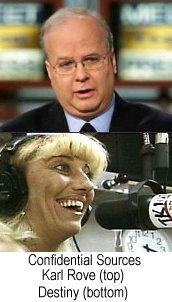
Lori "Destiny" Boudreaux, a dancer at Arety's, gave a sworn affidavit saying she was Yaeger's confidential source. The affidavit was not part of the 11th circuit's record when it ruled, [Heninger] said.

Heninger said Boudreaux's account to the magazine was based on hearsay and not direct knowledge of what happened in Price's hotel room.

"She was never in the room. No sex. She merely told Yaeger there were two people there. That's all they had," he said.
Ooops! The very next day, according to the Washington Post:
"Time Inc. asked a judge to throw out its settlement and dismiss defamation claims of former Alabama football coach Mike Price over a Sports Illustrated article recounting his night of drunken partying at a Florida strip joint, court documents showed Wednesday.

In a motion filed in federal court, Time claimed Price and his lawyer, Steve Heninger, violated an agreement to make only limited public comments about the deal, reached last week to resolve Price's $20 million defamation suit against the magazine, which Time publishes.

Heninger denied violating the settlement's terms.
Apparently, Time Inc. is claiming that Heninger or his client broke the agreement by 'outing' Destiny as the 'confidential source' -- even though she seems in reality not to have been an eye witness to anything that happened in the hotel room.

The case promises to make more law in the growing field of confidential sources, so quick! Break out a new beach festival banner! How about "Shaky Witness Week"?

Then there's Bush administration guru Karl Rove, who returned to testify to a grand jury today for the fourth time.

Karl doesn't live on Pensacola Beach, but he is building a Panhandle beachhouse close by. Whether he'll get to live in it any time soon is up to a grand jury that's now investigating the 'outing' of CIA undercover operative Valerie Plame.

Over a 15 year period Plame used a Boston international trade company as cover to build a worldwide network of spies specializing in weapons of mass destruction. Her cover was blown and her network probably endangered when neocon columnist Bob Novak identified her as a "CIA operative" who was married to former ambasador Joe Wilson. In the article, Novak wrote his information came from "two senior administration officials."

Joe Wilson and his wife, it would seem, were added to a White House enemies list after Wilson published an article in the New York Times daring to question Mr. Bush's claim in a State of the Union address that Saddam Hussein had attempted to buy uranium from the African country of Niger. After Wilson's article appeared, the White House admitted that Bush had his facts wrong and Wilson was right.

It was long speculated that, just like Destiny the dancer, Rove was one of the "confidential sources" for more than six reporters who were fed the same line Novak published. One of them was Matt Cooper who is -- are you ready? -- a reporter who also works for a Time, Inc. magazine.

Cooper initially refused to testify before the grand jury investigating the Valeria Plame affair. Late this summer, however, he changed his mind, fingered Rove in front of the grand jury, and then told all in the magazine's pages.

It's also known that before the Iraq War Rove chaired the White House Iraq Group, a now-infamous cabal of "senior Administration people" and neocon ideologues who 'stove-piped' unverified intelligence about Iraq direct to the Oval Office, as Seymour Hersh reported two years ago:
What the Bush people did was “dismantle the existing filtering process that for fifty years had been preventing the policymakers from getting bad information. They created stovepipes to get the information they wanted directly to the top leadership. Their position is that the professional bureaucracy is deliberately and maliciously keeping information from them.

“They always had information to back up their public claims, but it was often very bad information,” Pollack continued. “They were forcing the intelligence community to defend its good information and good analysis so aggressively that the intelligence analysts didn’t have the time or the energy to go after the bad information.”

The Administration eventually got its way, a former C.I.A. official said. “The analysts at the C.I.A. were beaten down defending their assessments. And they blame George Tenet”— the C.I.A. director— “for not protecting them. I’ve never seen a government like this.”
Ever since reporter Cooper testified in July, news reports have speculated that Rove is at risk of being charged with perjury. As Murray Waas of the National Journal wrote recently:
Rove's being called before the grand jury a fourth time and so late in the inquiry is a strong indication that Fitzgerald is "attempting to tighten up the noose" and is contemplating criminal charges against Rove. [Prof. Stephen] Gillers said that if Fitzgerald is "pursuing a potential case for false statements, perjury, or obstruction, every time Rove speaks at this point, he is taking a risk. For better or worse, he is locked into his previous statements and testimony."
Once again - quickly, now! Let's have another beach banner.

How about we celebrate "Perjured Witness Week"?

Thursday, October 13, 2005

Obit-A-Torial

One or two blogs, like the often interesting Prairie Weather, are taking note of a bitterly amusing obituary in the Chicago Tribune earlier this week. We reprint it here in full:
Theodore Roosevelt Heller, 88, loving father of Charles (Joann) Heller; dear brother of the late Sonya (the late Jack) Steinberg. Ted was discharged from the U.S. Army during WWII due to service related injuries, and then forced his way back into the Illinois National Guard insisting no one tells him when to serve his country. Graveside services Tuesday 11 a.m. at Waldheim Jewish Cemetery (Ziditshover section), 1700 S. Harlem Ave., Chicago. In lieu of flowers, please send acerbic letters to Republicans ....
Be sure to pay your respects by visiting the Tribune's Guest Book page.

Are 'obit-a-torials' the latest trend on the internets?

Evangelical Irony

Talking Points Memo:
"We are, needless to say, engaged in a vast, shambling and tragic occupation of Iraq, the nominal aim of which is to create a secular, rule-of-law-based democracy which would end the cycle of repression, fanaticism and violence which spilled onto America's shores four years ago.

At the same time, President Bush argues for [Harriet] Miers' confirmation neither on the basis of her 'judicial temperament' nor her judicial philosophy or ideology but because she is a staunch evangelical Christian."


Postscript

Article VI, Cl. 3, U.S. Constitution:
"... and all executive and judicial officers, both of the United States and of the several states, shall be bound by oath or affirmation, to support this Constitution; but no religious test shall ever be required as a qualification to any office or public trust under the United States."

Wednesday, October 12, 2005

FEMA's Flood Insurance

A comment left by an Anonymous at the end of yesterday's blog entry, Pensacola Perversity, says, "[L]ast time I checked the national flood insurance program was not subsidized by the gov't. Premiums exceeded payouts. The gov't will loan money to the program but the program must pay it back."

The comment hints at an interesting, and as it turns out, difficult question. Is FEMA's flood insurance program paid for with taxpayer money -- or, as Anonymous believes, is it self-sustaining? The answer seems to be ambigous, depending on which FEMA we're talking about -- or, more precisely, which part of FEMA's flood insurance program and at what point in time.

It is an article of faith-based conviction with many beach people that the National Flood Insurance Program is self-sustaining through annual premiums. As a group, we tend to get cranky if someone suggests that we might be relying on taxpayer give-aways when so many among us in 'Red State' Northwest Florida enthusiastically vote against sharing taxpayer funds with anyone else in society, including the young, the poor, the medically needy, or the less fortunate.

What we receive from the government, you see, are sensible subsidies and incentives. What you get are undeserved welfare payments and the dole.

So it seems some people get exercised over the largely ideological issue of whether FEMA's Federal Flood Insurance is, or is not, a common welfare program in disguise.

The Big Picture

Astonishingly, Russ Knocke, the Bush administration's current spokesman for FEMA/Homeland Security finds it "really tough to say" what FEMA's budget, which includes NFIP expenses and income, actually amounts to. "There are so many ancillary pockets," he says. "People can play the numbers game."

Nevertheless, it seems from a review of more reliable, although voluminous, publicly available budget records and reports that yesterday's commentator has it only half-right. The NFIP is a federal program and, overall, it has been 'subsidized' in past years as well as the present by Government funds: First, when the government appropriates money to the NFIP -- that is to say, every year when the NFIP has to borrow ahead of anticipated premium receipts, (although it is expected to repay those funds with interest); second, in those years when FEMA's NFIP cumulative deficit has grown so large that Congress sees fit to 'forgive' the whole thing; and third, as with last year's four Florida hurricanes and this year's devastation of the central Gulf Coast, when Congress makes outright appropriations for disaster relief that cover both insured and uninsured diaster victims. (See, for example, the first $10.5 billion Emergency Supplemental Appropriation for FEMA and the Department of Defense for Hurricane Katrina relief.)

The first happens at least annually. The latter two occur irregularly, depending on the frequency and size of the accumulated debt and the severity of new natural catastrophes. In between times, the overall National Insurance Flood Program, with a little political lipstick and rouge, can be gussied up to look as if it is self-funded and self-sufficient. So score one for our Anonymous commentator.

Even that picture blurs, however, when you look more closely at congressionally-mandated subsidies for certain sub-sets of the insured property population, including pre-FIRM (older) homes in flood zones and the privately owned casualty insurance companies themselves.

FEMA's Flawed Design

On its web site, FEMA boldly declares, "The NFIP is self-supporting for the average historical loss year... ." But that curious phrase -- "average historical loss year" -- masks a larger truth, as surely as it would be deceptive to say 'on average' you're paying your bills when you write rubber checks for the rent and run up credit card charges for food.

A fair summary of why this is so can be found in Douglas Clement's contribution to the Minneapolis Federal Reserve Bank's FedGazette for November, 2001:

The problem is, NFIP is broken. In fact, it was designed to be that way.

To encourage people to enroll in the program, NFIP subsidized premiums from the start, charging policyholders less than would be required in an actuarially sound insurance program. In other words, policyholders don't have to assume the full risk because taxpayers cover part of it.

Because of these premium subsidies — and with the extensive flooding of the 1990s — NFIP incurred losses totaling $1.56 billion between 1993 and 1998. To finance those losses, NFIP borrowed from the U.S. Treasury. Fortunately, lower payouts in 1999 and 2000 enabled NFIP to repay its debt, according to a July 2001 General Accounting Office (GAO) analysis. But chances are good that NFIP will again be knocking on the Treasury's door, "because it does not collect sufficient premium income to build reserves to meet the long-term future expected flood losses," according to GAO [the nonpartisan Government Accounting Office]. "The program is not, by design, actuarially sound."

Still, if you put a hand over one eye, look narrowly at a few recent "good" years, and don't think about the billions of dollars in relief bills appropriated in "bad" years like 1992-93, 1995, and 2004-2005, there is something to the point our commentator made yesterday. As the Federal Reserve Bank's article acknowledges:
The subsidy has been reduced since the program's inception in 1968. Eligibility requirements for lower premiums have tightened, and the size of the premium reduction itself has diminished. Nevertheless, about 30 percent of policies remain eligible for subsidized rates, and those policyholders pay only 38 percent of the full-risk premiums for their properties.
[emphasis added]
Who is among that 30 percent? For sure, many Florida -- and Pensacola Beach -- properties, as a detailed study of NFIP claims payments has shown.

Actuarial Accuracy

Few have devoted more energy to uncovering the details of the matter or have had a larger influence in pushing FEMA toward more permanent and satisfactory solutions for flood insurance reform than David Conrad of the National Wildlife Federation. As he says when regularly testifying to Congress (for two examples, see here and here) :
The National Flood Insurance Program (NFIP) is not actuarially sound. It has faced serious and rather chronic deficits. The premiums charged by the NFIP often fail to generate the funds needed to cover flood insurance payments, creating a substantial strain on the program’s financial stability. Between August 1995 and 1998, the NFIP had net borrowing from the U.S. Treasury of $810 million. When the NFIP had accumulated a similar deficit in the early to mid-1980's, Congress was forced to spend more than $1.2 billion to bail out the program.
Things haven't changed much since Conrad's testimony. Three months ago, a useful and easily-accessed analysis of the NFIP was transmitted to Congress by the non-partisan Congressional Research Service and added to the web: Federal Flood Insurance: The Repetitive Loss Problem by Rawle O. King (June 30, 2005) [pdf file].

King slaps a little lipstick on FEMA's NFIP budget numbers when he states that at the core of the NFIP mission is the expectation that it will be self-funding over the long haul: "The NFIP has been able to cover losses through the premiums charged to all policyholders, total income generated from insurance premiums and investments... ." But he also acknowledges that "in heavier loss years the program has had to borrow from the U.S. Treasury to cover losses and other expenses in the short term." And he mostly ignores, presumably because it was irrelevant to the immediate purpose of his report, the huge ad hoc direct relief appropriations that Congress occasionally has provided the agency in years past.

With all of that, Mr. King's tables and apprendices show that before the full bill for Florida's horrific 2004 hurricane season had arrived -- much less the expense of Dennis and Katrina in 2005 -- over the course of its existence FEMA's National Flood Insurance program had fallen in the red by about $14 billion and was 'borrowing' another $200 million for the coming year.

Nuanced Definitions

Is that bad? Not necessarily. As originally established by Congress, only part of FEMA's NFIP was theoretically expected to be self-sustaining -- at least in our lifetime. As King's CRS report infers, one way to view it depends on what is meant by words and phrases like "self-sustaining" and "financially solvent."

The definitional problems are those only an accountant would love, but the voters in a democracy need to understand them if we are to make sound public policy choices through our elected representatives. King writes:
The NFIP does not operate on the traditional insurance definition of fiscal solvency; rather, it operates under a statutory mandate that premiums on pre-FIRM structures — i.e., structures built before the issuance of a FIRM or before [January 1,] 1975, whichever is later — must be reasonable and, if necessary, be subsidized. The subsidy is provided by charging premium rates discounted from full actuarial rates.
This is done by charging premiums based on a so-called "target level of premium income for the program as a whole" that is sufficient to cover losses for a theoretical "average historical loss year."
The premium level generated to cover the average historical loss year must accommodate the combined effect of the portion of NFIP business paying less than full risk premiums and the portion of the business paying full risk premiums."
In other words, more modern structures that meet the latest flood mitigation standards are expected to subsidize older "pre-FIRM" structures that do not. Eventually, the theory goes, those older structures will matriculate out of the picture and the NFIP will be placed on a sustainable pay-as-you-go basis. Meanwhile --
In the event that premium and investment income are inadequate in a given year, the NFIP has statutory authority to borrow up to $1.5 billion from the U.S. Treasury to cover losses. Borrowed funds must be repaid with interest.
Unless, that is, a calamity like Katrina hits a major metropolitan area. Then it's time write home for help.

Corporate Subsidies

Other policies effectively handcuff FEMA's ability to become self-sustaining. One is the congressionally-mandated "Write-Your-Own" flood policy.

The WYO program is characterized as "privatization" or a "private sector business incentive" by its advocates, but it looks a lot more like corporate welfare to the rest of us. A large share of FEMA's insurance business simply is handed off to private insurance companies who are virtually guaranteed a profit without taking any risk. In effect, under the WYO program, insurance corporations are asked to gamble with the house's money while being paid to take an appreciable slice for themselves.

As King explains --
Under the WYO program, private insurers enter into a "Financial Assistant/Subsidy Arrangement" whereby they agree to issue flood policies in their own name and take responsibility for policy administration, claims processing, marketing and sales. Private insurers handle all claims issued in their name, and adjust and settle flood loss claims consistent with their general claims practices. In adjusting flood insurance claims, which are binding upon the federal government, a WYO insurer is authorized to use staff adjusters or independent contractors selected and supervised by the company. The WYO insurer also determines when and how adjusters will be compensated for their work on flood claims.
Repetitive Loss Subsidies

But King's CRS report, like that of the National Wildlife Fund referred to below, focusses on the larger problem of "repetitive losses." These are insured losses which certain dwellings suffer storm-after-storm-after-storm.

You know who you are. From 1978 to 2004, Florida had 5,987 residential properties, alone, that collected a total of $ 292.2 million in repetitive losses, according to FEMA data summarized at Appendix B in King's report.

As many others have, too, King acknowledges the tremendous contribution of Conrad and the National Wildlife Fund for being the first to reveal how, on a nationwide basis, "only two percent of all insured properties" experience "25 percent of all losses" and "claimed 40 percent of all NFIP payments." Many of those were not oceanside properties, as it happens. At least until the past year, a majority tended to be damaged by flooding fresh water from inland rivers and streams.

In 1998, Conrad and his colleagues at NWF managed to drill down into the once-neglected data mine of FEMA NFIP payments. What they discovered was that out of more than 4,500 communities then participating in the NFIP, only 1 percent, or 32,000 insured properties, accounted for 20 percent of the $6.4 billion in NFIP insurance claims paid over the preceding 18 years. Each of these properties had been flooded at least twice, though not beyond the "50 percent rule," and all but a handful were pre-FIRM dwellings. See, Higher Ground: A Report on Voluntary Buyouts in the Nation’s Floodplains (1998). [Caution: this is a digitally-heavy 227-page book in pdf format which has not been optimized for downloading and is slow to load. A hard copy can be obtained by contacting the NWF] Indeed, it was found that "less than one percent (.08 percent) of all flood-prone properties -- those repetitive loss properties with three or more losses -- received more than one-fifth (21.5 percent) of all flood insurance payments costing the NFIP almost $1.4 billion."

Futile Engineering

The NWF also found that flood losses in the United States had risen dramatically over the last century, despite huge federal expenditures on traditional flood control (“structural”) projects. In a prescient passage that might have been written a month ago, after Hurricane Katrina, but in fact was penned seven years earlier, Conrad wrote:
All too often we've seen rivers straight-jacketed into concrete chutes and floodplains transformed into suburbs. Unfortunately, Nature's reminders that we are not her master too often produce more flood victims, more damaged property and more costly disaster relief.
Abandoning Solutions

The convincing facts and tightly reasoned policy proposals of the NWF report triggered among the experts seven years ago a national debate about "non-structural" ways to reduce flood damage and thus more quickly place NFIP premiums on a more realistic actuarial basis. Among them, most attention was devoted to the NWF's recommendations to buy out the rebuilding rights of those properties most at risk and to land-bank them in conservation easements so as to expand wetlands that absorb the brunt of flooding water. Or, as the CRS report puts it, policymakers began to consider new programs to increase funding for "voluntary buyouts, demolition, elevation, and flood-proofing."

All of these programs essentially were scuttled by the Bush administration, however, when FEMA was folded into the newly created Homeland Security Department. Incredibly, as Florida-based reporter Jon Elliston was reporting a year ago:
"[S]ince 2001, key federal disaster mitigation programs, developed over many years, have been slashed and tossed aside. FEMA's Project Impact, a model mitigation program created by the Clinton administration, has been canceled outright. Federal funding of post-disaster mitigation efforts designed to protect people and property from the next disaster has been cut in half, and now, communities across the country must compete for pre-disaster mitigation dollars.
Just a month ago, the Los Angeles Times found things had gotten even worse:
[I]n the aftermath of the Sept. 11 attacks, FEMA lost its Cabinet-level status as it was folded into the giant new Department of Homeland Security. And in recent years it has suffered budget cuts, the elimination or reduction of key programs and an exodus of experienced staffers.

The agency's core budget, which includes disaster preparedness and mitigation, has been cut each year since it was absorbed by the Homeland Security Department in 2003. Depending on what the final numbers end up being for next fiscal year, the cuts will have been between about 2% and 18%.

The agency's staff has been reduced by 500 positions to 4,735. Among the results, FEMA has had to cut one of its three emergency management teams... .

"They've taken emergency management away from the emergency managers," complained Morrie Goodman, who was FEMA's chief spokesman during the Clinton administration. "These operations are being run by people who are amateurs at what they are doing."
Whither National Flood Insurance?

Ideologues, as 'Anonymous' may or may not be, can take heart that the past trend for NFIP was toward a pay-as-you-go, actuarily sound NFIP system. That trend was principally driven by programs that removed repetitive loss properties from the rolls and replaced them with conservation wetlands. It was slow, to be sure, but it was working.

Rationalists, as 'Anonymous could be instead, will focus on the current administration's bungling and cronyism, hoping to stop whatever money FEMA may be given from being shifted away from mitigation to no-bid contracts for the likes of Halliburton and Shaw Group to engineer solutions that haven't solved the problem in the past and aren't likely to do so now.

Either way, calling one or another path 'welfare for the rich' or 'sensible incentives' is pointless. The real issue is, which approach is more likely to work for the betterment of the national community and society as a whole?

The answer is not a matter of faith or didactics, but facts. And, as perhaps 'Anonymous' will agree, on the facts the National Wildlife Federation proposals win, hands down.

Local FEMA

FEMA is announcing that the last remaining Disaster Recovery Center in Santa Rosa County will close Friday, October 14.

A "Joint Assistance Center" in Pensacola (Town and Country Plaza, 3300 N. Pace Blvd.) and a Disaster Recovery Center (348 Racetrack Road, Fort Walton Beach) will remain open.