Showing posts with label oil leak. Show all posts

Wednesday, June 02, 2010

Tarballs Today: Early Wednesday June 2 BP Oil Spill Update

“It’s inevitable that we will see it on the beaches.”
-- Keith Wilkins, Escambia County Neighborhood Services

1. Oil Expected on Pensacola Beach as Early as Today.

Escambia County's Disaster Response team warned late yesterday afternoon that the leading edge of BP's oil slick was only nine and a half miles offshore and could reach Pensacola Beach as early as today. The Panama City News Herald notes that the warning "conflicted with the official forecast released by NOAA and the state of Florida on Tuesday morning, which did not predict oil reaching Pensacola beaches within the next 72 hours."

A beach friend who monitors local message boards tells us there were scattered reports from others of a smell of oil in the air. We personally were gobsmacked with a strong jolt of oil odor about 3pm yesterday near Live Oaks National Park, just east of Gulf Breeze.

The smell didn't affect most of Gulf Breeze so far as we could detect, but where the odor was detectable it was so acrid it brought tears to the eyes; not from the emotion of the moment but from a physical reaction to the truly revolting smell. By week's end, we will not be surprised if all of coastal Escambia County could stink like some lower circle in Dante's hell.

The News Herald also reports that Escambia County Health officials are again warning "sensitive" residents "may experience eye, nose and throat irritation from exposure to the fumes."
People with pre-existing respiratory conditions should stay inside an air-conditioned home with the windows closed if they experience symptoms from the fumes, Health Department officials said. Affected individuals should consult their doctors if symptoms persist.
No fooling: this oil stuff smells absolutely awful, worse than we could have imagined.

2. 'Moonpie Beach.'

Many have been wondering how Pensacola Beach likely will look like when the oil reaches us. Unfortunately, courtesy of WALA-TV in Mobile, we can give you some idea based on how Dauphin Island's beaches looked yesterday as the first, lighter wave of oil washed ashore.

Every beach is different, of course, and much may depend on water currents and wind. Considering that Dauphin Island is seeing only the older, lighter crude right now, however, it's horrific for lovers of Pensacola Beach to imagine a shore like beach goers at Dauphin Island found yesterday:


3. Don't Go Fish.

Yesterday afternoon, NOAA closed more Gulf of Mexico waters to fishing. The official announcement begins:
NOAA has extended the northern and southern boundaries of the closed fishing area in the Gulf of Mexico to capture portions of the slick moving into waters off eastern Alabama and the western tip of the Florida panhandle, as well as some large patches of sheen moving onto the west Florida shelf and southward to Cuban waters.

This federal closure does not apply to any state waters. * * * The closed area now represents 75,920 square miles, which is slightly more than 31 percent of Gulf of Mexico federal waters.

Click the photo, above left, for the latest don't-go-fishing map.

4. BP Remediation.

Shortly before Midnight last night, Jim Polson of Bloomberg News was reporting that "BP PLC has decided not to attach a second blowout preventer on its leaking well in the Gulf of Mexico and efforts to end the flow are over until the relief wells are finished, according to the U.S. Coast Guard’s Thad Allen, who spoke at a press conference today."

5. P.R.

CNN reports that Coast Guard Commander Thad Allen no longer will participate with BP spokesmen in joint press briefings:
Allen, the administration's point man on the oil spill, later told reporters in New Orleans that his job is to speak "very frankly with the American public."

"I think we need to be communicating with the American people through my voice as the national incident commander," he said.

The move come amid growing frustration from the White House that BP is delivering inaccurate information and not being transparent, said the senior administration officials, who spoke on condition of not being identified by name.

One official said the last straw was Saturday, when BP officials downplayed the possibility that the amount of oil flowing could actually increase from BP's latest strategy to cut the broken pipe and cap the leak
.
If true, it's a welcome move. Watching Admiral Allen stand by while BP's flack-catchers poured oil in the eyes of journalists was almost as distressing as seeing the journalists swallow the lies whole.

The oil company long ago proved unworthy of anyone's trust. The federal government's decision to offer separate briefings is long overdue.
minor edit 6-02 am

Thursday, May 13, 2010

BP's Deepwater Oil Gusher Video

Yesterday, British petroleum released the first video which gives a good look of the oil leak that threatens all life in the Gulf of Mexico. Rachel Maddow narrates and adds context, including news about yesterday's congressional hearings and commentary:


Visit msnbc.com for breaking news, world news, and news about the economy

Wednesday, May 05, 2010

Categorial Surprise

WaPo, buried on page 4:

The Interior Department exempted BP's calamitous Gulf of Mexico drilling operation from a detailed environmental impact analysis last year, according to government documents, after three reviews of the area concluded that a massive oil spill was unlikely.

The decision by the department's Minerals Management Service (MMS) to give BP's lease at Deepwater Horizon a "categorical exclusion" from the National Environmental Policy Act (NEPA) on April 6, 2009 -- and BP's lobbying efforts just 11 days before the explosion to expand those exemptions -- show that neither federal regulators nor the company anticipated an accident of the scale of the one unfolding in the gulf.
* * *
While the MMS assessed the environmental impact of drilling in the central and western Gulf of Mexico on three occasions in 2007 -- including a specific evaluation of BP's Lease 206 at Deepwater Horizon -- in each case it played down the prospect of a major blowout.

In one assessment, the agency estimated that "a large oil spill" from a platform would not exceed a total of 1,500 barrels and that a "deepwater spill," occurring "offshore of the inner Continental shelf," would not reach the coast. In another assessment, it defined the most likely large spill as totaling 4,600 barrels and forecast that it would largely dissipate within 10 days and would be unlikely to make landfall.

In recognition of BP's predictive skills, MMS gave it a safety award last year. Then, the agency probably invited BP to get back in bed with it.

Tuesday, May 04, 2010

BP's Cofferdam Claim

Late today BP's chief exec, Tony Hayward, told the Associated Press that the company's experimental underwater containment vessel, known generically as a "cofferdam," will be sunk at the site of the Deepwater Horizon well by Thursday. If everything goes as planned, it will be "hooked up to a drill ship over the weekend.

The plan is to lower the 98-ton, 40-feet tall concrete and metal box "over the source of the leaking oil about a mile underwater" and then connect it to a pipe.
In theory, once in place oil will flow into the containment system’s dome through the pipe to a barge on the surface.
As always when learning about a BP assertion, don't let yourself be as credulous as a certain congressman we know. At least, not unless BP is paying you more than a measly $5,000 to act like a simpleton.

If it works, according to Hayward, "then you would have the principal leak contained by the early part of next week. But there's no guarantees."

Our blogging neighbor Bryan, over at Why Now?, points out that BP has not previously built a cofferdam capable of operating at 5,000 feet "because it 'seemed inconceivable' the blowout preventer would fail." He then reminds readers that BP and its subcontractor, Transocean, were first alerted to problems with the same blowout preventer when one failed off the coast of Mexico a decade ago.

As the blogger known as The Maritime Lawyer explains:
Back in 2000, BP informed Transocean that there were problems with the blowout preventer on its rig, the Discover Enterprise. BP issued a notice of default to Transocean, and the latter admitted that there were issues with the blowout preventer. While BP was finding out about the problems with the blowout preventer on the Discover Enterprise, the same blowout preventer was being installed on the Deepwater Horizon, the semisubmersible offshore rig that blew up in the Gulf of Mexico this month. The blowout preventer was manufactured by Houston-based Cameron International. and Hydril. which is now owned by BP.
Of course, everyone is hoping the cofferdam works. But no one knows what the odds might be that sinking a four-story stack of concrete and metal under the sea next to the broken drilling pipes will make things many times worse.

Tuesday BP Oil Spill Update: Temporary Reprieve


1. Temporary reprieve.

Just last Friday, we were expecting the oil by the first of this week. But weather forecasters have been saying for the past day that "favorable winds and waves" could forestall a Florida landfall of the BP oil slick "for a few more days or longer."

Presently, local TV weather forecasts in Mobile and Pensacola estimate the earliest Perdido Key may see tarballs or ribbons of oil is late Thursday or Friday. The PNJ is carrying an AP dispatch that says --
So far only oil sheens have reached into some coastal waters, and the oil’s slow progress despite an uncapped seafloor gusher was allowing crews and volunteers to lay boom in front of shorelines. That effort was stymied by choppy seas into the weekend but the calmer weather should help.
The later the better.

2. Many Questions, No Answers.


BP and the Florida Department of Environmental Quality held a "standing-room-only" meeting last night for Pensacola Beach residents and business leaseholders. The venue was the always-accommodating Community Church (United Church of Christ). Another smaller gathering was held on Navarre Beach.

On Pensacola Beach, things didn't go well, the PNJ reports. Although the meeting was billed as "informational," as it turned out there were lots of questions and no real information. This exchange pretty well sums it up:
"This meeting was a whole lot of 'I don't knows,' " said Brittany Cook, 23, who attended the Pensacola Beach meeting.

[DEP assist director Darryl] Boudreau didn't dispute that.

"Some questions I can answer," he said. "Some I can't. Some nobody can."

Last night, WEAR-TV showed a number of our beach friends and acquaintances pitching fits at the BP and DEP spokes-people, to no apparent effect. But that's okay. In a week or two they'll be able to pitch tarballs.

3. Oil Spill Liability.

There's been a lot of talk from the President Obama on down to the lowliest congressmen and senators in Washington, D. C. about holding BP "accountable" for the catastrophic river of oil slowly sloshing around the Gulf Coast. BP CEO Tony Hayward repeated the same apparent assurances countless times over the last two weeks, as he did yesterday on National Public Radio:
"We will absolutely be paying for the cleanup operation. There is no doubt about that. It's our responsibility — we accept it fully," he added.
Never mind that in the same breath Hayward implicates others, although it does make him sound as if he's saying, "It's really someone else's fault." There's something else that rings hollow about these assurances.

The tone and context of what Hayward is saying -- and, for that matter, the same could be said about many of our own "drill, baby, drill" congressmen and senators -- is that BP will make everyone "whole" for the losses the catastrophic oil leak has caused. Turn on any TV and you'll see Gulf Coast commercial fishermen, boat captains, tourist business owners, restauranteurs, and homeowners near vulnerable wetlands in places like Plaquemine Parish, Louisiana, expecting BP to honor its word.

Not so fast. It seems to us the assurances of BP and its hired help in Congress are as slippery as their oil slicks. They echo corporate-friendly legalese drawn straight out of the Oil Pollution Act of 1990.

The Act is summarized here and here. The full text is here. Recent amendments to the act, making it more industry-friendly, are discussed here. A relatively recent, and long, student-written law review commentary explaining some of the ways the oil industry hopes to evade the act or have it declared unconstitutional is here.

Essentially, the act fixes an industry-wide cap, or limit, on the total damages to be paid to the entire universe of claimants in any one incident. That legal cap looks a lot tighter than any oil well plug BP ever used.

Attorney Abigail Field writes that the maximum BP can be stuck for is $75 million, "a sum that's orders of magnitude below the losses" likely to be suffered across the Gulf Coast.
BP will face unlimited damages under the 1990 law [only] if the accident was caused by BP's "gross negligence," or by BP's violations of federal safety, operational or construction regulations.
So, when you read the assurances of some spokesperson for BP, or one of the congressmen and senators they have in their pocket, or a state DEP official who says BP is the "responsible party," be sure to look carefully to see if anyone is admitting that BP was "grossly negligent." We know a corporation that would probably bet you $ 35 billion dollars it'll never happen.

4. Senator Bill Nelson.

On CNN yesterday, Bill Nelson (D-FL), said it was "baloney" to believe that BP willingly will pay more than a pittance to compensate for the all damage its Deepwater Horizon well has caused. That's why he's offering new legislation next week to amend the law.
Even as lawmakers rush to put together legislative responses to the spill, none appeared to be trying halt drilling in the gulf altogether. Instead, they are likely to focus on increasing inspections, oversight and safety requirements on offshore rigs. There could also be broad support for measures to halt new deep-water exploration and ensure that oil companies will foot the bill for cleanup.

Florida Democrat Bill Nelson , who has been one of the most vocal opponents of new offshore drilling, has introduced legislation to do both. One bill would halt new exploratory wells such as the exploded Deepwater Horizon, until an investigation of the current disaster is complete. Another would dramatically raise the cap on an oil company’s liability for economic damages in a spill from $75 million to $10 billion.
It will be a challenge to draft legislation that would effectively, and within the constraints of the Constitution, accomplish what Nelson proposes. It also will be a huge task to marshal the bill through the thoroughly dysfunctional U.S. Senate.

But Nelson has been a stalwart opponent of drilling in the Gulf. At least until Obama cut the legs out from under him, he was effective, too. If anyone can do it, we're guessing Bill Nelson can.

Monday, May 03, 2010

Before the Oil: One Last Sunday on Pensacola Beach

"Man has much more to fear from the passions of his fellow-creatures than from the convulsions of the elements."
--Edward Gibbon, History of the Decline and Fall of the Roman Empire (1776-1788)
"I feel like a Roman trapped inside the walls, waiting, defenseless, for the Goths to sack my city."
-- Friend on Pensacola Beach, Sunday, May 2
Gibbon was writing of the folly of war. Comparing the "mischievous effects of an earthquake or ... a hurricane or the eruption of a volcano," he observed that these bear "a very inconsiderable proportion to the ordinary calamities" caused by mankind's uglier passions for money, power, and violence.

Five of us gathered yesterday on Pensacola Beach, feeling much as one of our friends described -- like Roman citizens who are utterly powerless to stop the Gothic onslaught. We were standing in front of The Dock at Casino Beach, weirdly assailed by upbeat music from one side and Nature's pounding surf on the other.

Our small, glum group had come for what we believe may be the last time, for many years to come, when we can taste the best seafood the Gulf of Mexico has to offer, see the pure white sand and clean surf of Pensacola Beach, and commiserate with others feeling the same pain. As we wandered the beach we met a number of others from the Pensacola area who had made the same trek.

As more than one of them said, the mood was one of impending doom. Many of these fellow sufferers wept as they talked with us. We wept with them.

Sunday, May 02, 2010

River of Oil to Rush Around All of Florida

A Pensacola Beach resident writes to ask if there could be any truth to this prediction from University of Florida Professor Y. Peter Sheng, as reported a few days ago in the Ocala Star-Banner:
The oil slick that's growing south of the Louisiana coast could get caught in what's called the “Loop Current,” which flows through the Florida Straits and becomes the Gulf Stream.

The Gulf Stream runs up the eastern coast of Florida. Sheng said he believes it is entirely possible, even probable, that this will happen, thus impacting the beaches from Miami to Jacksonville. The Loop Current is about 35 miles south of the slick, which currently is 125 miles wide and 40 miles long.

“I would say the east coast of Florida has the higher probability (of being impacted by the oil spill),” said Sheng, adding his opinion is based on NOAA's ocean current forecast and wind direction.
Our correspondent's question and the professor's prediction triggered a faint memory. Sadly, the answer appears to be 'yes' it could happen. Funny enough, it's a decade-old news item involving Great Britain that offers substantiation.

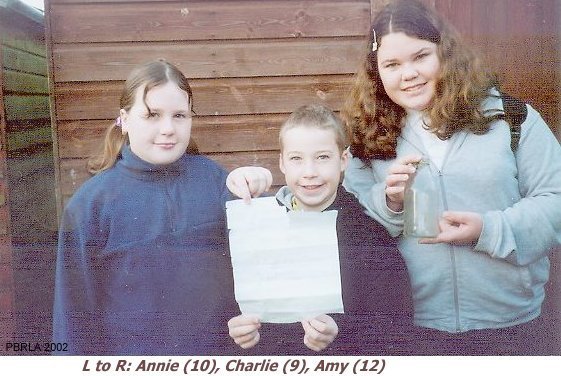
Way back in 2005 we reported on this blog that a photo had been recovered from the detritus of hurricane evacuations. It was a small treasure that somehow had survived two hurricanes. The whole story is worth reading. ["Message in a Bottle"].

The short of it is, sometime in the late 1990's two boys at Pensacola Beach Elementary School stuffed a message in a bottle one day, with their teacher's name on it, and dropped it into the Gulf of Mexico just beyond the breaking waves. The bottle was found by two young girls and a boy on Camber Beach in Southwestern England a year or two later.

The girls' mother -- ironically, an environmental worker of some sort -- sent an email to the beach residents' association of the time and sent along a picture of the three kids holding the bottle. Today, of course, the two boys would be men. The British adolescents would be adults. But the message in the bottle from Pensacola Beach remains somewhere in England.

If a message in a bottle can navigate south through the Gulf of Mexico, around the Florida Keys, and across the Atlantic, it's no stretch to imagine BP's river of oil eventually will follow the same path.

Sunday Morning BP Oil Spill Update

1. Oil River to Arrive in Florida This Week

Yesterday, officials were predicting the eastern edge of the BP oil spill would arrive in Florida tomorrow. Today, the News Journal reports that "Florida Department of Environmental Protection Secretary Michael Sole said Saturday that the slick will likely not hit Florida's coast until Tuesday or Wednesday." Or maybe not, the paper admits. "Those estimates could change depending on wind and currents in the Gulf of Mexico."

Is there any doubt no one knows when, how, or what is really going on?

2. New York Car Bomb Eclipses BP Oil Spill.

The big news today, of course, isn't about the Gulf Coast and the floating oil monster headed our way. It's about the car bomb that emptied Times Square last night.

This is a useful heads-up for coastal residents. The time is fast approaching when it won't be "Gone but not forgotten" but the reverse: "Forgotten but not gone."

That's what to expect in a week or two as what passes these days for the U.S. News Machine tires of the BP oil spill... all the dead fish and animals... the stinky air.... the foul water.... all the discouraged people... and just quietly slips out the door and moves on.

3. Early Warning.

Some of the more well informed reporting on the causes of the leak and the negligence of the oil company, however, is coming out of Great Britain. The London Times is reporting that BP was warned of rig fault 10 years ago":
BP faces fresh questions over the cause of the Gulf of Mexico oil spill after it emerged that problems with the type of equipment that led to the disaster were first reported a decade ago.

In June 2000, the oil giant issued a "notice of default" to Transocean, the operator of the rig that blew up last month. The dispute was over problems with a blowout preventer, a set of iron slabs that should close out-of-control wells. It failed on the Gulf of Mexico rig, triggering the explosion and oil spill.

Transocean acknowledged at the time that the preventer did "not work exactly right". The rig in question, the Discover Enterprise, was unable to operate for extended periods while the problem was fixed.

4. Lasting Effects.

The U.K. Guardian -- formerly known as the Manchester Guardian -- explains why the BP oil spill will live on... and on... and on, even as the corporate news cycle leaves us behind:
Crews have struggled for days without success to activate the well's underwater shut-off valve using remotely operated vehicles. They also are drilling a relief well in hopes of injecting mud and concrete to seal off the leak, but that could take three months.

The prospect of oil pouring into the gulf for such a period could have horrifying effects on wildlife, added [Liverpool University Prof. Chris] Frid. "That part of the gulf's coastline consists of a sedimentary shore with lots of muddy inlets. The oil will penetrate into the mud, and because it contains no oxygen the oil will not biodegrade. For generations, any disturbance of the sediment will bring oil back to the surface and that will happen over a very large area." [emphasis added]
5. The Stink of Oil.

The U. S. Environmental Protection Agency has fired up a new web site dedicated to reporting air quality along the Gulf Coast. Chief concerns are "particulate matter" like smoke in the air, ozone levels, and what the scientists call "volatile organic compounds." That's what the rest of know as "really bad smells."

6. Prize Winner.

As we mentioned last night, Mineral Management Services, the U.S. Interior Department agency in charge of promoting approving and inspecting deep water oil wells in the Gulf of Mexico, postponed this year's 'Safety Awards Luncheon' scheduled for Monday in Houston.

Turns out, last year's winner was BP Corp.'s chief executive officer Daryl Luoma. He couldn't be present this year, but he should'a been a shoe-in to repeat BP's triumph. Last year, MMS handed Luoma the award for his "innovative and visionary approach" to something called "extended-reach drilling technology."

How much more 'extended' can your drilling 'reach' be than sending an oil slick the size of France all the way to Pensacola Beach?

Saturday, May 01, 2010

Saturday Morning Oil Spill Update

1. Worse Case Spill.

A discouraging AP report by Seth Borenstein suggests if you sat down and modeled a "worst case" kind of oil spill, the BP Deepwater Horizon would be it:
Experts tick off the essentials: A relentless flow of oil from under the sea; a type of crude that mixes easily with water; a resultant gooey mixture that is hard to burn and even harder to clean; water that's home to vulnerable spawning grounds for new life; and a coastline with difficult-to-scrub marshlands.Gulf Coast experts have always talked about "the potential for a bad one," said Wes Tunnell, coastal ecology and oil spill expert at Texas A&M University-Corpus Christi.

"And this is the bad one. This is just a biggie that finally happened."
* * *
The first analysis of oil spill samples showed it contains asphalt-like substances that make a major sticky mess, he said. This is because the oil is older than most oil in the region and is very dense.

This oil also emulsifies well, [LSU Professor Ed] Overton said. Emulsification is when oil and water mix thoroughly together, like a shampoo, which is mostly water, said Penn State engineering professor Anil Kulkarni.

It "makes a thick gooey chocolate mousse type of mix," Kulkarni said.

And once it becomes that kind of mix, it no longer evaporates as quickly as regular oil, doesn't rinse off as easily, can't be eaten by oil-munching microbes as easily, and doesn't burn as well, experts said.

That type of mixture essentially removes all the best oil clean-up weapons, Overton and others said.
If that weren't enough, it's now spawning season for fish and time for marshland plants to fragment, bud, and otherwise reproduce; the windy weather and strong currents offshore have been unfavorable; the river of oil will overwhelm many marshlands that are harder to clean than sandy beaches; and, of course, a new hurricane season is looming.

On this last point, LSU professor Ed Overton says, "A hurricane is Mother Nature's vacuum cleaner. Normally it cleans things up. But that's not a solution with a continuing spill."

2. Who Could Have Predicted?

We commented the other day about all the similarities between BP's Deepwater Horizon oil leak and the oil platform disaster last year in Australia's Timor Sea.

Turns out, the Wall Street Journal has identified yet another. Both oil platform explosions occurred about the same time Halliburton Corp. -- Dick Cheney's old outfit -- was finishing up a deep water well process called "cementing."
An oil-drilling procedure called cementing is coming under scrutiny as a possible cause of the explosion on the Deepwater Horizon rig in the Gulf of Mexico that has led to one of the biggest oil spills in U.S. history, drilling experts said Thursday.

The process is supposed to prevent oil and natural gas from escaping by filling gaps between the outside of the well pipe and the inside of the hole bored into the ocean floor. Cement, pumped down the well from the drilling rig, is also used to plug wells after they have been abandoned or when drilling has finished but production hasn't begun.In the case of the Deepwater Horizon, workers had finished pumping cement to fill the space between the pipe and the sides of the hole and had begun temporarily plugging the well with cement; it isn't known whether they had completed the plugging process before the blast.

Regulators have previously identified problems in the cementing process as a leading cause of well blowouts, in which oil and natural gas surge out of a well with explosive force. When cement develops cracks or doesn't set properly, oil and gas can escape, ultimately flowing out of control. The gas is highly combustible and prone to ignite, as it appears to have done aboard the Deepwater Horizon, which was leased by BP PLC, the British oil giant.
* * *
Houston-based Halliburton is the largest company in the global cementing business, which accounted for $1.7 billion, or about 11%, of the company's revenue in 2009,
3. Come Monday.

The Pensacola News Journal reports the river of oil from BP's Deepwater Horizon well is expected to reach Pensacola as early as Monday. Also from the Pensacola News Journal, Escambia County Commissioners have come up with what they call a "plan" to seal off Pensacola Bay's East Pass.

It looks to us more like a Hail Mary pass:
The plan is to use about 30,000 feet of boom — now at Pensacola Naval Air Station, a staging area for oil company BP's response to the slick — and BP's resources to set up a "V-shaped" barrier across East Pensacola Pass to catch the oil.* * *
The hope is that the floating pools of oil coming into the pass will funnel into the center point of the "V," where there will be a "skimmer" or collection area where the oil can be removed, Turpin said.
On its web site, the News Journal is running a suspiciously cheesy-looking map showing a large, red-colored "V" superimposed on what seems to be an old NOAA satellite photo of the East Pass into Pensacola Bay. (Click here or on the image to the left). Better than nothing, perhaps, but if that's all the local governments have, good luck to us.

4. Boom-Boom.


As the Mobile Register reported late last night, typically --
About 1 foot of the boom sits above the surface. Waves taller than that can lap over a boom, something that had been reported Friday off the coast of Louisiana.
The tides will be over 1 foot on Monday, but moderate after that. However, Weather Underground (working as everyone does from NOAA data) is forecasting vigorous seas of 5 to 9 feet through Monday. it will be subsiding to a "light chop" of 2 to 3 feet by Wednesday. Wavefinder more or less agrees.

The nefarious thing, of course, is that no one can forecast the seas for the next three months, which Senator Bill Nelson identifies as the time it will take to drill a new hole and seal off the leaking Deepwater Horizon leak. And that assumes the wellhead doesn't blow.

Bring on the booms, but no one should expect them to be more than a band-aid on the bleeding rivers of oil.

5. Bumper Sticker Politicians.

Speaking of tides, J. Earle Bowden, justly known as the "Father of Gulf Islands National Seashore," understandably takes just about every politician in Florida to the woodshed -- along with President Obama -- for promoting an "oily future" for our "vulnerable Florida beaches" and "potentially shattering the state's mostly clean tourism economy."

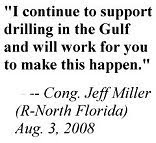
Obama he derides as "Mr. Green, playing into the political intrigue, throwing proponents a bone, echoing McCain's willingness to pollute coastal waters to help wean America from its Mideastern obsession." Coming in for a double dose of venom are Governor Charlie Crist, Congressman Jeff ("Mr. Oil Spill") Miller, and those "South Florida politicians who seek to please the Big Oil lobby."

Bowden rants:
I cannot believe insensitive politicians, including Rep. Jeff Miller and U.S. Senate aspirant Charlie Crist, buying John McCain's "Drill, Baby! Drill!" desperation pitch before his campaign for the presidency was shipwrecked on the tides of Obamadom.
Oddly, it's becoming almost impossible to find anyone here in Tea Party country who will admit to having joined in that "drill, baby, drill" chorus. Just yesterday, we found ourselves being passed by a pickup truck that was sporting a "drill, baby, drill" bumper sticker, half-torn off.

We take that as sign that very soon now, all the oily politicians and their Tea Party supporters will be madly trying to erase their despicable records.

Reality is so unfair to right-wingers.

6. Blame Game.

It appears no one -- not BP, not escambia County, not even the federal government -- knows what the hell to do about the river of oil flowing over the Gulf Coast for what may be several months. So, instead of sucking their fingers, federal officials have begun pointing them at BP Corp., and corporate officials are quietly trying to stick them in the eye of federal government's MMS.

The New York Times headline captures the finger-pointing: "BP Is Criticized Over Oil Spill, but U.S. Missed Chances to Act."

At the heart of the story is BP's February, 2009 application to commence drilling at the Deepwater Horizon site. The multi-page application is here in pdf format. Below are some tantalizing excerpts we captured on the screen. Click on each image to read the original.

BP doesn't have a Deepwater Horizon "blowout scenario plan"

But BP does claim to have the "capability to respond" to the "worse-case scenario"


It looks like there's plenty of blame to go around:

U. S. Mineral Management Services "required" to "inspect" and ensure "compliance"


If BP's word can be trusted -- no sure thing -- the well also complied with Louisiana and Mississippi state law:

The Deepwater Horizon purportedly complied with Louisiana legal requirements:


And with Mississippi Law:

Friday, April 30, 2010

'Deepwater Deep Throat': Secret 'Gusher' Memo Alleged

"A leaked memorandum obtained by the Press-Register on the unfolding spill disaster in the Gulf makes clear the Coast Guard now fears the Deepwater Horizon well site could be on the verge of becoming an unchecked gusher shooting millions of gallons of oil per day into the Gulf."
Is there a 'Deepwater Deep Throat?' Ben Raines, Mobile (Ala.) Register, reports this late news, although without providing a copy of the memorandum he describes:
A confidential government report on the unfolding spill disaster in the Gulf makes clear the Coast Guard now fears the well could become an unchecked gusher shooting millions of gallons of oil per day into the Gulf.

"The following is not public," reads the National Oceanic and Atmospheric Administration's Emergency Response document dated April 28. "Two additional release points were found today in the tangled riser. If the riser pipe deteriorates further, the flow could become unchecked resulting in a release volume an order of magnitude higher than previously thought."
* * *
Kinks in the piping created as the rig sank to the seafloor may be all that is preventing the Deepwater Horizon well from releasing its maximum flow. BP is now drilling a relief well as the ultimate fix. The company said Thursday that process would take up to 3 months.
* * *
"The pipe could disintegrate. You've got sand getting into the pipe, it's eroding the pipe all the time, like a sandblaster," said Ron Gouget, a former oil spill response coordinator for the National Oceanic and Atmospheric Administration.
More here....

'Worst Case' Oil Spill Scenario

UPDATED BELOW
Ben Raines in today's Mobile Register:
The worst-case scenario for the broken and leaking well gushing oil into the Gulf of Mexico would be the loss of the wellhead currently restricting the flow to 5,000 barrels -- or 210,000 gallons per day.

If the wellhead is lost, oil could leave the well at a much greater rate, perhaps up to 150,000 barrels -- or more than 6 million gallons per day -- based on government data showing daily production at another deepwater Gulf well.

By comparison, the Exxon Valdez spill was 11 million gallons total. The Gulf spill could end up dumping the equivalent of 4 Exxon Valdez spills per week. [emphasis added]
That is a prospect so utterly appalling it leaves one stunned. To say nothing of this:
Thursday, federal officials said they were preparing for the worst-case scenario but didn't elaborate.
What kind of "preparation" could anyone make against the prospect of 6 million gallons of petroleum pollution a day bearing down on the Gulf Coast each and every day for two or three months until a new hole is drilled and the black crude river shut off? Abandon the coast?

A beach friend we were talking to today says this entire BP mess reminds her of nothing so much as 9-11. Because, she says, "It changes everything."

UPDATE
4-30 pm

National Public Radio is carrying the "worst case scenario" story, too. It is so painfully obvious the feds aren't "elaborating" on their plans because they don't have any.

We're not being critical, mind you. No one has a clue what to do right now with the consequences of "drill, baby, drill." Much less does anyone know what to do if 6 million gallons of crude a day begin gushing into the Gulf.

Meanwhile, Bryan at Why Now? reports newly "Independent" governor Charlie Crist has officially declared an "emergency" for the Florida Panhandle. North Escambia.com tells us what little that means.

UPDATE 2
4-30 PM

CBS has the BP oil leak, by the numbers.

Beach Perspectives on the Oil Spill Catastrophe

So far as we can see today, the only oil leak booms on Pensacola Beach are floating near the southwestern shoreline of Little Sabine Bay (click here or on the above photo). We can't be sure whether they were put in place anticipating the massive BP Deepwater Horizon oil spill reaching here, or are serving another purpose.

A New Orleans reporter, by the suitably sonorous name of Cain Burdeau, early this morning filed a report about the 'river of oil' bearing down on Louisiana today. ["Some Oil Begins to Ooze Ashore"]. Along the way, he mentions the marine weather forecast and how it impacts the delta:
The National Weather Service predicted winds, high tides and waves through Sunday that could push oil deep into the inlets, ponds and lakes that line the boot of southeast Louisiana. Seas of 6 to 7 feet were pushing tides several feet above normal toward the coast, compounded by thunderstorms expected in the area Friday.
* * *
Crews are unable to skim oil from the surface or burn it off for the next couple of days because of the weathe
r, Coast Guard Rear Adm. Sally Brice-O'Hara said on ABC's "Good Morning America."

Waves may also wash over booms strung out just off shorelines to stop the oil, said Tom McKenzie, a spokesman for U.S. Fish and Wildlife Service, which is hoping booms will keep oil off the Chandeleur Islands, part of a national wildlife refuge.

That same wind, for now at least, also is pushing the oil somewhat away from Pensacola Beach. Click here or on the photo to the left and you can see the familiar flag at Fort Pickens. At mid-day, a moderately strong southeast breeze was whipping it generally northwestward.

A number of beach residents we spoke with this morning are surprisingly sanguine about the oil spill. "I don't think it will reach us," one friend told us. "The winds are keeping it away," another said, "but I really feel for Louisiana."

Out at the westernmost point of Santa Rosa Island, beyond the point where Union-held Fort Pickens stares sternly northward toward the Confederate mainland, a handful of vacationers and locals are enjoying a cloudy but mild day at the beach, sheltered from the southeast breeze by the fort's old seawall (see below right).

Not everyone with a connection to the beach is as confident as the residents we spoke with. Last evening, we found ourselves in Gulf Breeze at a well known recreation center. In a corner near the entrance, a television reporter was announcing the latest alarming oil-leak news. A trim tennis player who looked to be in his in early 40's shook his head disgustedly and turned away muttering, "Looks like I'll never sell another house on Pensacola Beach."

The truth is, although Louisiana is not quite two hundred miles west of Pensacola Beach, we will be deeply affected -- and for a very long time -- by the BP oil spill, whether the tar balls reach us soon or never. So, indeed, will be the rest of the nation.

Louisiana's delta is the spawning ground for shore birds, sea life creatures of every description -- and countless plant and insect species upon which they depend. Millions of Americans depend upon all of that for their livelihood. Their misfortune can only worsen the national jobless recession.

Moreover, the entire nation depends upon the unique Louisiana wetlands to put food on the family table. Losing half the world's blue fin tuna, and a very high percentage of other sea-life dependent food sources, will be a severe blow to the overall economy.

As the Pensacola Journal perceptively editorializes today, "risk is not just the calculated numerical possibility of such an accident happening." Nor, we might add, is it measured, like hurricanes so often are, by whether it happens to hit us right here.

It is the calculated possibility of such an event happening — multiplied by the extent of the damage that could result if the event did occur. That's the risk we should focus on.

And when the potential extent of the damage is unacceptable? It should be clear that the risk is unacceptable.
What makes the BP oil spill so much more catastrophic than almost any other disaster you can conceive is the "potential extent of the damage." That "extent" reaches well beyond Louisiana -- and Pensacola Beach, for that matter. It will have a severe impact on the entire nation.

As McClatchy News reports --
Oil from a ruptured drilling rig could harm all kinds of marine life in the Gulf of Mexico, from the Atlantic tarpon and bluefin tuna that have key spawning areas nearby to endangered sea turtles, commercial fisheries, migrating song birds and marine mammals.
Bluefin tuna, tarpon, red snapper, dolphins, sea turtles, shrimp, oysters, shore birds -- merely to glance at the top of a long list of wildlife life about to be extinguished -- do not respect state boundaries. They occupy and depend upon a healthy ecology that does not stop at the water's edge of the Chandeleur Islands, or Santa Rosa Island for that matter. Nor more so than the shrimp you buy in the grocery store or the shore birds that are nesting this year on Pensacola Beach.

All Americans will be deeply and directly affected by the BP oil spill, however far the oil itself may or may not reach, and whatever state's shorelines it may or may not pollute.
minor edit 4-30 pm

Thursday, April 29, 2010

Thursday Gulf Oil Leak Update

Mobile Register

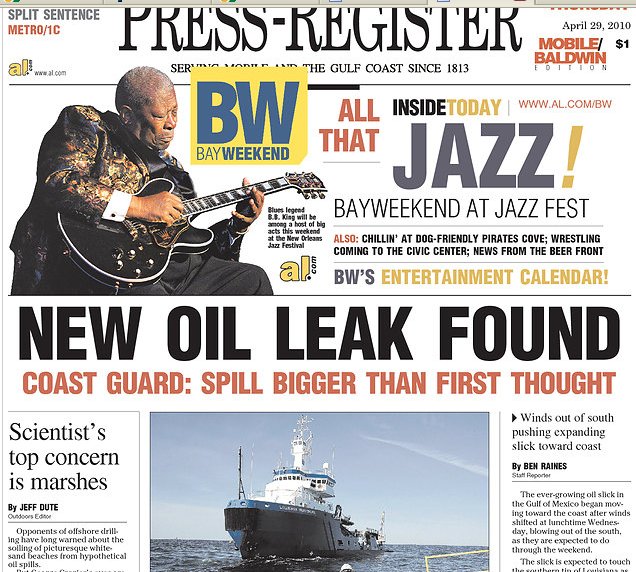
"A massive oil spill in the Gulf of Mexico is even worse than officials believed and the federal government is offering to help industry giant BP contain the slick that is threatening parts of the U.S. shoreline, the Coast Guard said.

"A new leak discovered in a blown-out well a mile underwater means five times as much oil is spewing into the water — an estimate BP disputes. The time may have come for the defense department and other public agencies to offer up 'technologies that may surpass abilities of the private sector' to get the mess under control, Coast Guard Rear Adm. Mary Landry said at a news conference late Wednesday."-- AP, via Atlanta Constitution, Apr. 29l

* * * * *
"A third leak had also been discovered at the site, Adm Landry said. * * * One fire-fighting expert told the BBC the disaster might become the "biggest oil spill in the world."

If US Coast Guard estimates are correct, the slick could match the 11m gallons spilt from the Exxon Valdez within less than two months." -- BBC News, Apr. 29

* * * * *
"The oil well spewing crude into the Gulf of Mexico didn't have a remote-control shut-off switch used in two other major oil-producing nations as last-resort protection against underwater spills.
* * *
"The U.S. considered requiring a remote-controlled shut-off mechanism several years ago, but drilling companies questioned its cost and effectiveness, according to the agency overseeing offshore drilling. The agency, the Interior Department's Minerals Management Service, says it decided the remote device wasn't needed because rigs had other back-up plans to cut off a well.
* * *
"Industry critics cite the lack of the remote control as a sign U.S. drilling policy has been too lax. 'What we see, going back two decades, is an oil industry that has had way too much sway with federal regulations,' said Dan McLaughlin, a spokesman for Democratic Florida Sen. Bill Nelson. 'We are seeing our worst nightmare coming true.'

"U.S. regulators have considered mandating the use of remote-control acoustic switches or other back-up equipment at least since 2000. After a drilling ship accidentally released oil, the Minerals Management Service issued a safety notice that said a back-up system is 'an essential component of a deepwater drilling system.'" --Wall Street Journal, Apr. 29

* * * * *

"Emergency workers in the United States have set fire to a small portion of an oil spill that has been leaking crude into the Gulf of Mexico since Friday. Crews are struggling to contain the spill before it reaches coastline as early as Friday.

"Boat crews used the burn technique on a small patch of oil in the center of the slick, which officials say is continuing to grow and encroach on U.S. coastline. An airplane survey conducted late Wednesday showed the western edge of the slick is now some 25 kilometers from the Louisiana coastline." -- Voice of America News, Apr. 29

* * * * *
"As a massive oil slick approached the fragile Louisiana coast, officials prepared Thursday for an environmental disaster which threatens a slow and painful death for waterfowl, wildlife and their wetland habitat.
* * *
Any oil spill is devastating. But experts say the US Gulf Coast -- which houses 40 percent of the nation's wetlands and a multi-billion-dollar fishing industry -- is particularly vulnerable. And the concern is multiplied by the fact nobody knows when oil will stop spewing from an offshore well destroyed last week following an explosion in the Gulf of Mexico.

"'It's not like a bunch of volunteers can go (drive) down and mop up the beach,'" said LuAnn White, director of Tulane University's Center for Applied Environmental Public Health. 'There are just miles and miles of coastal wetlands there that can only be reached by boat. And they're very delicate.'" -- AFP International News, Apr. 29

* * * * *
"Escambia County commissioners held a special session Wednesday afternoon to discuss local preparations. * * * They were told that local emergency crews should await further instruction from the federal agencies, which have jurisdiction over offshore areas.

"'Basically, we're in a monitoring stage right now,' said John Dosh, head of the Escambia County Emergency Operations Center.

"Commissioners Gene Valentino and Grover Robinson IV, whose districts include Perdido Key and Pensacola Beach, expressed frustration that local officials are forced to take the back seat to federal response crews."-- Pensacola News Journal, Apr. 29

* * * * *
"In the northern Gulf... wind tends to drive the currents. This time of year, prevailing winds in the Gulf tend to be from the east, which would keep the slick away from Florida.

"But it's not unusual to get southwest winds; if we get several days of these winds, the slick could come here. The winds have been from the north recently, keeping the slick out to sea.

"The major worry right now is for the marshes, reefs and other habitats in Louisiana. But if the slick heads to Florida, it likely would hit Northwest Florida beaches first." -- Pensacola News Journal, Apr. 29