Showing posts with label escambia county. Show all posts

Thursday, July 01, 2010

Surreal Thursday July 1 BP Oil Spill Update

1. Beach Report.

Escambia DisasterResponse acknowledged in this morning's Beach Report # 28 (not yet online as this is written) that "Pensacola Beach is seeing coverage of up to 50 percent in some areas in tar balls and tar patties today." Also:
  • Cleanup crews were on the beach last night and crews working today as weather permits.
  • Heavy equipment is being utilized on Pensacola Beach. Work will continue as weather permits.
Natch', county and beach officials claim the beach "remains open" for swimming except for the area west of the fishing pier.

The open area is exactly the one we visited yesterday, a popular 6-mile stretch of beach from the County East Beach to popular Casino Beach in the commercial core. All of it, although officially "open," has been inundated by BP's tarballs and disgusting orange oil mousse for days on end.

2. Surreal Surf Presser.

Island Authority administrator Buck Lee yesterday held a joint press conference at the fishing pier. He was joined by county neighborhood services chief Keith Wilkins. Conspicuously missing in action was county public health director John J. Lanza.

The presser must have been, by all accounts, a surreal experience. The Pensacola News Journal carried two versions about it. One makes the two county officials sound like idiots. The other paints them as shameless shirkers, blaming everyone else for not stopping them from endangering the public.

The first PNJ dispatch was filed by Mike Greear ["Is It Safe to Swim in Gulf?"]. Greear is a new guy on the block, formerly opinions editor for the University of West Florida's student newspaper.

His on-line report didn't make it into today's print edition. But Travis Griggs sewed a few threads of it together with other hair-raising facts of his own to make it today's above-the-fold top story in the dead-tree News Journal. ["Oil Spill: Water Safe? You'll have to Wing It"]

Griggs' report of the 'news' from the two county officials can be quickly summarized:
  • Yes, County and SRIA officials "have the authority to close the beach waters to swimming."
  • But no, they haven't closed the beach except for one brief two-day period last week "after the heaviest waves of oil yet washed ashore on Pensacola Beach."
  • Yes, county officials will close swimming "when there is no way beachgoers can reasonably avoid the oil washing ashore."
  • But no, they didn't close it yesterday even though there were tarballs and orange mousse in the surf all the way along the 7 1/2-mile stretch of beach we trekked both east of the fishing pier and west to Ft. Pickens Gate.
  • Yes, county official Williams would no longer let his own children swim in the Gulf.
  • But no, he won't close any more beach to swimming until the U.S. Environmental Protection Agency issues new guidelines specifically "determining the maximum safe levels of oil in swimming water."
Reporter Griggs also contacted Molly Payne-Hardin, a "spokeswoman for the Escambia County Department of Health." She told him the county health department "does not have the authority to close Gulf waters to swimming. " It can only issue "public advisories... based on the amount of visible oil present." (And, as we know, Dr. Lanza relies on Buck Lee's eyesight for what oil is visible.)

Let's hope an infectious viral epidemic never strikes Pensacola Beach. The county public health office might be limited to posting personal appeals on Craig's List to be cautious about spreading disease.

Buck Lee, no doubt realizing someone should look like they're in charge, reassured the press yesterday that he monitors beach conditions daily. "I went swimming Saturday afternoon. It was fine," he said. Let's hope he slept in a Holiday Inn, too.

On Pensacola Beach it comes down to this: the health of tourists and beach visitors now depends on a broken-down county pol's impressionistic view of the state of the water whenever he happens to take a dip in it.

Lee also said, according to cub reporter Greear, that "health advisories refer only to water." Only water!? Rather than boasting about that, Buck Lee ought to be apologizing to the sand. Rick Outzen reports "at least one sand dune has been leveled to provide access to the beach" for heavy bulldozers.

After blowing all this sand in the eyes of reporters Lee does admit, "Even if you can't see tar balls or mousse, there may be oil residue in the water."

3. False Message of an 'Open Beach.'

What is Buck Lee doing to warn beach-goers of tar, mousse, or "oil residue?" We happened into three members of a large church group from Texas yesterday. They told us they checked "on the internet" and the 'city' said the beach was open. From that, like most out-of-towners we suppose, they assumed the water was 'clean enough' for swimming.

Essentially, Lee and Wilkins are preying on the uninformed and naive, hoping the 'open beach' message will convince them it's safe to come to Pensacola Beach to spend their money. But it is not safe. Not unless, like the Texas group, you want to spend your time indoors, staring at a beach you cannot reach without wading through tarballs.

4. What Locals Know.

All of this is known to most locals, of course. At Casino Beach yesterday we met a retired haz-mat worker now living in Pensacola. He's got it figured out:


5. Happy Birthday, No. 412.

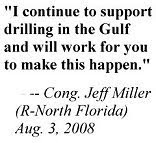
Progressive Pensacola the other day passed along "belated birthday wishes" to the congressman ranked No. 412 out of 435 in the House of Representatives. Hey! That's a generous ranking for "Mr. Oil Spill."

6. Grasping at Straws.

A friend on the beach calls to our attention a new and even more desperate straw for everyone to grasp: Taiwan's giant oil skimmer, now said to be on its way to the Gulf of Mexico. It's called the "A Whale."

We're partial to a more nature-friendly solution -- another whale, actually. This one is the giant whale just discovered to have inhabited the oceans some 12 or 13 million years ago.

Leviathan melvillei was up to fifty long and its mouth "was about 9 feet long and up to 7 feet wide."
The upper and lower teeth interlocked when the mouth closed — good for securing prey and ripping through flesh... . Leviathan probably ate anything it wanted to."
First, we'd have it eat all the oil sloshing around in the Gulf, then what's left of the Deepwater Horizon rig, and finally BP itself.

Now and then it's nice to dream.

Thursday, June 03, 2010

Loathsome Landfall Likely: Thursday June 3 BP Oil Update

What would-be tourists in their right mind are likely to pack up and head for the "clean, clear" water of Pensacola Beach ... when the forecast comes from something called "DisasterResponse.com?"

1. Pensacola Area.

As of mid-morning, the oil slick widely reported to be just a few miles offshore still was not visible from Pensacola Beach. Orange booms are at the ready along shorelines but not yet stretched across vulnerable sea lanes such as Pensacola Pass and the narrow entrance to Little Sabine Bay. Both are still open for boat traffic.

Occasional brief but intense rain storms this morning came from the southwest. Consistent with that, all local media are reporting that winds and water currents will be unfavorable over the next three days, very likely pushing BP's oil from the south and west onto local beaches and into bayous and estuaries connected with Gulf waters.

"Several areas of sheen were spotted as close as 7 1/2 miles from Pensacola Pass on Tuesday," the Pensacola News Journal report. Later this morning, it also updated that news with this: "Oil sheen was reported by the Florida Fish and Wildlife Conservation Commission approximately six miles from Navarre Pier in Santa Rosa County today."

The PNJ adds:

Any potential impacts to Florida’s shoreline will be highly weathered, in the form of tar balls, oil sheen, tar mats or mousse – a pudding-like oil/water mixture that could be brown, rust or orange in color.
To see an animated graphic of the expected winds through the weekend, click here for the Windmapper.

Or, you could simply reason out our dim prospects from the sudden appearance of national media. That's a sure sign things are about to get visually much worse.

If anyone feeds off delicious disaster pictures, it's the Tee-Vee pod people. You will know them by their perfectly coiffed hair and the crocodile tears in their eyes.

2. What Lies Beneath.

Using huge shears rather than the diamond-edged saw blade that got stuck in the well riser yesterday, BP managed to sever the riser pipe this morning. The New York Times explains:
Delicately manipulating a 20-foot-long shear at depths of nearly a mile, technicians successfully snipped a key riser pipe in their effort to contain the oil spewing into the Gulf of Mexico. They prepared to cap the remaining pipe later in the day with a dome that they hoped would allow them to funnel the oil to tankers on the surface.

Adm. Thad W. Allen, who is commanding the federal response to a spill that has been called the nation’s worst environmental disaster, told a news conference in Metairie, La. that the cut was “ a significant step forward.” But he cautioned that using as shear, rather than a finer diamond-laced wire saw, as the slicing instrument resulted in a jagged cut that will mean the containment cap will fit less snugly.
As a consequence, there is an increased risk "that oil may escape and that the cap itself could become filled with hydrates, ice-like crystals of gas and water that form at low temperatures and high pressures."

3. Surface Surfactants.

With this latest setback, it seems inevitable we will be living with the recurrent fear of new oil invasions on Pensacola Beach for months ahead. When, how thoroughly, and how often the beach will need to be cleaned is as yet undetermined. It's entirely possible it will become at least a daily event.

Hotels may be stocking up right now on Tarroff Towelettes for their guest rooms. But that could be an overly optimistic move. Will there be any tourists left who could use them? Not that many, we fear.

4. Disaster Response: 'C'mon In, the Water's Fine!'

The oil catastrophe has put local businesses and government agencies in a pickle. If they tell the truth, who would want to waste precious family vacation time and money playing dodge-the-tarballs on our beaches? On the other hand, if they don't tell the whole truth they risk alienating forever all those who rely on a too-optimistic description of current conditions.

The dilemma is illustrated all too well by an "alert" we received in our email box this morning from the Escambia County Disaster Response team:

The message is true enough, as far as it goes at this hour -- and maybe the next. But what would-be tourists in their right mind are likely to pack up and head for the "clean, clear" water of Pensacola Beach or Perdido Key when the forecast comes from something called "DisasterResponse.com"?

The dilemma is reminiscent of one we encountered twenty-five years ago. At the time we were living far away from the Gulf Coast. Our dear mother (now deceased) was living out her final years in Ft. Walton Beach. We would fly down to visit her regularly, and thus became acquainted with the only local newspaper in town at that time.

It was known as the Playground Daily News. It was an absolutely awful newspaper, printed on the cheap so badly that the black ink came off in your hands as you turned the pages. Some locals we came to know actually acquired the habit of donning gloves before they would sit down and touch the newspaper.

Typically, each issue was six or eight pages long. Advertisements made up more than half the copy. As for actual news, most of it consisted of engagement announcements, marriages, hospital admissions, civic and social club awards, and the like. The rest of the "news" was almost always happy, happy, happy stuff.

There were, as we recall, surprisingly few obituaries and none whatsoever about the occasional drowning. An entire county full of people could have sunk out of sight in the waters off Ft. Walton Beach and the Playground Daily News would not have had room to mention it.

In winter, we often encountered Canadian tourists at the local convenience store where we went to seek out a real, imported, newspaper. We noticed the Canadians always bought the local paper; many almost immediately would turn to page two, where the Playground Daily News printed the daily weather report. They would glance at the page, grunt with satisfaction, and, as we supposed, head off for their rented condo.

Invariably, the weather forecast as related by the Playground Daily News was "warm and sunny." It might be raining buckets outside, or even snowing, but inside the pages of that Ft. Walton Beach newspaper perfect beach weather was always in the offing.

One day, we finally asked a Canadian snowbird who had just purchased the paper if he hadn't noticed that the local weather report was pure hokum, ginned up (as we supposed) to keep tourists like him from heading farther south or going home.

"Of course," he said. "The wife and I don't even read it. We just mail it back home to make everyone there jealous." [Update below]

5. Cams, Cams, and More Cams.

For much of the early morning today, BP's spillcam was down and showing nothing. But BP Corp. has a number of others which it hasn't been especially eager to share with the public.

Through the magic of the Internet Tubes, however, they've been discovered on-line. And several are hard at work. For alternative robotic views of what's going on a mile below the Deepwater Horizon site, click here or here.

Our neighboring blogger Bryan over at Why Now? makes the same point about honesty in tourism promotion. He's much more direct than we are.

"If you lie to people to bring them down to the coast," he says, "they’ll leave angry and won’t be back. But if you tell them the truth, they will believe you when you tell them it is alright to return."

Unless, that is, they're inclined to lie to their friends, like the Canadian we mentioned.

Saturday, May 22, 2010

Swampy Saturday: May 22 BP Oil Spill Update

1. Local Oil Forecast.

No significant changes from late yesterday afternoon. C'mon down and enjoy the water while you can. Or, at worst (and less likely) witness history being made before your very eyes.

2. Pensacola Perspicacity.


Yesterday's New York Times prominently mentioned Pensacola resident Taylor Kirschenfeld, an environmental official for Escambia County, Florida, and an adjunct instructor in environmental studies at the University of West Florida. He has since become something of a local hero in Pensacola for his perspicacity and pluck in successfully resisting NOAA's orders to send water samples he's been collecting to a Texas lab that "that counts oil firms, including BP, among its biggest clients."

Kirschenfeld was concerned that the Texas lab was not sufficiently independent of oil industry influence and control. He successfully chose instead, the Times reports, "to get a waiver so he could send his county’s samples to a local laboratory that is licensed to do the same tests."

Among other advantages of using a local lab, we imagine, Kirschenfeld has a higher level of confidence in the skills of lab technicians he knows. Plus, he is assured of getting the results back some time before the end of the century. After all, BP hasn't exactly been forthcoming, reliable, or honest in sharing oil spill data with the public.

The Times adds:
Mr. Kirschenfeld said he was also troubled by another rule. Local animal rescue workers have volunteered to help treat birds affected by the slick and to collect data that would also be used to help calculate penalties for the spill. But federal officials have told the volunteers that the work must be done by a company hired by BP.

“Everywhere you look, if you look, you start seeing these conflicts of interest in how this disaster is getting handled,” Mr. Kirschenfeld said. “I’m not a conspiracy theorist, but there is just too much overlap between these people.”

The local TV staff at WEAR-TV did a creditable job of featuring Kirschenfeld near the start of last night's newscast. As usual, however, Sinclair Broadcasting's station management is on the cheap and still busy turning localism on its head. As of this writing it hasn't made a video of the broadcast available on the station's web site -- and it probably never will.

3. Sand Berms for the Messes.

Today's Times also quotes another figure familiar to Pensacola Beach residents: Prof. Greg Stone of Louisiana State University's Coastal Studies program. Prof. Stone has made Pensacola Beach a special concern of his since his graduate student days under the late Dr. James P. Morgan. As visitors will recognize, Morgan Park on Pensacola Beach is dedicated to the memory of Dr. Morgan.
( See below)

Stone is quoted in today's paper as one of the experts 'expressing doubts' about a proposal to "build sand berms and plug holes in barrier islands in a desperate effort to stop oil from the Deepwater Horizon spill from destroying marshes, sounds and bayous." The proposal sounds very much like a mega-version of what Escambia County proposed, a couple of weeks ago: scraping the sand off a 2-mile stretch of Pensacola Beach and building a tempo
rary berm up-beach.

For the "complex inlets and bays" of coastal Louisiana, he told the Times, "
dredging and pumping large amounts of sand... could harm ocean life" and needs more study.
“I understand that time is of the essence, but I really think that we’re taking a gamble here,” he said.
Such a berm, however, would present problems of its own. Some of those problems are peculiar to Louisiana, such as the "degraded" marshlands of the Mississippi delta and the unavailability of high quality sand. Others may have equal applicability to Pensacola Beach. Among these, as we've mentioned before, are three that resound loudly for Pensacola Beach:
  • Some experts worry the sand scraping would be a colossal waste of money.
  • Sand engineering would disturb sensitive habitats for turtles and other species "which are already under threat from the oil slick."
  • If a tropical storm were to pass near Pensacola, the whole berm could be washed away.
All the experts we've talked to were definite in saying that scraping up berms for marshes and wetlands is much more problematic than for a sandy beach, as we have in Florida. But doubts remain about the wisdom, feasibility, and expense of the plan.

4. Remembering Dr. Morgan.

Mention of Dr. Morgan is timely. What's happening in the Gulf would have broken his heart. But it probably would not have surprised him.

Some years ago, Prof. Stone wrote an affecting personal remembrance of Dr. Morgan, published in the Journal of Coastal Research. There, Stone noted that throughout the course of his career Dr. Morgan compiled a "research record was nothing short of exemplary."

Much of it focused on the fragile Louisiana wetlands that are now being fouled by thick sheets of oil:
[T]he oil companies frequently attempted to lure him from academia with the promise of embarrassingly high salaries and assorted perks. He resisted industry, for he relished the challenge of teaching in the lecture room and had become devoted to the Coastal Studies Institute and Louisiana State University.

His meritorious teaching and research was rewarded in 1962 when he was promoted to full Professor of Geology. In 1966 he stepped down from the managing directorship of the Institute, to become leading scientist on research funded by the National Science Foundation and the United States Geological Survey, conducted on the Louisiana continental shelf. Toward the end of the project in 1970, he accepted chairmanship of the Department of Geology at LSU, a position he held until 1973.

After stepping down as chair, Dr. Morgan took sabbatical leave to write-up some of the data he had generated during his continental shelf research. He and his wife spent most of that time on Pensacola Beach where they developed a love for the area and made several new friends. That sabbatical helped solidify Dr. Morgan's decision to retire from LSU, and after 30 years in Baton Rouge, he and his wife relocated to Pensacola.
In retirement, Dr. Morgan continued his research, expanding it to the barrier island occupied by Pensacola Beach. Once he retired to the beach, he also became an early environmental activist. Through such community organizations as the Pensacola Beach Residents & Leaseholders Assn. and an ad hoc group known as the S.O.B.'s ("Save Our Beach"), he often found himself pitted against corporate and developer interests whose unbridled lust for profits at the expense of the public's ecological resources was not that different from BP's.

In a companion article in the same issue as the personal remembrance, J.M. Coleman and Prof. Stone described Dr. Morgan's pioneering research work. He was the first to study the "coastal and deltaic processes" of the Louisiana coastline.
It was Dr. Morgan and his students who first documented the high rates of shoreline change along the Louisiana coast. Realizing that much of the coastal change was episodic in nature, the monitoring program indicated that much of the erosion of the coastline took place during winter storms and the passage of hurricanes. Some of this information was published towards the end of the 1950's and concerned changes in the coastal landscape and damage to the marshlands following hurricanes, particularly hurricane Audrey which made landfall in Louisiana in 1957.

These papers are regarded as "classic" in that they were among the first quantitative data sets used to document the hurricane effects on coastal regions.
James M. Coleman and Gregory W. Stone, "James P. Morgan: Scientific Contributions," 14 Journal of Coastal Research 867, 868 (Summer, 1998).
5. Tropical Storm Concerns.

All of this seems timely because we are fast approaching the season of hurricanes, the very thing that Dr. Morgan identified decades ago as having deep and long-lasting effects on beach ecology. Already, there is a low pressure area in the Atlantic ("Invest 90") that has attracted the attention of hurricane watchers. Tomorrow Hurricane Preparedness Week begins.

"Scientists tracking the Gulf of Mexico oil spill are beginning to think about what would happen if a storm hit the growing slick," the New York Times warned the other day. Wherever the oil slick may wander in the Gulf, scientists believe a tropical storm could disrupt the Florida Loop and send it, and both the surface oil spill and the underwater lake of oil, almost anywhere.

"It's impossible to predict," says Prof. Frank Muller-Karger of the University of South Texas. Especially when hurricanes begin to hit, he adds, some of the oil is almost certain to affect not only Gulf coast states, but other nations like Cuba and Mexico.

"This is a problem," Muller-Karger says, "that we'll have to deal with for years, as opposed to months."

Just as Dr. Morgan documented many years ago.

Thursday, May 06, 2010

Thursday, May 6 Oil Spill Update: Preparing for the Siege

"Misfortune to you Byzantium, because * * * each horse of Ismail will cross over, Byzantium, and will begin the battle and break the gate of the Wooden Circus and enter as far as the Ox."

-- ominous prophecy contained in
"The Apocalypse of Pseudo- Methodius" (669 A.D.),
quoted in Roger Crowley,
"1453,"
New York: Hyperion Press (2005)
1. Preparing for the Siege.

The big news on Pensacola Beach is Travis Griggs' local newspaper report that "Escambia County officials are trying to get approval for an ambitious plan to steepen a two-mile section of Pensacola Beach along the shoreline and stockpile sand outside of the oil's reach."

Like doomed Christians inside the glorious capital of the Eastern Roman Empire, local authorities continue casting about desperately for some means -- any means -- of salvation from the approaching invasion. In 1453, siege was laid by Sultan Mehmet the Second's army.
No one knows exactly how many men Mehmet brought to the siege. * * * To the eulogizing Ottoman chroniclers they were simply "a river of steel... as numerous as the stars."

-- Crowley, 1453 at 102.
In 2010, no one knows exactly how much oil is leaking from British Petroleum's Deepwater Horizon well. All that is certain is that it is a "river" of toxic pollution whose destructive consequences could last for generations.

2. Sand Scraping on Pensacola Beach.

The latest plan was developed by SRIA's longtime engineering retainer, Baskerville-Donovan, along with the Jacksonville firm of Olsen Associates. It was submitted to the U.S. Coast Guard on Tuesday, but was rejected yesterday afternoon. Although the Coast Guard turned the plan down yesterday, there's every reason to suppose something very much like it will be approved soon.

Reporter Griggs writes that the plan involves bulldozing two miles beach sand to move it "higher on the beach," where it presumably would be "out of reach of the oil slick." The sand would be used to "steepen the slope of low-lying swaths of the beach that are frequently washed over by surf." (Never mind that wash-overs during storms these days include almost every part of the beach from Portofino to the Fort Pickens picnic area.)

Ostensibly, so Griggs writes, "Santa Rosa Island Authority officials asked the unified command for permission to use heavy equipment to move sand away from the waterfront so it won't be affected if oil comes ashore."
"Once we get this cleaned up and there's no more oil, you take that beautiful sand that's been saved and you put it back down by the water," said Buck Lee, executive director of the Santa Rosa Island Authority.
The first impression one gets is that county officials are desperate enough to try just about anything. And who can blame them? The oil lake floating in the Gulf of Mexico now has become so large, and the consequences are likely to be so devastating and long-lasting, that there are no good options left.

Quite obviously, the plan submitted by Island Authority and County officials will be destructive to whatever sand habitats and sea turtle nesting areas may be found in that "two-mile stretch" they're worried about.

If any Gulf sea turtles happen to survive this calamity, good luck to them. Purportedly, this is why the Florida Department of Environmental Protection turned the Escambia County plan down. As Griggs reports, the agency doesn't want to disrupt turtle nesting season "which begins this month."

3. Necessary Questions.

Sea turtles are in for a terrible time, oily sand or no. Their fate well could be sealed. It is in some ways the least of the issues this plan raises.

Reporter Grigg's article focuses on how scraping the sand back from the shoreline is designed to save the white sand so it later can be returned to where it belongs. The other side of the coin, however, is that the sand is to be deposited up-beach near the foundations of a good many buildings, many of which have been too close to the shore for comfort for a long time, anyway.

Protecting private property from the ravages of oil pollution is a legitimate objective. We do it every year when hurricane season rolls around. But both the scraping part and the up-beach deposit aspects leave unanswered many questions. Here are some of them:
  • If bulldozing sand off the beach is such a good idea, why just two miles of beach instead of the full 7.5 miles of Gulf front seashore from one end of Pensacola Beach to the other?
  • For that matter, which two miles have been designated for bulldozing? The commercial core, certainly. That's where most visitors go and where most beach businesses are. But two miles is a much longer stretch of coastline than the core occupies. Is the 'steepening the slope' in front of low lying areas which officials have in mind designed to protect mainly beach-front condos and hotels, leaving others to fend for themselves?
  • How was the "two mile" stretch decided upon? Who did the deciding and what was their criteria?
  • Few, if any, beach residents or business leaseholders knew of this plan before it was described in today's paper. None, that we know of, was consulted. If the plan happens to shield from oil intrusion one favored condominium or business and not others, what safeguards against favoritism are in place to prevent officials (or their engineers) from playing the all-too-familiar Pensacola game of "good ol' boy?"
  • How much will it cost to bulldoze a part of the beach and who gets the bill? Rick Outzen reports on his Independent News blog that --
    Escambia County is asking BP for five million dollars for a contingency mitigation account. County will add $5 million from county’s disaster recovery fund."
    If this "request" includes the expense of scraping up a beach sand wall, is the entire plan dependent on British Pettroleum's generous assent? Or, is Escambia County prepared to foot the whole bill if BP declines?
  • If the county pays the bill, you can be sure it will pass the cost along to beach people. But which ones? Assuming (as we do) that BP eventually will openly fight every demand for just compensation, as it has done in past oil spills, will the burden of reimbursing for the up-front expense fall only on condos and businesses shielded from oil by the "up-beach" sand wall? Or, will all leaseholders pay, regardless?
  • Hurricane season officially begins in just a little over three weeks. As everyone here knows, a gradually sloping sandy beachfront is Nature's first defense against a water surge. What are the likely consequences to everyone of a denuded "steeper" beachfront? Will it make a storm cut-through of Santa Rosa island more or less likely?
4. Dauphin Island.

Reporter Griggs also mentions that a "similar" effort is underway at Dauphin Island, Alabama. His own news article, however, reads as if the plan isn't so much "similar" as it is completely the opposite. On Dauphin Island, engineers are --
constructing sand dunes to protect interior, low-lying areas of the barrier island that are frequently washed over during storms and high tides.

Dauphin Island Mayor Jeff Collier said the main concern was that a storm could wash a slick of oil over the entire narrow island, inundating the sewer system, covering roads and contaminating sensitive environmental areas on the island's north shore.

In other words, as Mayor Collier told the PNJ, the Dauphin Island plan "will still allow the oil onto the shorelines and beaches. We're just trying to keep it out of sensitive environmental areas." That plan was "approved by the unified command within about 48 hours... ."

So, when you can't have everything what's it to be? Protect the wetlands and other low-lying areas as on Dauphin Island? Or, build a sand wall on a small select stretch of Pensacola Beach and let the rest of the island fend for itself?

5. Important Precedent.


Of course, the Granddaddy question of all is -- to borrow Buck Lee's date for replacing the sand he wants to scrape up -- "When will there be "no more oil?"

Nine years ago, on an Earth Day visit to the Pensacola Beach EPA research site, we wound up in the office of a top researcher who had only recently returned from a long professional visit to the site of the Exxon-Valdez oil spill site. He was still pretty shook up over what he had seen.

Although the Exxon-Valdez oil spill had happened a dozen years before his visit, the researcher told us it was still a god-awful mess. And, he expected it would remain so for generations to come. He was quite emphatic in saying "people down here" have no idea of the extent of environmental damage a large oil spill can have.

Years and years of beach cleaning had barely 'whitewashed' the appearances of things in Prince William Sound, he concluded. "Dig down an inch or turn over a rock," he said, "and it's still there. The entire food chain was broken."

And, he added, the chain of life along with it. "I don't know if it can ever come back," he told us.

That's almost exactly what coastal scientists fear today: Buck Lee's anticipated day when there is "no more oil" will never arrive in our lifetime. As Brandon Keim wrote yesterday ["Gulf Coast May Be Permanently Changed By Oil Spill"], unless the experimental underwater containment system BP is trying to install over the next few days works, "the Gulf Coast could be damaged beyond recovery."

If that entirely foreseeable outcome comes to pass, of what use will two miles of dead sand be to any of us?

Thursday, April 29, 2010

Thursday Gulf Oil Leak Update

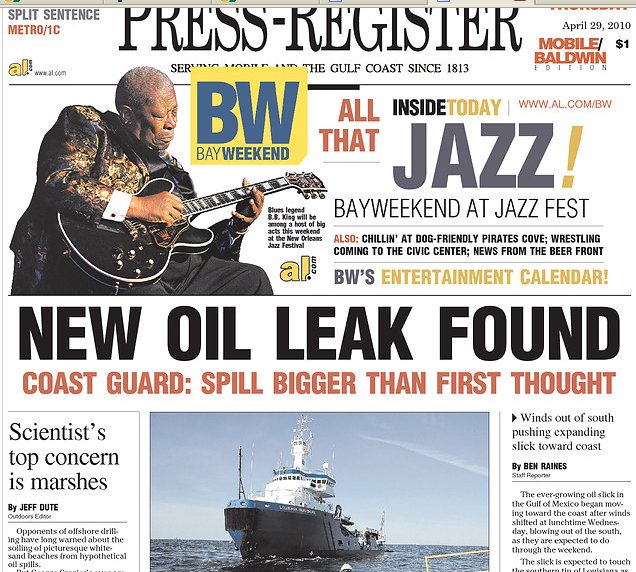
Mobile Register

"A massive oil spill in the Gulf of Mexico is even worse than officials believed and the federal government is offering to help industry giant BP contain the slick that is threatening parts of the U.S. shoreline, the Coast Guard said.

"A new leak discovered in a blown-out well a mile underwater means five times as much oil is spewing into the water — an estimate BP disputes. The time may have come for the defense department and other public agencies to offer up 'technologies that may surpass abilities of the private sector' to get the mess under control, Coast Guard Rear Adm. Mary Landry said at a news conference late Wednesday."-- AP, via Atlanta Constitution, Apr. 29l

* * * * *
"A third leak had also been discovered at the site, Adm Landry said. * * * One fire-fighting expert told the BBC the disaster might become the "biggest oil spill in the world."

If US Coast Guard estimates are correct, the slick could match the 11m gallons spilt from the Exxon Valdez within less than two months." -- BBC News, Apr. 29

* * * * *
"The oil well spewing crude into the Gulf of Mexico didn't have a remote-control shut-off switch used in two other major oil-producing nations as last-resort protection against underwater spills.
* * *
"The U.S. considered requiring a remote-controlled shut-off mechanism several years ago, but drilling companies questioned its cost and effectiveness, according to the agency overseeing offshore drilling. The agency, the Interior Department's Minerals Management Service, says it decided the remote device wasn't needed because rigs had other back-up plans to cut off a well.
* * *
"Industry critics cite the lack of the remote control as a sign U.S. drilling policy has been too lax. 'What we see, going back two decades, is an oil industry that has had way too much sway with federal regulations,' said Dan McLaughlin, a spokesman for Democratic Florida Sen. Bill Nelson. 'We are seeing our worst nightmare coming true.'

"U.S. regulators have considered mandating the use of remote-control acoustic switches or other back-up equipment at least since 2000. After a drilling ship accidentally released oil, the Minerals Management Service issued a safety notice that said a back-up system is 'an essential component of a deepwater drilling system.'" --Wall Street Journal, Apr. 29

* * * * *

"Emergency workers in the United States have set fire to a small portion of an oil spill that has been leaking crude into the Gulf of Mexico since Friday. Crews are struggling to contain the spill before it reaches coastline as early as Friday.

"Boat crews used the burn technique on a small patch of oil in the center of the slick, which officials say is continuing to grow and encroach on U.S. coastline. An airplane survey conducted late Wednesday showed the western edge of the slick is now some 25 kilometers from the Louisiana coastline." -- Voice of America News, Apr. 29

* * * * *
"As a massive oil slick approached the fragile Louisiana coast, officials prepared Thursday for an environmental disaster which threatens a slow and painful death for waterfowl, wildlife and their wetland habitat.
* * *
Any oil spill is devastating. But experts say the US Gulf Coast -- which houses 40 percent of the nation's wetlands and a multi-billion-dollar fishing industry -- is particularly vulnerable. And the concern is multiplied by the fact nobody knows when oil will stop spewing from an offshore well destroyed last week following an explosion in the Gulf of Mexico.

"'It's not like a bunch of volunteers can go (drive) down and mop up the beach,'" said LuAnn White, director of Tulane University's Center for Applied Environmental Public Health. 'There are just miles and miles of coastal wetlands there that can only be reached by boat. And they're very delicate.'" -- AFP International News, Apr. 29

* * * * *
"Escambia County commissioners held a special session Wednesday afternoon to discuss local preparations. * * * They were told that local emergency crews should await further instruction from the federal agencies, which have jurisdiction over offshore areas.

"'Basically, we're in a monitoring stage right now,' said John Dosh, head of the Escambia County Emergency Operations Center.

"Commissioners Gene Valentino and Grover Robinson IV, whose districts include Perdido Key and Pensacola Beach, expressed frustration that local officials are forced to take the back seat to federal response crews."-- Pensacola News Journal, Apr. 29

* * * * *
"In the northern Gulf... wind tends to drive the currents. This time of year, prevailing winds in the Gulf tend to be from the east, which would keep the slick away from Florida.

"But it's not unusual to get southwest winds; if we get several days of these winds, the slick could come here. The winds have been from the north recently, keeping the slick out to sea.

"The major worry right now is for the marshes, reefs and other habitats in Louisiana. But if the slick heads to Florida, it likely would hit Northwest Florida beaches first." -- Pensacola News Journal, Apr. 29

Saturday, February 21, 2009

The Perdido Key Disaster


For the second time in two days, we read that gambling venues are multiplying in Pensacola.

First, Escambia County commissioners approved setting up poker rooms at the dog track. It's just to keep the jobs, don'cha know.

Now, a Texas developer has announced he's partnered with the "Perdido Bay Tribe of Lower Muscogee Creek Indians" to build "a first-class bingo facility and resort" exceeding anything from here to Biloxi.

"Perdido Key Tribe of Lower Muscogee Indians?" Who knew?

If they haven't already, you can be sure enterprising local developers will soon stumble across descendants of a hitherto unknown knot of Native Americans, probably to be called something like the "Sabine Bay Band of West Santa Rosa Island Apalachicola" Indians. Frightened away by Tristan de Luna's expedition, it may be explained, they fled their native homeland, which we now call Pensacola Beach, before a lawful treaty could be negotiated.

"Compensation must be paid!" will be the scream. "How about a casino boat off Quietwater Pier?" will be the settlement proposal.

We don't want to be a Cassandra, but though our Indian story is fanciful it sure looks inevitable that Pensacola Beach residents will soon, again, be facing a referendum on legalizing casino gambling in Escambia County. Over the past decade we've seen at least two of those on ballots that we can remember, and the state narrowly missed a third.

Expect a new, well-financed campaign to authorize casino gambling in barrier island communities like Pensacola Beach. Greed will be the driving force, of course. It always is. But fear of another Great Depression will be the public argument pushed by gambling proponents.

Such is the history of gambling in America. As a California revenue department study observed a few years ago:
The great depression led to a much greater legalization of gambling. The antigambling mood changed as tremendous financial distress gripped the country, especially after the stock market crash of 1929. Legalized gambling was looked upon as a way to stimulate the economy.
Indeed, Las Vegas practically owes its existence to the Great Depression. As Thomas Barker and Marjie Britz wrote in their book Jokers Wild: Legalized Gambling in the Twenty-first Century
(Praeger 2000) --

In 1931 the Nevada legislature, reacting to the effects of the Great Depression and the decline in the price of silver, passed two revenue-generating devices.*** Gambling proponents argued that the taxes would bring in sorely needed revenue and reduce property taxes. *** The "Wide Open Gambling Law" started the modern era of legalized gambling in the United States.
Personally, our objections to gambling on Pensacola Beach have nothing to do with religion or morality. It wouldn't matter if they did. Along with the excesses of Wall Street and consumerism run wild, the past twenty years have seen such a proliferation of government sponsored lotteries and other forms of legalized gambling -- from bingo halls and race tracks to on-line gambling and casinos -- that most folk don't have far to walk to find some place to throw away their money.

Our objections are rooted mostly in concerns about maintaining the environmental sustainability of our fragile island paradise, the heightened risk of public official corruption that inevitably follows legalized gambling, the certainty that desperate poor people will become even more vulnerable to exploitation, and the increased vulgarization of American culture.

Widespread gambling inevitably cheapens an entire community. If you doubt it, visit Atlantic City. Or, Perdido Key in a couple of years.

As for Pensacola Beach, open gambling and the tourist theme of a "family friendly beach" are wholly incompatible. But that won't stop certain interests from arguing otherwise as the local economy deteriorates and more shops, restaurants, and businesses close.

Beach residents need to begin organizing, now, to have any hope of avoiding the same kind of disaster that is about to befall Perdido Key.

Tuesday, November 04, 2008

Local Elections Results

Bucking the national trend, here are preliminary results of the November 4 general election in Florida's three western-most counties.

Escambia County election results (90/90 precincts reporting)

Santa Rosa County election results (41/41 precincts reporting)

Okaloosa County election results (28/28 precincts)

Friday, August 08, 2008

Ten Questions for Peacock


Someone claiming to be John Peacock, a board member of the Santa Rosa Island Authority, has found his way to yesterday's article on this web site about the SRIA meeting that wasn't. "Please feel free to contact me," he writes, "if you want to really set the record straight." Then, he issues us instructions on how to do that privately.

We accept Mr. Peacock's generous invitation to "set the record straight." But in the interests of keeping things in the Sunshine, rather than do it privately we'd like to give him the opportunity to answer ten simple questions right here, for everyone to see.

Just use the message function, Mr. Peacock. You know how it works.

TEN QUESTIONS

1. Were you the decision-maker in calling a “special” SRIA board meeting for August 6 at 5 pm? If not, who was?

2. The Notice of Meeting bears the date of July 5 for a meeting scheduled for July 6. What day and time was the Notice of Meeting actually published?

3. Did you direct Jayne Bell to publish the Notice of Meeting; if not, who did?

4. How, when, and by whom was the decision made that “John Peacock will be acting chairman” as stated in the notice of meeting?

5. Did you or any other board member decide to make you, John Peacock, “acting chairman” of this "special meeting" before the notice was published; if so, when, where, why, and by whom was that decision made?

6. What was the agenda business to be considered at that “special meeting”?

7. It has been claimed on the Independent News web site blog that “the issue was an attempt by Mr. Peacock... to...squelch the investigation of the manager by numerous complaints of numerous ex-employees.” To your knowledge, is there an ongoing internal investigation of complaints from employees or ex-employees about Buck Lee? What is the specific nature of those complaints?

8. When you and other members of the board met on August 6, did SRIA attorney Stebbins advise that the meeting was improperly noticed to the public and might well violate the Sunshine Law?

9. On the Independent News' "Rick's Blog" a message by “robertonlamar” claims News Journal reporter Michael Stewart sent a letter to SRIA officials asking for comments and information about employee or ex-employee complaints. Is there such a letter and, if so, when does the SRIA intend to respond?

10. As an appointed SRIA board member, are you in favor or opposed to Mike Whitehead’s oft-expressed desire to abolish the SRIA and have county officials take over its functions?

Thursday, August 07, 2008

Turtle Soup's On

Glen Phillips, age 15, will forever be remembered as the brave slayer of a helpless, old alligator turtle whom he first abused by sticking him in "a pool of shallow water in a john boat," against state law. A Fish & Wildlife spokesman says one caller offered him "$500 if they released back into the river. No questions asked."

The Chamber of Commerce should have paid him five times that amount, just to burnish the reputation of Northwest Florida. Too late, now.

Mystery of the Agenda that Didn't Bark

On his personal blog, Independent News publisher Rick Outzen broke the mysterious news story that a surprise meeting of the Santa Rosa Island Authority late yesterday was cut short by Dr. Thomas Campanella's fast thinking. Campanella is the only one of six board members who is not a political appointee of an Escambia County commissioner. He's elected by island residents and currently is chairman of the SRIA's governing board.

Reports Outzen:
The special meeting set for the Santa Rosa Island Authority yesterday was stopped before it began. Chairman Tom Campanella, vice chair John Peacock, Ed Guernsey and Vernon Prather were in attendance. Fred Gant was in route.

Peacock had called the meeting. Campenella struck the gavel and immediately asked Board attorney Mike Stebbins if the meeting had been properly noticed. Stebbins advised that the meeting - even though it was a special one - had to be noticed 48 hours prior.

According to what we've been able to piece together from multiple sources, the episode almost looks like an attempted coup. Perhaps less than 48 hours beforehand, we're told, someone at the SRIA authorized lower level staff to publish the "special meeting" notice which we have reproduced above. You can view it yourself on-line right here [pdf warning].

Who dunnit? We can't be sure, but our sources say the shadow of suspicion falls heavily over Buck Lee, John Peacock, and Mike Whitehead.

Lee is what used to be known as the "general manager" of the Island Authority, now retitled "executive director." He has close ties to county commissioner Mike Whitehead, as we've previously observed. Peacock is an SRIA board member. He was appointed by Whitehead and is widely regarded as the commissioner's personal sock puppet.

The curious thing is the meeting notice included this odd prediction:
"For the purpose of this meeting John Peacock will be acting as chairman and Fred Gant will be acting as vice-chairman."
That, apparently, was news to current SRIA board chairman Campanella and his board colleague, Vernon Prather. (Two other commissioners were either out of town or on the road.)

There was a brief but unsuccessful effort to get to the bottom of the mysteries -- Who called the supposed "special" meeting? and How is it Peacock was determined in advance to be the "acting chair"? Then, Island Authority attorney Mike Stebbins warned the remaining board members that the meeting notice was likely in violation of Florida's Sunshine in Government Act.

Chairman Campanella dutifully declared the meeting adjourned and he and Prather walked out.

You'd think Whitehead and his hand-picked buddy, Peacock, would be more sensitive to Sunshine Act violations than this. After all, a number of Whitehead's former colleagues lost their jobs, faced jail, and incurred stiff fines for violating that same law back in 2002.

The mystery of the meeting notice, however, is wrapped inside a larger enigma: What was the substance of this abortive meeting supposed to involve? Outzen says on his blog, "Campenalla has had Stebbins investigate complaints about SRIA manager Buck Lee without informing his fellow board members. " And a following comment posted under the screen name "robertonlamar" adds:
the issues are outlined in a letter from the penscola [sic] news journal which is a public record for anyone to see in the SRIA office.
That letter, it turns out, is from investigative reporter Michael Stewart. (Stewart is all over the place these days, isn't he?) What he's probing are employee complaints of abusive management practices by none other than Buck Lee himself.

Some time ago, Whitehead announced his intention to engineer a county take over of the SRIA and ample evidence suggested Lee was behind him. Now, Whitehead's own appointee has been caught trying to muscle in on SRIA board meeting schedules to run the show and bury the employee complaints about Buck Lee.

Campanella, Prather, and Stebbins deserve praise for stopping the SRIA board coup in its tracks and, in effect, insisting that personnel complaints proceed in a systematic and balanced manner. For that matter, Peacock owes thanks to Campanella for keeping him off the criminal court docket.

But you know we haven't heard the last of the matter. Not as long as Buck Lee is where he is and Whitehead remains a county commissioner.

Further Amplification Dept.

Ten Questions for Peacock
SRIA board member John Peacock has offered in the comment below to "set the record straight." He's invited to answer ten simple questions, right here on this blog for everyone to see.

Dark Secrets on Pensacola Beach


Per curiam affirmances "are incompatible with the spirit of Florida's 'Government in the Sunshine' laws, whose purpose... is to prevent at non-public meetings the crystallization of secret decisions to a point just short of ceremonial acceptance."
-- Krosschell, DCAs, PCAs, and Government in the Darkness, 1 Fla. Coastal L. Rev. 12 (1999)

Overnight, Pensacola news reporter Michael Stewart has written a second article about the Portofino real estate tax decision of the First District Court of Appeals. Is this guy prolific, or what?

Michael Stewart has more words at his fingertips than your average Florida appeals court judge scratches out in a month at five times the money! And that, of course, was the point of our baseball metaphor.

Much of Stewart's latest effort is devoted to gathering reactions from local pols to the really, really tough question, "How would you like to scoop up $19 million in extra tax money from a few folks with almost no voting power, for reasons the Florida appellate court has approved without articulating what those reasons may be?"

Naturally, Escambia County commissioner Mike Whitehead -- who's made a career of baiting beach residents for his mainland constituents -- offered up a reaction that rests on an outright lie. Whitehead is quoted as saying:
Beach residents use all the same services as other Escambia County residents, from the Sheriff's Office to the court system, and animal control to mosquito control.
Whitehead knows full well that from time immemorial Pensacola Beach residents annually are specially assessed Municipal Service Benefit Unit fees for county law enforcement, fire and emergency medical services, mosquito control, and, yes, even animal control. Like everyone else in Escambia County, they also pay court filing fees, state intangible taxes, sales taxes, and other assessments which, as elsewhere, in part go to support the state court system.

What Whitehead also knows is that it's a whole lot easier to get away with such public prevarications when judicial panels employed to decide the legality of adding new taxes routinely 'crystallize' their decisions in secret, in the dark.

Stewart roped in one more interesting reaction. Escambia County Property Appraiser Chris Jones told him "he had no choice but impose the taxes."
"I understand and empathize with leaseholders out there," Jones said. "But my job is to uphold the law."
Ironically, Jones appears to have done done this by attacking "a state law as part of the defense in a law suit disputing his or her assessments." That could be a problem for him in the still-pending lawsuit affecting all other Pensacola Beach residents.

Wednesday, August 06, 2008

Reporter Bests Florida Appeals Court

In a surprise victory that left hot dog munching onlookers stunned, Pensacola News Journal reporter Michael Stewart today overwhelmed Florida's First District Court of Appeals in a series of eight back-to-back appeals involving county taxation of Portofino Towers residential units on Pensacola Beach. Although out-manned 3 to 1, and technically disabled for want of a law degree, the PNJ's ace newsman wrote circles around the appeals court panel of judges Michael Allen, Marguerite Davis, and Paul Hawkes.

The final score was 301 words to 8. Stewart scored all of his words in a single newspaper article, written inside of an hour just today. He was dazzling behind the mound on his desk, frequently firing facts right down the pipe while masterfully mixing up his delivery with active verbs, multi-syllabic words, and the occasional off-speed historical fact or futuristic prediction. Here's just a sample:
A three-judge panel of the First District Court of Appeals upheld Escambia County Circuit Judge Frank Bell’s March 2007 decision that Portofino Towers condominium leaseholders must pay property taxes.

The court’s ruling released late Tuesday paves the way for payment of $19 million in back taxes by residents of the upscale condominiums.
* * *
Beach leaseholders do not own the land on which their homes and businesses are built. They pay lease fees and have argued beach taxes are not legal. Lease fees are for a minimum of 99 years, with many leases providing an option for an additional 99 years.
The three appellate court judges barely showed up to play. They had home field advantage and nearly a year to prepare their own opinions in the various Portofino cases, designated Nos. 07-2292, 07-2293, 07-2293, 07-2294, 07-2296, 07-2297, 07-2298, and 07-2305.

Yet, the trio of high-salaried judges only managed to dink out a single bush-league word, repeated eight times: "Affirmed." Everybody was left stranded on the constitutional bases.

As we have noted before with this court, "that's 2.66 alphabet letters for each of the three judges." At an annual salary of $147,524 per judge -- assuming they all contributed equally to the effort -- writing that single word "affirmed" works out to $55,460.15 for each of the three judges. By contrast, we're guessing that news reporter Stewart draws a salary of ten cents for every whole word, on his best days.

Onlookers disappointed in the pricey judges' curiously laconic performance may seek season-ending tickets to a bigger league.

Dept. of Further Amplification

Dark Secrets on Pensacola Beach
More from reporter Michael Stewart about less from the Florida appeals court.

Monday, May 12, 2008

Document the DCF Atrocities

Near Kris Wernowsky's lede in today's Pensacola News Journal, May 12, 2008:
One-year-old Ali Jean Paterson died in November 2006 from severe burns she suffered when her father left her unattended in the bath, authorities said. The father, Christopher Paterson, 28, of Molino, was arrested in May 2007 near Gainesville several months after a grand jury indicted him on a manslaughter charge.

Buried deep in the article:
In May 2006, the Florida Department of Children and Families looked into another incident involving Paterson and his child.

The DCF investigated Paterson and the child's mother, Brittany Knapp, after Ali was taken to a local hospital with a broken leg. The parents said they believed Ali tangled her leg in a slot in her crib, said Janice Thomas, circuit administrator for the DCF.

"Based on the information we gathered, we didn't think there was abuse and neglect at that time," Thomas said.

Another great job by Escambia County's Department of Children & Family Scoundrels.

Saturday, May 10, 2008

Deceit Beach: Reply to a Critic


We don't visit message boards much, not even our own. So, as it happens, we learned of an anonymous comment about William L. Post's new book, Deceit Beach, from a loyal reader who keeps one eye on this blog and another on the message boards of the Pensacola News Journal.

Essentially, the message board commentator grumbles that because Post is not a lawyer he shouldn't be writing a book "which claims the government deceived leaseholders." This is quite frivolous, as we will show in a moment. First, however, let's give the anonymous critic his moment in the sun:
To claim that advertisements or other parol evidence somehow carries any weight in a legal lease is naive and wrong. The merger doctrine basically... says that ads, verbal promises, merge into the deed or lease, which requires specific language in those conveyance documents to reserve rights set forth in other documents or representations. If the leaseholds were never to be taxed, the lease should have had specific language stating the same.
The short answer to this is that Post has written a history of the Pensacola Beach "tax free" leasehold policy, not a legal brief. His history is written for a general audience, not a lawyers' seminar. As he explains in the book, Post sets out to describe the applicable main legal principles, both for and against taxation of Pensacola Beach leasehold interests, to give context to the historical facts he has uncovered.

It's completely appropriate that in Deceit Beach Mr. Post declines to go into excruciating, lawyer-like detail. For every legal doctrine like "merger" that someone can point to, you can be sure there will be exceptions, and exceptions to the exceptions, and exceptions to those exceptions, ad nauseum.

And, after all, the market for densely written legal writing is confined mostly to the handful of appellate judges who are paid big bucks by the taxpayers to read the turgid tomes of attorneys. It's a nasty job, but someone has to do it.

It also needs to be said that Post gets the general legal principles right. Lawyers are not the only scholars who can write a history of governmental policy.

Take the message board writer's "merger doctrine." Perhaps the leading case in Florida on the so-called "merger doctrine" is Milu v. Duke, 204 So.2d 31 (3d DCA 1967). Although not from the highest court in the state, in real estate cases where the issue is raised Duke continues to be the most-cited precedent in modern Florida appellate court decisions for this proposition:
It is a general rule that preliminary agreements and understandings relative to the sale of property usually merge in the deed executed pursuant thereto. * * *

However, there are exceptions to the merger rule. The rule that acceptance of a deed tendered in performance of a contract to convey land merges or extinguishes the covenants and stipulations contained in the contract does not apply to those provisions of the antecedent contract which the parties do not intend to be incorporated in the deed, or which are not necessarily performed or satisfied by the execution and delivery of the stipulated conveyance.
[emphasis added]
In other words, if there is a promise made which is to be performed after the deed has been issued the merger doctrine will not apply. As the late, great contracts expert, Prof. Charles Corbin, wrote in his seminal treatise, with all of the exceptions that have been endorsed by the courts the merger doctrine has become "merely a 'handy' phrase, of convenient uncertainty and obscurity, that is used so as to avoid the necessity of clear thinking and accurate analysis.” 6 Corbin On Contracts § 1319 (1962).

Moreover, as Post also points out in his book, the law is not so blind to common sense as to endorse outright fraud every time a con man is clever enough to include a merger clause in his sales (or lease) forms.

To be sure, the purely legal discussion in Post's book may appear to the eye of some lawyers to be the least satisfactory part of the book. The main reason for this is that Post intentionally doesn't spend a lot of time or ink delving into complex legal doctrines or fashioning endless lawyer-like arguments, counter-arguments, and surrebuttals about the nuances of prior legal precedents or why they might or might not be applicable to the Pensacola Beach situation.

Quite evidently, that was not his purpose in writing the book. Even so, the purely legal argument passages of Post's book, in themselves, add something valuable to the debate. In those passages Post shows fairly conclusively how his historical research undermines key factual premises adopted by, or openly assumed to be true in, the Florida court opinions he criticizes.

And that, manifestly, is the main purpose of his book: to document the true history and chronology of Escambia County's Pensacola Beach lease tax policy, which he has done meticulously, and to counter-pose the historical facts with the erroneous gloss Florida courts have slapped on that history in their published opinions.

Thus, Post's book does something more subtle -- and far more valuable -- than repeat stale legal arguments. At several key points in his book he adverts to the over-arching legal arguments on the other side, briefly describes their main theme, and then argues that, regardless, given the historical facts he has laid out one truth is ineluctable: for twenty years Escambia County and the SRIA deliberately advertised tax-free leaseholds -- in some instances (like the one illustrated at the top of this article) expressly avowing the exemption would be "permanent policy" -- without disclosing that the county had actual or constructive knowledge that those leaseholds could be taxed at any time the county decided to change its mind.

Escambia County and the SRIA never mentioned this to the potential public of leasehold purchasers (hence the title, "Deceit Beach"). Indeed, during the formative 20 year period from 1949 to 1969 in a number of instances that Post documents, county officials went so far as to claim that taxes were "included" in the lease fees.

This is not a legal point; it is a fact of history. Post is writing a history here, not a lawyer's legal brief. And, thank goodness for that. It so happens, as he ably points out in the book, this history exposes critical factual errors in the Florida supreme court's prior tax case decisions.

As any lawyer should acknowledge, one of the greatest frustrations practicing lawyers experience is to see an appeals court fudge, or ignore, or completely distort key facts of a case, and then use that erroneous recitation of facts to justify application of a legal principle which becomes decisive of the case.

Lawyer or not, in his book William L. Post has exposed just that sort of key factual error in the Florida Supreme Court case of Straughn v. Camp, 293 So.2d 689 (Fla.1974) and others that followed. As the author admits, there is no way to prove conclusively that the Straughn case would have come out in favor of leaseholders had the court gotten the facts right. But it certainly raises serious questions about the validity of the holding in that case and its progeny as guiding precedent.

Assuredly, Mr. Post could have happily collaborated with a lawyer if it had been his intent to write something other than a history of the tax exempt leasehold. But it wasn't. It seems to us a ridiculous criticism to complain that he didn't write the book someone else wants.

For that matter, if he had intended to write a different book, Post might have collaborated with an economist to analyze the historical and contemporary market forces and policy considerations behind leasing beach property versus assessing ad valorem taxes on a beach deed. Certainly, the market dynamics have changed dramatically on Pensacola Beach in the past fifty years. They assuredly will be changing again, thanks to global warming, increased hurricane intensity, and ever-rising property insurance premiums. But it's no accident that some of the more recent residential single family dwelling lease fees on Pensacola Beach are equal to, or even exceed, what mainlanders pay in ad valorem taxes for comparable property.

We also can envision yet another very different book, a sociological study. Why is it, for example, that there seems to be such a disproportionate number of aging trust fund babies who own Pensacola Beach leases? How does it happen that school enrollment at the top-rated Pensacola Beach Elementary School each year seems to include an ever-rising number of students who commute from off the island? What accounts for the manifest trend of diminishing family residences and increasing numbers of non-residential rental spaces replacing them, a trend well documented in detailed U.S. census numbers for Pensacola Beach over the last three decades?

For that matter, why not a book about the environmental and public health issues that led Escambia County to offer tax-free leases in the first place? After all, one substantial reason the island was not attractive to any but a handful of pioneers in the '50s and '60s was fear of polio, the intractable mosquito infestation problem, the primitive condition of water, sewers, and roads, and the slower-than-most-folk-remember adoption of home air conditioning.

The short canal-like area now overgrown with vegetation along the Sound (still visible from the tallest dunes east of Portofino) remains a monument to the fear, greed, and despair of Escambia County officials in the '50s and '60s as they tried everything they could think of to make Pensacola Beach into a viable economic asset. Those man-made rectangular water canals were dug, so informed sources have told us, to be a "mosquito attractor" in hopes of reducing the insect infestation so the island could be developed.

None of these, of course, was the book Post wanted to write. So what? Let those who come after build on his work, be they economists, sociologists, public health specialists, urban planners -- or lawyers for that matter.

First, however, they need to get the facts right. William L. Post has done that. His book will be, as we have said, a must-have for anyone who lives on Pensacola Beach or wants to really know or write about this most unique island community.


Wednesday, May 07, 2008

Must-Have Pensacola Beach Book

Title: Deceit Beach: The True Story of Deception
Author: William L. Post
Publisher: Trent's Prints & Publishing (Chumuckla, FL)
ISBN: 10:: 1-934035-42-4 / 13: 978-1-934035-42-9
130 81/2" x 11" pp. (incl. 40 pages of historic illustrations and 33 pp. of appendices and an index)
Price: $29.95 $24.95 (plus shipping)


Pensacola Beach resident William L. Post has just published "Deceit Beach," a 92-page (not counting appendices) historical analysis of the "tax-free" promises made, nationwide, by Escambia County officials to encourage development of Santa Rosa island. The book arrived from the publisher today and it should be hitting the shelves of bookstores and beach shopping venues in the coming weeks.

It will be a brisk seller. We'll have more, much more, to say about Deceit Beach in the coming days and weeks. Judging from a quick skim, however, it's undeniable that with this book Mr. Post has made a vital contribution to the historical record of the greater Pensacola area.

The book is both a narrative history of the tax-free promise that made development of Pensacola Beach possible and a compilation of reproduced historical documents from 1949 to 1969. It belongs in every area library, on the shelf of every Pensacola Beach resident, and in the hands of every mainlander who may be wondering what the ad valorem tax lawsuit is all about. It would serve the public well, too, if Escambia County commissioners and other officials gave it a read.

Post, who is 56 years old, holds an advanced degree in chemistry from Auburn University. He has been a Pensacola Beach resident since 1993 when he retired from the oil industry. His interest in beach history was piqued eleven years later when, as he writes, "Chris Jones, the Property Appraiser for Escambia County... and Janet Holley, the Tax Collector... decided it was time in 2004 to tax the [Pensacola Beach] leaseholders as if the leaseholds were deeded real property."

What ensued for Mr. Post was a sixteen month odyssey through the dusty archives of the Santa Rosa Island Authority, the records of the Escambia County Commission, local public libraries, law libraries, university "special" collections usually not available to the general public, and countless other repositories of historical documents. He has compiled much, though far from all, of what he discovered in Deceit Beach.

The book provides the reader with a clear chronological time line of how, why, when, and which public officials at the federal, state and local levels engineered, and then widely promoted, the express promise that beach leaseholds would remain free from ad valorem taxation for the duration of their renewable leases. Included in Chapter 7 are fifteen pages indexing key documents from governmental files -- and obvious clues to where even more can be found.

Beach readers are likely to find most compelling 41 pages of reproductions of merely some among the hundreds of newspaper and magazine ads, pamphlets, tourist brochures, and other printed media showing how explicitly the Island Authority, Escambia County itself, and even the State of Florida put the governmental imprimatur on their "tax free" promises, from coast to coast in order to attract individuals and families to settle on Pensacola Beach and contribute to its development.

The reproductions in Post's book, although in black and white, are the clearest, cleanest, and most easily readable we have ever seen. In some cases, we recognized ads from the SRIA's muddy archives of reproductions which we and select other residents have seen before; but Post appears to have tracked down the originals, or as close to them as one can get, and the results are stunning. The assembly of documents in itself is compelling evidence that somewhere, someone has been deceiving the public about Pensacola Beach.

"The county flat-out did twenty years of advertising promising no taxation, ever," Post told us today. Those promises were unequivocal, he adds:
These days, I see some county politicians and even state judges trying to say that the ads only described the 'present' condition, as it was back then, of no taxation -- as if no one promised that the tax free exemption would remain that way. But you can't read these advertisements or the minutes of governmental meetings at the time without concluding that is simply wrong. Repeatedly, Escambia County and the SRIA made the explicit promise that the exemption would be binding on the government in the future, too.
Post spares no one who has engaged in the latter-day gloss-over of history. He is especially critical of the state Supreme Court's ruling in Straughn v. Camp, a 1974 ruling which, in Post's words, "ruled that the leaseholds are not [a] public purpose, therefore, no exemption."

Writes Post:
Newly revealed historical facts support the claim that the imposition of ad valorem taxation on plaintiff's leaseholds does impair the obligation of contract. Possibly because of their ignorance of the historical facts, the Florida Supreme Court made illogical statements and ruled there was no impairment of contract.
* * *
The perpetuated error of the Straughn v. Camp ruling is the reason for all litigation which has followed.
Post told us today that while the Straughn v. Camp court was mistaken about the nature and duration of local governmental promises for tax exemption on beach leaseholds, he suspects it was the fault of lawyers who argued the case at the time.

"They didn't have the historical documents that have since come to light," he says. "It's little wonder. It took me over a year to unearth them."

Just one of the surprises Post has dug up from the historical record are minutes from a May 29, 1946 "special joint meeting" of the Santa Rosa Island Authority board and Escambia county commissioners. Those minutes show that the federal government's original intention actually was to deed Santa Rosa Island over to the county without restrictions.

It was at the request of the SRIA and Escambia County commissioners that language was added to the federal legislation, and eventually the deed itself, stipulating that Santa Rosa Island could be "leased or not leased but [was] never to be otherwise disposed of or conveyed by it." That language was drafted at the joint SRIA-County commission meeting and sent off to then-U.S. Congressman Bob Sikes. The congressman then amended his draft bill, as requested, and it became law shortly thereafter.

What effect this long-forgotten fact may have on the current deeds-for-taxes debate is any one's guess. But at least we can say, thanks to William Post's thorough research, that the pretense is over: 'poor little Escambia County' didn't have the deed restriction against re-selling beach property imposed on it by the big, bad wolf of the United States government. The county asked for the restriction so it could lease the land but not sell it.

Like a mugger with a conscience who fears he can't stop himself, maybe the commissioners of that time were, in effect, scrawling a note in bright red lipstick on the deed: "Stop us before we kill the environment again."

It's a good thing the feds listened. It's also good that William Post is here to record what happened afterwards.

To order an advance copy of Deceit Beach, until distribution begins, at the moment you have to email the author: WilliamLPost@hotmail.com

Happy reading!

Amplification Dept.

Deceit Beach: Reply to a Critic