The Gainsville Sun and blogger Mark Lane are providing useful summaries of reactions to the Florida Supreme Court's decision in Bush v. Holmes.
South Florida history professor Sherman Dorn says "it's very tough to explain with a straight face why local public schools have to have their kids tested, with scores revealed for the whole world, while private schools receiving vouchers don't."
Not really. The reason, as Clive Belfield has pointed out, is Ideology Trumps Evidence. Especially when one side, the voucher advocates, can't or won't agree to have their results measured.
Friday, January 06, 2006


Thursday, January 05, 2006
Public Principles and Private Vouchers
"Education lies at the intersection of two sets of competing rights. The first is the right of parents to ... rear their children in the manner that they see fit. The second is the right of a democratic society to use the educational system as a means to reproduce its most essential political, economic, and social institutions through a common schooling experience."Thursday, the Florida Supreme Court upheld the result of an earlier 1st District Court of Appeals decision by declaring the Florida School Voucher program unconstitutional under the 1968 Florida State Constitution.-- Henry Levin, "The Economics of Educational Choice,"
Economics of Education Review (1991) at 137-158.
Sticks of Fire, St. Petersblog, and the earnest, esquiring law blogger Matt Conigliaro, author of Abstract Appeal, were among the first bloggers with the story. Conigliaro wrote:
A 5-2 majority held that the OSP [Opportunity Scholarship Program] is unconstitutional because it diverts money to private schools, away from public schools, and also because the private schools eligible to receive OSP funds do not constitute a "uniform" school system. Both of these features, the court determined, violate article IX, section 1's requirement that the legislature provide for a uniform system of free public schools.He also promises a full-bore legal analysis soon.
For the moment, it's enough to know that the key language at issue in the case of Bush v. Holmes is found in Art. IX, section 1 of the Florida Constitution:
The education of children is a fundamental value of the people of the State of Florida. It is, therefore, a paramount duty of the state to make adequate provision for the education of all children residing within its borders. Adequate provision shall be made by law for a uniform, efficient, safe, secure, and high quality system of free public schools... and other public education programs that the needs of the people may require.Summarizing its 35-page majority opinion, the Court majority wrote:
[T]he OSP ... diverts public dollars into separate private systems parallel to and in competition with the free public schools that are the sole means set out in the Constitution for the state to provide for the education of Florida’s children. This diversion not only reduces money available to the free schools, but also funds private schools that are not 'uniform' when compared with each other or the public system. Many standards imposed by law on the public schools are [under the OSP voucher system] inapplicable to the private schools receiving public monies. In sum, through the OSP the state is fostering plural, nonuniform systems of education in direct violation of the constitutional mandate for a uniform system of free public schools.We're happy to leave the heavy-lifting legal analysis to Matt Conigliaro. Judging from the majority and dissenting opinions, it will involve such arcana as the doctrine of "expressio unius est exclusio alterius" and competing rules governing statutory construction -- detailed stuff only a lawyer could love, anyway.
Instead, it seems worthwhile to take a step back and look at the bigger picture. What the state supreme court seems to be telling us is that Article IX of the Florida Constitution embodies the same core values the Founding Fathers of our Nation subscribed to when they threw off the chains of royalist England.
It's a distinctly American view that universal "public education was needed to serve the public interest as a public good," in the words of Robert Maranto, et al., authors of School Choice In The Real World: Lessons from Arizona Charter Schools.
[S]elf-government and citizen education drove certain of the Founders' strong beliefs in universal education. If republican government in America was to survive and flourish, all future participants had to be prepared for fulfilling their obligations as citizens. Jefferson, possibly the most prominent advocate of universal education, was joined by John Jay, Benjamin Franklin, John Adams, James Madison, Benjamin Rush, and George Washington in supporting universal education at least at the primary level... .For our Founding Fathers, just as for those who wrote and ratified the 1968 Florida Constitution, government funding of universal education was seen as a "public good" that furthers democracy and benefits society as a whole.
The institution of universal public education would be hollow in the absence of financial support. The fear that not only individuals but also the nation would suffer politically and economically if people were denied schooling for financial reasons played a large part in the push for public support and public control of the nation's schooling, as did the nation's drive for egalitarianism.
By contrast, the two dissenting justices in Florida, including Frank Bell of Pensacola, can be understood as saying, 'No, education is not a public good. It's a private benefit.' Under the Florida Constitution, as they would rather have it, it should be okay for the state legislature to use public tax money to create "a system of charter schools [with] the trappings of a private good," to quote once again from Maranto, et al. This, despite the reality that --
Government and the market are dissimilar ways of organizing human activities, because the polity and the market have different purposes, values, and operating principles. As a market-based education system, charter schools present education as a consumer good, with parents as consumers. The fragmentation of the school system, the weakening of the common school ethos, and explicit messages encouraging parents to shop around, all challenge views of education as a public good. In sum, the existence of charter schools could institutionalize education as a private good.There you have it, in a non-legal way. Politically, sociologically, and economically a publicly funded private school voucher system raises a very fundamental issue: Ought we to regard universal education as a "public good" essential for sustaining our democratic society and values? Or, have we become so enamored of free market ideology that we should encourage competition as an organizing principle for every sphere of social life, even at risk of undermining the democratic principles and ideals on which our Nation, and the State Florida, are founded?
Florida blogger Can't Keep Quiet notes that the voucher plan struck down Thursday is only one of three such state programs. All of them have exempted private schools from teacher qualifications and accountability standards required of Florida public schools. "Basically, the vouchers allowed the private schools to get free money and to do nothing to prove their expense was valid."
As we said, Florida school vouchers amount to a private benefit, not a public good. Constitutional law aside, they are a terrible public policy idea.
A Hint for Heloise
Someone named Mary from Pensacola writes to share a hint for Heloise. You know who Mary is. You've seen her idling at the green lights and running through the red ones on Highway 98. She's the one with a two-story utility closet jammed into the front seat.
SRIA Income Down
In recent good years, the SRIA collected nearly $6.5 million a year in residential and business lease income. Nearly 12% of that traditionally was earmarked for the infamous slush fund cookie jar known as "advertising and promotion."
Today, Sean Smith reports the SRIA is projecting more than a 25% reduction in lease revenues for 2006. The advertising and promotion budget apparently has been halved. Once again, the long-promised public safety building for lifeguards and EMT personnel has been scuttled. The long-sought residents' recreation center is at best a dim memory.
"We're running on a bare-bones budget," says the SRIA's elected representative, Thomas Campanella.
No doubt, too, the budget is based on the optimistic assumption that hurricanes stay away from Pensacola Beach this year.
Today, Sean Smith reports the SRIA is projecting more than a 25% reduction in lease revenues for 2006. The advertising and promotion budget apparently has been halved. Once again, the long-promised public safety building for lifeguards and EMT personnel has been scuttled. The long-sought residents' recreation center is at best a dim memory.
"We're running on a bare-bones budget," says the SRIA's elected representative, Thomas Campanella.
No doubt, too, the budget is based on the optimistic assumption that hurricanes stay away from Pensacola Beach this year.
Yet Another Erosion Study
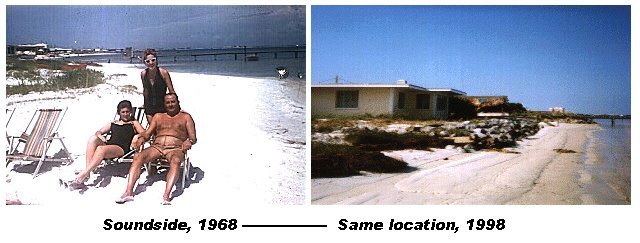
"It's strange; we look just east and west of us and homeowners are losing beach," Charlie Thompson said. "A lot of these docks are sitting over sand."Above the front-page fold in today's PNJ, Sean Smith reports that the National Park Service has ponied up "$50,000 to $60,000" for a University of West Florida study of the "impact of north winds compared to hurricanes" along Santa Rosa Sound.-- Pensacola News Journal, January 5, 2006
This isn't the first such "study" and you can be sure it won't be the last. When it comes to Santa Rosa island, studying and re-studying -- and re-studying again -- is a cottage industry for colleges, academic institutes, coastal engineering firms, consultants, and government agencies.
Think full employment program for geologists and their students.
The SRIA has funded, in part or in whole, at least two such studies of Santa Rosa Sound, alone, in the last ten years. One of them supposedly was intended to measure the effects of a first-ever sand renourishment project along Quietwater Beach. Nothing but a preliminary report ever came of it. The final report (if there was one) has never been released to the public.
The Corps of Engineers launched a major study of island erosion after Hurricane Opal, and a second one in July 2001, in preparation for the Gulf-side sand renourishment project of 2002-03. Results? Who knows? It's not even clear if there was a final report.
The National Science Foundation gave a 5-year grant to Louisiana State University coastal morphologist Dr. Greg Stone after Hurricane Opal. He released a detailed final report in March, 2001. Among other things, it includes surveys -- right down to the centimeter -- of sand deposition and erosion on Pensacola Beach from the time of Hurricane Fredric (1979) through Hurricane Georges (1998). Want to wager if any board member on the Santa Rosa Island Authority or the Escambia County Commission has read it?
The State of Florida issued both a preliminary and a final coastal erosion report covering the same topic after Hurricanes Opal and Erin in '95. Odds are no one in any department of Escambia County could find a copy if you gave them a week.
Another Florida agency regularly compiles erosion data on all Florida coastal lands using aerial and GPS satellite measuring devices. They visit every coastal area in the state at least once every five years, often more frequently. Results then are compared with earlier data, resulting in a detailed analysis of erosion changes over time. (The team last visited Pensacola Beach in the summer of '04, just before the up-tic in hurricanes began.)
And through it all, island government, county officials, and state licensing agencies continue to authorize new construction on the coast, bulkheads, seawalls, rip-rap, rock revetments, ever longer piers jutting into intercoastal waterways, and other counter productive thumbs- in-the-dike.
Today's News Journal article quotes beach resident Charlie Thompson's observation that the Soundside erosion he sees all around him is "strange." But there's no mystery to it.
We study and we study and we study. But we never learn.
Wednesday, January 04, 2006
Beach School Reopens
PNJ reporter Michael Stewart does his amends by covering the reopening of Pensacola Beach Elementary school.
"Grain Casserole'
Pensacola native, and now WaPo city editor, Robert Barnes shares his an old cookbook's recipe for oven baked grits in today's Washington Post.
Tuesday, January 03, 2006
Shorter Greenwald
Shorter Glenn Greenwald: "[T]he only way to defend George Bush is by arguing that he has the right to disregard the law – a premise so intrinsically alien to the most ingrained American principles, regardless of political ideology, that all but his most slavish supporters will be highy reluctant, if not outright unwilling, to defend him here."
Small Town News
There are slow news days... And there are small town newspapers ... And there are student newspapers even in Middle School.
Then, there is the Pensacola News Journal.
The real news here is "Pensacola Beach Elementary School ... reopens today after a $2 million renovation to repair damage caused by Hurricane Ivan in September 2004." But the PNJ's headline reminds one of the headline in an old mid-'70s parody Sunday Newspaper, the "Dacron, Ohio Republican-Democrat," produced byHarvard National Lampoon.
The front page headline reads something like, "Two Local Women Missing in Japan." Eight paragraphs or so down the column one learns an atomic bomb had exploded over Tokyo, incinerating millions.
Addendum, Correction, and Amplification
Below is an excerpt from the front page:
Then, there is the Pensacola News Journal.
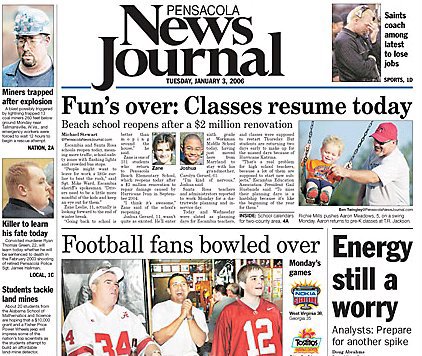
The real news here is "Pensacola Beach Elementary School ... reopens today after a $2 million renovation to repair damage caused by Hurricane Ivan in September 2004." But the PNJ's headline reminds one of the headline in an old mid-'70s parody Sunday Newspaper, the "Dacron, Ohio Republican-Democrat," produced by
The front page headline reads something like, "Two Local Women Missing in Japan." Eight paragraphs or so down the column one learns an atomic bomb had exploded over Tokyo, incinerating millions.
No, we remembered that wrong. It wasn't an atomic bomb. (We should have figured this out. Atomic bombs are not funny. Apparently, volcanos are.)
The actual front page of the Dacron Republican-Democrat is here:
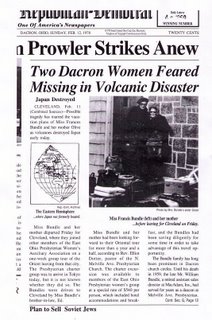
The actual front page of the Dacron Republican-Democrat is here:
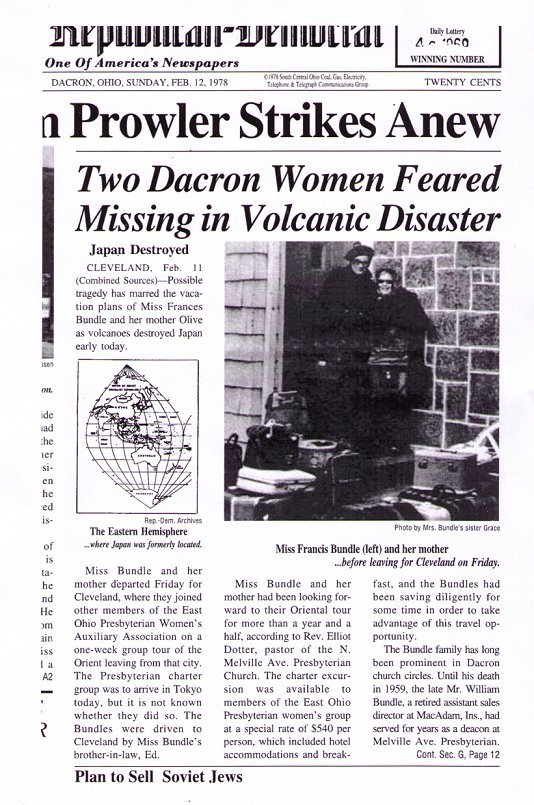
Possible tragedy has marred the vacation plans of Miss Frances Bundle and her mother Olive as volcanoes destroyed Japan early today.And, just what happened to everyone else in Japan?
Miss Bundle and her mother departed Friday for Cleveland, where they joined other members of the East Ohio Presbyterian Women's Auxiliary Association on the one week group tour of the Orient leaving from that city. The Presbyterian charter group was to arrive in Tokyo today, but it is not known if they did so. The Bundles were driven to Cleveland by Miss Bundle's brother-in-law, Ed.
Miss Bundle and her mother had been looking forward to their Oriental tour for more than a year and half, according to Rev. Elliot Dotter, pastor of the N. Melville Avenue Presbyterian Church. The charter excursion was available to members of the East Ohio Presbyterian women's group at a special rate of $540 per person, which included accommodations and breakfast; and the Bundles had been saving diligently for some time in order to take advantage of this travel opportunity.
The Bundle family has long been prominent in Dacron church circles. Until his death in 1959, the late Mr. William Bundle, a retired assistant sales director at MacAdam, Ins., had served for years as a deacon at Melville Avenue Presbyterian.....
Monday, January 02, 2006
Hindcasting Wind vs. Water
"In almost every instance, you're going to find that a significant amount of damage was caused by the wind before the water ever got there."It's hard to imagine if you don't live in the South, but as the new year gets underway hundreds of thousands of Americans along the Gulf Coast and in Florida are still living in temporary shelters, hotel rooms, or tents while trying to collect on their property insurance policies. On Pensacola Beach, an estimated 400 homeowners are still being stiff-armed by their insurance companies, nearly a year and a half after Hurricane Ivan.-- Ron Peresich, Boloxi hurricane victim
An AP dispatch reprinted in Sunday's Picayune (MS.) Item offers one of the more practical and succinct reports we've seen about how homeowners can successfully fight the insurance industry's coordinated claims-denial strategy. The context is property damage caused by Hurricane Katrina, but it could just as easily be applied in the context of hurricanes Wilma, Dennis, or Ivan.
The question storm damage insurers always want to ask is: 'Was wind the culprit, or water?'
Because of Katrina's unprecedented destruction, it is a multibillion-dollar question for the insurance industry. Companies have hired engineers to provide the answer, one property at a time, even when a slab is the only evidence left.A number of property owners personally witnessed the destruction of their homes. Almost invariably, they report that destructive high winds long preceded the flooding water.
Property owners must either settle for what's offered, or hire their own experts, including attorneys and engineers, and find eyewitnesses to document wind damage.
Bay St. Louis resident Kelvin Schulz, whose mother-in-law died during the hurricane, saw the wind cause plenty of damage before water swamped his beachfront neighborhood. One neighbor, who was left with only a slab, is relying on him as a witness to her wind losses.Can't prove it? Not so fast... It can be proved even if you had the good sense to evacuate beforehand and therefore cannot be your own eye witness.
“The wind came in and did a tremendous amount of damage,” Schulz said, “and then the water just finished it off. The only thing the insurance companies are doing is adding insult to injury. A lot of people had losses prior to the flooding, but you can't prove that because it washed away.”
The U.S. Navy and NOAA have prepared "Preliminary Storm Surge Hindcasts" for every recent hurricane, modelling the exact timing and extent of damaging winds and flooding waters. The Hurricane Katrina Hindcast is available here, courtesy of U.S. Rep. Gene Taylor (D-Miss). (Congressman Taylor's web site has other useful storm recovery information as well.)
Apparently, the "hindcast" was prepared by the Navy Meteorological and Oceanography Command at the Stennis Space Center in Biloxi. Surface wind analyses for other hurricanes also have been compiled by NOAA's Hurricane Research Center.
In most cases, it will take an expert to analyze the data. But it's worth it. Here's how Tim Destri of NOAA's National Weather Service summarizes the data --
“It's always the wind, no matter what insurance (companies) try to tell people. You almost always get some damaging winds before the water starts coming.”When you think about it, hindcasting will save lives, too. How many homeowners, burned once by their property insurers, will insist on staying home the next time a hurricane comes along, just so they can personally collect proof enough to satisfy their insurance companies?
The Insurance Storm
Insurance Struggles 'Worse Than Ivan'
Parsing of the Peril
Citizens' Ministry of Truth
Wind vs Water Rematch
Quote of the Week
Mississippi Beating
'Mired in Mud'
Slow Rolling In Mississippi
Trent Lott Sues State Farm
Sunday, January 01, 2006
Hot Times on Pensacola Beach
On New Year's Day morning Barrier Island Girl says it's too warm on the beach.
Florida Dog Food Alert

Diamond Pet Food Company is recalling a wide variety of dog food products sold under labels that include "Diamond," "Country Value" and "Professional." The dog food is contaminated with aflatoxin, a poisonous chemical which can cause liver failure and death.'Quite a few distributors are in the Pensacola area and across the Florida Panhandle including, alarmingly, the Pensacola Greyhound Track... .'
The food was manufactured between September and December and distributed throughout the Southeastern U.S. -- including Pensacola, the state of Florida, and some 29 other countries, according to a U.S. Food and Drug Administration public alert.
Typical symptoms of an afflicted animal include lethargy, loss of appetite, yellowing of the eyes or gums, vomiting, and bloody diarrhea.
The Diamond Pet Food web site lists over 400 retailers throughout Florida who sell Diamond dog food. Quite a few distributors are in the Pensacola area and across the Florida Panhandle -- including, alarmingly, the Pensacola Greyhound Track at 525 Windrose Circle.
For more information on identifying the contaminated dog food, check the brand names listed by the FDA and check the Diamond product recall guide explaining how to identify the recalled products.
Saturday, December 31, 2005
Friday, December 30, 2005
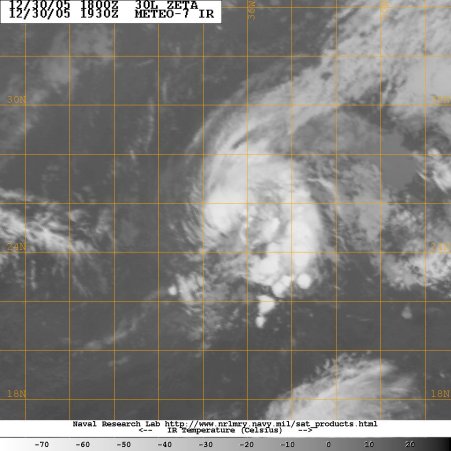
T.S. Zeta Closes Out '05
Pensacola Journalists of the Year
As the year comes to a close, Pensacola's Independent News is busy patting its own back about the free weekly newspaper's Top Ten Cover Stories of the year. Allegations about the brutality and stupidity of local law enforcement officials (Headlines # 1, and # 2, and # 6) definitely predominate.
We'd like to give the Independent News a big pat on the back, too. The year-end issue and the top ten stories it references deserve a read by anyone who's interested in knowing the underside of Pensacola, the one that somehow never gets mentioned in the tourist brochures. (Unfortunately, the web article itself doesn't provide direct hyperlinks from each featured headline of the year to the archived original story, but you can use the search function page to navigate to each weekly issue.)
Along the way, the Independent News also takes a few potshots at the "Gannett-owned daily paper, Pensacola News Journal." That's a snarky subplot which has run through a number of IN stories over the years -- and fairly so. The news stories the News Journal doesn't cover, or arrives at embarrassingly late, certainly underscore just how much the media giant, Gannett Corporation, starves its Northwest Florida outlet of necessary resources.
The IN doesn't always pick on its daily competitor. Publisher Rick Outzen himself complimented the paper when Gannett assigned 30 extra reporters for a time to ensure truly superb coverage of Hurricane Ivan.)
But the lack of sufficient resources isn't the only cause for failings at the News Journal. Witness the IN itself. While the weekly isn't entirely a one-man show, there's little doubt that Independent News editor Duwayne Escobedo is its heart, soul, and brains. He wrote six out of the "top ten" stories featured for the year and several others just as good.
So what if he also wrote the "Top Ten" article itself? Almost alone, Duwayne Escobedo is more than a match for the daily News Journal's entire investigative reporter staff -- or what's left of it. The only thing Escobedo can't match is the News Journal's proclivity for choking its pages with trite, white bread family feature articles and the insipid ramblings of local columnists.
Which brings us to the one story from 2005 you won't see mentioned by anyone, not even the Independent News. That's the persistent rumor over the last half of the year that IN publisher Rick Outzen is exploring the possibility of selling the weekly.
Some speculate that he soured on the virtues of being a truly independent publishing voice after drawing heavy criticism for raising questions about Rebuild Pensacola's opaque accounting practices (Headline # 4). Given the close and cozy atmosphere of Pensacola's business elite, inevitably some of those critics were his personal friends, business associates, and advertisers.
The rumors may be just that and no more. After all, only a typically naive, bargain-hunting Yankee carpetbagger-- the same kind of customer all those water-front house sellers are hoping to snag before next year's hurricane season -- would buy the Independent News without a guarantee that Duwayne Escobedo would be part of the bargain.
In the ever-shrinking league of Pensacola journalism, Escobedo is The Franchise; he's Alex Rodriquez and Albert Pujols rolled into one.
Which is why, if there were an award for Pensacola Journalist of the Year, Duwayne Escobedo should get it. And Rick Outzen deserves to be named Pensacola Publisher of the Year for somehow keeping him on the job.
We'd like to give the Independent News a big pat on the back, too. The year-end issue and the top ten stories it references deserve a read by anyone who's interested in knowing the underside of Pensacola, the one that somehow never gets mentioned in the tourist brochures. (Unfortunately, the web article itself doesn't provide direct hyperlinks from each featured headline of the year to the archived original story, but you can use the search function page to navigate to each weekly issue.)
Along the way, the Independent News also takes a few potshots at the "Gannett-owned daily paper, Pensacola News Journal." That's a snarky subplot which has run through a number of IN stories over the years -- and fairly so. The news stories the News Journal doesn't cover, or arrives at embarrassingly late, certainly underscore just how much the media giant, Gannett Corporation, starves its Northwest Florida outlet of necessary resources.
The IN doesn't always pick on its daily competitor. Publisher Rick Outzen himself complimented the paper when Gannett assigned 30 extra reporters for a time to ensure truly superb coverage of Hurricane Ivan.)
But the lack of sufficient resources isn't the only cause for failings at the News Journal. Witness the IN itself. While the weekly isn't entirely a one-man show, there's little doubt that Independent News editor Duwayne Escobedo is its heart, soul, and brains. He wrote six out of the "top ten" stories featured for the year and several others just as good.
So what if he also wrote the "Top Ten" article itself? Almost alone, Duwayne Escobedo is more than a match for the daily News Journal's entire investigative reporter staff -- or what's left of it. The only thing Escobedo can't match is the News Journal's proclivity for choking its pages with trite, white bread family feature articles and the insipid ramblings of local columnists.
Which brings us to the one story from 2005 you won't see mentioned by anyone, not even the Independent News. That's the persistent rumor over the last half of the year that IN publisher Rick Outzen is exploring the possibility of selling the weekly.
Some speculate that he soured on the virtues of being a truly independent publishing voice after drawing heavy criticism for raising questions about Rebuild Pensacola's opaque accounting practices (Headline # 4). Given the close and cozy atmosphere of Pensacola's business elite, inevitably some of those critics were his personal friends, business associates, and advertisers.
The rumors may be just that and no more. After all, only a typically naive, bargain-hunting Yankee carpetbagger-- the same kind of customer all those water-front house sellers are hoping to snag before next year's hurricane season -- would buy the Independent News without a guarantee that Duwayne Escobedo would be part of the bargain.
In the ever-shrinking league of Pensacola journalism, Escobedo is The Franchise; he's Alex Rodriquez and Albert Pujols rolled into one.
Which is why, if there were an award for Pensacola Journalist of the Year, Duwayne Escobedo should get it. And Rick Outzen deserves to be named Pensacola Publisher of the Year for somehow keeping him on the job.
Subscribe to:
Posts (Atom)