Showing posts with label pensacola beach. Show all posts

Tuesday, June 15, 2010

Obama at the Pensacola Beach Fishing Pier

Full text of President Obama's remarks on Pensacola Beach:
_______________________

Remarks by the President After a Briefing with Admiral Thad Allen and Local Officials on the BP Oil Spill

Fish Sandwich Snack Bar, Pensacola, Florida

9:48 A.M. CDT

THE PRESIDENT: We just had a very useful discussion, and I want to thank Governor Crist and the congressional delegation, as well as our owner here, Mike Pinzone, of this wonderful facility overlooking this beautiful beach. I want to also thank the mayor of Pensacola for his hospitality.

What we’ve done is to try to find out from local business owners, local officials, as well as state officials like Alex Sink and Senator LeMieux and others, how the response can be most effective here specifically in Florida. And when you look out over this unbelievable beach, one of the things that you can see is that so far at least this beach has not been affected.

This is a still place that’s open for business and welcoming so vacationers and people can have a wonderful holiday here. And I know the mayor wants to emphasize that. But there are obviously fears about the oil that is offshore.

And what we emphasized was that we’re going to be doing everything we can -- make sure that there are skimmers out, there are booms out, and a response to keep the oil offshore. But even if we do the best possible job on that, what the mayor described, what Mike described as a local business owner here, is that they’re still being affected by perceptions -- that business has dropped off as much as 40 percent in this area. And that has an impact on the entire economy. You saw the same thing yesterday when we were in Alabama and Mississippi.

So a couple of things that we’ve done. Number one, to make sure that there is a nimble and effective local response, Thad Allen has now assigned deputy incident commanders to each of the individual states, so Florida will have its own deputy incident commander, as Mississippi and Alabama do.

In addition to the sites in Houma and in Mobile, we’re also going to set up an incident management team in Tallahassee, here in Florida. All this is designed to make sure that on the federal response we are able to work and make decisions at a local level in response to the suggestions of people who know the communities best and know the waters best. And my expectation is, is that we’re going to see a lot of good ideas coming from the local area that we can implement right away, as opposed to waiting until it goes all the way to the top.

But the other thing that we’re hearing here is the same thing we heard yesterday, which is businesses need help right now. I’m going to be addressing this this evening, the issue of how we can make sure that claims to businesses that have been affected are responded to quickly and fairly.

I’ll be meeting with BP chairmen and officials tomorrow to discuss the stories that I’ve heard from people like Mike. Mike has put in all the paperwork. In fact, he has documented more than amply the fact that his business has been deeply affected by this crisis, but he hasn’t received the compensation that he needs to make sure that his business stays open.

And I told Mike -- and I want every business person here in Florida to know -- that I will be their fierce advocate in making sure that they are getting the compensation they need to get through what is going to be a difficult season. But what I described for them is the fact that if we can get through this season, cap this well, mitigate the damage -- we’re not going to eliminate it completely; there’s going to be damage to the shoreline -- but if we can reduce it as much as possible, help businesses get through this season, clean it up, by the time we get to next season there’s no reason why this beach behind us is not going to be as beautiful as ever, and Pensacola and other coastline communities across Florida won’t be thriving as they always have.

So the key right now is just to make sure that people like Mike are helped, that they’re able to get through what’s going to be a tough time. And I told him and I told the governor and all the other Florida officials here that we’re not going to go away. We’re just going to keep on at this until we are able to not only get back to normal, but maybe even get better than it was before this crisis.

So I appreciate everybody’s input, and we look forward to continuing to work with you on this enormous challenge.

END

9:53 A.M. CDT

Sunday, June 13, 2010

Pensacola Pass Before the Booming

We've already mentioned Friday's stroll around Ft. Pickens National Seashore Park. That was when we lucked into a two-hour scoop on word that the Unified Command in the Mobile section had just authorized the booming of Pensacola Pass.

We took a number of other photographs that day which we normally wouldn't bother sharing since we were using a simple little pocket camera and there were on hand a number of far more skilled and much better equipped newspaper and television photographers at the same location. But, as it turns out, they weren't interested in what we stumbled upon, so what the heck.... Let's share.

Here are some more or less selected scenes from our walk-about to the western tip of Santa Rosa Island before the booming. (You can see a detailed view by clicking on each picture.)

At the seawall near Ft. Pickens fishing pier (above), Cheeseburger the chihuahua eagerly introduced himself with tongue and paw. He and his owner, Pensacola painting contractor Ted Dwiggins, were taking the rest of the day off to say goodbye to a healthy Pensacola Bay.

"I finished a job this morning," Dwiggins explained, "and we thought we'd come out here while it dries."

"Got treats?" Cheeseburger asked.

"There are tarballs all along the beach," Dwiggins warned.

He had brought with him a pair of binoculars. Pointing them at the bay he added, "I think there's a large sheet of oil beneath the surface out there. Can't really see it, though."

"Throw ball?" Cheeseburger inquired. "Or stick?"

"We come out here a lot," Dwiggins added. "It's our favorite place. Guess we won't be coming out for months, now. Maybe longer."

"Scratch my back?" Cheeseburger proposed.

We patted our good-byes and walked along the surf line a short distance down the beach before spotting large and small tarballs washing back and forth in the surf (below).

Most were black, crusty things variously the size of a dime to a half dollar. Others were orange-colored, oleaginous blobs of goo.

Some tarballs had been caught up in clumps of seaweed and thin plastic strings that look like cheerleader pom-poms (below).

Those that didn't cling to small bits of seaweed were amorphic in the water. Once deposited on sand above the water's edge, they assumed a somewhat more definite shape, almost like sea anemones, and glinted brightly in the sun as if to counterfeit signs of life.

Our walk along the beach was interrupted by a television crew from Mobile. They were wandering the beach, as we suppose, looking for visually compelling images suitable for a commercial television audience.

The relatively small tarballs at their feet must not have been sufficiently dramatic for the camera lens. But they found Joe Magyarosi.

Joe is a long time, colorful character who lives on Pensacola Beach. He once was a plumber in Allentown, Pennsylvania, as we recall.

Asked by the TV news reporter what he thought about the looming environmental crisis, Joe answered with a question of his own, "Why are we on defense?" he demanded. Quickly, he answered his own question: "We should be playing offense."

Before the startled reporter could respond, Joe dropped to his knees and like a field general in the midst of a battle that's going badly he started to furiously sketch out in the sand a battle plan he had in mind for positioning an entire navy of oil skimmers here, and there, and over yonder. The reporter snapped to attention and the cameraman continued filming (below).

The sun was bright. The sand was dry and powdery. Any finger-digging collapsed easily. The crucial battle lines, circles of imaginary boats, and the sweeping paths of Joe's mythical Skimmer Navy remained elusive to our eye. They probably didn't show up too well on camera, either.

Randomly scattered nearby were used oil booms and plastic garbage bags filled with clumps of thin plastic strips resembling cheerleading pom-poms (below). In the distance, around a gentle bend in the beach, we could make out what looked like a large garbage scow anchored in the water. On shore, a small group of clean-up workers were resting in the shade of a tent.

We stopped to talk with the crew leader. He didn't tell us his name, but said he was from Pensacola. He explained that he leads subcontractor disaster clean-up crews for a living.

He told us he had just arrived back in Pensacola from the Nashville flood. It was "an awful mess," he said. "Got almost no news coverage, though. I guess the media would rather watch the oil."

Farther along the beach we found more evidence of oil pollution on the surface of a discarded motor oil jug (below). The irony was evident.

Some boater, somewhere, had tossed the emptied jug overboard as if this one small addition of plastic pollution could not possibly harm the vast waters of the Gulf of Mexico. Later, fresh oil from BP's broken Deepwater Horizon well had clung to it like a life raft. Now, the whole mess had made landfall to despoil the beach.

More evidence of the transport of leaking oil through man's careless littering rested near the water's edge, fresher than the last. An old, weathered plastic bottle had washed up on the beach (below). Stuck to its underside was an orange-colored, pulpous patty of oil. Grains of sand clung to it, trapped by the sticky substance.

We passed the garbage scow, or barge, we had seen earlier. In the bow was a huge garbage container. Behind that, about midship, we noticed a meeting seemed to be taking place.

About half a dozen men were sitting around a makeshift table under a tent (below). One was writing something down. At that distance we couldn't be sure but it looked like he was dressed in a cream-colored suit and wearing a hazmat vest over it.

Others in work clothes were milling about looking for shade wherever they could find it.

We mused at the scene: a rusty old barge that serves as a meeting place for swells in suits as well as shade for workers in blue jeans dressed for hard labor. A catastrophic oil spill levels everybody.

At the western-most end of Santa Rosa Island we came upon three figures fishing (below).

"You don't plan on eating anything you catch, do you?" we asked.

The two men, both locals, said yes, they did. "Haven't seen any oil yet," one added as he baited a hook.

"There are tarballs all along the beach," we pointed out.

"Didn't see 'em," the other man claimed in a surly way as he turned back toward his pole.

The fishermen didn't seem to want company any more than the blue heron did. As we turned back to retrace our steps it occurred to us that all three of these creatures may well be the last fishers at Pensacola Pass for months or even years to come. Of the three, however, only one of them truly did not know what was about to happen to his way of life.

We turned back to take one last photo. All three were back at their labors, seemingly oblivious to the arriving oil.

Just beyond, we could plainly see the dividing line between bay and Gulf. It's where the turquoise water of the western tip of Santa Rosa island meets the deep blue waters of the Gulf of Mexico (below).

On the return trip we saw a pontoon party boat had been beached. A dozen or so women were swimming, sitting, wading, and standing in the water (below). They appeared to be of a wide range of ages, from their twenties to the sixties.

Although it was early afternoon, these women were feeling no pain. Several of them hollered out and raised their glasses in a raucous greeting as we approached.

"Are you members of some club?" we stupidly asked.

"Thas' raht, hon'," one shouted back amid a din of laughter. "We're the N'awlins Girls."

"Y'all like wimmin or men?" another asked to more peels of laughter.

Standing there at the water's edge, talking with half-dressed strangers in the midst of the largest natural disaster in U.S. history, it seemed an odd question, yes, but we have long since given up judging others for how they are reacting to the BP oil spill.

We considered a judicious reply. We answered that we liked them both but only slept with women.

"Wall, thas' all right, then. Y'all come rah't in the water."

We politely declined and wished the visitors well. That evening, She Who Must Be Obeyed mentioned that she thought she had seen some of the same women on the television news, being interviewed by another TV reporter while they partied on Orange Beach.

It was after this that we passed a Pensacola News Journal photographer. We laughed to ourselves as we contemplated him being cross-examined about his sexual orientation by the "N'awlins Girls."

It was then that we met Dusty Warner, the park ranger who told us he's section head for the Unified Command. He was marching smartly behind us as we walked toward the fishing pier where we'd first met Cheeseburger and his owner.

We stopped and the ranger quickly caught up. He was an enormously friendly, charming man -- and completely open about who he was and what he had been doing.

We were so interested in Ranger Warner's description of his decision to permit booming of Pensacola Pass that we didn't even think to ask him why he happened to be in full uniform walking the beach on such a hot day, or where he was coming from. It was only later that we realized the only place he could have come from was that old barge, the one where we had seen the indistinct figure of a man, dressed in an oddly formal way under a hazmat vest, writing at a table.

We have no way of knowing for sure, but we'd like to think our little pocket camera accidentally captured the very moment history was made on that old barge and Pensacola Pass was closed for the first time since the Civil War.

Monday, June 07, 2010

Mellow Monday: June 7 BP Oil Spill Update

1. Three-Day oil forecast.

NOAA projects the leading edge of BP's oil spill, nudged by "persistent southerly winds" will continue hugging the coast of Northwest Florida over the next three days. (Click here or on graphic, above, for enlarged view.)

Monday morning on the beach, however, a light, hot wind was blowing north-to-south, just as weatherman Matt Barrentine (Channel 10, Mobile) predicted:


2. Clean beach.

Despite the new "don't touch oil" warning on the electronic greeting board for those entering the beach (see left), so far today there have been almost no reports of tarballs or oil sheen.

Of course, this disappoints all the robots inside the media trucks gathered at Casino Beach (see right). They're waiting impatiently for the chance to break into the news cycle with blood-stirring bulletins of an oil tsunami.

On the other hand, a good many of the human TV crew members we've met have fond personal memories of vacationing on Pensacola Beach. More than a few even lived here for a time in their younger days.

It's plain to see they're just as happy to see the oil stay away. Plus, the rest breaks are more relaxing:

3. Sarcastic Sand Sculptures.

Yesterday, as the local newspaper reports, "sand art" blossomed on the beach. More than one of the sand sculptures in the annual Five Flags Festival contest struck an oily theme.

One incorporated tarballs as the eyes of a large crab. Another was a gargoyle with a sickly green hue named "Mr. BP."

All were still visible this morning. Some were more at risk from the next high tide than any oil.

Our personal favorite, for both aesthetic and political reasons, is the sand art entry submitted by David and Kathy Bosso. Judging from the comments we overheard from discerning beach-goers, it's their favorite, too (click graphic for enlarged view):


4. Tarball Report.


On most of the 15 mile stretch of sugar white sand which we saw this morning there was no sign of oil. Beach walkers, curiosity seekers, surfers, swimmers, sunbathers, lifeguards, and park rangers, all told us they had seen no tarballs or new evidence of oil.

Apparently, however, one report had been made of small tarballs on a stretch of beach just west of Pensacola Beach's "Ft. Pickens Picnic Area," inside the federal park itself.

This is where we saw two of the best-equipped beach cleaning squads we have witnessed in the past week. They were all outfitted with hazmat suits, armed with appropriate tools and water for today's expected heat index of 105+, and afforded the shade of two tents for frequent breaks.

That's the way all clean-up crews should be outfitted. But we worry that BP Corp. has subcontracted to other companies much of the beach clean-up responsibility and then defaulted in its responsibility to ensure that subcontractors treat their clean-up employees with fairness and humanity.

5. Bay Booms.

Because the oil arrived last Friday and continues to hang around just offshore, booms now have been stretched at least part-way across the entrance to Pensacola Bay, known as Pensacola Pass, and the much narrower entrance to Little Sabine Bay at Pensacola Beach.

At the pass, frankly, it's hard to see what good they will do. Although the water was unusually calm this morning, most of the time the surface waters at the pass are choppy. That's where most tourists learn whether they're prone to seasickness. Large amounts of oil will have no trouble sloshing over the planned V-shaped boom.

The boom isn't quite closed at Little Sabine Bay, for good reason. Some charter boats anchored there are still hopeful of customers; many fishing boats have been hired by BP to scout the open Gulf waters for oil slicks. Both need to get in and out of Sabine Bay as well as Pensacola Bay.

6. Family Values on the Move.

Then there are the immigrant swans. They need access to Little Sabine Bay, too.

We happened to encounter a swan family moving into Sabine Bay this morning. Unlike human beings, swans are notoriously monogamous. They usually mate for life, although some Australia researchers think they have detected evidence that some of them are learning bad habits from humans.

Sorry, Arizona, we forgot to ask the swans for their papers. But we assume what we saw this morning was the more usual story-book "traditional American family unit" of a daddy swan, a mommy swan, and a baby swan.

Look carefully. Such an idealized family exists only among swans and in the fevered imaginations of right-wing preachers and hypocritical politicians.

7. EPA air monitors.

While we were wandering around the western tip of Santa Rosa Island, we spotted a number of multi-gas air quality detectors. They bear the ownership label of the U.S. Environmental Protection Agency and were placed inside the federally-maintained Ft. Pickens portion of the Gulf Islands National Seashore.

Not long after, we encountered a two-man team of environmental assessment specialists who also were touring the grounds of Ft. Pickens. They, too, were planning to monitor air quality. They claimed to be working for a private company "under contract" to someone else.

To whom were they under contract? They said they didn't know. But they were most interested in seeing our photos of the EPA's equipment.

One gets the notion, now and then, that BP's left hand doesn't know what the Government's right hand is doing, and vice versa.

Saturday, June 05, 2010

Mid-Day Pensacola Beach Oil News

From Escambia Disaster Response:
  • This morning, Saturday, June 5, reports have been received that more tar balls and mats have washed ashore on Pensacola Beach. Initial reports are that the extent of this second impact is less than the initial one. Unified Command has deployed clean-up and assessment teams.
  • The oil sheen is reported less than one mile off the shore.

  • On the morning of Friday, June 4, tar balls and tar mats, ranging in size from 3 cm to 18 cm in size, washed ashore on a widely scattered areas on Pensacola. The unified command deployed over 300 people as part of clean-up, assessment and boat crews to the affected areas.

  • Pensacola Beach is open for business.
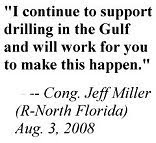
In an earlier advisory EDR mentioned that Northwest Congressman Jeff ("Mr. Oil Spill") Miller "will have a media availability at 11:15 am" at some distant location on Airport Blvd. in Pensacola -- just about as far as one can get from the oily beaches and still be inside the Pensacola city limits.

We're sure everybody is real sorry to have missed him. Many of us were too busy wiping his tarballs off the beach.

Friday, June 04, 2010

A Trip Down the Emer-Oiled Coast: Friday June 4 BP Oil Spill Update

"I've been all over the world; even south Florida. I've seen many pretty places, but this beach is the most beautiful I've ever seen."
-- Northeastern clean-up worker, June 4, 2010.
By now the whole world knows that an advance tongue of BP's lake of oil has reached Pensacola Beach. Indeed, it is washing up on beaches along the entire forty-mile length of Santa Rosa Island.

Today we took a leisurely trip along the westernmost half of what used to be known as the "Emerald Coast." We began at Navarre Beach and gradually proceeded, with refreshment stops, all the way to the western tip of Santa Rosa Island. Here's what we found:

1. Navarre Beach Near Normal.

To all outward appearances, Navarre Beach late this morning was unusually crowded for a Friday morning but otherwise normal. Lots of sunbathers, young kids gamboling in the surf, even a surf boarder or two.

Only a close inspection of the waves as they spent themselves on the beach revealed the occasional small, orange tarball. There were not many, even at mid-day. And, most were as small as dime; a very few were the size of a quarter.

The vast majority of tarballs were small, burnt-orange in color, and gooey-soft.We looked particularly for any signs that young swimmers were coming in contact with the oil. We saw none. Everybody seemed to be having a great time.

2. BP Clean-up Workers.

We happened to arrive at Navarre Beach just as three clean-up crews were unloading from a fleet of brand-new oversized white vans. Some of the vans were so new they had only temporary plates.

The vehicles bore license plates from a variety of states -- Alabama, Florida, Georgia, North Carolina. From the looks of it, BP has rented every van they could lay their corporate tentacles on throughout the Southeast.

Just for fun, we snapped a photo of a couple of the license plates and mashed them up (below).
These plates are from two of eight vans we saw at Navarre Beach. All were disgorging workers who had been given no protective clothing. After each crew exited a van they gathered together, then headed immediately for the beach.

The crews had shockingly few tools. One or two were armed with a shovel, some with sticks and plastic bags. Most were carrying nothing.

3. Clean-up Crews Under Wraps.

Every time we encountered clean-up crews, we tried to engage them in conversation. Normally, we're pretty good at that. We're a talkative sort, fairly friendly, and even if we do say so ourselves, we've had a lot of experience, from one end of the globe to the other, at getting complete strangers to open up.

Not today. Not with this crowd. We tried talking with several of the workers at several different beaches. Almost all refused to say a word.

Some ignored us. Most merely shook their heads from side to side as if to say, 'No, man. I can't say a word' or 'Don't you get it? I need this job.'

One brave worker did tell us he wasn't "from around here." But he, too, silently shook his head when we followed up by asking where he was from.

It was obvious that all the workers were under strict instructions to talk to no one. Many seemed, frankly, terrified to be approached. One fellow referred us to what he called "the head man." He turned out to be a middle-aged guy with a southern accent and a large paunch hanging over his belt. His hands looked as soft as his belly.

He, too, admitted he wasn't "from here." But he wouldn't say where he came from. When we asked, he silently dug into his pants and, after a short struggle, pulled out a small roll of ten identical thin strips of paper, all bearing the same typed message:

"Here," he said, handing us one of the strips. "You got any questions you call this number."

"Do they know where you're from?" we asked innocently.

On the slip of paper was a Louisiana phone number. If you want to know who we were trying to talk to, give 'em a call.

4. Opal Beach, National Seashore.

At Opal Beach, a few miles down the road, we had much better success talking with two bird watchers and their family. Using a classy spotting scope, they thought they might have identified two Pacific something-or-others -- loons or gulls or whatever -- out over the water. "They're quite rare here," I was assured.

They told me that just minutes before I arrived, clean-up crews had been covering the beach in front of them.
"Then, one of them got a call," the woman said. "We heard him say something about a report of oil at Navarre Beach. They all packed up and went running for their vans. And, poof! they were gone."

In fact, the tarballs at Opal Beach were bigger and much more in evidence than anything we had seen on Navarre Beach. The average size of tarball there was a half-dollar, as one of our new found friends illustrated (up, left).

With every ebb of the surf, dozens of coin-sized black tarballs and larger patties of orange goo remained behind. With every flow, more came ashore.


5. Pensacola Beach.


Pensacola Beach was crowded, too. Partly, perhaps, due to all the national media crews that have descended on us.

Conditions there were worse than at Opal Beach. Tarballs were a bit larger and much more numerous. This didn't stop sunbathers or most swimmers, at least not while we watched.

They should have taken a look at what we saw. A CNN crew member had been handed two tarballs, so she told us, by a 'clam digger' who said he had found them at Navarre Beach. (See photo at the top of this article.) She had placed them in a 16 oz. styrofoam cup.

"But they melted in the heat of the sun," she complained.

A woman standing next to us asked if she could take a picture of the melted tarballs.

"Does this belong to you?" she asked the CNN woman.

For answer, the CNN woman snickered. "It belongs to BP, I guess."

6. Ft. Pickens.

At Ft. Pickens, on the very western edge of Santa Rosa Island, things remained much as they were yesterday. At early afternoon, the V-shaped boom planned to protect Pensacola Bay was still not deployed, although it looked like preparations were underway.

A small crew of workmen were taking a break in the shade of a small bathroom building when we pulled up. Many had been here, they told us, for more than a month. They were employed by a subcontractor of BP's.

These men were outfitted with hazmat suits and safety equipment, although we didn't see any air filter masks.

"They're coming -- tomorrow," one man said. We couldn't be sure, but it sounded as if he was quoting a boss who might have been repeating the same phrase day after day.

These men spoke much more freely than the other clean-up crews we had encountered. We asked how the oil spill was affecting Ft. Pickens. One man from the Northeast answered, "We've got it under control."

"You know?" he added. "I've been all over the world; even south Florida. I've seen many pretty places, but this beach is the most beautiful I've ever seen. Even with the oil."


We who live on Pensacola Beach know he's right. For now. Many of us also fear that soon enough he will be wrong.

BP's oil has now come ashore. It will get worse here, no matter what happens at the wellhead from now through August. The beach can be cleaned, eventually. In the meantime, we'll just have to enjoy what pleasures the beach still can give -- and pitch in to help keep it that way.

More on that last point another day.

add pic minor edit 6-05am

Thursday, June 03, 2010

Loathsome Landfall Likely: Thursday June 3 BP Oil Update

What would-be tourists in their right mind are likely to pack up and head for the "clean, clear" water of Pensacola Beach ... when the forecast comes from something called "DisasterResponse.com?"

1. Pensacola Area.

As of mid-morning, the oil slick widely reported to be just a few miles offshore still was not visible from Pensacola Beach. Orange booms are at the ready along shorelines but not yet stretched across vulnerable sea lanes such as Pensacola Pass and the narrow entrance to Little Sabine Bay. Both are still open for boat traffic.

Occasional brief but intense rain storms this morning came from the southwest. Consistent with that, all local media are reporting that winds and water currents will be unfavorable over the next three days, very likely pushing BP's oil from the south and west onto local beaches and into bayous and estuaries connected with Gulf waters.

"Several areas of sheen were spotted as close as 7 1/2 miles from Pensacola Pass on Tuesday," the Pensacola News Journal report. Later this morning, it also updated that news with this: "Oil sheen was reported by the Florida Fish and Wildlife Conservation Commission approximately six miles from Navarre Pier in Santa Rosa County today."

The PNJ adds:

Any potential impacts to Florida’s shoreline will be highly weathered, in the form of tar balls, oil sheen, tar mats or mousse – a pudding-like oil/water mixture that could be brown, rust or orange in color.
To see an animated graphic of the expected winds through the weekend, click here for the Windmapper.

Or, you could simply reason out our dim prospects from the sudden appearance of national media. That's a sure sign things are about to get visually much worse.

If anyone feeds off delicious disaster pictures, it's the Tee-Vee pod people. You will know them by their perfectly coiffed hair and the crocodile tears in their eyes.

2. What Lies Beneath.

Using huge shears rather than the diamond-edged saw blade that got stuck in the well riser yesterday, BP managed to sever the riser pipe this morning. The New York Times explains:
Delicately manipulating a 20-foot-long shear at depths of nearly a mile, technicians successfully snipped a key riser pipe in their effort to contain the oil spewing into the Gulf of Mexico. They prepared to cap the remaining pipe later in the day with a dome that they hoped would allow them to funnel the oil to tankers on the surface.

Adm. Thad W. Allen, who is commanding the federal response to a spill that has been called the nation’s worst environmental disaster, told a news conference in Metairie, La. that the cut was “ a significant step forward.” But he cautioned that using as shear, rather than a finer diamond-laced wire saw, as the slicing instrument resulted in a jagged cut that will mean the containment cap will fit less snugly.
As a consequence, there is an increased risk "that oil may escape and that the cap itself could become filled with hydrates, ice-like crystals of gas and water that form at low temperatures and high pressures."

3. Surface Surfactants.

With this latest setback, it seems inevitable we will be living with the recurrent fear of new oil invasions on Pensacola Beach for months ahead. When, how thoroughly, and how often the beach will need to be cleaned is as yet undetermined. It's entirely possible it will become at least a daily event.

Hotels may be stocking up right now on Tarroff Towelettes for their guest rooms. But that could be an overly optimistic move. Will there be any tourists left who could use them? Not that many, we fear.

4. Disaster Response: 'C'mon In, the Water's Fine!'

The oil catastrophe has put local businesses and government agencies in a pickle. If they tell the truth, who would want to waste precious family vacation time and money playing dodge-the-tarballs on our beaches? On the other hand, if they don't tell the whole truth they risk alienating forever all those who rely on a too-optimistic description of current conditions.

The dilemma is illustrated all too well by an "alert" we received in our email box this morning from the Escambia County Disaster Response team:

The message is true enough, as far as it goes at this hour -- and maybe the next. But what would-be tourists in their right mind are likely to pack up and head for the "clean, clear" water of Pensacola Beach or Perdido Key when the forecast comes from something called "DisasterResponse.com"?

The dilemma is reminiscent of one we encountered twenty-five years ago. At the time we were living far away from the Gulf Coast. Our dear mother (now deceased) was living out her final years in Ft. Walton Beach. We would fly down to visit her regularly, and thus became acquainted with the only local newspaper in town at that time.

It was known as the Playground Daily News. It was an absolutely awful newspaper, printed on the cheap so badly that the black ink came off in your hands as you turned the pages. Some locals we came to know actually acquired the habit of donning gloves before they would sit down and touch the newspaper.

Typically, each issue was six or eight pages long. Advertisements made up more than half the copy. As for actual news, most of it consisted of engagement announcements, marriages, hospital admissions, civic and social club awards, and the like. The rest of the "news" was almost always happy, happy, happy stuff.

There were, as we recall, surprisingly few obituaries and none whatsoever about the occasional drowning. An entire county full of people could have sunk out of sight in the waters off Ft. Walton Beach and the Playground Daily News would not have had room to mention it.

In winter, we often encountered Canadian tourists at the local convenience store where we went to seek out a real, imported, newspaper. We noticed the Canadians always bought the local paper; many almost immediately would turn to page two, where the Playground Daily News printed the daily weather report. They would glance at the page, grunt with satisfaction, and, as we supposed, head off for their rented condo.

Invariably, the weather forecast as related by the Playground Daily News was "warm and sunny." It might be raining buckets outside, or even snowing, but inside the pages of that Ft. Walton Beach newspaper perfect beach weather was always in the offing.

One day, we finally asked a Canadian snowbird who had just purchased the paper if he hadn't noticed that the local weather report was pure hokum, ginned up (as we supposed) to keep tourists like him from heading farther south or going home.

"Of course," he said. "The wife and I don't even read it. We just mail it back home to make everyone there jealous." [Update below]

5. Cams, Cams, and More Cams.

For much of the early morning today, BP's spillcam was down and showing nothing. But BP Corp. has a number of others which it hasn't been especially eager to share with the public.

Through the magic of the Internet Tubes, however, they've been discovered on-line. And several are hard at work. For alternative robotic views of what's going on a mile below the Deepwater Horizon site, click here or here.

Our neighboring blogger Bryan over at Why Now? makes the same point about honesty in tourism promotion. He's much more direct than we are.

"If you lie to people to bring them down to the coast," he says, "they’ll leave angry and won’t be back. But if you tell them the truth, they will believe you when you tell them it is alright to return."

Unless, that is, they're inclined to lie to their friends, like the Canadian we mentioned.

Thursday, May 27, 2010

Hot Oil News, Thin Verification

The Associated Press claims to have breaking news this afternoon that "Marine scientists have discovered a massive new plume of what they believe to be oil deep beneath the Gulf of Mexico, stretching 22 miles from the leaking wellhead northeast toward Mobile Bay, Alabama." The scientists mentioned are from the University of South Florida's College of Marine Science.

The odd thing is that the reporters offer no quotes on the main scare in the story. Moreover, a news release by the College itself mentions nothing about Mobile Bay.

What the scientists themselves say is:
Researchers aboard the University of South Florida’s R/V Weatherbird II conducting experiments in a previously unexplored region of the Deepwater Horizon oil spill have discovered what initial tests show to be a wide area with elevated levels of dissolved hydrocarbons throughout the water column, possibly indicating that a limb of an undersea oil plume has spread northeast toward the continental shelf.
* * *
The findings will undergo confirmation testing when the R/V Weatherbird II returns to its homeport of St. Petersburg at approximately 8 a.m. on Friday.
* * *
“Our concern regarding these contaminants is they have the potential to be incorporated in the food web,” said David Hollander, a chemical oceanographer who is a lead investigator in the research mission. “The first ecological impact of this spill is the effect on coastal habitats, including marshes, beaches and estuaries. The second threat to nature would be the impact on the food webs. That is what’s at risk.”

Based on what's been seen today from the Wall Street Journal and the Associated Press, we have entered the "Hysterical Press Season." That's the time that frequently follows a widely publicized crisis that has a painfully prolonged denouement.

Some reporters get itchy and restless. They want to wrap this thing up. Readers beware.

Closer to home, the Pensacola News Journal is reporting, responsibly, that a hundred or so pieces of what appear to be "tarballs" -- but may be anything, including old storm-damaged road material left from 2004 -- were found on the beach Wednesday. County neighborhood services deputy Keith Wilkins and SRIA general manager "Buck" Lee are being suitably cautious. They --
said most of what has been found on the beach so far has been pieces of asphalt from beach roads destroyed in Hurricane Ivan, charcoal, old tar balls from ships or oil spilled during Hurricane Katrina or from unknown sources.
The material has been sent to a lab for analysis.

Wilkins isn't being hysterical, merely realistic when he adds, "One day a tar ball will wash up here, and it will be BP's. And that will show the slick has reached this far and has impacted this area."

Meanwhile, about the last thing we need are bogeyman stories from impatient journalists at the AP or anywhere else.

Thrombosis Thursday May 27 BP Oil Spill Update

"[T]his is really an art, not a science."
-- Richard Harris, NPR

1. Free Beach.

As in past years, gay and lesbian visitors have begun arriving at Pensacola Beach for the Memorial Day weekend. This morning a couple of dozen tents were going up mainly along the undeveloped stretch of county beach about a mile east of Portofino.

Farther east at "Opal Beach" -- so christened by Gulf Islands National Seashore officials after the 1995 hurricane -- only a couple of tents and perhaps a dozen beach-goers were in evidence. A park official told us he suspects prospective visitors are being scared off by the official NPS sign at the roadway entrance that announces an $8 daily visitor fee.

"Actually, we're not charging this weekend," he said. "It's free. But a lot of the gay people don't know it. They just see the sign and turn around to leave."

2. Top Kill Reports Mixed and Contradictory.

We are in the midst of a "crucial stage" in the BP oil spill catastrophe, the UK Guardian reported overnight. Even into the early morning hours, what little BP was saying about the "Top Kill" attempt to give BP's oil well a heart attack was that they were seeing mostly drilling mud. Some suggested that wasn't good; it meant the mud wasn't sinking as deeply as hoped.

At mid-morning, however, the Wall Street Journal was reporting "U.S. Coast Guard Admiral Thad Allen, who is overseeing the disaster response in the Gulf of Mexico, said the company's "top kill" maneuver had successfully prevented oil and gas leaking from the well." The Los Angeles Times is reporting the same news, adding "Engineers plan to begin pumping in cement and then will seal the well."

The reports are sketchy and incomplete, and at least when it comes to the Wall Street Journal, focused on the minute-by-minute stock price of BP. That, alone, is reason enough to withhold faith in the reports.

NPR at noon Eastern Time still was reporting that U.S. Coast Guard Adm. Thad Allen is saying it's "too early" to determine if the leak has been stopped or even ameliorated.

3. Sick People.

WWL-TV in Orleans reports seven contamination clean-up volunteers were hospitalized last night. They reportedly are suffering from severe headaches, owing to direct contact with the oil or breathing its fumes.

London's Daily Mail claims the U.S. Coast Guard also has ordered all commercial ships to leave the site of the Deepwater Horizon oil spill so crew members can be checked "as a precaution." The newspaper says, "Four crew members from three vessels were hospitalised after reporting nausea, dizziness, headaches and chest pains."

4. Dead Sea Life.

From Reuters News Service:
More than 300 sea birds, nearly 200 turtles and 19 dolphins have been found dead along the U.S. Gulf Coast during the first five weeks of BP's huge oil spill off Louisiana, wildlife officials reported on Monday.
5. Animal Life Missing from the Gulf.

Kate Sheppard, who has been doing a tremendous job reporting from Louisiana for Mother Jones Magazine, had a great catch yesterday:
There's mounting evidence that federal regulators at the Minerals Management Service were paying zero attention to the oil industry, particularly when it came to authorizing oil spill response plans. Case in point: BP's Oil Spill Response Plan for the Gulf of Mexico lists sea lions, seals, sea otters, walruses in its evaluation of how a spill might affect local wildlife. The problem? None of these critters live in the Gulf.
That's true, of course. We haven't seen a sea lion or walrus since we last visited the Oregon coast. But there is a sea otter trapped inside a glass cage at the Gulfarium in Ft. Walton Beach. They have some performing seals, too.

Here's hoping that's not where we'll have to go to see the only dolphins left along the Gulf Coast.

6. Another Oil Well Leaking.

BBC reports an on-going oil drilling emergency in the North Atlantic, almost 200 miles miles west of Bergen, Norway. Heavy drilling mud is being used there, as well, to stop the leakage.
Under the Norwegian platform, the BOP, or blow-out preventer, is acting as a barrier if the pressure continues to build. But the other barrier, drilling 'mud', has not proved effective in containing the Gullfaks well.

That may have changed on Wednesday morning. Statoil, Norways' state-owned oil company, has been pumping drilling mud into the well since the incident began, in an attempt to reach a point where it caps the pressure.

A spokesman for Statoil, Gisle Johansen, said today that the point has been reached where "loss of mud into the formation has stopped and we do not have to pump additional mud into the well. This is positive information and tells us that the pressure situation in the well is more stable".

However, he said: "We still don't have the necessary safety barriers in place".

The next stage is to cement a plug into the well, said the spokesman. That work has yet to start, and will take several days.

7. Obama's Katrina?

The usual assortment of partisan hacks has been trying for over a month to tag BP's oil spill as "Obama's Katrina." While the Obama administration surely could have done some things better, it's as plain as the oil glop on the wings of Louisiana's coastal birds that if there are any politicians to be blamed, they are the greed- and power-driven nasties like former vice-president Dick Cheney and the pathetic "drill, baby, drill" sycophants like our own congressman, Jeff "Oil Spill" Miller.

Today's New York Times, however, is running a thought-provoking series of short opinion pieces from respectable thinkers about the blame question. ["Is It Obama's Oil Spill, Now?"]
Definitely worth a read.

Blaming politicians may be fun, but Glenn Greenwald expresses a view that the question posed should be seen in a broader context, raising the more fundamental question of 'What do we Americans expect of any president, and what do those expectations say about us?'
[T]here is little the White House can actually do to stop a massive underwater oil spill, and expectations that he do more are largely unreasonable.

But that does not mean that the president will be immune from political damage from this incident, nor does it mean that he should be immune.

Our political culture is shaped by what the Cato Institute’s Gene Healy has called “The Cult of the Presidency.” White House aides perpetuate the mythology that presidents are paternal, virtually omnipotent figures who will protect us from harm and, in the broadest sense, ensure that justice is done.
* * *
As more and more Americans come to understand the true magnitude of the oil spill disaster, it will matter little that President Obama was not at fault.

Far more significant will be the perception that he failed to “protect” us from this threat, a potentially devastating belief in a society where “protecting us from harm” has come to be seen as the president’s overarching responsibility (far higher than what the Constitution actually describes as the prime presidential duty: “to preserve, protect and defend the Constitution”).

Put simply, unless the oil spill is brought under control quickly, Obama as the holder of centralized political power is likely to be blamed for these failures whether or not that blame is fair.

8. Obama's MMS Director Out.

Reliable new reports late this morning from NPR and ProPublica say Elizabeth Birnbaum has been fired as MMS director. [Update: Interior Secretary Salazar predictably claims Birnbaum "resigned today on her own terms and on her own volition."]
Birnbaum has only been head of the agency since July 2009 — less time than her boss, Ken Salazar, has been secretary of the Interior Department, which oversees MMS. We’ve put in a call to MMS to confirm these reports.
Unlike the execrable associate director of MMS, Chris Oynes -- who suddenly "retired" under a cloud after a decade mismanaging oil and gas leases in the Gulf of Mexico -- Birnbaum wasn't suspected of being too close to the oil industry. Instead, as it seems to us, she simply knew too little and was not a strong enough manager to handle the snake pit that MMS has become.

One thing is certain: Birnbaum won't be the only Interior Department official to be canned.

Sunday, May 23, 2010

Tarballs at Ft. Pickens

WALA-TV, Mobile, reports tarballs have been found on the beach at Ft. Pickens, which is the National Seashore Park situated at the extreme western end of Santa Rosa Island.

At least one of the tarballs was "new" enough that it reportedly "melted" while being inspected. The station does not mention if lab tests confirm it is from the BP oil disaster.

Dept. of Amplification
5-23 am

Rick's Blog has a little more... And, he wonders if Mr. Oil Spill is "changing sides" after being run over by the truck of bad BP publicity. Too little, too late, too much of a "drill, baby, drill" record, Jeff.

Wednesday, May 19, 2010

Smelly Afternoon

Well, after a great start to the day locally, multiple informants who ventured near or into the surf this afternoon are reporting the scent of oil has returned to Pensacola Beach, riding a mild southwest wind. One we know, who goes by the handle "BeachLover" on the Internet, adds it is "not as strong as last week, and more intermittent, but definitely there." Another says it has a pungent odor, "like paint thinner or turpentine."

No one considered it over-powering, but all found it distinctly unpleasant and very foreign to the beach they know.

Still Waters Wednesday: May 19 BP Oil Spill Report

"Pensacola Beach has rarely looked cleaner or more inviting."

UPDATED BELOW

1. Still Waters on Pensacola Beach.

A reader was wondering early this morning if the Internet web cam images of Pensacola Beach were showing an oily sheen. The simple answer is "no."

What is visible is one of those glorious beach days when the sun is shining, the wind has died, the sand is blindingly white, the surf is so calm you can see it reflect birds as they fly overhead, and a small pod of dolphins lazily gambols above the underwater sand bar offshore, feeding off a school of mullet (click here or photo, left). The still waters are running clean.

There is, as yet, no sign of oil on Pensacola Beach. Quite the opposite: Pensacola Beach has rarely looked cleaner or more inviting. The reason is, no one is here. The beach is weirdly empty. Tourists have, with few exceptions, simply fled.

The operator of the sand cleaning machine, a standard fixture on the beach as early morning beach walkers know (click here or on photo, above), told us this morning he hasn't even found much of the usual Thoughtless Tourist Trash -- cigarette butts, plastic cups, beer cans, etc.

"It's almost empty," he complained, pointing at the collection hopper (photo insert, above). "Not much trash 'cause nobody's here. And I've just finished a run down the entire beach."

2. The Oil Straw.

The new BP videos released yesterday by senators Bill Nelson and Barbara Boxer have raised public apprehension over the amount of oil that continues pouring into the Gulf. They also should have thoroughly killed whatever faith the public and our elected officials still may have invested in the credibility of BP executives. As the old sarcasm would have it, 'Who you gonna believe, the suits at BP or your own lyin' eyes?

One more thing the videos have done: reawaken concern over the injection of a secret chemical mix generically known as "dispersants" at the point of the leak. Distributing dispersants at this depth and with a leak this size is an untested palliative with unknown consequences for the environment, sea life, and human health. The one thing we do know is the dispersants don't destroy the oil; they merely break it up into smaller molecules that likely will behave, chemically and physically, in different ways.

3. What Lies Beneath: Dispersants Damage

A couple of days ago Joel Achenbach of the Washington Post published an article whose importance cannot be over emphasized. ["Oil Spill Imperils an Unseen World at the Bottom of the Gulf".] In it, he warns that the larger threat of the BP oil disaster is not what we see, but what lies beneath, hidden in the deep:

Fan corals, lacylike doilies, form gardens on the seafloor and on sunken ships. The deep is full of crabs, sponges, sea anemones. Sharks hunt in the dark depths, as do sperm whales that feed on giant squid. The sperm whales have formed a year-round colony near the mouth of the Mississippi River, and have been known to rub themselves on oil pipes just like grizzlies rubbing against pine trees.

This is the unseen world imperiled by the uncapped oil well a mile below the surface of the gulf. The millions of gallons of crude, and the introduction of chemicals to disperse it, have thrown this underwater ecosystem into chaos, and scientists have no answer to the question of how this unintended and uncontrolled experiment in marine biology and chemistry will ultimately play out.
* * *
The well is surrounded by a complex ecosystem that only in recent years has been explored by scientists. Between the uncapped well and the surface is a mile of water that riots with life, and now contains a vast cloud of oil, gas and chemical dispersants and long, dense columns of clotted crude.
* * *
More is known about the surface of the moon than about the world at the bottom of the sea.
* * *
The depths of the gulf are also a potential answer to a question that has been in the air for weeks now: Where, exactly, has all the oil gone? A partial explanation is that the slick has been bombed with more than half a million gallons of the chemical dispersant Corexit 9500, made by Nalco. More dispersants have been applied at depth, directly on the main leak. Much of the oil sinks to the bottom.

"If you apply the dispersants to the source of the oil down there, you are completely hiding the problem," said Kert Davies, research director for Greenpeace. "It looks like it's gone away, but there is no 'away' in the ocean. It's like sweeping it under the rug."
4. Banned in Britain.

ProPublica today adds this (with supporting links, to its great credit) to the dispersants debate:
  • "The two types of dispersants BP is spraying in the Gulf are banned for use on oil spills in the U.K."
  • "[T]wo products" from BP's "Corexit" line of dispersants are "more toxic and less effective in handling southern Louisiana crude than those made by competitors.
  • Equally chilling, "Corexit was also used after the Exxon Valdez disaster and was later linked with human health problems including respiratory, nervous system, liver, kidney and blood disorders."
  • One of the two Corexit products also contains a compound that, in high doses, is associated with headaches, vomiting and reproductive problems.
The inescapable truth is that no one knows for sure what BP may be doing to the entire chain of life in the Gulf of Mexico as it applies its favored dispersants at the source of the oil gusher. As NOAA administrator Jane Lubchenco told PBS' News Hour Monday, both oil and dispersants are toxic to sea life. NOAA decided to approve BP's use of dispersants only because they are considered "less of an evil" than oil.

But one is left to wonder, just how can she know it's a "lesser" evil when the effects of dispersants applied at the depth of BP's oil gusher have never been studied or tested?

5. Keys Tarballs Not from BP.

Those twenty-five tarballs found at a state park yesterday are not from the BP oil spill, the U.S. Coast Guard is saying. The tarballs were sent for analysis to "US Coast Guard Marine Safety Laboratory in New London, Connecticut."

According to the commanding officer of the coast guard's Key West sector, " these tar balls are not from the Deepwater Horizon oil spill incident."

5. Oil Slick Coming to Florida Keys, Nevertheless.

Not to worry. The Florida Keys will be seeing the BP river of oil soon, anyway.

According to computer models developed by the University of South Florida's College of Marine Science, the Florida Loop will be transporting it to beaches in the Keys "in the next eight to 10 days," reports Christine Stapleton of the Palm Beach Post.

A Post artist, working from the USF models, has prepared a graphic showing the expected route of the oil. (Click here or on graphic, left.) It's a little cartoonish for scientists, no doubt, but it does dramatically illustrate how far, and how quickly, the oil may reach:

Scientists and researchers said Monday that their data showed oil was sucked into the Gulf Loop over the weekend. On Tuesday scientists at the University of South Florida released trajectories based on five models.

"All the five model trajectory forecasts … show that this southern part of the oil slick will be transported along with the Loop Current," according to the University of South Florida oceanographers. "Our best estimates of the arrival dates of the oil spill, transported along with the Loop Current, for Key West, the middle Keys, and Miami are around May 23-24, May 26 and May 28, respectively."

Happy Memorial Day, Keys! It will be one to remember.


Mid- and late-afternoon beach walkers report a southwest breeze brought the distinct odor of oil along with it.