Showing posts with label oil spill. Show all posts

Wednesday, June 02, 2010

BP Covering Up the Consequences

Pensacola Independent publisher Rick Outzen reported earlier today that a captain he knows says "boat crews" working the oil spill "have been ordered to not wear respirators, because BP doesn’t want a media helicopter to see the men and women wearing them."
The boat captain said, “I had a daughter call me, crying because her father was trapped in the oil and had the breathe the fumes.”
Mother Jones reporter Kate Sheppard writes, "BP is apparently barring cleanup workers from sharing photos of dead animals that have washed ashore." Nevertheless, she says, "the bodies are starting to add up."
Late last week, the US Fish and Wildlife Service, the National Oceanic and Atmospheric Administration, and other responders issued a tally of the animals collected as of Friday in oil-impacted regions of Alabama, Florida , Louisiana, Mississippi, and Texas—dead and alive. Those stats are shocking: 444 dead birds, 222 dead sea turtles, and 24 mammals (including dolphins).
Sheppard has asked the Unified Command for an updated report, but has not yet heard back.

We're expecting more such reports, and less factual accuracy from BP, as the days and weeks of spouting oil continue. As Duncan Black says, BP's --
theoretical primary responsibility is to their shareholders, in practice it's a bit more weighted towards the pockets of top executives. Birds and turtles, not so much.
Healthy people, not at all.

Demanding a Refund for Florida Oil Study

"Oil spills from offshore exploration, development, production and the transportation associated with these activities are unlikely to present a major risk to Florida."
-- Florida Gulf Coast Oil and Gas Risk Assessment, April 9, 2010
-- Phil Ellis, CEO, Structured Risk Solutions, London, England
Ordered by Florida House Speaker Dean Cannon (R-Winter Park, FL)
Paid for by Florida taxpayers

Just a week and a half before the BP oil disaster, the Republican majority in the Florida Legislature paid $200,000 in taxpayer money to commission a 'drill-baby-drill' report. The report found "minimal risks in drilling off Florida's coasts."

Would you be surprised to learn the money went to a British firm called The Willis Group? You can read the full text of the laughably incompetent report here. You also can print it out as a fisher-wrapper to hold the tarballs and dead, oil-befouled fish you'll be picking up off Pensacola Beach for years to come.

Governor Crist, whom the crazed Florida Republican Party has abandoned because he wasn't stupid enough for them, should demand a refund. Especially since just two months beforehand the Collins Center for Public Policy, a home-grown Florida think tank, had given the Legislature for free a much more complete and balanced report. ["Potential Impacts of Oil and Gas Explorations in the Gulf"] Warned the Collins Center:
Oil spills can cause impacts from only a few days to multiple years or even decades. Florida’s coastline is especially sensitive to spills because of its mangrove forests, seagrass beds and coral reefs.

Complex processes of oil transformation in the marine environment start developing from the first seconds of’oil’s contact with seawater. The progression, duration, and result of these transformations depend on the properties and composition of the oil, the size of the oil spill and a range of environmental conditions such as temperature, wind and currents.

Oil released into marine waters more than 100 miles off the West Florida shore would probably become entrained in the Loop Current, which feeds back into the Gulf Stream. Depending upon the ability of emergency responders to contain the spill and/or the rate of oil degradation, such spills could pose some risk to coastal communities in the Florida Keys and on the east coast of Florida. Accidental releases on the West Florida shelf closer to land would be subject to prevailing winds and water currents. These can vary considerably.

Holding all other factors constant, the closer an accidental spill occurs to the coastline the greater the risk it poses to coastal communities.

We repeat: That was free.

But the Florida Legislature paid $200,000 US to a British firm that said, "Oil spills from offshore exploration, development, production and the transportation associated with these activities are unlikely to present a major risk to Florida."

If The Willis Group doesn't refund our money, then the Speaker of the Florida House of Representatives, Dean Cannon, should pay it back out of his own pocket.

Monday, May 24, 2010

BP Spokeswoman Chucked Out of Pensacola Council Room

UPDATE BELOW

Rick's Blog reports that BP's Civic Affairs Director, Liz Castro, was more or less thrown out of the Pensacola city council room today "after the community liaison failed to answer a simple question about the boom decontamination operation BP wants to establish at Pensacola Shipyards on Bayou Chico." Rick says she was only "three pages into her PowerPoint presentation."

Once upon a time, there was a hilarious web site on the Internet called "Power Point Makes You Stupid." It was, wouldn't you know, in the form of a Power Point presentation.

Last we looked, that particular parody had disappeared. But there are a number of follow-ups verifying the eternal truth. Here's one: "Why I Still Use an Overhead Projector: " And here's another: Power Point Makes You Stupid." Not as funny, but still worth reading if you're a BP spokeswoman.

Rick Outzen has in hand a copy of BP's Power Point presentation. Take a look:

Staging operations
Booming strategies

It almost looks as hilariously stupid as the original, long-lost "Power Point Makes You Stupid" parody. From the looks of BP's picture-book presentation, Liz Castro may well have planned to conclude by saying, "Do you get it now, children? Okay, take out your pencils for the pop quiz."

EPA Backs Down on Dispersants

Late this afternoon, EPA director Lisa Jackson backed down on the agency's order, issued last week, that BP cease using its Corexit 9500 dispersant. Instead, she said, the agency would continue to research and monitor dispersant use.

On May 20, in EPA's own words, the agency ordered BP --
to identify a less toxic alternative – to be used both on the surface and under the water at the source of the oil leak – within 24 hours and to begin using the less toxic dispersant within 72 hours of submitting the alternative.
On the same day, however, BP replied that the large store of Corexit it had on hand:
was the only dispersant that was available immediately in sufficiently large quantities, to be useful at the time of the spill. Subsequent efforts have identified Sea Brat # 4 as a possible alternative that is equally effective at dispersing oil, but has fewer acute toxicity effects.
However, BP's letter added:
Sea Brat #4 contains a small amount of a a chemical that may degrade to a nonylphenol (NP). The class of NP chemicals have been identified by various government agencies as potential endocrine disrupters, and as chemicals that may persist in the environment for for a period of years. The manufacturer has not had the opportunity to evaluate this product for those potential effects, and BP has not had the opportunity to conduct independent tests to evaluate this issue either.
Several years ago, the EPA described nonylphenol in a previous advisory as --
an organic chemical produced in large quantities in the United States. It is toxic to aquatic life, causing reproductive effects in aquatic organisms. Nonylphenol is moderately soluble and resistant to natural degradation in water. It is used as a chemical intermediate and is often found in wastewater treatment plant effluent as a breakdown product from surfactants and detergents.
At this afternoon's brief news conference, EPA director Jackson said the agency will continue to evaluate the dispersants identified by BP for both effectiveness and toxicity. If an alternative to Corexit 9500 in sufficient quantities can be found, she implied the agency would proceed with orders for BP to make the switch.

The root problem, however, Jackson said as she began winding up the presser, is that "the science of dispersants has not in any way kept up with the science and technology" of deep sea drilling.

Last week, Sylvia Earle, a famed oceanographer in her own right and former NOAA director, told a congressional committee, "Until we know more about the dispersants, I'd follow up with BP and EPA and tell them to stop, stop."

Monday May 24: BP Oil Spill Update

1. Local Air quality.

The hourly Air Quality Index for Pensacola, including observed particulate matter, can be accessed here. Earlier today, it looked rather normal for this time of year; fair but not good. How much of the particulates in the air may be due to Mother Nature's insistence that flowers and plants continue send their propagating pollen into the air and how much to man's preparations of the planet for the ants we will not hazard a guess.

2. Gulf Coast Oil Forecast.

WKRG-TV out of Mobile has begun posting a useful daily "oil forecast" on its web site, along with links to other important information. For now, it appears, the oil is expected to continue moving primarily "west and south," as you can see and hear below:


3. Pensacola Oil-cast.

As for Pensacola and nearby beaches, three screenshots we took this morning give you some idea of why forecasting the future direction of BP's spreading lake of oil is so tricky. The screenshots are taken from the University of South Florida's "Ocean Circulation Group" web site.

Within the Gulf and along the coast, the mix of winds, surface water currents, and subsurface water currents is complex and sometimes contradictory. Below is the final frame of an animation forecasting prevailing wind direction:


And a second screenshot, below, is the final frame for the same time of an animated forecast for prevailing surface water currents:
Notice how the arrows for wind and water don't always agree?

Finally, below is a screenshot of the subsurface oil measured by as of the end of the animation period, May 27:
To see each of the full animations, and more, visit the web site for USF's "Ocean Circulation Group."

4. Mobile 'Graduation' Day on Pensacola Beach.

On one Sunday in May, every year, a large and predominantly black crowd from Mobile, Alabama, makes the trek to Pensacola Beach. We've written about this before here here and here and here. It's one of the larger events on Pensacola Beach distinguished by crowds of visitors motivated in some way by a particular cultural affinity.

The so-called "Mobile graduation" Sunday ranks right up there on the stress-o-meter of some local residents with the invasion of drunken Bubbas for the Mardi Gras parade; the hormone-driven invasion of college students over Spring Break; and Pensacola Beach's unique "Gay Memorial Day Weekend." We would have added early August's "Bushwhacker Festival," but we're not sure excessive drinking and listening to ear-splitting music is a recognized cultural identity.

This year, the Mobile 'graduation' thing went off without a hitch. The feared violence of past years, the overtly racist reception occasionally experienced by some visitors, and BP's oil spill were not in evidence.

"By 2 p.m.," Thyrie Bland of the PNJ reports, "the crowd remained light and some of the extra deputies assigned to work at the beach Sunday were let go." A few thousand more showed up late in the afternoon, but "it wasn't as big as last year," according to Deputy Sheriff Sgt. Mike Ward.

5. Pensacola Geography Lesson.

The other day we mentioned that a few tarballs washed up on the beach at Ft. Pickens. An estimable neighboring blogger we admire, Rick Outzen, did the same.

One of our readers, another estimable object of our admiration, took umbrage at Rick's referring to the fort as being on "Pensacola Beach." Then he, so we understand, took umbrage at her for taking umbrage.

We were going to ignore the minor contretemps, but then, last night, a question popped up on the Internet Tubes. "Admin" for something called RAEstate ("Consumption and Real Estate") posted this:

Question for anyone who lives or ever been to Pensacola Beach? [I]n the current there in June and I wonder how Pensacola is and how close is the public beach? [sic]
It is not uncommon for otherwise intelligent folk to confuse Pensacola or even Ft. Pickens with Pensacola Beach. Technically, they are all separate legal entities, just as Brooklyn, Queens, and Manhattan each has separate legal status, although most folk broadly refer to each of them as "New York City."

We see no harm in that. The five boroughs of New York may seem vastly different to those who live in New York, but to the rest of us they all kind of mush together in one huge, crowded, smelly, exciting, ugly, dangerous, wonderful metropolis.

So, too, Pensacola and nearby environs probably mush together in the eyes of past and prospective visitors. The area shares essentially the same ecology and weather (not to mention the same economy, politics, and culture).
Even more so are Pensacola Beach and Ft. Pickens part of the same barrier island environment. They border one another and share about twenty miles of the same stretch of beach, the same winds, and the same water currents. Click here or on the map:

The political differences are vast, of course. One is an unincorporated Golden Goose without democratic representation that Escambia County seems intent on killing with higher and higher taxes, tolls, high rise buildings, and ridiculous elevated highways. The other is part of the federally-protected Gulf Islands National Seashore and, except for the nineteenth century fort, actually looks like a barrier island should.

Some day soon, perhaps, Pensacola Beach and the Fort Pickens part of the National Seashore will be physically separated. In the meantime, everyone is right, as far as we are concerned. They ought to save their umbrages for a better opportunity, like throwing them at BP.

Sunday, May 23, 2010

Gulf Oil Gusher Estimates

PBS News Hour:

Here's a look at some of the other numbers that form the basis of our oil leak range, including our update on May 21 about reports of a new estimate on the way:

* NOAA | 210,000 gal/day
* Outside Estimates | 1,050,000 gal/day
* BP (Worst Case as of May 5) | 2,520,000 gal/day
* Experts' Worst Case | 4,200,000 gal/day

A new "flow rate technical team" comprised of outside experts and multiple government agencies is beginning work on a new estimate of the leak's magnitude, which could come as early as this weekend. We'll update both our widgets until the leak is stopped.

Thursday, May 20, 2010

Smelly Gulf Breeze

We don't know if it's related to BP's river Great Lake of oil, due south by about 50 miles, but this afternoon the Pensacola suburban town of Gulf Breeze -- just off 3-Mile Bridge -- smelled horrible to us. BeachLover noticed it, too. She writes: "Essence of oil was the perfume of the day in Gulf Breeze proper mid-morning."

Actually, it smelled to us more like the Cayahoga River, circa 1969.

Sure enough, the Pensacola News Journal is reporting this afternoon that "A fuel-like odor throughout parts of Escambia County could be related to the oil spill in the Gulf of Mexico."
The Escambia County Emergency Operation Center received reports of the smell this afternoon. There is no measurement data for petroleum-like substances in the air, but officials have reported the smell to a BP hotline and the source is being investigated, according to an EOC press release.
We have to say this: BP can shovel all the money it wants into Florida "to support the [tourist] industry’s efforts to provide accurate information about the state of the beaches across the region.” But if the smell that assaulted us today persists over the coming weeks and months, it won't do a bit of good except, perhaps, to attract those few tourists who suffer from incurable anosmia.

Dept of Amplification
5-20 pm
Duncan Black reacts to Florida Senate candidate Kendrick Meek's 'demand' that BP give more money to Florida to be used for tourist advertising:
Now, in a world where people have the wrong idea that Florida is about to be covered in a glorious rainbow in chocolate sheen and are therefore not making travel plans there's a certain logic to this. However, in a world where Florida is actually about to be covered in a glorious rainbow in chocolate sheen I don't really think a tourism ad campaign is going to do the trick.
But Duncan forgets about all those tourists without working noses who are dying to visit Florida!

Wednesday, May 19, 2010

Still Waters Wednesday: May 19 BP Oil Spill Report

"Pensacola Beach has rarely looked cleaner or more inviting."

UPDATED BELOW

1. Still Waters on Pensacola Beach.

A reader was wondering early this morning if the Internet web cam images of Pensacola Beach were showing an oily sheen. The simple answer is "no."

What is visible is one of those glorious beach days when the sun is shining, the wind has died, the sand is blindingly white, the surf is so calm you can see it reflect birds as they fly overhead, and a small pod of dolphins lazily gambols above the underwater sand bar offshore, feeding off a school of mullet (click here or photo, left). The still waters are running clean.

There is, as yet, no sign of oil on Pensacola Beach. Quite the opposite: Pensacola Beach has rarely looked cleaner or more inviting. The reason is, no one is here. The beach is weirdly empty. Tourists have, with few exceptions, simply fled.

The operator of the sand cleaning machine, a standard fixture on the beach as early morning beach walkers know (click here or on photo, above), told us this morning he hasn't even found much of the usual Thoughtless Tourist Trash -- cigarette butts, plastic cups, beer cans, etc.

"It's almost empty," he complained, pointing at the collection hopper (photo insert, above). "Not much trash 'cause nobody's here. And I've just finished a run down the entire beach."

2. The Oil Straw.

The new BP videos released yesterday by senators Bill Nelson and Barbara Boxer have raised public apprehension over the amount of oil that continues pouring into the Gulf. They also should have thoroughly killed whatever faith the public and our elected officials still may have invested in the credibility of BP executives. As the old sarcasm would have it, 'Who you gonna believe, the suits at BP or your own lyin' eyes?

One more thing the videos have done: reawaken concern over the injection of a secret chemical mix generically known as "dispersants" at the point of the leak. Distributing dispersants at this depth and with a leak this size is an untested palliative with unknown consequences for the environment, sea life, and human health. The one thing we do know is the dispersants don't destroy the oil; they merely break it up into smaller molecules that likely will behave, chemically and physically, in different ways.

3. What Lies Beneath: Dispersants Damage

A couple of days ago Joel Achenbach of the Washington Post published an article whose importance cannot be over emphasized. ["Oil Spill Imperils an Unseen World at the Bottom of the Gulf".] In it, he warns that the larger threat of the BP oil disaster is not what we see, but what lies beneath, hidden in the deep:

Fan corals, lacylike doilies, form gardens on the seafloor and on sunken ships. The deep is full of crabs, sponges, sea anemones. Sharks hunt in the dark depths, as do sperm whales that feed on giant squid. The sperm whales have formed a year-round colony near the mouth of the Mississippi River, and have been known to rub themselves on oil pipes just like grizzlies rubbing against pine trees.

This is the unseen world imperiled by the uncapped oil well a mile below the surface of the gulf. The millions of gallons of crude, and the introduction of chemicals to disperse it, have thrown this underwater ecosystem into chaos, and scientists have no answer to the question of how this unintended and uncontrolled experiment in marine biology and chemistry will ultimately play out.
* * *
The well is surrounded by a complex ecosystem that only in recent years has been explored by scientists. Between the uncapped well and the surface is a mile of water that riots with life, and now contains a vast cloud of oil, gas and chemical dispersants and long, dense columns of clotted crude.
* * *
More is known about the surface of the moon than about the world at the bottom of the sea.
* * *
The depths of the gulf are also a potential answer to a question that has been in the air for weeks now: Where, exactly, has all the oil gone? A partial explanation is that the slick has been bombed with more than half a million gallons of the chemical dispersant Corexit 9500, made by Nalco. More dispersants have been applied at depth, directly on the main leak. Much of the oil sinks to the bottom.

"If you apply the dispersants to the source of the oil down there, you are completely hiding the problem," said Kert Davies, research director for Greenpeace. "It looks like it's gone away, but there is no 'away' in the ocean. It's like sweeping it under the rug."
4. Banned in Britain.

ProPublica today adds this (with supporting links, to its great credit) to the dispersants debate:
  • "The two types of dispersants BP is spraying in the Gulf are banned for use on oil spills in the U.K."
  • "[T]wo products" from BP's "Corexit" line of dispersants are "more toxic and less effective in handling southern Louisiana crude than those made by competitors.
  • Equally chilling, "Corexit was also used after the Exxon Valdez disaster and was later linked with human health problems including respiratory, nervous system, liver, kidney and blood disorders."
  • One of the two Corexit products also contains a compound that, in high doses, is associated with headaches, vomiting and reproductive problems.
The inescapable truth is that no one knows for sure what BP may be doing to the entire chain of life in the Gulf of Mexico as it applies its favored dispersants at the source of the oil gusher. As NOAA administrator Jane Lubchenco told PBS' News Hour Monday, both oil and dispersants are toxic to sea life. NOAA decided to approve BP's use of dispersants only because they are considered "less of an evil" than oil.

But one is left to wonder, just how can she know it's a "lesser" evil when the effects of dispersants applied at the depth of BP's oil gusher have never been studied or tested?

5. Keys Tarballs Not from BP.

Those twenty-five tarballs found at a state park yesterday are not from the BP oil spill, the U.S. Coast Guard is saying. The tarballs were sent for analysis to "US Coast Guard Marine Safety Laboratory in New London, Connecticut."

According to the commanding officer of the coast guard's Key West sector, " these tar balls are not from the Deepwater Horizon oil spill incident."

5. Oil Slick Coming to Florida Keys, Nevertheless.

Not to worry. The Florida Keys will be seeing the BP river of oil soon, anyway.

According to computer models developed by the University of South Florida's College of Marine Science, the Florida Loop will be transporting it to beaches in the Keys "in the next eight to 10 days," reports Christine Stapleton of the Palm Beach Post.

A Post artist, working from the USF models, has prepared a graphic showing the expected route of the oil. (Click here or on graphic, left.) It's a little cartoonish for scientists, no doubt, but it does dramatically illustrate how far, and how quickly, the oil may reach:

Scientists and researchers said Monday that their data showed oil was sucked into the Gulf Loop over the weekend. On Tuesday scientists at the University of South Florida released trajectories based on five models.

"All the five model trajectory forecasts … show that this southern part of the oil slick will be transported along with the Loop Current," according to the University of South Florida oceanographers. "Our best estimates of the arrival dates of the oil spill, transported along with the Loop Current, for Key West, the middle Keys, and Miami are around May 23-24, May 26 and May 28, respectively."

Happy Memorial Day, Keys! It will be one to remember.


Mid- and late-afternoon beach walkers report a southwest breeze brought the distinct odor of oil along with it.

Escaping the Blame for the Oil Spill

There's plenty of blame to go around for the continuing catastrophe of the Deepwater Horizon oil spill: BP corp., Transocean, Halliburton, and the U.S. Interior Department agency known as "MMS," foremost among the guilty parties.

Last night, Rachel Maddow showed where some of the blame should be placed. She also gives us a glimpse at how the executive teams for these miscreants can gin up special stockholder distribution plans, if they have to, to avoid their own responsibility -- thus beggaring themselves before the bills comes due -- and how several Republican politicians in Washington, including Lisa Murkowski (R-AK) James Inhofe (R-OK), can enable them by misusing the dysfunctional rules of the U.S. Senate.

minor edit 5-19

Tuesday, May 18, 2010

Sen. Bill Nelson Releases New BP Oil Leak Video

UPDATED BELOW

Senators Bill Nelson (D-FL) and Barbara Boxer (D-CA) a day or two ago demanded that BP release to them all videos of the Deepwater Horizon oil leak. The senators doubtless did so for at least two reasons.

First, they want to aid scientists in calculating the leak rate. The more videos, the more exact scientists can be in determining the total volume of oil pouring into the Gulf.

Second, the senators also must be skeptical about the corporation's recent boasts that the leak has been diminished by "20 percent" or even "40 percent." That's a claim that we've noticed too many journalists are eager to swallow whole, despite the fact not much that BP claims about Deepwater has proved true.

Today, BP agreed to turn over more videos rather than be served with a Senatorial subpoena. Senator Nelson promptly posted one of the first new videos received on his official web site. Now, it's on Youtube and it looks to be about to go viral.

The video codes indicate it was filmed yesterday, May 17, at 1:05 am (Past videos establish BP uses military time and codes the dates in the European style, day-month-year.)

Below is the latest video. Does it relieve your concerns? Didn't think so.

UPDATE
Wed., May 19 6 am

Senator Barbara Boxer (D-CA) narrates the above film clip:


Florida Oil Loop Image

"The oil pollution 'could endanger Florida’s shoreline mangroves, seagrass beds and the third-longest barrier reef in the world, the 221-mile-long Florida Keys National Marine Sanctuary.'"
-- Jeff Hoffmeyer, Univ. of Southern Mississippi Center
for Fisheries Research and Development
(quoted by Think Progress.org)
The composite image below comes via ThinkProgress.org. Brad Johnson laid a MODIS satellite image of BP's massive oil spill over a National Weather Service HYCOM model of Gulf water currents. For a detailed view, click the image or these words.

Tarball Tuesday May 18 BP Oil Spill Update

1. Pensacola Beach.

Things remain much the same for the moment on Pensacola Beach. Air quality and ozone levels are "moderate." As friend William at North Escambia.com reports, "No direct surface oil impacts are expected on Escambia County shores within the next 72 hours."

2. Emergency Plans.

So far as is known at this writing, the Escambia County Emergency Oil Spill Plan, has not yet been approved by the Unified Command. Nor is there yet any agreement on a plan for Perdido Pass, which sits on the border between Florida and Alabama.

In nearby Ft. Walton Beach, however, Rick's blog reports that Okaloosa County's emergency oil disaster plan has won approval.

That plan, according to the Daily News, was developed by a "harrowing process" that involved "public meetings, creating a task force, soliciting citizen input... working long days to create the action plan, and ... then [a] fight [with] the state EOC to keep the document intact."

Public meetings? What are those? Never seen 'em in Pensacola. The Oklaoosa Plan calls for:
  • Barges, skimming boats, and workboats "to contain and remove the approaching oil," working "within 1 to 5 miles offshore."
  • Booms will be deployed in "nearshore operations... in depths less than 30 feet" and to safeguard East Pass by deflecting oil to collection sites. Booms with hanging plastic curtains below the surface will be used at near-shore collection sites to protect the beach and shoreline.
  • For bays, bayous, coves, marinas, and similar boating areas "an open chevron boom" system will be used to allow continued boat traffic while deflecting any invasive oil to collection areas.
  • "A harbor skimmer, equivalent to a Heavy Duty SeaVac Delta Skimmer System will be used to recover" any oil entering East Pass.
  • Mini-barges and workboats will try to deflect, or skim and recover, oil "approaching an identified environmentally sensitive area" as needed.
  • A Shoreline Cleanup Assessment Team (SCAT) will make daily inspections of "oiled" areas and those in danger of being invaded by oil, to determine "the best cleanup strategy" for each location.
  • "Snares and pom poms" (see illustration, above left) "will be attached to ropes, anchored just seaward of the dry beach or just seaward of the surf zone."
  • Tarballs "will be manually removed using rakes and shovels."
  • "All recovered oil, oil in water emulsions, and oil contaminated materials will be handled, treated or disposed of according to state and federal regulations. Disposal of recovered waste and oily waste will only occur after all options for treatment and recycling have been exhausted."
3. Tarballs on Key West.

Florida Keys newspapers are reporting today ["Oil Tarballs Found in the Keys"] that twenty tarballs "ranging in size from approximately three to eight inches in diameter" have been found on at least two beachs at Key West. The find was reported by Florida state park officials at Fort Zachery Taylor State Park.
Park rangers conducted a shoreline survey of Fort Zachary Taylor State Park and the adjacent Navy beach at Truman Annex and recovered the tar balls at a rate of nearly three tar balls an hour throughout the day, with the heaviest concentration found at high tide, around 12:30 p.m.
The tarballs have been taken by the Coast Guard for laboratory confirmation. The St. Petersburg Times quotes several marine scientists as saying "they would be shocked" if the tarballs came from the Deepwater Horizon oil disaster.

If BP's oil spill is affirmed as the source, the discovery would confirm that the river of oil has reached the "Florida Loop Current" and is on its way to the Gulf Stream, just like that notable "Message in a Bottle" from Pensacola Beach. As our blogger buddy, Bryan, acidly puts it: "This spill is large enough that it can destroy the state’s barrier reef, with plenty available to destroy Louisiana’s wet lands." And, he says, it's time for South Carolina "to cancel those ads talking about Myrtle Beach being 'oil free'... ."

4. Briefings Briefers Wished They'd Never Briefed.

About the same time tarballs were being picked off Key West beaches by park officials, U. S. Coast Guard Rear Admiral Mary E. Landry was briefing the Senate Committee on Homeland Security. She told them, as reported by the New York Times, "We know that the oil has not entered the loop current at this time." Landry was appearing with Homeland Security secretary Janet Napolitano.

Other Coast Guard officials announced that along with NOAA scientists they "will conduct shoreline surveys" in the Keys beginning Tuesday morning, including aerial surveys.

The Weather Channel has a dramatic satellite photo showing the "oil streak" that's visibly heading south. (Click the photo for a closeup. For other views of the loop current, click here.)

5. Unsafe at Any Deepwater Depth.

The Wall Street Journal's news side, as yet unaffected by Rupert Murdoch's rock-stupid editorial board, explores the scary record of failures for deepwater drilling platforms. Reporters Ben Casselman and Guy Chazan write:
The brief, roughly two-decade history of deepwater drilling has seen serious problems: fires, equipment failures, wells that collapsed, platforms that nearly sank. Since last July, one brand-new deepwater rig—among the 40 or so operating in at least 1,000 feet of water in the Gulf—was swept by fire. Another lost power and started to drift, threatening to detach from the wellhead. Poor maintenance at a third deepwater well led to a serious gas leak, according to regulatory records.
* * *
[D]rilling for oil at depths no human could survive presents special risks when something does go wrong. The water pressure is crushing, the seabed temperature is almost freezing, the underground conditions explosive.
Although oil industry spokesmen and executives repeatedly claim deepwater drilling is "like outer space in terms of the complexity of the operating environment," what's not like space travel is that the oil companies continue to short-cut safety and go where they have no proven, redundant safeguards against accidents. They use antiquated technologies to prevent well blowouts and employ 'guesstimate' engineering technologies which have never been tested in a deep-water environment:
"While drilling as a whole may be advancing to keep up with these environments, some parts lag behind," Texas A&M professors Samuel Noynaert and Jerome Schubert wrote in a 2005 paper published in an industry journal. "An area that has seen this stagnation and resulting call for change has been blowout control in deep and ultra-deep waters."
6. Sister Rig Sued.

With that kind of background, it's no wonder that a BP whistle-blower and the environmental organization Food and Water Watch have filed suit to shut down "Atlantis," the 'sister' oil drilling platform to BP's now-destroyed Deepwater Horizon:
The allegations about BP's Atlantis platform were first made last year, but they were laid out in fresh detail in the lawsuit filed in U.S. District Court in Houston against Interior Secretary Ken Salazar and the Minerals and Management Service, the agency responsible for regulating offshore drilling in the Gulf.

The whistleblower is Kenneth Abbott, a former project control supervisor contracted by BP who also gave an interview to "60 Minutes" on Sunday night.

In a conversation last week with ProPublica, Abbott alleged that BP failed to review thousands of final design documents for systems and equipment on the Atlantis platform -- meaning BP management never confirmed the systems were built as they were intended – and didn't properly file the documentation that functions as an instruction manual for rig workers to shut down operations in the case of a blowout or other emergency.
* * *
The Atlantis rig is even larger than the Deepwater Horizon rig that sank in April. It began producing oil in 2007 and can produce 8.4 million gallons of oil a day.

According to plaintiffs, if BP's Atlantis platform were to fail or the wellhead blow, the consequent oil spill "could be many times larger than the current oil spill from the BP Deepwater Horizon."

7. False Analogies.

That "outer space" stuff mentioned above is a favorite with BP executives. A little over a week ago, BP's chief executive officer, Tony Hayward, invoked the same analogy in an NPR interview. "The space program was not cancelled because of the issues around Apollo 13," he whined.

What Hayward and his BP colleagues don't say, of course, is that the two have no important parallels other than they both were nail-biters.
  • No one died on Apollo 13. Eleven died in the explosion of the Deepwater Horizon platform.
  • No one on earth was put in danger by the electrical failure on Apollo 13. Hundreds of thousands of residents along the Gulf coast from Texas to the Florida Keys are threatened with serious respiratory disease, chemical contamination, and other serious health hazards.
  • The human environment on Earth was not put at risk by Apollo 13's failure. From the moment BP's oil platform blew up, it began poisoning the waters of the Gulf, threatening nearby coastal wetlands and estuaries, and destroying what could amount to at least forty percent of the nation's seafood supply.
  • Most importantly, as the subsequent Final Report of the independent investigative board for the Apollo 13 disaster shows, NASA had in place effective, redundant, safety measures to protect the lives of the public at large as well as the astronauts on board. BP, it is now becoming clear, had none.
For the British BP firm to analogize the oil catastrophe in the Gulf, which it created by its own gross negligence and greed, to Apollo 13 is a slur on NASA.

Monday, May 17, 2010

Hot Oil League Trade

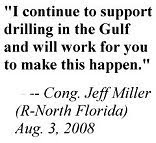
Independent News publisher Rick Outzen, just back from an interview and photo trip to Louisiana, wants to trade Northwest Florida's congressman Jeff Miller (R-Oil Spill) for Massachusetts congressman Edward Markey (D-Medford), who represents the suburbs along the north side of Boston.

We know the north Boston suburbs, Rick. They're no Northwest Florida. They'll never fall for your scheme.

Misdirection Monday: May 17 Oil Spill Update

"I make the weather! All of this moisture coming up out of the Gulf is gonna push off to the east and hit Altoona."

-- Phil Connors (Bill Murray), Groundhog Day

1. Weekly Oil Spill Forecast.


For much of the past month since the April 20 BP oil platform explosion, Northwest Florida has been protected from direct damage by the river of oil in the Gulf of Mexico predominantly by Southeast-to-Northwest winds and water currents. The web site Windmapper, however, is forecasting a change for the first few days of this week.

Monday through Wednesday, it suggests, we are likely to experience a slowly strengthening trend of Southwest- to- Northeast winds. This is the worst kind for our beach.

One of the TV weathermen at local station WEAR-TV is saying, however, that the drift toward the northeast won't be strong enough to push BP oil onto Pensacola Beach. (click photo up and to the left). We'll see how well he imitates Bill Murray's Goundhog Day character in 'making the weather.'

To view Windmapper's daily forecast animation click here. For an hour-by-hour overview of each day of the week, click here.

2. Pipe Smoke Gets In Your Eyes.

Of course, one big news item yesterday was that on the third try, as McClatchy News puts it, the "BP Oil giant succeeded Sunday in connecting a mile-long pipe to help capture what it hoped will be a majority of the oil flowing from a damaged well into the Gulf of Mexico."

But confusion reigns. British Petroleum wasn't saying on Sunday how much oil it really was collecting on board the oil tanker tethered a mile above the wellhead pipe. All we could be sure about is that the pipe insertion didn't completely plug the "massive oil leak." According to Shaila Dewan of the New York Times, BP vice president Kent Wells "could not say how much oil had been captured or what percentage of the oil ... was now flowing into ... the insertion tube."

"Could not?" More likely, would not. The more BP talks, the less they seem to tell us. As a result, reporters can't even agree on the dimensions of the tube that BP inserted:
We could go on. Near-endless examples exist. The real lesson to remember is that none of these reporters have a clue what they're writing about. Every one of them is dependent on BP, itself, for the numbers.

Apparently, the ancient adage 'You're entitled to your own opinion but not your own facts' is no longer operative in the Gulf of Mexico. BP drowned it.

3. BP's PR.

There also is a yawning chasm between what BP seems to be saying and what, in fact, it is saying. Only lawyers and those journalists accustomed to dealing with slippery oil corporations have noticed that BP is playing a very "cagey" game -- to borrow the admiring word from the Jakarta Globe, a newspaper published in a country that has a long and sad history of being shamelessly exploited by underwater oil drillers.

For just one example, an early report Sunday afternoon by Shaila Dewan of the New York Times at 1:58 pm CDT clashed with another by Jeffrey Collins and Jason Dearen of the Associated Press which was originally published within minutes that same afternoon. Dewan reported that BP would not disclose "how much oil and gas were taken aboard the... drill ship... as it is siphoned off" by the 4- (or is it 6-?) inch pipe. Contrariwise, Collins and Dearen claimed that "BP said a mile-long tube was siphoning most of the crude from a blown well to a tanker... ." [emphasis added]

At mid-day Monday, BP owned up to the reality. As CBS News, France's wire service, and other sources are now reporting, only "about 20 percent of the oil gushing into the Gulf of Mexico is being swallowed up by its insertion tube system." That "20 percent," moreover, is based on now-discredited estimates that the leak consists of 5,000 barrels a day.

In fact, yesterday's insertion of the "mile-long pipe" enables BP to capture only 1,000 barrels a day. This means the "success" yesterday is far less consequential than either the Times or the Associated Press were saying yesterday.

As multiple news outlets are reporting today, the actual leak rate is now believed by scientists to "be between 25,000 and 80,000 barrels per day." Accordingly, a thousand barrels a day means the 4- or 6-inch pipe is capturing as little as one-and-one-quarter percent of the oil gushing into the Gulf every day.

Are we better off than we were on Friday? Reality has not appreciably changed. But insofar as public knowledge is concerned, in the space of just three days we've gone from 5,000 barrels of oil a day freely pouring into the Gulf to as much as 80,000 barrels a day, minus a measly one thousand barrels captured by the 4-inch -- or is it 6-inch? -- pipe plug.

4. Oil Lakes Beneath the Sea.

There are other, even more momentous issues, where it's useful to bear in mind all the misdirection going on. For example, independent researchers, like oceanography professor Vernon Asper of Southern Mississippi University, have found huge pools of oil "at substantial depths down to at least 1,300 meters, which is very close to the depth of the well."
We’re thinking that this oil is probably some fraction of the oil that’s not reaching the surface but instead is sort of spreading out and then the currents are taking it wherever the currents are going.
The pools of underwater oil are said to be just "too big" for the usual bottom-dwelling organisms that metabolize oil to "gobble" them up. (You can read the interview with Prof. Asper last Friday here; or, listen to the podcast here.)

As Justin Gillis of the New York Times reports:
Scientists are finding enormous oil plumes in the deep waters of the Gulf of Mexico, including one as large as 10 miles long, 3 miles wide and 300 feet thick in spots.
* * *
“There’s a shocking amount of oil in the deep water, relative to what you see in the surface water,” said Samantha Joye, a researcher at the University of Georgia who is involved in one of the first scientific missions to gather details about what is happening in the gulf. “There’s a tremendous amount of oil in multiple layers, three or four or five layers deep in the water column.”

The plumes are depleting the oxygen dissolved in the gulf, worrying scientists, who fear that the oxygen level could eventually fall so low as to kill off much of the sea life near the plumes.

5. Damaging Dispersants.

This is especially worrisome given BP's practice of continuing to release hundreds of tons upon hundreds of tons of "dispersants" a mile below the surface near the wellhead. As USM professor Asper told The World radio program Friday, "we don’t know what affect the dispersants might have." And, as usual, BP isn't talking.

For more on the threat posed by excessive use of dispersants, check out The Truth about Gulf Oil Spill.

6. Swallowing BP's Word for It.

Journalists are one thing. Washington politicians should be even more embarrassed by their unquestioning acceptance of whatever BP says. As Sam Stein suggests over at the Huffington Post, foremost among them is our next-door neighbor, Alabama senator Jeff Sessions (R-AL):
Late this past week, Republicans in the Senate effectively blocked legislation that would have raised the cap on the amount of money oil companies like BP would have to pay for economic damages caused by oil spills.
* * *
Sen. Jeff Sessions (R-Ala.) suggested on Sunday that raising the cap was unnecessary because BP had given him it's word that it would cover the costs of the spill in the Gulf.
Not far behind is the Obama administration. It took them until last Friday to wake up to the legal reality that BP's oral word is meaningless when it comes to paying all "legitimate claims" for damages. As veteran reporter James Ridgeway writes, the company's reputation is "coated in sludge."

So far as we can tell, the oil company's only response to this hour has been to have their PR flack-catchers repeat the same oral assurances:
"What they are requesting in the letter is absolutely consistent with all our public statements on the matter," BP spokesman David Nicholas said.
But will they love us in the morning? We'll wait for an answer in writing, signed, and notarized by BP's chief executive officer and board chairman Carl-Henric Svanberg. Then, BP can kiss us.

Oral assurances that BP will fully pay all "legitimate" damages caused by this disaster are of no use whatsoever when the graven law imposes a $75 million limit on its liability.

Dept. of Amplification
05-17 pm

Robert Reich, former Secretary of Labor, has additional thoughts along the same lines ["BP Stands for Bad Petroleum"]:
Saturday the White House warned BP that it expects the oil giant to pay all damages associated with the disastrous oil leak into the Gulf of Mexico, even if the costs exceed the $75 million liability cap under federal law. BP responded Sunday saying its public statements are “absolutely consistent” with the Administration’s request.

When you hear dueling public statements like these, watch your wallets. You can safely assume BP’s lawyers are already at work to ensure that the firm pays not a cent more than $75 million — not to taxpayers bearing cleanup costs, not to consumers whose gas bills will rise, not to businesses along the coasts that will lose a fortune. And BP won’t pay more unless or until there’s a law requiring it to.

BP * * * [is] the poster child for PR masquerading as CSR.
There's a good deal more worth reading ...

Saturday, May 15, 2010

Slow Damage: Saturday: May 15 Oil Spill Update

"Dammit, Fernando, why shouldn't it? Why shouldn't a corpse be transmitted by express?"
-- Malcolm Lowry, Under the Volcano
1. Impatient for Disaster.

Most news journalists are in love with the story. When the story begins, say, with a spectacular explosion followed by a continuing oil leak of historic proportions, they want to know how it all will end. If the story seems be unfolding too slowly for their tastes, they grow querulous and impatient. They want to see the disastrous climax now.

If they can't have it, then some of them turn to writing peevish headlines like the one in today's Pensacola News Journal ["Where's the Oil?"] and captious complaints like Cain Burdeau's lede for the Associated Press: "For a spill now nearly half the size of Exxon Valdez, the oil from the Deepwater Horizon disaster is pretty hard to pin down."

To be sure, Burdeau quickly returns to the objective voice of the Impartial Journalist and tells us exactly where the oil can be found, just as shown by the imagery (above) at the Center for Southeast Tropical Advanced Remote Sensing (CSTARS) of the University of Miami:
Satellite images show most of an estimated 4.6 million gallons of oil has pooled in a floating, shape-shifting blob off the Louisiana coast. Some has reached shore as a thin sheen, and gooey bits have washed up as far away as Alabama. But the spill is 23 days old since the Deepwater Horizon exploded April 20 and killed 11 workers, and the thickest stuff hasn't shown up on the coast.
Still, Mr. Burdeau can't help himself from continuing to carp, "So, where's the oil? Where's it going to end up?"

This chronic impatience well may account for the chronically lousy job journalists do with news stories that don't lend themselves to a quick wrap-up. We're thinking, for example, of global climate change, the Iraq and Afghanistan wars, Dick Cheney's still-secret meetings with oil industry executives at the outset of the George Bush administration, and the century-long collapse of the Chicago Cubs.

Like children, one suspects the attention span of journalists grows shorter with every new television season. We don't know what's to be done about it. Somehow, the news mavens must find a way to sustain their own interest in slow to develop, long-lasting disasters if the public is to be expected to pay attention.

2. Out of Sight, Out of Life.

Though the whereabouts of the oil spill may be out of sight for most journalists, that doesn't mean it's disappeared or that it's a benign presence. National Geographic points out ["Dead Zone in the Making?"] that --

Even if oil never washes up in the refuge, the region's birds may be silenced if the crude lingers deep in the Gulf of Mexico, experts say.

That's because 5,000 barrels of oil (210,000 gallons, or 794,937 liters) a day are thought to be bleeding from a damaged wellhead at the nearby site of the Deepwater Horizon rig disaster. All that oil is poisoning the less photogenic creatures—plankton, sand crabs, and fish larvae, among others—at the base of the region's food web, Schweiger noted.

If the oil spill can't be contained, the Gulf of Mexico could have another "dead zone in the making," according to Sylvia Earle, a marine biologist and National Geographic explorer-in-residence. (National Geographic News is owned by the National Geographic Society.)

As surely as disaster will follow if we continue ignoring the scientific data on global warming, BP's oil spill will have catastrophic consequences up and down the western hemisphere's food chain if Americans do not learn from it.

3. Complex Currents.

Peter Spotts of the Christian Science Monitor does a good job of describing the whys and whereabouts of the large oil lake that's been infiltrating Gulf waters for nearly a month. It's not your father's Exxon Valdez.
For anyone using the Exxon Valdez spill in Alaska's Prince William Sound as a visual reference point, it might look as though the Gulf spill so far is a dodged bullet.

But the differences between the two events are significant, cautions Michelle Wood, a marine biologist who recently became head of the ocean chemistry division of the National Oceanic and Atmospheric Administration's Atlantic and Oceanographic and Meteorological Laboratory in Miami. Not the least of those differences is the seascape into which the oil is flowing.

The Exxon Valdez spill involved a large, single, intense pulse of oil into Prince William Sound – "a shallow, near-shore environment with a rocky coast," she explains. The heavy crude had lots to cling to as it came ashore. In the Gulf, "spill" is a so-far continuous infusion of a lighter grade oil, which at least initially forms a foamy mousse rather than tarry blobs. And so far, the oil has remained far at sea.
* * *
The system is chaotic enough that given enough time, say 90 days, oil in some form could wind up anywhere from the Mexican Coast to Palm Beach, research suggests.
* * *
Once it reaches the surface, currents and ever-shifting winds can carry the oil just about anywhere, adds Peter Niiler, a researcher at the Scripps Institution of Oceanography in La Jolla, Calif., who has conducted extensive studies of current patterns in the Gulf.
Results of a 5-year experiment by Peter Niiler of the Scripps Institution of Oceanography in La Jolla, Calif., give some idea of who along the Gulf Coast most likely will be effected: everyone.
In a five-year experiment in the late 1990s, Dr. Niiler and a colleague dropped between 700 and 800 drifters – devices to help track currents -– into the Gulf at locations where offshore drilling was taking place.

Within 90 days, the drifters could be anywhere in the Gulf, including Mexico or even as far away as Miami Beach, he says.
4. Floating "Vessels."

Speaking of unpredictable drifting, this week hundreds of lawsuits were filed against BP, Transocean, and Halliburton over the mounting losses caused by the continuing oil spill. The oil corporations are responding with legal filings in Houston which allege that oil platform owner Transocean enjoys limited liability under an 1851 act of Congress still on the books and as owner of the oil platform its liability is limited to no more than $27 million.

1851? That's the year Herman Melville published Moby Dick! This is, as the saying goes, an argument only a lawyer could love. Transocean became a foreign company two years ago when it moved its headquarters from the U.S. to Switzerland. It owns the Deepwater Horizon rig that blew up on April 20.

Because underwater drilling rigs can be floated from one well to the next, the argument goes, it is a "vessel" at sea. Accordingly, Transocean is arguing that it is protected by "Limitation of Liability Act of 1851" and owes the entire universe of claimants no more than a grand total of $26 million and change.

Never mind that Transocean already has collected a "partial" payment of $ 401 million in insurance benefits. As the Wall Street Journal explains it:
Under the LLA of 1851, a vessel owner is liable only for the post-accident value of the vessel and cargo, so long as the owner can show he or she had no knowledge of negligence in the accident, maritime lawyers say. Since “the remains of the. . . Deepwater Horizon now lay sunken” about a mile deep in the federal waters of the Gulf of Mexico, the value of the rig and its cargo comes to no more than $26,764,083, Transocean claims in the filing. Before the accident, the rig was worth around $650 million.
Federal court procedural rules make special provision for admiralty lawsuits. Under Supplemental Rule F (9) --
The complaint shall be filed in any [Federal court] district in which the vessel has been attached or arrested to answer for any claim with respect to which the plaintiff seeks to limit liability; or, if the vessel has not been attached or arrested, then in any district in which the owner has been sued with respect to any such claim. When the vessel has not been attached or arrested to answer the matters aforesaid, and suit has not been commenced against the owner, the proceedings may be had in the district in which the vessel may be, [1] but if the vessel is not within any district and no suit has been commenced in any district, then the complaint may be filed in any district. For the convenience of parties and witnesses, [2] in the interest of justice, the court may transfer the action to any district; if venue is wrongly laid the court shall dismiss or, if it be in the interest of justice, transfer the action to any district in which it could have been brought. If the vessel shall have been sold, the proceeds shall represent the vessel for the purposes of these rules. [numerals added]
You can see where this likely is headed. One obvious point-counterpoint is [1] because "the vessel is not within any district" Transocean (and BP, following it) are seeking the oil-friendly venue of Houston, Texas. But [2] lawyers representing hundreds of individual claimants and perhaps tens upon tens of thousands of potential class members likely will be claiming "the interests of justice" require all their cases be returned to a Multi-District court panel in Louisiana.

And that is just one coupling of the arguments. There will be many more -- whether an oil rig fixed to the ocean floor is a "vessel;" if so whether it was within a federal court "district" other than Southern Texas; whether on balance "the interests of justice" of injured claimants outweigh those of needy oil companies; whether the insurance proceeds to be paid fix a minimum value for the rig; etc., etc., etc. And each of those seemingly dry procedural arguments are, in theory, subject to appeal in higher courts.

The WSJ sums up --
[I]n actuality, the Act very rarely helps companies limit liability. It can, however, allow a defendant to gain some control over the legal process, since a judge could place a stay on all pending litigation, which would then have to be refiled in the federal court where the limitation of liability was sought. Vessel owners routinely seek protection under the act following accidents at sea, lawyers said.
Pensacola Beach residents who've had experience with property insurance claims law after the hurricanes of 2004 and 2005 will recognize what's really going on here. The oil companies are sending a message: 'If you think the environmental effects of the BP oil spill are destined to last a lifetime, wait until your great-grandchildren live long enough to see the end of your lawsuit.'

Standing on the White House lawn, Barack Obama can throw all the "angry" fits he wants over the "ridiculous spectacle" of oil companies publicly blaming each other during congressional hearings. Obama is a lawyer. He knows what's really going on in the courtroom clinches. The oil companies are a tag-team, united in one purpose: to beat down all the fishermen, unemployed service workers, tourist-dependent businesses, beach front property owners, and other claimants.

They'll need a lot more from the president than angry rhetoric.

Friday, May 14, 2010

Claims Friday - Oil Spill Update May 14, 2010


1. Oil Spill Forecast.

The latest public information from NOAA states:
Onshore winds (currently SE 10-15 kts) are forecast to persist at about 10 kts throughout the weekend. The Mississippi Delta, Breton Sound, the Chandeleur Islands and areas directly north
have a potential for shoreline contacts throughout the forecast period.

Locally, skies remain partly overcast but there is little chance of rain or oil for the weekend.

2. Another "Last Weekend."

It often seems as if PNJ columnist Mark O'Brien was born with a mind that anticipated Twitter by half a century; his brain thinks only in ideas needing 140 characters or less.

Nevertheless, Mark actually got something right today: The coming weekend offers "yet another chance for 'one last trip to the beach' before the oil spill turns toward Escambia and Santa Rosa counties." Of course, soon as he says that, tarballs are certain to start washing up on Pensacola Beach.

3. Oil Spill Claims.

For those stupid enough to try it without a lawyer, BP has opened two 'claims offices' in the local area. The Pensacola BP claims office" is at 3960 Navy Blvd., Suites 16 and 17, but no telephone number has been reported. It has another "community outreach office" at 435 E. Government St. which has a local telephone number: (850) 912-8640.

The Gulf Breeze office is "down-the-highway" at 5668 Gulf Breeze Parkway, Unit B-9 in Midway. If memory serves, that's either very near or at the same address of a large business building that was flashing an over-sized banner touting John ("Drill, Baby, Drill") McCain for President in 2008.

Local TV station WEAR was reporting last night that anyone seeking to file a claim will be told to first send in the appropriate claim forms. For further information To get the run-around or listen to corporate propaganda and other communications, claimants are told they can call BP at 1-800-440-0858.

4. Oil Leak Estimates.

We've previously mentioned that"size matters" when it comes to this oil spill. The longer the leak persists, the larger the spill area grows and the more likely some part of it will wash up on Pensacola Beach. Until yesterday, BP had shrewdly refused to release videos of the underwater spill even though it was known the wellhead was being filmed.

Pressure from the White House forced release of at least one, grainy video yesterday. With that, the media's group-think narrative that "only" 5,000 barrels of oil a day was spilling into the Gulf collapsed. Scientists from coast-to-coast now are using the video to gauge the size of the leak -- and the results are shocking.

A commentator on Nature magazine's blog, The Great Beyond, probably is right: calculating the volume of the spill is not rocket science. "You only need to know the diameter of the pipe, and to watch the video to see how fast the oil moves out of the pipe end."

Even so, entire textbooks have been written about how to do it. This morning, NPR aired an interview with the author of one of them. It's definitely worth a listen:


You can read a transcript of the radio report here.

Now, everybody's getting in on the act. The New York Times reports the spill may be as much as "ten times" the size BP has admitted. The pressure on BP to come clean is building. Expect to hear more in coming days.

5. Judge Shopping.

Plaintiffs' lawyers suing BP, Halliburton, and Transocean
have asked that the hundred-plus lawsuits already filed be heard "by one of the Multi-district federal judges in New Orleans." By contrast, BP, relying on a predicted Transocean suit, has asked that the cases be assigned only to Houston-based U.S. District Judge Lynn Hughes.

We confess that we have never before seen a party to a lawsuit so blatantly judge-shop by asking for a change to a specifically-named judge. Maybe it's a Texas thing. Or, maybe it's a special privilege accorded by law to oil companies under some Congressional statute which we somehow overlooked.

In any event, it may be illuminating to know a little more about Judge Hughes, Transocean's preferred judge. He's an Alabama alum (1963) who graduated from the University of Texas Law School in 1966. He served for a year as President of "Southwest resources" and was appointed to the federal bench by Ronald Reagan in 1985.

For what it's worth, Hughes has earned a dismal rating at The Robing Room from lawyers who have appeared before him. On a scale of 1 ("awful") to 10 ("excellent") Hughes draws an average of 4.7. That's the third-worst of all 19 federal judges in the Southern District of Texas who have been evaluated by lawyers.

Over the years, our personal observation is that lawyers are surprisingly kinder to judges whom they take the time to evaluate than you might suppose if you've ever heard them in casual conversation. To be sure, even formal evaluations are highly subjective. And, no doubt some lawyers who have lost a case or two in a judge's courtroom are not above taking their anger out on the judge with a harsh review -- or even gaming the system by convincing their barrister buddies to help out.

But when it comes to Judge Hughes, judging from the comments section at The Robing Room, certain themes recur with surprising frequently. Among them:

  • "worst judge in Texas"
  • "pompous and arrogant"
  • "a disgrace"
  • "biased"
  • "ignores rules of discovery"
  • "incredibly unfair"
  • "hates plaintiffs"
Time and again, the complaint is made that Judge Hughes picks his "favorite" side of a case "early" and if it isn't yours, then "god help you."

Could this explain BP's unusually brash motion to have Judge Hughes hear all the cases filed against it? Ya' think they know him too well?

minor edit 5-14 pm
clarify BP-Transocean-Halliburton suits 5-14 pm