Showing posts with label florida courts. Show all posts

Monday, October 20, 2008

Florida Judges Retention - 2008 Edition

Beginning with early voting today through Election Day, among other issues and candidates Northwest Florida voters will be asked a simple question, over and over: "Yes" or "No" on whether to retain in office "Supreme Court Justice Charles Wells and six judges on the 1st District Court of Appeal in Tallahassee."

Normally, we would inform ourselves on these important questions by doing what every red-blooded American voter in a democracy does: After getting home following a long day at work, we'd serve the family dinner, do the dishes, oversee the kids' homework, and then put them to bed. Once things quieted down, we'd spend the next eight or ten hours on the Internet researching and reading all the judicial opinions written over the past several years by the judges who are seeking our approval.

Not this year. Not a chance. When we go to the polls this year, we're going to follow the very precedent set time again, like here and here, by those judges on the 1st District Court of Appeals who now seek our approval.

We'll write a one-word decision and let them guess at our reasoning. And here it is:

No.

Dept. of Amplification

Bryan at Why Now? also resides and votes in the panhandle, aka First District Court of Appeals. He reaches the same conclusion we have:
The entire court... has a nasty habit of issuing rulings without issuing opinions. They make decisions that affect people’s lives without any explanation at all. * * * I can’t justify retaining them.

Friday, September 19, 2008

Judicial End Run

Bill Post, who has become the authority on the history of Pensacola Beach lease taxation issues, has a new Viewpoint article in the Independent Sun. The weekly newspaper titles it "Ignoring 1987 Ruling."

Among other things, Mr. Post has unearthed a nugget of legislative history about the key Florida statute (Florida Statute chapter 196) that no court, so far as we can recall, has ever mentioned:
The current legislative statute's intent was clearly explained in the June 3, 1980 written state senate staff Analysis that said the leaseholds will no longer be "assessed and taxed as real property" as if leaseholders were owners, but "shall be taxed only as intangible personal property." Please again take note of the word "only."
As Post observes, this expression of legislative history rather directly undermines an argument Escambia County property appraiser Chris Jones has been trumpeting through the legal system: that the legislature was "silent" about taxation of leaseholds insofar as the alternate theory of "equitable ownership" is concerned. It is not an act of silence when a legislature says this is the "only" tax intended.

If one were able to summon faith that Florida's courts, as presently constituted, truly judge cases based on proven facts and law rather than, say, politics or power, Post's historical nugget might loom large. On the other hand, to borrow Finley Peter Dunne's famous epigram, there are some courts that "follow the election returns." In which case, of course, the facts become as inconsequential as legal precedent.

We're still waiting to see which kind of court is judging the Pensacola Beach residential leasehold tax dispute.

Thursday, September 18, 2008

Florida Court's Weird "Change of Mind"

In what is surely one of the weirdest events in state court history, today the Florida Supreme Court reversed its own county bond financing ruling of a year ago. The result will have long-lasting repercussions; not only for local government bond financing without voter approval but also, we suspect, for public perceptions about the rule of law under Florida's court system.

First Court Ruling

On September 6, 2007 -- a little more than a year ago -- the full seven-member state supreme court unanimously ruled that Escambia County was "without authority" to issue road-widening finance bonds for Perdido Key without first obtaining approval by popular referendum "as required by article VII, section 12 of the Florida Constitution."

The full text of that opinion has been scrubbed from the Florida Supreme Court web site. But it can still be found, for now, on the web site of the Miami Herald.

The opinion was written by Justice Kenneth Bell of Pensacola. All six other supreme court justices concurred in the decision.

As Justice Bell wrote for the court at the time --
The language of article VII, section 12 is plain and unambiguous. * * * [A]rticle VII, section 12 of the Florida Constitution provides as follows:
Counties, school districts, municipalities, special districts and local governmental bodies with taxing powers may issue bonds, certificates of indebtedness or any form of tax anticipation certificates, payable from ad valorem taxation and maturing more than twelve months after issuance only:

(a) to finance or refinance capital projects authorized by law and only when approved by vote of the electors who are owners of freeholds therein not wholly exempt from taxation; or

(b) to refund outstanding bonds and interest and redemption premium thereon at a lower net average interest cost rate.
Thus, article VII, section 12 plainly authorizes localities to issue long-term bonds "payable from ad valorem taxation" for the purpose of financing capital improvements only when "approved by vote of the electors."
The 2007 ruling was widely seen as a victory for citizens' right to vote before being saddled with taxes or destructive developments they may not desire. Local governmental units around the state, however, were upset. Many of them are seeking to jump-start big-ticket municipal projects. They expected to be free to hand the bill to taxpayers without letting them vote on it.

Locally, one such project put in jeopardy was the planned Pensacola Maritime Park. Although many community leaders favor it, the project also has substantial public opposition.

New Court Ruling

Today, however, Justice Charles Wells wrote a new opinion for the state supreme court in the same Perdido Key road case. This time, the court approved the bond action, although voters still have not approved it. The full text is here.

One year later! This could be a Guinness World Record for slow-motion change of mind.

The Tallahassee Democrat reports:
Now the court says financing schemes that use future property tax increases to pay off bonds are OK, changing utterly what a unanimous court said a year ago. It means local governments will have much greater latitude in approving millions of dollars of bonds for public projects without having to get voter approval.
Weirder and Weirder

But wait! There's more. In yet another odd twist, it turns out one of the supreme court justices signing onto the new opinion has been retired from the court for over a year!

Former Justice Raoul Cantero is listed in the new opinion as one of four judges who concurs in the result of the new, 2008, opinion. But Cantero retired September 4, 2007, -- over a year ago. That was just two days after the court published its first decision in the case and 16 days before September 20, when the first decision was finalized and released for publication.

Moreover, he has since joined the Miami law firm of White & Case. That firm's web site describes White & Case as representing --
public and privately held commercial businesses and financial institutions, as well as governments and state-owned entities, involved in sophisticated corporate and financial transactions and complex dispute resolution proceedings.
Do you suppose there might be, at a minimum, the appearance of a conflict of interest here? Only the firm's client list could tell us for sure.

Missing in Action

In yet another odd twist, Justice Bell, author of the original opinion, recused himself from participating in the reverse decision. No reason has been disclosed.

Justice Bell is only 52 years old. He has served on the court for not quite five years. Yet, earlier this year Bell announced he intends to retire in October and resume practicing law in Pensacola.

We doubt Justice Bell plans to hang out his own shingle as a solo practitioner. But finding a Pensacola corporate law firm that doesn't have ties to some interested party in this lawsuit will be quite a bit harder than scrubbing his old supreme court opinions from the web.

Justice Lewis wrote a dissent in which it is said a second judge, Chief Justice Peggy Quince, concurred. But Quince also is listed in today's court release as having concurred in part with the majority and dissented in part.

We can find no written opinion by Quince, as yet, explaining what the heck is up with that. Normally, a judge who concurs in part and dissents in part issues a separate opinion explaining which parts were which.

Understanding the Result

Tallahassee lawyer David Theriaque, representing the Escambia County citizen who lost the appeal today after winning it a year ago, told the Tallahassee paper, "I'm having a hard time understanding what they did."

That's because you're a lawyer, David. This is a decision only a politician can understand.

DEPT. OF CORRECTIONS

A commentator correctly points out that Justice Cantero retired in 2008, not 2007, although still well before the recent re-ruling was announced. The original Miami Herald article about his retirement in 2007 which misled us has been either scrubbed or redated by the newspaper.

Thursday, August 07, 2008

Dark Secrets on Pensacola Beach


Per curiam affirmances "are incompatible with the spirit of Florida's 'Government in the Sunshine' laws, whose purpose... is to prevent at non-public meetings the crystallization of secret decisions to a point just short of ceremonial acceptance."
-- Krosschell, DCAs, PCAs, and Government in the Darkness, 1 Fla. Coastal L. Rev. 12 (1999)

Overnight, Pensacola news reporter Michael Stewart has written a second article about the Portofino real estate tax decision of the First District Court of Appeals. Is this guy prolific, or what?

Michael Stewart has more words at his fingertips than your average Florida appeals court judge scratches out in a month at five times the money! And that, of course, was the point of our baseball metaphor.

Much of Stewart's latest effort is devoted to gathering reactions from local pols to the really, really tough question, "How would you like to scoop up $19 million in extra tax money from a few folks with almost no voting power, for reasons the Florida appellate court has approved without articulating what those reasons may be?"

Naturally, Escambia County commissioner Mike Whitehead -- who's made a career of baiting beach residents for his mainland constituents -- offered up a reaction that rests on an outright lie. Whitehead is quoted as saying:
Beach residents use all the same services as other Escambia County residents, from the Sheriff's Office to the court system, and animal control to mosquito control.
Whitehead knows full well that from time immemorial Pensacola Beach residents annually are specially assessed Municipal Service Benefit Unit fees for county law enforcement, fire and emergency medical services, mosquito control, and, yes, even animal control. Like everyone else in Escambia County, they also pay court filing fees, state intangible taxes, sales taxes, and other assessments which, as elsewhere, in part go to support the state court system.

What Whitehead also knows is that it's a whole lot easier to get away with such public prevarications when judicial panels employed to decide the legality of adding new taxes routinely 'crystallize' their decisions in secret, in the dark.

Stewart roped in one more interesting reaction. Escambia County Property Appraiser Chris Jones told him "he had no choice but impose the taxes."
"I understand and empathize with leaseholders out there," Jones said. "But my job is to uphold the law."
Ironically, Jones appears to have done done this by attacking "a state law as part of the defense in a law suit disputing his or her assessments." That could be a problem for him in the still-pending lawsuit affecting all other Pensacola Beach residents.

Wednesday, August 06, 2008

Reporter Bests Florida Appeals Court

In a surprise victory that left hot dog munching onlookers stunned, Pensacola News Journal reporter Michael Stewart today overwhelmed Florida's First District Court of Appeals in a series of eight back-to-back appeals involving county taxation of Portofino Towers residential units on Pensacola Beach. Although out-manned 3 to 1, and technically disabled for want of a law degree, the PNJ's ace newsman wrote circles around the appeals court panel of judges Michael Allen, Marguerite Davis, and Paul Hawkes.

The final score was 301 words to 8. Stewart scored all of his words in a single newspaper article, written inside of an hour just today. He was dazzling behind the mound on his desk, frequently firing facts right down the pipe while masterfully mixing up his delivery with active verbs, multi-syllabic words, and the occasional off-speed historical fact or futuristic prediction. Here's just a sample:
A three-judge panel of the First District Court of Appeals upheld Escambia County Circuit Judge Frank Bell’s March 2007 decision that Portofino Towers condominium leaseholders must pay property taxes.

The court’s ruling released late Tuesday paves the way for payment of $19 million in back taxes by residents of the upscale condominiums.
* * *
Beach leaseholders do not own the land on which their homes and businesses are built. They pay lease fees and have argued beach taxes are not legal. Lease fees are for a minimum of 99 years, with many leases providing an option for an additional 99 years.
The three appellate court judges barely showed up to play. They had home field advantage and nearly a year to prepare their own opinions in the various Portofino cases, designated Nos. 07-2292, 07-2293, 07-2293, 07-2294, 07-2296, 07-2297, 07-2298, and 07-2305.

Yet, the trio of high-salaried judges only managed to dink out a single bush-league word, repeated eight times: "Affirmed." Everybody was left stranded on the constitutional bases.

As we have noted before with this court, "that's 2.66 alphabet letters for each of the three judges." At an annual salary of $147,524 per judge -- assuming they all contributed equally to the effort -- writing that single word "affirmed" works out to $55,460.15 for each of the three judges. By contrast, we're guessing that news reporter Stewart draws a salary of ten cents for every whole word, on his best days.

Onlookers disappointed in the pricey judges' curiously laconic performance may seek season-ending tickets to a bigger league.

Dept. of Further Amplification

Dark Secrets on Pensacola Beach
More from reporter Michael Stewart about less from the Florida appeals court.

Tuesday, October 23, 2007

Beach Tax Lawsuit Tanked

WHEREAS, Santa Rosa Island Authority on behalf of Escambia County represented to the general public and all parties dealing with them, that the said properties on Santa Rosa Island owned by Escambia County were not subject to ad valorem taxes, and

WHEREAS, said governmental authorities induced hundreds of persons, who relied upon the representations and the decision of the Supreme Court to enter into long term leases providing for rentals and which contained many onerous provisions... .
House Bill No. 3913, 1976 Laws of Florida, chap. 76-361
Florida's First District Court of Appeals yesterday upheld a lower court decision by Pensacola circuit judge Nick Geeker which approved assessing real estate taxes on Pensacola Beach business leases. The business lease tax case was one of four lawsuits filed three years ago, when Escambia County commissioners moved to squeeze more gold out of the wounded goose known as Pensacola Beach.

Yesterday's appeals court opinion was learned and erudite; it explored the unique historical context of the on-again-off-again- on-again promises of Florida state and county government that beach leases would be tax-free, and the opinion brought to bear on the issue incisive reasoning, ample precedent, and an enlightened discussion of public policy. Right?

Not a chance. The court's opinion consists of one word: "Affirmed." That's 2.66 alphabet letters for each of the three judges (annual salary: $147,524) who issued yesterday's decision, by name Marguerite Davis, Joseph Lewis, and Clayton Roberts.

Despite the First District Court of Appeals' 1987 precedent of Bell v. Bryan I, the handwriting has been on the wall for some time with more recent court opinions like this one and this one. Few above the lowly political level of a trial judge seem willing to leave their fingerprints on it. That's one advantage of what judges call a "per curiam" (unsigned) opinion: individual judges can hide their own responsibility and reasoning, albeit at the steep price of undermining the democratic principles of accountability, transparency, and public education about the judiciary's function.

To be sure, we still await a final appellate court ruling on the main case involving Pensacola Beach residential leaseholds. So, unless you've lost faith in the impartiality and wisdom of the Florida court system (Now, stop that snickering!) don't sell your evidence on Ebay just yet.

Unless, like our friend Bryan, you think it's a Zen thing -- in which case you might want to convert your beach home to a start-up high tech "business with no track record" to get a $2 million tax break from the county.

Tuesday, April 03, 2007

For Whom Bell Tolls: Portofino Taxes

Judge Frank Bell ruled that Escambia County is legally authorized to impose ad valorem taxes on Portofino condo unit owners, according to Michael Stewart's abbreviated article in today's Pensacola News Journal. The unpublished opinion was filed last week but just came to public attention today.

That has to be devastating news for the five-tower high-rise complex. At last count, more than 120 units were listed for sale. Many more were rumored to be "pocket listings" -- not listed anywhere but readily available for purchase if you knew your way around the local real estate swamp. Now that real estate taxes have to be taken into consideration, the market will be just that much smaller and slower.

Explains Stewart:
Because beach leaseholders do not own the land on which their homes and businesses are built, they pay lease fees and have argued beach taxes are not legal. Leases are for a minimum of 99 years, with many leases providing an option for a second 99 years.
Earlier, a similar ruling rendered Pensacola Beach businesses subject to property taxation on their commercial rental land leases.

Among the lawsuits yet to be decided by the courts is a homeowner residents' suit. Many have considered that one to be the strongest case of all because of the explicit written, oral, and even state statutory promises that beach leaseholds and improvements would be tax-free, promises which Escambia County consistently made over the decades in an effort to develop the island.

The Portofino development wasn't leased until 1999, by which time the county had stopped making tax-free promises. The strong record of historic tax-free promises didn't affect Navarre Beach, either, where serious development didn't get underway until the mid-1980's. In any event Santa Rosa County never engaged in the same "tax free" public marketing strategies.

Even so, some residents are pessimistic. Florida courts don't have a good record for requiring Escambia County to keep its governmental word. That pessimism may explain why one person even sold evidence of Escambia County's "tax-free promise" pamphlets on Ebay a while ago.

The winning bidder paid $20.50 for the evidence. That may be the most anyone ever makes out of the otherwise worthless promises of Escambia County -- except, of course, for the lawyers and real estate brokers.

Someone knew what he was doing when he borrowed the Creek Indian word for "money exchange" to name Escambia County.

Tuesday, November 28, 2006

Judge: Beach Businesses Subject to Taxation

Pensacola Beach businesses are subject to real estate taxation on their commercial leaseholds even if they do not have title to the real estate or buildings, Escambia County circuit court judge Nick Geeker ruled yesterday. The decision directly affects many of the approximately one hundred hotel, restaurant, and souvenir shops on the beach.

Still pending are lawsuits brought by home and condo residents who are also challenging renewed efforts by Escambia County to impose real estate taxes on occupants of the island, which is titled in the county's name. Whatever the outcome of the suits, the issue is unlikely to be resolved until all appeals are exhausted over the next two years.

As reporter Derek Pivnick writes in today's PNJ:
It's the first loss in the court battle against property taxes on structures -- homes, businesses and condominiums -- on the beach.
* * *
If the ruling is upheld on appeal, it could mean a substantial influx of tax money for Escambia County. More than $12 million in taxes remains unpaid, according to Escambia County Tax Collector Janet Holley's office.
June Guerra, owner of the still-closed Jubilee Restaurant, spoke for many when she told the News Journal, "The county's taxation is going to be the downfall of the island."

If not a downfall, certainly a radical change. Businesses, unlike residents, can always pass the added expense of real estate taxes onto their customers. As prices escalate, fewer local mainlanders will be able to afford beach accommodations, restaurant meals and beverages, and other goods and services.

Over time, many believe, raising the cost of having a business or home on Pensacola Beach will price the average family out of the market -- both as day visitors and as potential home owners. To survive, properties will have to convert to more high rises, greater density, and higher prices.

Mainlanders and politicians who are applauding today's ruling could well find themselves unable to afford a visit to the beach tomorrow.

South Florida -- here we come.

Additional Links

Beach Leaseholders' Lawsuit Filed (Dec. 21, 2004)

Friday, May 12, 2006

Sucker Punch

"It's been said that negligent local government is Northwest Florida's most lucrative source of revenue."
Navarre Beach residents just can't catch a break. First, they lose their leaseholder tax appeal. Now, they're up in arms over escalating Santa Rosa County MSBU assessments for public beach renourishment, according to William Rabb's report in today's PNJ:
"The county set up a taxing district for the beach renourishment work in 2003 and sent bills to beach residents last month. The renourishment fees were based largely on the 2005 appraised value of the property. But because of rising housing prices after recent hurricanes, those values have little basis in reality, property owners said."
Rabb's article includes the obligatory individual tale of horror. It's compelling -- and probably representative of a good many other Navarre Beach residents and businesses:
"Adrienne Wilson and her husband purchased a condominium unit on Navarre Beach a decade ago so they could rent it out and build their retirement nest egg.

"'Now, we're going to have to sell it because we can't pay the assessment fees,' said Wilson, a dental hygienist from Atlanta.

* * *
"Wilson, for example, must pay $13,000 over six years for her 14th-story unit at The Pearl condominium, while a similar unit on the second floor pays much less, she said. She can't rent her condo for much because the development's swimming pool is still out of service, but she still must pay more than owners in other high-rise developments on the beach, she said."

"'It's just not fair,'" Wilson said.
What Rabb has missed is that Navarre Beach residents actually asked for the MSBU tax to be imposed on themselves. Worried some years ago that Santa Rosa County was dragging its feet addressing the issue of post-Hurricane Georges sand replacement, Navarre Beach residents went so far as to propose taxing themselves as a way of persuading the county to undertake the project.

Even the Navarre Beach Leaseholders & Residents Assn. supported the move. The organization's leadership told others at the time it was a "good will" gesture.

The county apparently saw it as a sucker's move. First, Santa Rosa county created the new MSBU taxing authority, as requested, to make beach residents shoulder a substantial part of public beach renourishment expenses. Then, tax assessor Greg Brown went one better and imposed ad valorem taxes on all Navarre Beach leaseholds. Now, it seems, he's calculating the special MSBU assessment on the basis of artificially inflated property values.

So much for good will gestures. If beach renourishment is a good idea -- and as Cornelia Dean has documented there are plenty of reasons to think it may not be -- as long as the beaches remain public, paying for it should be a public responsibility, not a private burden.

It's been said that negligent local government is Northwest Florida's most lucrative source of revenue. Haven't planned for picking up hurricane debris? Let FEMA pay for it. Don't have enough storm shelters? Ask the state legislature for money. Idiotically located a smelly sewer plant in downtown Pensacola? Have the feds pay to move it. Avoided sensible zoning to keep dangerous dioxin plants away from residential neighborhoods? Let EPA pay the clean-up costs.

They don't call this the "Florida Panhandle" for nothing.

The next time a Northwest Florida city or county ducks its public responsibility in hopes someone else will pay for it, remember the "good will" gesture of Navarre Beach residents. More likely than not, all you'll get is a sucker-punch.

Tuesday, May 09, 2006

Tax Suit Memory Jogger

Derek Pivnick of the Pensacola News Journal has a memory-jogger about the pending Pensacola Beach tax suit in today's PNJ. The point seems to be 'Hey, don't forget this juicy little item we still have on the back burner.'

It's like a medical alert. The PNJ doesn't want subscribers, having forgotten all about the litigation, opening up their newspaper one morning and having a heart attack over some big black headline announcing a tax decision.

Pivnick writes:
The legal fight about whether millions of dollars in property taxes should be paid on Pensacola Beach homes, condominiums and businesses continues unabated by the Navarre Beach leaseholders' recent court loss.

Six lawsuits are pending in Escambia County, and it could be only a matter of weeks before the first one gets a trial date... .
In over 450 words, Pivnick manages to avoid reporting one new fact about the lawsuits. But he does grab a telling quote from the attorney representing some of the litigating leaseholders:
"The leases at Portofino do not have that 99-year perpetual renewal language," said Ed Fleming, a lawyer for Portofino's homeowners associations.
That's not exactly a Robert Luskin press leak. What Fleming is saying is well known, too. As we've said before, not all leases Pensacola Beach leases are the same. It stands to reason not all leaseholder tax suit arguments will be the same, either.

Some residential and commercial leases on Pensacola Beach are for a period of 99 years with an automatic right of renewal for an additional 99 years on "like" terms. Others - like the Portofino leases -- are for 99 years with a right to renew, but the terms are left open to negotiation. That leaves nothing but a generalized obligation of "good faith" in coming to terms over any renewal.

A few leases we've seen have garbled renewal language specifying only a right to renew without more and in key sentences seem to be missing a few subjects and verbs. Among residential as well as commercial leases, there are some for a shorter duration and others that flatly terminate after a set term of years, usually less than 50.

If all of this illustrates anything, it's that when the Island Authority wrote individual leases it was perfectly capable of specifying terms that did, or did not, convey the kind of "equitable ownership" that was decisive in last year's Navarre Beach tax ruling. That the SRIA did not always do so seemingly supports Fleming's argument.

The real lesson is for anyone contemplating a purchase on Pensacola Beach: read the lease before you buy. Every word of it.

For more about the beach leaseholders' tax lawsuits, check the Pensacola Beach Tax Suit web site.

Background Links
Beach Tax Litigation
Nov. 10, 2004
Beach Leaseholders' Lawsuit Filed
Dec. 21, 2004
Beach Tax Update
Feb. 12, 2005
Navarre Beach Tax Ruling
June 18, 2005
For Sale: Beach Evidence!
January 27, 2006
Beach Tax Settlement In The Wind?
Feb. 6, 2006
Hey Y'all
Feb. 19, 2006
An Airline
Mar. 3, 2006
Island Parable
March 12, 2006

Monday, February 06, 2006

Beach Tax Settlement in the Wind?

Last Saturday's Pensacola News Journal carried an item by Michael Stewart about two local school districts' effort to 'borrow' money from the state against a theoretical judgment for back taxes on Pensacola Beach and Navarre Beach leaseholds. Why Santa Rosa County's school district needs to do this is something of a mystery, since the Navarre Beach tax suit now has been lost. But the Pensacola Beach lawsuit marches on.

Yet, as Stewart reports, "How much money the districts can borrow is unclear."
"The Escambia School District could get as much as $6.9 million; Santa Rosa could get a loan of as much as $2.1 million.

* * *
In Escambia, the $6.9 million represents an annual $2.3 million shortfall for the 2004-05, 2005-06 and 2006-07 school years deducted when Pensacola Beach was placed on the tax rolls.
In other words, the county tax assessor's decision -- cheered on by our Escambia county commissioners -- to break long-standing promises of tax-free leases actually results in a reduction of state education funding to the Escambia County School District. Taxing beach property, it seems, would represent a windfall to the State, not the county. This is why the state has agreed to 'loan' money to the school district as long as it's paid back when and if taxes are imposed on island leaseholds.
In Escambia County, when Pensacola Beach was added to the tax rolls, the state reduced the School District's yearly funding by $2.3 million, the estimated amount the new tax money would generate for Escambia schools.

But many beach residents chose not to pay until a lawsuit contesting the taxes is settled. If a judge rules the taxes are legal, beach residents will have to pay back taxes plus interest. If that happens, the School District will repay the interest-free loan.

If beach residents prevail, DOE would recalculate the School District's funding to make up for the shortfall, Arnold said.
To explain why this is so would require a lengthy article all to itself about Florida's antiquated, unequal, highly politicized, and inadequate public education funding system. All we have to know for present purposes is that Florida' s system for funding public schools is as convoluted as a Rube Goldberg mousetrap. It short-changes school districts which happen to have a disproportionately high percentage of low-income students; and it well may be vulnerable to constitutional challenge.

What catches the eye in Stewart's article, though, has nothing to do with school funding issues. Twice he mentions the possibility of a "settlement" of the tax suit. It's possible Stewart simply made the common mistake of conflating "settlement" with "judgment," and he means nothing more than finality. Or, he could be hinting that true out-of-court settlement talks are underway.

Either way, Stewart's mention of a "settlement" recalls past efforts to amicably resolve out of court the long-standing tax dispute on the basis of a bargain that everyone could live with, beach residents and businesses as well as mainlanders.

What kind of deal might that be? For at least a decade, one group of beach leaseholders always favored trading taxes for an outright deed to leasehold property. Another group bitterly opposed any move toward compromise.

The split was mirrored among the membership of the Pensacola Beach Residents & Leaseholders Assn. While most PBRLA leaders at least privately favored negotiating a deed-for-taxes trade, none was able to marshall the support of enough beach residents and commercial leaseholders to make it happen.

Some PBRLA leaders who addressed the issue, like Ray O'Keefe (1998), argued that agreeing to pay taxes inevitably would lead to the desirable goal of self-government through municipal incorporation. Others like Don Ayres (1999) added that a deed-for-taxes solution also would improve the beach economy substantially by easing bank lender worries and by removing the uncertainty of leasehold renewal policies.

This last is an issue that has haunted the Santa Rosa Island Authority for many years. It's one that seems to be crawling out of its coffin once again, as we noted recently.

Still others, like Gary Smith (2004) recognized that a deed-for-taxes deal likely would satisfy the emotional need for security that many beach homeowners have, regardless of the common legal understanding that a deed is merely one kind of 'bundle of sticks' that other forms of property tenure, like a long term lease, closely approximate. Out of staters, in particular, are often puzzled by the leasehold tenure system on Pensacola Beach. Many potential buyers are scared off. Others simply accept the nonchalant assurances of real estate sales people that it's nothing to worry over.

It's been said that the revered "father of Pensacola Beach," the late Dr. Jim Morgan, also favored a deed-for-taxes solution. One surviving memorandum he wrote for posterity, decades ago, would seem to reflect this, although it also acknowledges that "granting the leaseholders absolute title will have consequences far beyond the taxation issue." (The only copy of the memo known to have survived was later edited by someone else, so it's impossible to be sure whether Morgan or the editor added the mysterious caveat.)

The closest anyone came to negotiating the kind of trade O'Keefe and Ayres (and maybe Morgan) favored came in the late 1990's, when county commissioner Mike Whitehead privately signalled that he would be open to a deed-for-taxes agreement as long as it happened within a few years. Whitehead ran for higher office soon afterwards, however. He lost and left the commission and was only recently elected once more as county commissioner.

With the adverse ruling on taxation of Navarre Beach leaseholds now final, some may assume that it is too late to settle the Pensacola Beach lawsuit. There are good reasons to reject that notion, however.

First among them is that a settlement with the right terms is in the interests of everyone. Even in the teeth of an adverse ruling, there would be plenty of basis for concluding that a true out-of-court settlement would be in the interests of mainlanders, county government, and state government, as well as beach residents.

Okalaoosa County solved the leasehold taxation issue decades ago when they traded beach taxes for a deed. Fort Walton Beach noticeably has prospered since then. One reason, perhaps, is that credit institutions often find it easier to lend money to businesses (or write mortgages for homes) that are secured by a deed to the property rather than a declining years lease. Residential as well as commercial real estate listings sell quicker, and probably for more, when buyers are assured the land tenure system is comparable to what they would find elsewhere, rather than the unique "99 year leasehold interest in Government owned land" that has prevailed on Pensacola Beach since the early 1950's.

A further reason is one of equity -- basically the same principle of fundamental fairness that led the courts in the Navarre Beach suit to conclude that long term leaseholds had so many incidents of ownership that they were the near-equivalent of deeded real estate and therefore taxable. If that is so, then to tax without a deed uniquely disadvantages beach property leaseholders.

Yet another reason is that a deed-for-taxes deal actually would bring in more money to the County than any court ruling. Under the Navarre Beach ruling, only improvements to the land -- house and business structures themselves -- are taxable. Until deeded outright, the land itself remains free of taxation. For those who would declare a beach residence as their homestead, that freedom has less value because the land tax they are avoiding would be less in any event. But for businesses, real estate taxes on deeded land will be just as deductible as a business expense as leasehold fees are today.

There are many more reasons for believing that all sides to the pending tax suits could benefit from a settlement. Undoubtedly, federal legislation along the same lines that enabled Okaloosa County to tax Fort Walton Beach property would be needed, however. The original deed to Santa Rosa Island prohibits Escambia County from titling the land in any other non-governmental peson or entity.

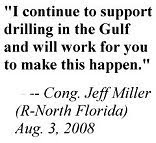
Former congressman Bob Sikes managed to eliminate that provision for the part of the island that is now called Okaloosa Island. Current congressman Jeff Miller has indicated in the past a willingness to sponsor such legislation for the rest of the island.

The lawyers and politicians entangled in the ongoing Pensacola Beach tax suit could do their clients and constituents a very large favor by approaching him again. A true settlement of the tax dispute would be in everyone's interests.

Friday, February 03, 2006

Court Rejects Beach Tax Appeal

"Unreason and injustice at the top, unreason and injustice at the heart and at the bottom, unreason and injustice from beginning to end — if it ever has an end — how should poor Rick, always hovering near it, pluck reason out of it? He no more gathers grapes from thorns, or figs from thistles, than older men did, in old times.”
-- Charles Dickens, Bleak House
The Pensacola News Journal is reporting today that the Florida Supreme Court has dismissed without comment the last appeal of Navarre Beach leaseholders against imposition of county real estate taxes.

The end of the bitter 5-year battle between Navarre Beach leaseholders and Santa Rosa County came with a whimper, not a bang. In a one-sentence order, the Supreme Court simply declined to review the case. This allows last year's First District Court of Appeals ruling to stand. That opinion is archived on the web site of the Navarre Beach Leaseholders Assn..

As Gannett's Tallassee reporter writes:
[T]he end of the legal challenge... means 800 leaseholders now owe about $2 million in 2001 taxes. In all likelihood, it also means more than 1,700 Navarre leaseholders now will have to pay more than $19 million in taxes assessed through 2005.
It's a matter of some concern what effect draining nearly $20 million from local residents may have on Santa Rosa County's economy and real estate market. The decision also darkens the clouds over similar lawsuits by Pensacola Beach leaseholders who are challenging Escambia County's parallel effort to impose taxes.

Some are saying that even if the tax is upheld, residents and business who can prove they relied on past promises of tax exemption when they bought beach property still may have a breach of contract suit against the state or county.

If the lawyers get creative enough, maybe the county should rename the beach Pensacola Bleak House.

Friday, January 27, 2006

For Sale - Beach Evidence!


Linda L. tipped us off to this weekend pleasure:

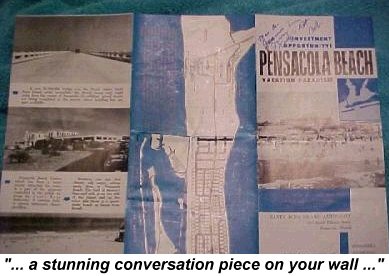
Someone from Kingsport, Tennessee, is auctioning off on Ebay a "tri-fold brochure [that] touts the lots available on Santa Rosa Island and the income potential as such."

Better hurry! Bidding ends Sunday at 4:00 PM (central time).

Old timers on the beach may recognize the brochure as the very kind of promotional literature the Santa Rosa Island Authority and Escambia County used to circulate coast-to-coast in the late '50s and '60s. Often, such brochures (and newspaper ads) promised "tax free lots" and made other explicit assurances that if you bought a 99-year lease you'd "never have to pay ad valorem taxes."

The Escambia county commissioners sure knew how to break that promise, didn't they!? (You can get the latest on the pending lawsuits over on the Pensacola Beach Tax Lawsuit web site.)

We can't be sure what this brochure on offer at Ebay actually says, but you can always ask the seller through Ebay's ask-seller-a-question system before bidding. At best, you might be able to use it as evidence in some drawn-out breach-of-contract litigation when and if the tax collector comes calling.

At worst, under the right lighting, the brochure would make a stunning conversation piece on your condo wall -- or in your jail cell when they haul all of us off to debtor's prison.

Tuesday, December 21, 2004

Beach Leaseholders' Lawsuit Filed

"WHEREAS, Santa Rosa Island Authority on behalf of Escambia County represented to the general public and all parties dealing with them, that the said properties on Santa Rosa Island owned by Escambia County were not subject to ad valorem taxes... ."
-- 1976 Laws of Florida, chap. 76-361
The widely anticipated litigation challenging last summer's decision by county government to impose ad valorem taxes on Pensacola Beach leaseholders has begun, according to a lead article in today's Pensacola News Journal.

Four Lawsuits Filed

Amber Bolman reports in today's Pensacola News Journal that over the last week:
four suits contesting property taxes that were levied on beach leaseholders for the first time this year have been filed against Property Appraiser Chris Jones and Tax Collector Janet Holley. Thousands of Santa Rosa Island residents, along with some of Pensacola Beach's biggest businesses, are plaintiffs in the lawsuits alleging that the ad valorem taxes should be voided.

Beach residents have argued they should not pay taxes because they lease, rather than own, property. An ad valorem tax is based on the assessed value of real estate or personal property.

"We believe the property appraiser has carried out a void and illegal act in imposing the taxes, and the tax collector has followed suit by collecting them," said attorney Danny Kepner, who is representing about 3,400 beach residents in one lawsuit and about 40 businesses or management groups in another.
The largest number of plaintiffs filed the lawsuit under the caption, "1108 Ariola, LLC, et al. vs. Chris Jones." A list of the 3,409 plaintiffs and 2,232 property addresses involved was posted yesterday on the Internet. The web site was created and is maintained by an ad hoc committtee of residential and commercial leaseholders who are opposing the county tax initiative.

Among the beach businesses filing suit are island restaurants Jubilee, Capt'n Fun Beach Club, Hooters, Flounder's Chowder House, Hemingway's Island Grill, and Peg Leg Pete's. Hotels joining the suit include the Hilton Garden Inn, Springhill Suites, Clarion Suites, and the Hampton Inn.

Bolman identifies Alvin's Island as the only souvenir shop contesting the taxes. Many others are known to be mere sublessees of the restaurant owners or newer businesses with leases less than 99 years in duration.

Bolman also writes that separate lawsuits were filed in the last week in behalf of leaseholders at two Portofino towers:
The other two lawsuits were filed by Ed Fleming of the firm McDonald, Fleming, Moorhead. Fleming is representing homeowners associations from Portofino's first and second towers in two lawsuits.

The suits allege that the beach properties actually are owned by the county and should be exempt from property taxes.

The lawsuits also argue that even if the taxes are deemed legal, they are excessive. They accuse Jones of improperly including "the value of the land itself into the valuation."

"The property appraiser made assessments at an amount nearly twice the cost to rebuild these units," the suits state. "The amount of the appraisals is grossly excessive and does not represent just value."
At widely attended leaseholders meetings over the past two months, attorneys also have mentioned that the Portofino development leases approved by the Santa Rosa Island Authority contain unique language that might be construed as offering additional guarantees against county real estate taxes.

History of Beach Taxes: Fool Me Once, Fool Me Twice

This is the third time in four decades Escambia County officials have tried to impose real estate taxes on Pensacola Beach property. The island originally was donated by the U.S. Department of Interior to Escambia County in 1947. The Federal deed expressly authorized the lease, but not sale, of island property.

Over much of the succeeding fifty years, the county was slow to develop island infrastructure, eradicate pestilent mosquitos, or build schools and other amenities that would attract private investment. Instead of spending public funds to develop Pensacola Beach, it settled on a strategy of enticing developers, residents, and businesses to spend their own money in exchange for a promise that leaseholds would be ad valorem tax-free.

Escambia County produced and widely distributed pamphlets that promised "no county or state taxes on the lot or structure." It also embarked on an aggressive nation-wide advertising campaign promising "tax free" 99-year lot leases with "no ad valorem assessments." Full-page ads promising "tax free beach lots" ran for many years in newspapers and magazines from Seattle to New York and Detroit to Dallas.

The Santa Rosa Island Authority maintains an extensive archive of those pamphlets, advertisements, letters, memos, and other evidence of the county's long-standing promises.

Still, for many years Escambia County found it difficult to attract anyone to invest in its sand-blown, undeveloped island. On occasion, the county even gave away 99-year leases as door prizes. In those days, the 'good news' was you'd just won a long term beach lot lease. The 'bad news' was that the fine print in your door prize lease required you to spend your own money building a house within two years -- or the lease would be forfeited. [Edit - A house, moreover, to which Escambia County would have title.]

Some of this history was later memorialized by the state legislature in the preamble to House Bill No. 3913, 1976 Laws of Florida, chap. 76-361. That bill was passed to bring an end to an earlier, similar, county effort to impose real estate taxes on Pensacola Beach property. In pertinent part, the legislation states:
"WHEREAS, in the year of 1949, the Legislature enacted a law... exempting the lands owned by Escambia County on Santa Rosa Island and all interests therein from all ad valorem and other forms of taxation, and

WHEREAS, [the law] was determined on April 17, 1951, to be valid and constitutional by the Supreme Court of Florida ... , and

WHEREAS, Santa Rosa Island Authority on behalf of Escambia County represented to the general public and all parties dealing with them, that the said properties on Santa Rosa Island owned by Escambia County were not subject to ad valorem taxes, and

WHEREAS, said governmental authorities induced hundreds of persons, who relied upon the representations and the decision of the Supreme Court to enter into long term leases providing for rentals and which contained many onerous provisions, among them the requirement that all utilities be purchased from such authorities, the requirement that lessees at their expense construct improvements on the leased land within a specified time which...became...the property of the county and were not subject to removal, and 21 provisions wherein the lease could be forfeited and the entire investment of the lessee lost, and
* * *
WHEREAS, the functions and representations of said governmental authority were performed for and made on behalf of Escambia County and are binding upon them... ."
Escambia County officials have chafed under the yoke of being required to keep their past promises. According to Bolman, county officials expect taxes on leasehold interests might generate about $5.2 million in revenue annually. Over the years, county politicians also have found it useful to demagogue among mainland voters by using the island's tax-free status as a wedge issue.

Bolman's news report adds that earlier this Fall, anticipating litigation over its latest effort to impose taxes, Escambia county commissioners "voted to hold those funds in reserve until legal challenges are resolved."

Commissioners may have hoped by that move to encourage more islanders to pay the disputed taxes in the expectation that the county would return the money if the leaseholders' lawsuit is successful. Given the county's history of breaking its word, however, many have scoffed at the commissioners' latest move.

"Why should we believe the county now?" one resident asked at an informationl meeting of leaseholders about a month ago. "You know what they say. 'Fool me once, shame on you. Fool me twice, shame on me.' Why should we fall for it a third time?"

County Attorney Janet Lander told reporter Bolman that she expects it could take up to two years for the lawsuits to be settled in court. A similar suit brought by Navarre Beach residents and leaseholders is now on appeal.

Some attorneys have said they expect the Navarre Beach appeal to be decided within the next six or eight months. However, attorneys meeting with Pensacola Beach residents have said there may be important differences between the Santa Rosa County leases at Navarre Beach and those written by Escambia County covering Pensacola Beach property.

Friday, November 19, 2004

Bell vs. Bryan I (1987)

There has been considerable talk about the earlier case in which both the Escambia County Circuit Court and the First District Court of Appeals ruled against county attempts to impose ad valorem taxes on Pensacola Beach leaseholds. For the convenience of interested persons, reproduced below is the actual decision as written in 1987.

Bell v. Bryan (I)
505 So.2d 690 (Fla. 1st DCA 1987)
First District Court of Appeal of Florida

Full case name: Matt Langley BELL, III, Tax Collector for Escambia County, Florida, Escambia County, Florida, a political subdivision of the State of Florida, R.J. Hooten, and Santa Rosa Island Authority, Appellants v. R.D. BRYAN, a/k/a Ruepert D. Bryan, and Nellie B. Bryan, Husband and Wife, Don Bryan, Merrell Fairchild, William O. Wedel, a/k/a W.O. Wedel and Dorothy Thayer, Appellees.

Summary: In dispute regarding county tax assessment on leased property owned by county, the Circuit Court, Escambia County, John T. Parnham, J., granted summary judgment in favor of taxpayers, and county appealed. The District Court of Appeal, Nimmons, J., held that: (1) it was improper for tax collector to issue tax certificates on improvement on property owned by county but leased by improver to enforce tax assessments, and (2) tax assessments erroneously taxed improvements at real property rate instead of at applicable intangible personal property rate.

Affirmed.

*690 Thomas F. Condon of Mitchell & Condon, Pensacola, for appellant Bell, Tax Collector.

J.B. Hopkins, Pensacola, and Larry E. Levy of McFarlane, Ferguson, Allison & Kelly, Tallahassee, for appellant Escambia County.
Spencer Mitchem of Beggs & Lane, Pensacola, for appellant Santa Rosa Island Authority.
M.J. Menge, of Shell, Fleming, Davis & Menge, Pensacola, for appellees.

ON REHEARING

NIMMONS, Judge.

We substitute the following for the opinion of January 23, 1987, filed in this case. Except for the modification exemplified by the amended opinion, rehearing is denied.

Appellants challenge a summary judgment entered in favor of appellees, taxpayers on Santa Rosa Island. We affirm.

Appellant, Escambia County, owns property on Santa Rosa Island which it leases to appellees through its agents, the Santa Rosa Island Authority. Each lease states in part:
(3) The above described property is leased to lessee as residential property for the purpose of constructing and maintaining a beach home or seasonal or permanent residence thereon. Lessee covenants and agrees at his own cost and expense to erect and complete a dwelling house on said property....
(4) Title to any building or other improvements of a permanent character that shall be erected or placed upon the demised premises by the lessee shall forthwith vest in said Escambia County, subject, however, to the term of years and option to renew granted to lessee under terms of this lease.

Appellees are leaseholders who improved their lots for residential purposes.

With regard to the taxes to be paid by appellees in 1982 and 1983, the County assessed no tax on the value of the leasehold *691 without improvements. This was apparently taxed by the state as intangible personal property pursuant to Section 196.199(2)(b), Florida Statutes (1981). However, taxes on the improvements made by the lessees/appellees were assessed at the full real property rate. Appellant/Tax Collector issued tax certificates on the property to enforce the assessments. Appellees filed a complaint requesting declaratory and injunctive relief. The trial court granted summary judgment in favor of appellees finding that the real property belonged to the County, thus making tax certificates an improper method of enforcing an assessment, and finding that the assessments should have been at the intangible property rate instead of the real property rate. We affirm on both grounds.

The first issue raised by appellants is that it was not improper for the tax collector to issue tax certificates on the improvements on the property owned by Escambia County.1 As the trial court found under the above quoted terms of the lease, the improvements on the Santa Rosa properties belong to Escambia County. That being the case, it is inappropriate to enforce tax assessments via sale of tax certificates. Section 197.116(8), Florida Statutes (1983). The trial court was correct in granting summary judgment on this ground.

The alternative ground suggested by appellees for granting summary judgment was that the assessments were erroneous in that they taxed the improvements at a real property rate instead of at an intangible personal property rate. The trial court agreed with this interpretation of existing law. So do we.2 Section 196.001, Florida Statutes, which has remained unchanged since 1971, provides:
Unless expressly exempted from taxation, the following property shall be subject to taxation in the manner provided by law:
(1) All real and personal property in this state and all personal property belonging to persons residing in this state; and
(2) All leasehold interests in property of the United States, of the State, or any political subdivision, municipality, agency, authority, or other public body corporate of the state.

The general method of taxation is prescribed in other parts of Florida Statutes, e.g. Chapters 193 and 200. However, within Chapter 196, entitled "Exemptions," appears Section 196.199(2)(b), Florida Statutes (1981)3 :
(2) Property owned by the following governmental units, but used by nongovernmental lessees, shall only be exempt from taxation under the following conditions:
* * *

(b) ... Such leasehold estate shall be taxed only as intangible personal property pursuant to Chapter 199 if rental payments are due in consideration of such leasehold estate. If no rental payments are due pursuant to an agreement creating such leasehold estate, the leasehold shall be taxed as real property. Nothing in this section shall be deemed to exempt personal property, buildings, or other real property improvements owned by the lessee from ad valorem taxation.

The exemption contained in this section is applicable to the instant leaseholds. All parties concede that the exemption applies to the real property on which the improvements were built. However, appellants argue the novel proposition that the improvements, which are property of Escambia County, and the development of which is the express purpose of the creation of the leasehold, are not part of that leasehold. We can find no basis in law or reason for determining that the improvements on the *692 real property are not as much a part of the leasehold as the real property itself.

The trial court correctly determined that the assessments placed on the improvements to the subject property were erroneous and should have been determined at the intangible personal property rate pursuant to the above quoted section.

Accordingly, the summary judgment in favor of appellees is AFFIRMED.

JOANOS and THOMPSON, JJ., concur.

FOOTNOTES


1. Appellant/Tax Collector concedes the correctness of the trial court's findings on this point. However, the other appellants do not.

2. No constitutional challenge to this statutory taxation scheme is raised on appeal and therefore, of course, no constitutional issues are determined.

3. The statute was slightly changed in 1985. Chapter 85-342, Laws of Florida.

Sunday, November 14, 2004

Tax Message from the PBRLA President

Gary E. Smith today posted the following message on the PNJ's Pensacola Beach message/chat board:

At yesterday’s meeting at Bamboo Willie’s, a litigation group was formed to contest taxation on beach property. Here are the highlights:

* The law firm selected is Shell, Fleming, Davis and Menge.
* The INITIAL fee is $200 per tax bill.
* The suit will be multi-plaintiff, NOT CLASS ACTION

If you wish to be included as a plaintiff, deliver or mail a check for $200, a copy of your current lease, assignment, master lease (if you have one) and tax bill, to:
The Visitor Information Center
735 Pensacola Beach Blvd.
Pensacola Beach, Fla. 32561

Make checks payable to the Pensacola Beach Tax Suit Trust Fund. ASAP. TIME IS SHORT.

The next meeting of persons participating or interested in participating will be at Bamboo Willie’s at 6:00pm on Thursday.
Spread the word as best you can. Tell your friends and neighbors and out of state owners.