Showing posts with label escambia government. Show all posts

Sunday, August 10, 2008

Injustice Repeated

Special to Pensacola Beach Blog by William L. Post:

Since the publication of Deceit Beach, The True Story, I have had overwhelming positive feedback. A reader of one of my newspaper Viewpoint articles wrote --
“It has warmed my heart to read your well thought out and written articles. I have wondered the very things you have so clearly articulated…”
Of particular interest to me is the history which the first leaseholders carry in their heads and the archival material which they possess. One of the first, and now a former leaseholder, wrote:
“As I was telling you today, people have short memories. When I was a flight instructor here in the late 50's I would fly over and look at waterfront properties. If I liked the looks of it I would inquire. Most waterfront property could be had from $3.00 to $30.00 a front foot or $300.00 to $3000 for a 100 foot lot. Taxes on the unimproved land were so low as to be negligible. Nobody wanted sand, mosquitoes and palmetto. Every one wanted to live in the latest modern subdivision. I came back in the 60's and little had changed except, there were ads for Pensacola Beach leases with no taxes ever. But when you considered that a $300.00 LEASE FOR 100 YEARS WAS $30,000.00 AND FEE SIMPLE OWNERSHIP WAS 300.00 IT DIDN'T SOUND LIKE SUCH A GOOD DEAL. The thing that decided it for me was the "no taxes." I believe I studied in Commercial law that baiting and switching on a contract was something called "fraud in the inducement,” which made the contract voidable. Wonder how Escambia County would cope with hundreds of voided contracts and have to buy them back at current prices? Thought you might like to know how it was in those times.”
One anonymous detractor protested my July radio interview and said in an online comment page, “please stop providing a forum for that crackpot Bill Post - his schtick is so tired.”

I replied online:
“I spent 16 months (and several thousand dollars) researching the topic of my book, Deceit Beach. This is considerably more time than the 15 seconds it took for you to write your commentary about me being a “crackpot.” It is clear to me, and probably to all others, that you have not read the book and that you are uninformed on its topic. But that short coming has a solution. Get a copy of the book and read it. If you find factual error in the contents of the book, please advise me so that I can make the correction for the next printing. Once you have read the book and researched the topic and wish to debate the facts, feel free to contact me at WilliamLPost@hotmail.com to set up a public debate time.”
Well, I did not hear from the anonymous detractor. I prefer to assume he has no facts with which to debate. The alternative explanations -- death, disease, amputation of his typing fingers -- are too horrific to contemplate.

The history is written and the facts available for all to read and see in illustrations. Hopefully, others will add to the research.

Unfortunately, the recent one-word "per curiam" decisions of Florida courts ignore the well documented history of behavior by Escambia County Commissioners and the SRIA. Through that silence, they sustain the injustice commenced in 1971 with the first taxing attempt.

On June 30, 1978, the Pensacola News Journal editorial board wrote about the injustice of the first attempt to tax the leaseholds, “If government itself won’t keep its promises, then we have come to a pretty sorry state.”

History does repeat itself and peoples’ memories are indeed short.

Saturday, May 03, 2008

Beach Deeds, Taxes, and Stare Decisis

It's 'Beach Deeds Day' at the Pensacola News Journal. The paper editorializes, "Don't Rush to Make Area Beaches Private."

Channeling county commissioner Grover Robinson IV and residents' SRIA representative Dr. Thomas Campanella, the newspaper's editorial flatly warns:
There should be no rush to convert leases on Santa Rosa Island to private ownership. There are serious questions to be answered, and obstacles in the way.
Adjacent to that in the print version of the Saturday edition, former PNJ editor in chief J. Earle Bowden observes "Public Loses When Beach Converted to Private." (Oddly, the on-line version when we first saw it gives no hint who wrote it.)

Newcomers may not know this, but Bowden is virtually the Father of Gulf Islands National Seashore. He courageously led the charge in the 1960's to save Santa Rosa Island from shockingly honky-tonk developer plans to pave the island from one end to the other. In the end, his efforts were instrumental in adding the Gulf Islands National Seashore to nine other seashore areas to form the biggest national park in the nation.

Largely due to Bowden's foresight and leadership, we still have a public beach to argue over. The story is told in "The Sands of All Time: Preserving America's Largest National Seashore." Doug Waitley's Best Back Roads of Florida has a synopsis.

Retired now, but still active, today Earle Bowden serves up a useful summary of beach deed history along with an abrupt condemnation of how the county to abuses its trust:
The Interior Department's public-use reverter clause protects a valuable asset. I question whether either county upholds the real spirit of the Interior Department public-use deed clause. Pricey high-rise condos and residences continue to diminish the openness of publicly-owned beaches; private ownership of the land would open the gate toward more private beach.
Pensacola Beach residents, like the public at large, seem to be sharply divided on the issue of a deed exchange. Listening to those who favor it and those who don't, one can't escape the conclusion that everyone is talking at cross purposes.

One camp is anxious over the prospect that Florida courts will upset half a century of expectations -- and express promises by Escambia County -- that island leases would be exempt from ad valorem taxes. They argue that if the courts are going to ignore that history and rewrite the deal at the urging of the very same county that made those promises, then it's only fair they be given deeds to their property like every other ad valorem taxpayer.

The other camp looks at the history of Santa Rosa Island and Escambia County politics, and with good reason worries that a deed exchange will eventually lead, just as the PNJ editorial warns, to 'corralling' the public like cattle into the county's few, relatively modest-sized public beaches.

Both sides may be right. At the root of all this agitation, quite obviously, is fear that the Florida courts are about to fiddle with a status quo worked out nearly fifty years ago to the benefit of all, after considerable effort by county voters (as detailed in Bowden's book), the state legislature, and Congress. That status quo has worked amazingly well to date.

Normally, the courts can be trusted to apply a legal doctrine so often short-handed as "stare decisis." In its original, full Latin meaning the doctrine is articulated as "stare decisis et non quieta movere," which translates as "stand by and do not disturb what is settled." Part of the genius of the common law is that this doctrine helps greatly to foster economic growth and political stability.

For now, what is settled is that no one can buy or sell any part of Santa Rosa Island. Long term leases are allowed, though at the cost of requiring leaseholders to build improvements on public land at their own expense and submit to other Island Authority design and building code restrictions. The leasehold property lines, moreover, ensure widespread public access to the unique 40-mile unbroken stretch of white sand beach.

In exchange, leaseholders have been assured of an exemption from ad valorem taxes. While there has been a healthy market for buying and selling those leases it has been, no doubt, at a far more affordable rate than would be the case if residents and businesses could claim absolute ownership of the fee.


Take away the widespread fear that the Florida courts are about to violate the stare decisis doctrine in the pending Pensacola Beach tax lawsuits, and you eliminate all this agitation. Leaseholders could relax, secure in the knowledge that their county-induced expectations will be honored. The market for selling leaseholds and improving properties would return to normal.

And the public would be relieved, too, knowing that the original federal deed's wise restrictions against over-development of Santa Rosa Island will be enforced. Pensacola Beach would remain open to public use.

On the other hand, if the courts "disturb what is settled" by allowing the county to break its word and impose ad valorem taxes, not only leaseholders but the public at large will be the losers.

Monday, April 28, 2008

Island Deeds-for-Taxes Resolution

Tomorrow morning at 8:30 a.m. (April 29, 2008), the elected commissioners governing both Santa Rosa and Escambia counties will meet in the county commissioners' meeting room in Pensacola "to discuss title issues on Santa Rosa Island and the Regional Transportation Finance Authority." It could be more than a "discussion." If the commissioners act sensibly, it might lead to a revived and expanding beach economy.

Jamie Page succinctly describes the background above the fold in today's PNJ Local News section.
All the land on Pensacola Beach is the property of the federal government, but Escambia County government holds the master lease. Residents with homes and commercial buildings on Pensacola Beach pay lease fees on the land. They have a 99-year lease, with various options for renewing, on the land.

It's a similar situation on Navarre Beach, except all leases have a continuous 99-year renewable lease.

These Santa Rosa Island residents also pay property taxes to their respective counties, and that doesn't sit well with many.

By "master lease" reporter Page no doubt has reference to the loose legal threads arising from the original titling of Santa Rosa Island to "Escambia County" rather than to the "State of Florida" and the subsequent sublease of the Navarre Beach portion of the island to Santa Rosa County.

Neither Escambia nor Santa Rosa are charter counties with an independent existence under the Florida Constitution. Both counties, therefore, effectively are administrative subunits of the state. Consequently, however the federal deed may read, it's the State of Florida that has the ultimate ownership power over the island, although in practice the state legislature often, though not invariably, routinely approves county actions.

The big thing Page's article fails to mention is that a specific resolution will be up for consideration at this rare joint meeting of both county commissioner boards. The detailed agenda includes a resolution, presumably to be voted upon separately by both county bodies:
RESOLUTION R2008-___

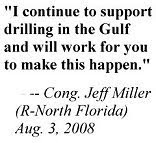
A JOINT RESOLUTION OF THE ESCAMBIA COUNTY BOARD OF COUNTY COMMISSIONERS AND THE SANTA ROSA COUNTY BOARD OF COUNTY COMMISSIONERS REQUESTING THE SUPPORT OF CONGRESSMAN JEFF MILLER TO RELEASE CERTAIN RESTRICTIONS ON CONVEYANCE FOR PROPERTY ON SANTA ROSA ISLAND; PROVIDING FOR AN EFFECTIVE DATE.

WHEREAS, on January 15, 1947, the United States of America conveyed to Escambia County, Florida, a portion of Santa Rosa Island, more particularly described in that deed recorded in Deed Book 248 at page 161 of the public records of Escambia County, Florida; and
WHEREAS, the deed recites that the property shall “always be subject to regulation by said County whether leased or not leased but never to be otherwise disposed of or conveyed”; and
WHEREAS, Santa Rosa County has an interest in the easternmost four miles of the property conveyed to Escambia County (Navarre Beach) pursuant to that certain Lease Agreement between the Santa Rosa Island Authority, an agency of Escambia County, Florida, and Santa Rosa County, Florida, dated February 11, 1956; and
WHEREAS, the Lease Agreement contemplates that Escambia County will convey Navarre Beach to Santa Rosa County and that the parties will cooperate “in obtaining such conveyance and congressional and legislative approval therefore”; and
WHEREAS, Escambia County and Santa Rosa County agree that it would be in the interests of both counties to release the restrictions on conveyance to facilitate transfer of Escambia County’s interest to Santa Rosa County and other persons and entities having leasehold interests on Santa Rosa Island; and
WHEREAS, the counties wish to express their intent to cooperate in drafting proposed legislation to release the restriction on conveyances and developing a process to convey Escambia County’s interest to Santa Rosa County and persons and entities with a leasehold interest on Santa Rosa Island, and to request the support of Congressman Jeff Miller to sponsor federal legislation to release the restrictions on conveyance; and
WHEREAS, the counties will direct their respective staffs and attorneys to cooperate in drafting proposed language for the legislation; and
WHEREAS, each County, through its Board of County Commissioners, has considered this Resolution at public meetings of their respective Boards.

NOW, THEREFORE, BE IT JOINTLY RESOLVED BY THE BOARDS OF COUNTY COMMISSIONERS OF ESCAMBIA COUNTY, FLORIDA, AND SANTA ROSA COUNTY, FLORIDA:

1. The above recitals are true and correct and incorporated herein by reference in the body of this Resolution.
2. Escambia County and Santa Rosa County hereby request the support of Congressman Jeff Miller to sponsor legislation to release the restriction on conveyances for property on Santa Rosa Island, which shall be mutually agreed upon and drafted by the counties.
3. Each County’s staff and attorneys shall cooperate in drafting the legislation, which will be approved by each of the Boards at future public meetings and subsequently forwarded to Congressman Jeff Miller for consideration.
4. The Clerk of the Board of the Escambia County Board of County Commissioners shall furnish a certified copy of this Resolution to Congressman Jeff Miller immediately upon its adoption and execution by both counties.
5. This Resolution shall become effective upon the date last adopted by each of the Boards of County Commissioners.
Why this resolution? And why now? Reporter Page doesn't address that, either.

Our guess is that it has a lot to do with the still-pending cases challenging the 2004 tax assessments issued against residential beach property lessees. Cross motions for summary judgment are scheduled for three hours of argument before Judge Michael Jones on May 2 beginning at 9:00 o'clock. If the above resolution passes, it could be the basis for settling all of the outstanding tax and lease fee issues.

This would be a just and fitting end to the tangled history that has plagued Island and county politics for decades. Equally important, it would at last provide a foundation for a prosperous island economy comparable to other Florida beach communities, for the reasons we described in a parable we authored some time ago.

As we pointed out there, via a series of links to contemporary economic land tenure studies, deeding the land outright to present-day island leaseholders in exchange for their assent to pay ad valorem real estate taxes would rescue Pensacola Beach and Navarre Beach from a stultifying, repressive, and counter-productive economic morass that is almost identical to the way rural land is leased in the People's Republic of China.

Yes, the People's Republic of China has a booming economy, overall. But as anyone who has visited there for any time can attest, and as the economic studies we cited in the parable convincingly show, the rural economy in China is in shambles, largely because the land there is owned by the government and leased to occupants on terms strikingly similar to those on Santa Rosa Island.

Before the 1920's, Santa Rosa Island was owned outright by Escambia County. When the then-mosquito infested swampland with a newly-abandoned 19th century cannon fortress was deemed a financial burden to maintain, the county gave it away to the U.S. War Department. After World War II, stewardship of the island passed to the Interior Department.

Jane Johnson picks the story up at that point in her excellent history of the island (pdf warning):
The Department of Interior reverted the portion of Santa Rosa Island (from Fort Pickens to Navarre Beach) back to Escambia County, in 1947. The Deed of Conveyance specified: “...that the above described land shall be retained by the said Escambia County and be used by it for such purposes as it shall deem to be in the public interest or be leased by it from time to time in whole or in part or parts to such persons and for such purposes as it shall deem to be in the public interest and upon such terms and conditions as it shall fix and always be subject to regulation by said county whether leased or not leased, but never to be otherwise disposed of or conveyed by it… .”

In Escambia County the Santa Rosa Island Authority was formed in 1947, an outgrowth of the island advisory board formed in 1946.

On February 11, 1956 Santa Rosa County began leasing Navarre Beach from Escambia County. The lease was for 99 years at the rate of $100 per year... .

To populate the island and promote the tourist trade throughout the ensuing decades Escambia County promised, in written advertisements in national newspapers and magazines and in promotional literature distributed locally, "tax free" leaseholds on the newly named Pensacola Beach. Archives held by the Santa Rosa Island Authority include hundreds of examples of these newspaper ads and brochures. Some in private hands have even made their way to Ebay as collector items.

As we have pointed out before, "some of this history was later memorialized by the state legislature in the preamble to House Bill No. 3913, 1976 Laws of Florida, chap. 76-361." Overall, it can be said that as long as the county kept its word Pensacola Beach and Navarre Beach prospered. The tax-free promotions worked, to a degree that Pensacola Beach eventually -- after half a century -- reached the maximum sustainable population of 4,128 units allowed by a state-approved building cap.

Thus, all was well enough until the late 1990's when county commissioners, spearheaded by Mike ("Deer Slaughterer") Whitehead , began agitating to impose ad valorem taxes on beach leaseholds in addition to the annual leasehold fees they pay. Then, lawsuits were filed. Some of those suits, including one over the issue of beach business leases and another over Navarre Beach condominium leases, were lost in front of appeal courts who issued one-word opinions.

But the granddaddy of them all, the Pensacola Beach residential leaseholders class action, has always presented the most compelling claim. History, facts, legal precedent, economic reality, and common sense are all on the residents' side.

Maybe, just maybe, this has at last sunk in with county commissioners. If so, the resolution being proposed tomorrow should pass unanimously. Most island residents are willing to exchange their leases for a deed and to pay real estate taxes like beach residents on other beaches, including nearby Fort Walton Beach. All sides benefit. County government gets the tax income. Beach residents get a deed absolute. Everyone in Northwest Florida profits by having, at long last, a truly free market in land tenure.

The People's Republic of China, communist as it may be, has come to realize that individual deeds to land holdings is good for everyone. Let's hope our county commissioners are at least as smart as the Chinese.

UPDATE

Tuesday, October 23, 2007

Beach Tax Lawsuit Tanked

WHEREAS, Santa Rosa Island Authority on behalf of Escambia County represented to the general public and all parties dealing with them, that the said properties on Santa Rosa Island owned by Escambia County were not subject to ad valorem taxes, and

WHEREAS, said governmental authorities induced hundreds of persons, who relied upon the representations and the decision of the Supreme Court to enter into long term leases providing for rentals and which contained many onerous provisions... .
House Bill No. 3913, 1976 Laws of Florida, chap. 76-361
Florida's First District Court of Appeals yesterday upheld a lower court decision by Pensacola circuit judge Nick Geeker which approved assessing real estate taxes on Pensacola Beach business leases. The business lease tax case was one of four lawsuits filed three years ago, when Escambia County commissioners moved to squeeze more gold out of the wounded goose known as Pensacola Beach.

Yesterday's appeals court opinion was learned and erudite; it explored the unique historical context of the on-again-off-again- on-again promises of Florida state and county government that beach leases would be tax-free, and the opinion brought to bear on the issue incisive reasoning, ample precedent, and an enlightened discussion of public policy. Right?

Not a chance. The court's opinion consists of one word: "Affirmed." That's 2.66 alphabet letters for each of the three judges (annual salary: $147,524) who issued yesterday's decision, by name Marguerite Davis, Joseph Lewis, and Clayton Roberts.

Despite the First District Court of Appeals' 1987 precedent of Bell v. Bryan I, the handwriting has been on the wall for some time with more recent court opinions like this one and this one. Few above the lowly political level of a trial judge seem willing to leave their fingerprints on it. That's one advantage of what judges call a "per curiam" (unsigned) opinion: individual judges can hide their own responsibility and reasoning, albeit at the steep price of undermining the democratic principles of accountability, transparency, and public education about the judiciary's function.

To be sure, we still await a final appellate court ruling on the main case involving Pensacola Beach residential leaseholds. So, unless you've lost faith in the impartiality and wisdom of the Florida court system (Now, stop that snickering!) don't sell your evidence on Ebay just yet.

Unless, like our friend Bryan, you think it's a Zen thing -- in which case you might want to convert your beach home to a start-up high tech "business with no track record" to get a $2 million tax break from the county.

Tuesday, April 03, 2007

For Whom Bell Tolls: Portofino Taxes

Judge Frank Bell ruled that Escambia County is legally authorized to impose ad valorem taxes on Portofino condo unit owners, according to Michael Stewart's abbreviated article in today's Pensacola News Journal. The unpublished opinion was filed last week but just came to public attention today.

That has to be devastating news for the five-tower high-rise complex. At last count, more than 120 units were listed for sale. Many more were rumored to be "pocket listings" -- not listed anywhere but readily available for purchase if you knew your way around the local real estate swamp. Now that real estate taxes have to be taken into consideration, the market will be just that much smaller and slower.

Explains Stewart:
Because beach leaseholders do not own the land on which their homes and businesses are built, they pay lease fees and have argued beach taxes are not legal. Leases are for a minimum of 99 years, with many leases providing an option for a second 99 years.
Earlier, a similar ruling rendered Pensacola Beach businesses subject to property taxation on their commercial rental land leases.

Among the lawsuits yet to be decided by the courts is a homeowner residents' suit. Many have considered that one to be the strongest case of all because of the explicit written, oral, and even state statutory promises that beach leaseholds and improvements would be tax-free, promises which Escambia County consistently made over the decades in an effort to develop the island.

The Portofino development wasn't leased until 1999, by which time the county had stopped making tax-free promises. The strong record of historic tax-free promises didn't affect Navarre Beach, either, where serious development didn't get underway until the mid-1980's. In any event Santa Rosa County never engaged in the same "tax free" public marketing strategies.

Even so, some residents are pessimistic. Florida courts don't have a good record for requiring Escambia County to keep its governmental word. That pessimism may explain why one person even sold evidence of Escambia County's "tax-free promise" pamphlets on Ebay a while ago.

The winning bidder paid $20.50 for the evidence. That may be the most anyone ever makes out of the otherwise worthless promises of Escambia County -- except, of course, for the lawyers and real estate brokers.

Someone knew what he was doing when he borrowed the Creek Indian word for "money exchange" to name Escambia County.

Tuesday, November 28, 2006

Judge: Beach Businesses Subject to Taxation

Pensacola Beach businesses are subject to real estate taxation on their commercial leaseholds even if they do not have title to the real estate or buildings, Escambia County circuit court judge Nick Geeker ruled yesterday. The decision directly affects many of the approximately one hundred hotel, restaurant, and souvenir shops on the beach.

Still pending are lawsuits brought by home and condo residents who are also challenging renewed efforts by Escambia County to impose real estate taxes on occupants of the island, which is titled in the county's name. Whatever the outcome of the suits, the issue is unlikely to be resolved until all appeals are exhausted over the next two years.

As reporter Derek Pivnick writes in today's PNJ:
It's the first loss in the court battle against property taxes on structures -- homes, businesses and condominiums -- on the beach.
* * *
If the ruling is upheld on appeal, it could mean a substantial influx of tax money for Escambia County. More than $12 million in taxes remains unpaid, according to Escambia County Tax Collector Janet Holley's office.
June Guerra, owner of the still-closed Jubilee Restaurant, spoke for many when she told the News Journal, "The county's taxation is going to be the downfall of the island."

If not a downfall, certainly a radical change. Businesses, unlike residents, can always pass the added expense of real estate taxes onto their customers. As prices escalate, fewer local mainlanders will be able to afford beach accommodations, restaurant meals and beverages, and other goods and services.

Over time, many believe, raising the cost of having a business or home on Pensacola Beach will price the average family out of the market -- both as day visitors and as potential home owners. To survive, properties will have to convert to more high rises, greater density, and higher prices.

Mainlanders and politicians who are applauding today's ruling could well find themselves unable to afford a visit to the beach tomorrow.

South Florida -- here we come.

Additional Links

Beach Leaseholders' Lawsuit Filed (Dec. 21, 2004)

Tuesday, May 09, 2006

Tax Suit Memory Jogger

Derek Pivnick of the Pensacola News Journal has a memory-jogger about the pending Pensacola Beach tax suit in today's PNJ. The point seems to be 'Hey, don't forget this juicy little item we still have on the back burner.'

It's like a medical alert. The PNJ doesn't want subscribers, having forgotten all about the litigation, opening up their newspaper one morning and having a heart attack over some big black headline announcing a tax decision.

Pivnick writes:
The legal fight about whether millions of dollars in property taxes should be paid on Pensacola Beach homes, condominiums and businesses continues unabated by the Navarre Beach leaseholders' recent court loss.

Six lawsuits are pending in Escambia County, and it could be only a matter of weeks before the first one gets a trial date... .
In over 450 words, Pivnick manages to avoid reporting one new fact about the lawsuits. But he does grab a telling quote from the attorney representing some of the litigating leaseholders:
"The leases at Portofino do not have that 99-year perpetual renewal language," said Ed Fleming, a lawyer for Portofino's homeowners associations.
That's not exactly a Robert Luskin press leak. What Fleming is saying is well known, too. As we've said before, not all leases Pensacola Beach leases are the same. It stands to reason not all leaseholder tax suit arguments will be the same, either.

Some residential and commercial leases on Pensacola Beach are for a period of 99 years with an automatic right of renewal for an additional 99 years on "like" terms. Others - like the Portofino leases -- are for 99 years with a right to renew, but the terms are left open to negotiation. That leaves nothing but a generalized obligation of "good faith" in coming to terms over any renewal.

A few leases we've seen have garbled renewal language specifying only a right to renew without more and in key sentences seem to be missing a few subjects and verbs. Among residential as well as commercial leases, there are some for a shorter duration and others that flatly terminate after a set term of years, usually less than 50.

If all of this illustrates anything, it's that when the Island Authority wrote individual leases it was perfectly capable of specifying terms that did, or did not, convey the kind of "equitable ownership" that was decisive in last year's Navarre Beach tax ruling. That the SRIA did not always do so seemingly supports Fleming's argument.

The real lesson is for anyone contemplating a purchase on Pensacola Beach: read the lease before you buy. Every word of it.

For more about the beach leaseholders' tax lawsuits, check the Pensacola Beach Tax Suit web site.

Background Links
Beach Tax Litigation
Nov. 10, 2004
Beach Leaseholders' Lawsuit Filed
Dec. 21, 2004
Beach Tax Update
Feb. 12, 2005
Navarre Beach Tax Ruling
June 18, 2005
For Sale: Beach Evidence!
January 27, 2006
Beach Tax Settlement In The Wind?
Feb. 6, 2006
Hey Y'all
Feb. 19, 2006
An Airline
Mar. 3, 2006
Island Parable
March 12, 2006

Sunday, March 12, 2006

Island Parable

"Chinatown"

Once upon a time there was a distant, beautiful, and exotic island owned by a poor and lonely King named "Red." In the beginning, no one but King Red himself lived on the island. This made it a very lonely place. It also caused the King to be very poor.

Over time, however, many people came to visit King Red's island. Some liked it so much they decided to stay the year around. Others liked it too but they lived on the island only some of the time, like weekends when their homes were within a day's drive or in the winter months when the Northland was cold and snowy.

With all of the people moving to King Red's island and others being born there, businesses were sure to follow -- and they did. Shopkeepers and chefs, innkeepers and barkeeps all started commercial enterprises on the King's island. Soon, commerce was brisk and business was booming. All of the King's island subjects were happy.

The King was happy, too, because now he wasn't lonely. And, he was growing rich from all the taxes which the shopkeepers, chefs, innkeepers, and barkeeps charged their customers and passed along to King Red's treasury.

Soon, however, problems arose and the people grew restive.

Land Tenure

The first problem was confusion over who really owned the land. Since the deed to the island was owned by the King himself, the people began to grow nervous about how long King Red would allow them to live there. Although the King was happy to be getting rich from all the subjects living and working on his island, he adamantly refused to allow anyone to own even a small part of it.

"We own the deed to this island," King Red said, using the royal 'we'. "All of it, forever. Including the homes and business you have built on our land at your own expense."

However, seeing that his subjects were concerned that some day he might change his mind and kick them all out, the King agreed to sell the island people limited-term leases.

"We are the Government," the King said, again employing the royal 'we', "We own the deed to all of this island, but we will let you rent small parcels for a limited time."

To subjects who had built homes in the part of the island called "Chinatown" the King sold them 70-year leases with a right to renew for a like period. To subjects who lived and worked in that part of the island known as "Beachland" the King sold 99-year leases with a right to renew for a like period.

Now the people are happy, the King thought to himself, and they will continue to build and remodel and improve the buildings and businesses that sit on my land, so I can become even richer.

Property Taxation

Soon, though, a second problem arose. Grown greedy from seeing so many homes and businesses being built upon his island, King Red decided he could get even richer by imposing a new tax on island subjects. He called it an "ad valorem tax."

As one scholar wrote later:
"Since the supply of land is fixed, the landowner (the state government in the case of China island King) would bear the ultimate tax burden even if land users paid the property tax directly to the government. This is because the new tax would dampen the demand for land use rights and in turn reduce the fees that local governments could receive from leasing public land.

Because the Chinese government King Red is both the landowner and property tax collector, lessees who leased land in the past and paid the entire leasehold value without anticipating the additional property tax burden would wonder why they should pay more land tax to the government. Thus it is essential to have a rationale for taxing leasehold land, so as to convince lessees to comply with their property tax obligation.
Other problems with taxing island land soon surfaced. As the same scholar wrote:
One technical issue [was] valuation of leasehold rights for tax purposes. Since the new property tax will be value-based, assessors will face the challenges of estimating the leasehold value of land independently, based on market data that normally reflect a combined value of land and all improvements. Most property valuation methods presume that land is freehold, and that developed real estate markets are present. Neither of these assumptions can be applied to China Chinatown or Beachland. Although there are practices that separate land and building values for tax purposes, the divisions are generally based on crude assumptions. How can assessors modify the existing (or invent new) valuation techniques to accommodate these special Chinese Chinatown and Beachland conditions?

More important, leasehold value is highly sensitive to the lease term and conditions, both of which can vary significantly from one case to another. At this moment, time-tested mass appraisal techniques for assessing large numbers of leasehold sites do not exist. Do these issues imply that property assessment for tax purposes under the Chinese island leasehold system requires a case-by-case approach? If so, do local governments have the capability to carry out such detailed property appraisals for the collection of the new property tax? The Chinese King's government must find ways to deal with these practical matters if it decides to tax leasehold rights as private property.
So, the King established a detailed property appraisal system and thought to himself, using the royal 'we', "Now my subjects will continue to build and remodel and improve the buildings and businesses on our land so we can become even richer."

Tax Reform

A new problem appeared. The taxes became too heavy... there were so many different kinds of taxes and assessments that it bewildered the people and impeded efficient and uniform collection ... off-island enterprises like pizza delivery, building contractors, and professional services which were conducted on the island by enterprises headquartered elsewhere were given preferential tax treatment resulting in a structure "unfair to equal competiton" ... and the tax system "did not reflect the allied cost of ecological degradation caused by the utilization of resources."

Although reforms were studied endlessly and often proposed, consensus about what to do eroded as a sharp debate over ideology erupted. The King wanted to maximize taxes while retaining absolute control. The island people thought this was a communistic idea which time had been shown impractical and would ruin the economy.

"What do my subjects know, anyway?" the King thought to himself. Using the royal 'we' he comforted himself by adding, "Have we not always been conservative and against raising taxes and anti-communistic in our thinking?" And he answered himself by saying, "Yes, we have."
Ideology

Island people increasingly grumbled that King Red was a hypocrite. They said he criticized communist ideas even as he imposed the same ideas on all his island subjects. This led them to wonder why they had no right to pick their own King or write the day-to-day rules for the island they lived and worked on.

A sharp debate over ideologies erupted.

"Is this island a democracy or is it a communist dictatorship?" the island people demanded to know. "We want the right to decide our own local government. If we're paying taxes on land we don't own, why should King Red be the only one to decide how the island is governed? Who elected him, anyway?"

And so the island people petitioned the King to allow the island people to elect their own government.

"No way," King Red replied. He tore up their petition stomped on the tiny shreds. Then, using the royal 'we' he added, "We own the island. We decide who will be king -- and that King is us."

Burdened by higher and higher taxes and deprived of democratic self-governance, the island people and the businesses began to move away. First by two's and three's and later by the dozens and the hundreds.

Eventually, the island kingdom was emptied of everyone except King Red himself. With no one left to tax, the King soon was reduced to his former condition: lonely and poor.

And there our fable ends except for the --

Moral: China is as stunningly beautiful as Pensacola Beach, it's grappling with many of the same difficult governmental problems -- and its people are governed just as democratically as those who live on the beach.

Monday, February 06, 2006

Beach Tax Settlement in the Wind?

Last Saturday's Pensacola News Journal carried an item by Michael Stewart about two local school districts' effort to 'borrow' money from the state against a theoretical judgment for back taxes on Pensacola Beach and Navarre Beach leaseholds. Why Santa Rosa County's school district needs to do this is something of a mystery, since the Navarre Beach tax suit now has been lost. But the Pensacola Beach lawsuit marches on.

Yet, as Stewart reports, "How much money the districts can borrow is unclear."
"The Escambia School District could get as much as $6.9 million; Santa Rosa could get a loan of as much as $2.1 million.

* * *
In Escambia, the $6.9 million represents an annual $2.3 million shortfall for the 2004-05, 2005-06 and 2006-07 school years deducted when Pensacola Beach was placed on the tax rolls.
In other words, the county tax assessor's decision -- cheered on by our Escambia county commissioners -- to break long-standing promises of tax-free leases actually results in a reduction of state education funding to the Escambia County School District. Taxing beach property, it seems, would represent a windfall to the State, not the county. This is why the state has agreed to 'loan' money to the school district as long as it's paid back when and if taxes are imposed on island leaseholds.
In Escambia County, when Pensacola Beach was added to the tax rolls, the state reduced the School District's yearly funding by $2.3 million, the estimated amount the new tax money would generate for Escambia schools.

But many beach residents chose not to pay until a lawsuit contesting the taxes is settled. If a judge rules the taxes are legal, beach residents will have to pay back taxes plus interest. If that happens, the School District will repay the interest-free loan.

If beach residents prevail, DOE would recalculate the School District's funding to make up for the shortfall, Arnold said.
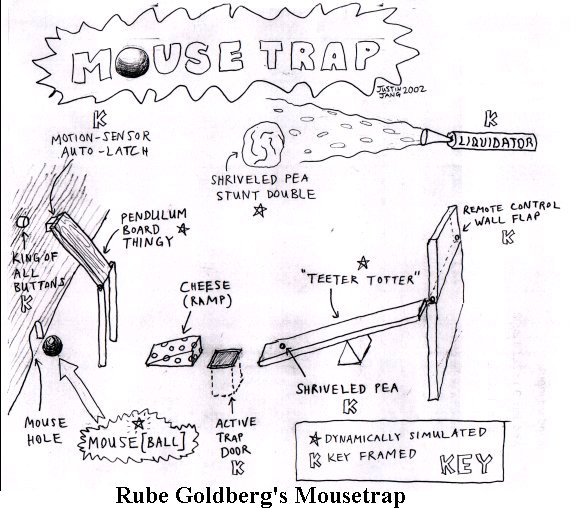
To explain why this is so would require a lengthy article all to itself about Florida's antiquated, unequal, highly politicized, and inadequate public education funding system. All we have to know for present purposes is that Florida' s system for funding public schools is as convoluted as a Rube Goldberg mousetrap. It short-changes school districts which happen to have a disproportionately high percentage of low-income students; and it well may be vulnerable to constitutional challenge.

What catches the eye in Stewart's article, though, has nothing to do with school funding issues. Twice he mentions the possibility of a "settlement" of the tax suit. It's possible Stewart simply made the common mistake of conflating "settlement" with "judgment," and he means nothing more than finality. Or, he could be hinting that true out-of-court settlement talks are underway.

Either way, Stewart's mention of a "settlement" recalls past efforts to amicably resolve out of court the long-standing tax dispute on the basis of a bargain that everyone could live with, beach residents and businesses as well as mainlanders.

What kind of deal might that be? For at least a decade, one group of beach leaseholders always favored trading taxes for an outright deed to leasehold property. Another group bitterly opposed any move toward compromise.

The split was mirrored among the membership of the Pensacola Beach Residents & Leaseholders Assn. While most PBRLA leaders at least privately favored negotiating a deed-for-taxes trade, none was able to marshall the support of enough beach residents and commercial leaseholders to make it happen.

Some PBRLA leaders who addressed the issue, like Ray O'Keefe (1998), argued that agreeing to pay taxes inevitably would lead to the desirable goal of self-government through municipal incorporation. Others like Don Ayres (1999) added that a deed-for-taxes solution also would improve the beach economy substantially by easing bank lender worries and by removing the uncertainty of leasehold renewal policies.

This last is an issue that has haunted the Santa Rosa Island Authority for many years. It's one that seems to be crawling out of its coffin once again, as we noted recently.

Still others, like Gary Smith (2004) recognized that a deed-for-taxes deal likely would satisfy the emotional need for security that many beach homeowners have, regardless of the common legal understanding that a deed is merely one kind of 'bundle of sticks' that other forms of property tenure, like a long term lease, closely approximate. Out of staters, in particular, are often puzzled by the leasehold tenure system on Pensacola Beach. Many potential buyers are scared off. Others simply accept the nonchalant assurances of real estate sales people that it's nothing to worry over.

It's been said that the revered "father of Pensacola Beach," the late Dr. Jim Morgan, also favored a deed-for-taxes solution. One surviving memorandum he wrote for posterity, decades ago, would seem to reflect this, although it also acknowledges that "granting the leaseholders absolute title will have consequences far beyond the taxation issue." (The only copy of the memo known to have survived was later edited by someone else, so it's impossible to be sure whether Morgan or the editor added the mysterious caveat.)

The closest anyone came to negotiating the kind of trade O'Keefe and Ayres (and maybe Morgan) favored came in the late 1990's, when county commissioner Mike Whitehead privately signalled that he would be open to a deed-for-taxes agreement as long as it happened within a few years. Whitehead ran for higher office soon afterwards, however. He lost and left the commission and was only recently elected once more as county commissioner.

With the adverse ruling on taxation of Navarre Beach leaseholds now final, some may assume that it is too late to settle the Pensacola Beach lawsuit. There are good reasons to reject that notion, however.

First among them is that a settlement with the right terms is in the interests of everyone. Even in the teeth of an adverse ruling, there would be plenty of basis for concluding that a true out-of-court settlement would be in the interests of mainlanders, county government, and state government, as well as beach residents.

Okalaoosa County solved the leasehold taxation issue decades ago when they traded beach taxes for a deed. Fort Walton Beach noticeably has prospered since then. One reason, perhaps, is that credit institutions often find it easier to lend money to businesses (or write mortgages for homes) that are secured by a deed to the property rather than a declining years lease. Residential as well as commercial real estate listings sell quicker, and probably for more, when buyers are assured the land tenure system is comparable to what they would find elsewhere, rather than the unique "99 year leasehold interest in Government owned land" that has prevailed on Pensacola Beach since the early 1950's.

A further reason is one of equity -- basically the same principle of fundamental fairness that led the courts in the Navarre Beach suit to conclude that long term leaseholds had so many incidents of ownership that they were the near-equivalent of deeded real estate and therefore taxable. If that is so, then to tax without a deed uniquely disadvantages beach property leaseholders.

Yet another reason is that a deed-for-taxes deal actually would bring in more money to the County than any court ruling. Under the Navarre Beach ruling, only improvements to the land -- house and business structures themselves -- are taxable. Until deeded outright, the land itself remains free of taxation. For those who would declare a beach residence as their homestead, that freedom has less value because the land tax they are avoiding would be less in any event. But for businesses, real estate taxes on deeded land will be just as deductible as a business expense as leasehold fees are today.

There are many more reasons for believing that all sides to the pending tax suits could benefit from a settlement. Undoubtedly, federal legislation along the same lines that enabled Okaloosa County to tax Fort Walton Beach property would be needed, however. The original deed to Santa Rosa Island prohibits Escambia County from titling the land in any other non-governmental peson or entity.

Former congressman Bob Sikes managed to eliminate that provision for the part of the island that is now called Okaloosa Island. Current congressman Jeff Miller has indicated in the past a willingness to sponsor such legislation for the rest of the island.

The lawyers and politicians entangled in the ongoing Pensacola Beach tax suit could do their clients and constituents a very large favor by approaching him again. A true settlement of the tax dispute would be in everyone's interests.

Friday, February 03, 2006

Court Rejects Beach Tax Appeal

"Unreason and injustice at the top, unreason and injustice at the heart and at the bottom, unreason and injustice from beginning to end — if it ever has an end — how should poor Rick, always hovering near it, pluck reason out of it? He no more gathers grapes from thorns, or figs from thistles, than older men did, in old times.”
-- Charles Dickens, Bleak House
The Pensacola News Journal is reporting today that the Florida Supreme Court has dismissed without comment the last appeal of Navarre Beach leaseholders against imposition of county real estate taxes.

The end of the bitter 5-year battle between Navarre Beach leaseholders and Santa Rosa County came with a whimper, not a bang. In a one-sentence order, the Supreme Court simply declined to review the case. This allows last year's First District Court of Appeals ruling to stand. That opinion is archived on the web site of the Navarre Beach Leaseholders Assn..

As Gannett's Tallassee reporter writes:
[T]he end of the legal challenge... means 800 leaseholders now owe about $2 million in 2001 taxes. In all likelihood, it also means more than 1,700 Navarre leaseholders now will have to pay more than $19 million in taxes assessed through 2005.
It's a matter of some concern what effect draining nearly $20 million from local residents may have on Santa Rosa County's economy and real estate market. The decision also darkens the clouds over similar lawsuits by Pensacola Beach leaseholders who are challenging Escambia County's parallel effort to impose taxes.

Some are saying that even if the tax is upheld, residents and business who can prove they relied on past promises of tax exemption when they bought beach property still may have a breach of contract suit against the state or county.

If the lawyers get creative enough, maybe the county should rename the beach Pensacola Bleak House.

Friday, January 27, 2006

For Sale - Beach Evidence!


Linda L. tipped us off to this weekend pleasure:

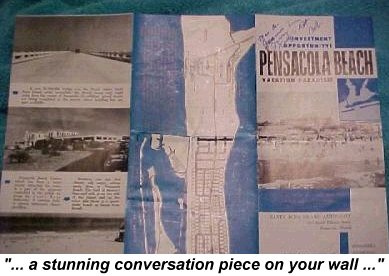
Someone from Kingsport, Tennessee, is auctioning off on Ebay a "tri-fold brochure [that] touts the lots available on Santa Rosa Island and the income potential as such."

Better hurry! Bidding ends Sunday at 4:00 PM (central time).

Old timers on the beach may recognize the brochure as the very kind of promotional literature the Santa Rosa Island Authority and Escambia County used to circulate coast-to-coast in the late '50s and '60s. Often, such brochures (and newspaper ads) promised "tax free lots" and made other explicit assurances that if you bought a 99-year lease you'd "never have to pay ad valorem taxes."

The Escambia county commissioners sure knew how to break that promise, didn't they!? (You can get the latest on the pending lawsuits over on the Pensacola Beach Tax Lawsuit web site.)

We can't be sure what this brochure on offer at Ebay actually says, but you can always ask the seller through Ebay's ask-seller-a-question system before bidding. At best, you might be able to use it as evidence in some drawn-out breach-of-contract litigation when and if the tax collector comes calling.

At worst, under the right lighting, the brochure would make a stunning conversation piece on your condo wall -- or in your jail cell when they haul all of us off to debtor's prison.

Tuesday, December 21, 2004

Beach Leaseholders' Lawsuit Filed

"WHEREAS, Santa Rosa Island Authority on behalf of Escambia County represented to the general public and all parties dealing with them, that the said properties on Santa Rosa Island owned by Escambia County were not subject to ad valorem taxes... ."
-- 1976 Laws of Florida, chap. 76-361
The widely anticipated litigation challenging last summer's decision by county government to impose ad valorem taxes on Pensacola Beach leaseholders has begun, according to a lead article in today's Pensacola News Journal.

Four Lawsuits Filed

Amber Bolman reports in today's Pensacola News Journal that over the last week:
four suits contesting property taxes that were levied on beach leaseholders for the first time this year have been filed against Property Appraiser Chris Jones and Tax Collector Janet Holley. Thousands of Santa Rosa Island residents, along with some of Pensacola Beach's biggest businesses, are plaintiffs in the lawsuits alleging that the ad valorem taxes should be voided.

Beach residents have argued they should not pay taxes because they lease, rather than own, property. An ad valorem tax is based on the assessed value of real estate or personal property.

"We believe the property appraiser has carried out a void and illegal act in imposing the taxes, and the tax collector has followed suit by collecting them," said attorney Danny Kepner, who is representing about 3,400 beach residents in one lawsuit and about 40 businesses or management groups in another.
The largest number of plaintiffs filed the lawsuit under the caption, "1108 Ariola, LLC, et al. vs. Chris Jones." A list of the 3,409 plaintiffs and 2,232 property addresses involved was posted yesterday on the Internet. The web site was created and is maintained by an ad hoc committtee of residential and commercial leaseholders who are opposing the county tax initiative.

Among the beach businesses filing suit are island restaurants Jubilee, Capt'n Fun Beach Club, Hooters, Flounder's Chowder House, Hemingway's Island Grill, and Peg Leg Pete's. Hotels joining the suit include the Hilton Garden Inn, Springhill Suites, Clarion Suites, and the Hampton Inn.

Bolman identifies Alvin's Island as the only souvenir shop contesting the taxes. Many others are known to be mere sublessees of the restaurant owners or newer businesses with leases less than 99 years in duration.

Bolman also writes that separate lawsuits were filed in the last week in behalf of leaseholders at two Portofino towers:
The other two lawsuits were filed by Ed Fleming of the firm McDonald, Fleming, Moorhead. Fleming is representing homeowners associations from Portofino's first and second towers in two lawsuits.

The suits allege that the beach properties actually are owned by the county and should be exempt from property taxes.

The lawsuits also argue that even if the taxes are deemed legal, they are excessive. They accuse Jones of improperly including "the value of the land itself into the valuation."

"The property appraiser made assessments at an amount nearly twice the cost to rebuild these units," the suits state. "The amount of the appraisals is grossly excessive and does not represent just value."
At widely attended leaseholders meetings over the past two months, attorneys also have mentioned that the Portofino development leases approved by the Santa Rosa Island Authority contain unique language that might be construed as offering additional guarantees against county real estate taxes.

History of Beach Taxes: Fool Me Once, Fool Me Twice

This is the third time in four decades Escambia County officials have tried to impose real estate taxes on Pensacola Beach property. The island originally was donated by the U.S. Department of Interior to Escambia County in 1947. The Federal deed expressly authorized the lease, but not sale, of island property.

Over much of the succeeding fifty years, the county was slow to develop island infrastructure, eradicate pestilent mosquitos, or build schools and other amenities that would attract private investment. Instead of spending public funds to develop Pensacola Beach, it settled on a strategy of enticing developers, residents, and businesses to spend their own money in exchange for a promise that leaseholds would be ad valorem tax-free.

Escambia County produced and widely distributed pamphlets that promised "no county or state taxes on the lot or structure." It also embarked on an aggressive nation-wide advertising campaign promising "tax free" 99-year lot leases with "no ad valorem assessments." Full-page ads promising "tax free beach lots" ran for many years in newspapers and magazines from Seattle to New York and Detroit to Dallas.

The Santa Rosa Island Authority maintains an extensive archive of those pamphlets, advertisements, letters, memos, and other evidence of the county's long-standing promises.

Still, for many years Escambia County found it difficult to attract anyone to invest in its sand-blown, undeveloped island. On occasion, the county even gave away 99-year leases as door prizes. In those days, the 'good news' was you'd just won a long term beach lot lease. The 'bad news' was that the fine print in your door prize lease required you to spend your own money building a house within two years -- or the lease would be forfeited. [Edit - A house, moreover, to which Escambia County would have title.]

Some of this history was later memorialized by the state legislature in the preamble to House Bill No. 3913, 1976 Laws of Florida, chap. 76-361. That bill was passed to bring an end to an earlier, similar, county effort to impose real estate taxes on Pensacola Beach property. In pertinent part, the legislation states:
"WHEREAS, in the year of 1949, the Legislature enacted a law... exempting the lands owned by Escambia County on Santa Rosa Island and all interests therein from all ad valorem and other forms of taxation, and

WHEREAS, [the law] was determined on April 17, 1951, to be valid and constitutional by the Supreme Court of Florida ... , and

WHEREAS, Santa Rosa Island Authority on behalf of Escambia County represented to the general public and all parties dealing with them, that the said properties on Santa Rosa Island owned by Escambia County were not subject to ad valorem taxes, and

WHEREAS, said governmental authorities induced hundreds of persons, who relied upon the representations and the decision of the Supreme Court to enter into long term leases providing for rentals and which contained many onerous provisions, among them the requirement that all utilities be purchased from such authorities, the requirement that lessees at their expense construct improvements on the leased land within a specified time which...became...the property of the county and were not subject to removal, and 21 provisions wherein the lease could be forfeited and the entire investment of the lessee lost, and
* * *
WHEREAS, the functions and representations of said governmental authority were performed for and made on behalf of Escambia County and are binding upon them... ."
Escambia County officials have chafed under the yoke of being required to keep their past promises. According to Bolman, county officials expect taxes on leasehold interests might generate about $5.2 million in revenue annually. Over the years, county politicians also have found it useful to demagogue among mainland voters by using the island's tax-free status as a wedge issue.

Bolman's news report adds that earlier this Fall, anticipating litigation over its latest effort to impose taxes, Escambia county commissioners "voted to hold those funds in reserve until legal challenges are resolved."

Commissioners may have hoped by that move to encourage more islanders to pay the disputed taxes in the expectation that the county would return the money if the leaseholders' lawsuit is successful. Given the county's history of breaking its word, however, many have scoffed at the commissioners' latest move.

"Why should we believe the county now?" one resident asked at an informationl meeting of leaseholders about a month ago. "You know what they say. 'Fool me once, shame on you. Fool me twice, shame on me.' Why should we fall for it a third time?"

County Attorney Janet Lander told reporter Bolman that she expects it could take up to two years for the lawsuits to be settled in court. A similar suit brought by Navarre Beach residents and leaseholders is now on appeal.

Some attorneys have said they expect the Navarre Beach appeal to be decided within the next six or eight months. However, attorneys meeting with Pensacola Beach residents have said there may be important differences between the Santa Rosa County leases at Navarre Beach and those written by Escambia County covering Pensacola Beach property.

Friday, November 19, 2004

Bell vs. Bryan I (1987)

There has been considerable talk about the earlier case in which both the Escambia County Circuit Court and the First District Court of Appeals ruled against county attempts to impose ad valorem taxes on Pensacola Beach leaseholds. For the convenience of interested persons, reproduced below is the actual decision as written in 1987.

Bell v. Bryan (I)
505 So.2d 690 (Fla. 1st DCA 1987)
First District Court of Appeal of Florida

Full case name: Matt Langley BELL, III, Tax Collector for Escambia County, Florida, Escambia County, Florida, a political subdivision of the State of Florida, R.J. Hooten, and Santa Rosa Island Authority, Appellants v. R.D. BRYAN, a/k/a Ruepert D. Bryan, and Nellie B. Bryan, Husband and Wife, Don Bryan, Merrell Fairchild, William O. Wedel, a/k/a W.O. Wedel and Dorothy Thayer, Appellees.

Summary: In dispute regarding county tax assessment on leased property owned by county, the Circuit Court, Escambia County, John T. Parnham, J., granted summary judgment in favor of taxpayers, and county appealed. The District Court of Appeal, Nimmons, J., held that: (1) it was improper for tax collector to issue tax certificates on improvement on property owned by county but leased by improver to enforce tax assessments, and (2) tax assessments erroneously taxed improvements at real property rate instead of at applicable intangible personal property rate.

Affirmed.

*690 Thomas F. Condon of Mitchell & Condon, Pensacola, for appellant Bell, Tax Collector.

J.B. Hopkins, Pensacola, and Larry E. Levy of McFarlane, Ferguson, Allison & Kelly, Tallahassee, for appellant Escambia County.
Spencer Mitchem of Beggs & Lane, Pensacola, for appellant Santa Rosa Island Authority.
M.J. Menge, of Shell, Fleming, Davis & Menge, Pensacola, for appellees.

ON REHEARING

NIMMONS, Judge.

We substitute the following for the opinion of January 23, 1987, filed in this case. Except for the modification exemplified by the amended opinion, rehearing is denied.

Appellants challenge a summary judgment entered in favor of appellees, taxpayers on Santa Rosa Island. We affirm.

Appellant, Escambia County, owns property on Santa Rosa Island which it leases to appellees through its agents, the Santa Rosa Island Authority. Each lease states in part:
(3) The above described property is leased to lessee as residential property for the purpose of constructing and maintaining a beach home or seasonal or permanent residence thereon. Lessee covenants and agrees at his own cost and expense to erect and complete a dwelling house on said property....
(4) Title to any building or other improvements of a permanent character that shall be erected or placed upon the demised premises by the lessee shall forthwith vest in said Escambia County, subject, however, to the term of years and option to renew granted to lessee under terms of this lease.

Appellees are leaseholders who improved their lots for residential purposes.

With regard to the taxes to be paid by appellees in 1982 and 1983, the County assessed no tax on the value of the leasehold *691 without improvements. This was apparently taxed by the state as intangible personal property pursuant to Section 196.199(2)(b), Florida Statutes (1981). However, taxes on the improvements made by the lessees/appellees were assessed at the full real property rate. Appellant/Tax Collector issued tax certificates on the property to enforce the assessments. Appellees filed a complaint requesting declaratory and injunctive relief. The trial court granted summary judgment in favor of appellees finding that the real property belonged to the County, thus making tax certificates an improper method of enforcing an assessment, and finding that the assessments should have been at the intangible property rate instead of the real property rate. We affirm on both grounds.

The first issue raised by appellants is that it was not improper for the tax collector to issue tax certificates on the improvements on the property owned by Escambia County.1 As the trial court found under the above quoted terms of the lease, the improvements on the Santa Rosa properties belong to Escambia County. That being the case, it is inappropriate to enforce tax assessments via sale of tax certificates. Section 197.116(8), Florida Statutes (1983). The trial court was correct in granting summary judgment on this ground.

The alternative ground suggested by appellees for granting summary judgment was that the assessments were erroneous in that they taxed the improvements at a real property rate instead of at an intangible personal property rate. The trial court agreed with this interpretation of existing law. So do we.2 Section 196.001, Florida Statutes, which has remained unchanged since 1971, provides:
Unless expressly exempted from taxation, the following property shall be subject to taxation in the manner provided by law:
(1) All real and personal property in this state and all personal property belonging to persons residing in this state; and
(2) All leasehold interests in property of the United States, of the State, or any political subdivision, municipality, agency, authority, or other public body corporate of the state.

The general method of taxation is prescribed in other parts of Florida Statutes, e.g. Chapters 193 and 200. However, within Chapter 196, entitled "Exemptions," appears Section 196.199(2)(b), Florida Statutes (1981)3 :
(2) Property owned by the following governmental units, but used by nongovernmental lessees, shall only be exempt from taxation under the following conditions:
* * *

(b) ... Such leasehold estate shall be taxed only as intangible personal property pursuant to Chapter 199 if rental payments are due in consideration of such leasehold estate. If no rental payments are due pursuant to an agreement creating such leasehold estate, the leasehold shall be taxed as real property. Nothing in this section shall be deemed to exempt personal property, buildings, or other real property improvements owned by the lessee from ad valorem taxation.

The exemption contained in this section is applicable to the instant leaseholds. All parties concede that the exemption applies to the real property on which the improvements were built. However, appellants argue the novel proposition that the improvements, which are property of Escambia County, and the development of which is the express purpose of the creation of the leasehold, are not part of that leasehold. We can find no basis in law or reason for determining that the improvements on the *692 real property are not as much a part of the leasehold as the real property itself.

The trial court correctly determined that the assessments placed on the improvements to the subject property were erroneous and should have been determined at the intangible personal property rate pursuant to the above quoted section.

Accordingly, the summary judgment in favor of appellees is AFFIRMED.

JOANOS and THOMPSON, JJ., concur.

FOOTNOTES


1. Appellant/Tax Collector concedes the correctness of the trial court's findings on this point. However, the other appellants do not.

2. No constitutional challenge to this statutory taxation scheme is raised on appeal and therefore, of course, no constitutional issues are determined.

3. The statute was slightly changed in 1985. Chapter 85-342, Laws of Florida.

Sunday, November 14, 2004

Tax Message from the PBRLA President

Gary E. Smith today posted the following message on the PNJ's Pensacola Beach message/chat board:

At yesterday’s meeting at Bamboo Willie’s, a litigation group was formed to contest taxation on beach property. Here are the highlights:

* The law firm selected is Shell, Fleming, Davis and Menge.
* The INITIAL fee is $200 per tax bill.
* The suit will be multi-plaintiff, NOT CLASS ACTION

If you wish to be included as a plaintiff, deliver or mail a check for $200, a copy of your current lease, assignment, master lease (if you have one) and tax bill, to:
The Visitor Information Center
735 Pensacola Beach Blvd.
Pensacola Beach, Fla. 32561

Make checks payable to the Pensacola Beach Tax Suit Trust Fund. ASAP. TIME IS SHORT.

The next meeting of persons participating or interested in participating will be at Bamboo Willie’s at 6:00pm on Thursday.
Spread the word as best you can. Tell your friends and neighbors and out of state owners.