Friday, February 10, 2006

Ask Your Doctor About 'Soma'

"By this time the soma had begun to work. Eyes shone, cheeks were flushed, the inner light of universal benevolence broke out on every face in happy, friendly smiles. Even Bernard felt himself a little melted."
A Food and Drug Administration panel surprised Washington GovCorp yesterday by voting 8 to 7 to require a "black box warning" on "several drugs widely used to treat attention-deficit hyperactivity disorder." Potential cardiovascular complications was one reason. What's catching the attention of Big Pharma, though, is that the panel majority also acted because it suspects doctors are over-medicating children with alleged behavior disorders.

The recommendation is advisory, only. Approval by the FDA itself is far from certain, although usually the FDA follows recommendations of its expert medical panels. Reports the Washington Post:
Members of the board said the recommendation was driven as much by worries that the drugs are being overused in the United States as by the possible side effects: About 10 percent of 10-year-old American boys are taking such medications, and there have been recent sharp increases in the number of adults taking them.

"On the surface, it is hard to believe," said Curt Furberg, professor of public health sciences at North Carolina's Wake Forest University Medical School, who voted for the black-box warning. "What is also interesting is this condition is not really recognized in other countries -- you wonder what we are treating. I am sure there are patients who need these drugs, but it is not 10 percent of all 10-year-old boys."
Brand names Ritalin, Concerta, Methylin and Metadate -- which last year generated $3.1 billion in sales -- were singled out by the board. But the panel might just as easily have targeted the disconnect between drug company promotions for adult anti-depressants and scientific reality, as Florida State University doctors Jeffrey R. Lacasse and Jonathan Leo did recently in a medical journal.

No doubt some children with serious hyperactive disorders benefit from the ADD and ADHD drugs, as a superb Frontline investigative report, "Medicating Kids," convincingly shows. But 10 perent of all 10 year-old-boys in America? Or, 9.3 percent of all 12-year-olds, as the New York Times reports?

Professor Ken Livingston, M.D. has written, "There is something odd, if not downright ironic, about the picture of millions of American school children filing out of "drug-awareness" classes to line up in the school nurse's office for their midday dose of amphetamine."

The pharmaeutical industry isn't happy with the FDA panel's recommendation. FDA bureaucrats are downright shocked.
Robert Temple, director of the FDA's Office of Medical Policy. Asked whether the panel's action surprised him, he said, "I don't know if taken aback is quite the word... it does not astonish me, but it wasn't the primary matter for what we went to them for."
It wasn't 'what we went to them for' because, as the Post report notes, the FDA medical panel "is not supposed to get into the practice of medicine."

Maybe not. But the FDA is supposed to regulate prescription drug marketing. The trouble is, the agency's marketing enforcement arm has been grossly underfunded and highly politicized over the past five years. Regulation of pharmaceutical marketing abuse has nearly disappeared, as USA Today reported last summer:
The FDA's drug-marketing enforcement office has only 40 employees to review more than 30,000 pieces of promotional material a year. Those include TV and print ads, sales brochures for doctors and company postings on Internet sites.
By contrast, Public Citizen reported, drug companies deployed "an army" of K-Street lobbyists with bags full of potential campaign donations. Many of these are former members of Congress themselves, like Florida's own Connie Mack. Another Public Citizen report titled The Medicare Drug War has the details. Congressman Henry Waxman is asking the GAO to investigate.

The latest action by the FDA advisory panel shines a tiny pinpoint of light into the darkness where the pharmaceutical industry, K Street lobbyists, and the Republican-dominated Congress recently engineered a trillion-dollar Medicare prescription drug fiasco that raises concern among both liberals and the few remaining traditional conservatives. It's also causing conflicts of interest for physicians.

As one University of Virginia newspaper columnist suggests, next time you're in your doctor's office, don't ask for the latest mood altering drug. Ask what your congressman has done to help rein in Big Pharma before it ruins the health of the nation -- financial and otherwise.

Thursday, February 09, 2006

The State of Fruit Flies

"[T]he thing we’d like to think distinguishes us from the animal kingdom is our ability to anticipate problems and head them off. Fruit flies just keep going, and when they hit the wall, millions die and they crash. I’d like to think that we’re better than fruit flies."
-- Eugene Linden, American Prospect
Donald Kaul finds the State of the Union delusional:
Perhaps the most glaring omission was his failure to so much as mention global warming, let alone lay out a high-priority plan to deal with it.

It’s time to get real: the jury is no longer out on global warming. It doesn’t need any more study to see if it’s happening. It’s happening. The Arctic icecap is disappearing, glaciers are melting, coral reefs are dying, storms around the world are becoming increasingly violent and average temperatures keep going up.

While there may be a cyclical element to this, the scientific community---with the exception of a few quacks and scientists on the payrolls of energy companies---is agreed that it’s being hurried along by the burning of fossil fuels that release carbon dioxide into the air, producing a “greenhouse effect.”

Yet the president continues to turn his back on this potentially cataclysmic problem and instead offers tax incentives to oil companies already bloated with profits.
Meanwhile, the State of Pensacola this weekend will be frozen.
This January was the 14th warmest on record in Pensacola since officials began keeping weather data in the 1880s. This year, the month only had one day of freezing temperatures.

"We had a warm January, and now, it looks like we'll make up for it in February," said Keith Williams, meteorologist with the National Weather Service in Mobile.

The Weather Service expects the low to reach 30 degrees inland Pensacola by Friday morning, with lows in the mid-30s along the coast. A low of 25 to 29 degrees is expected overnight Saturday, with colder temperatures inland. AccuWeather.com forecasts a low of 42 in Pensacola by this morning. Freezing weather is forecast for Saturday with a low of 31 degrees.
So, does that mean the State of the Globe isn't warming? Not at all, replies Time Magazine's veteran environmental reporter, Eugene Linden, author of the new book Winds of Change: Climate, Weather, and the Destruction of Civilizations:
Climate change and global warming don’t mean it gets warm every day everywhere from this point on. You can’t point to one event and say, that’s because of climate change. What you can say is that as the planet warms, these things become more likely. All sorts of changes begin to come about. You get warm winters. Yet things are warming up. The signs are everywhere. I don’t think anyone disputes that. Call it for shorthand, "global warming." But the danger for us in the near-term is more likely "climate chaos."

When climate changes states rapidly and abruptly, it tends to flicker back and forth. It can get warm, it can get cool, and you can get droughts. You can get all kinds of weather extremes as climate tries to find a new equilibrium. That’s the real deal, because that could ruin the entire world economy.

* * *
Climate’s changing. You can get past a point where you get these runaway effects. We don’t know what the tipping points are. * * *

The only way we’ll know the tipping point at this point is once we’ve passed it. That to me is a call to action. * * * A certain degree of warming has occurred. To the degree that it’s our fault, it’s locked in.

I’ve written a lot about animal intelligence over the years, and in the past the thing we’d like to think distinguishes us from the animal kingdom is our ability to anticipate problems and head them off. Fruit flies just keep going, and when they hit the wall, millions die and they crash. I’d like to think that we’re better than fruit flies.

Wednesday, February 08, 2006

Sneak Attack

Josh Marshall has the low-down:
It's actually pretty amazing. President Bush took pretty much his entire Social Security phase-out plan from last year and put it into next year's budget without telling anyone.

Newsweek's Allan Sloan took a closer look and found it all there.
Mike at Florida News tells us what to do.

Tuesday, February 07, 2006

Can You Hear Me Now?

You'd think at least we could have an Attorney General who knows that George Washington didn't have a telephone.

Monday, February 06, 2006

Beach Tax Settlement in the Wind?

Last Saturday's Pensacola News Journal carried an item by Michael Stewart about two local school districts' effort to 'borrow' money from the state against a theoretical judgment for back taxes on Pensacola Beach and Navarre Beach leaseholds. Why Santa Rosa County's school district needs to do this is something of a mystery, since the Navarre Beach tax suit now has been lost. But the Pensacola Beach lawsuit marches on.

Yet, as Stewart reports, "How much money the districts can borrow is unclear."
"The Escambia School District could get as much as $6.9 million; Santa Rosa could get a loan of as much as $2.1 million.

* * *
In Escambia, the $6.9 million represents an annual $2.3 million shortfall for the 2004-05, 2005-06 and 2006-07 school years deducted when Pensacola Beach was placed on the tax rolls.
In other words, the county tax assessor's decision -- cheered on by our Escambia county commissioners -- to break long-standing promises of tax-free leases actually results in a reduction of state education funding to the Escambia County School District. Taxing beach property, it seems, would represent a windfall to the State, not the county. This is why the state has agreed to 'loan' money to the school district as long as it's paid back when and if taxes are imposed on island leaseholds.
In Escambia County, when Pensacola Beach was added to the tax rolls, the state reduced the School District's yearly funding by $2.3 million, the estimated amount the new tax money would generate for Escambia schools.

But many beach residents chose not to pay until a lawsuit contesting the taxes is settled. If a judge rules the taxes are legal, beach residents will have to pay back taxes plus interest. If that happens, the School District will repay the interest-free loan.

If beach residents prevail, DOE would recalculate the School District's funding to make up for the shortfall, Arnold said.
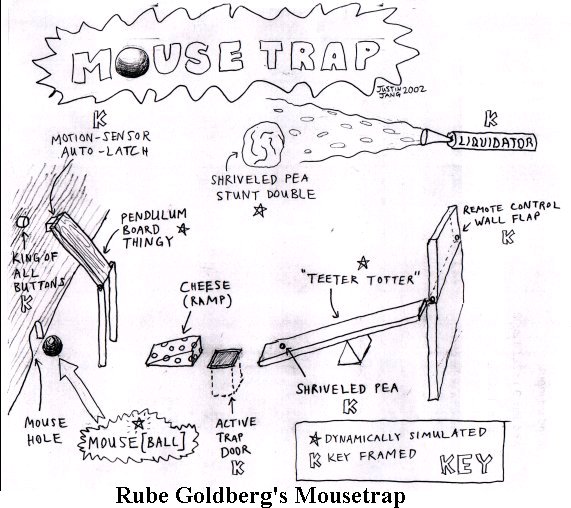
To explain why this is so would require a lengthy article all to itself about Florida's antiquated, unequal, highly politicized, and inadequate public education funding system. All we have to know for present purposes is that Florida' s system for funding public schools is as convoluted as a Rube Goldberg mousetrap. It short-changes school districts which happen to have a disproportionately high percentage of low-income students; and it well may be vulnerable to constitutional challenge.

What catches the eye in Stewart's article, though, has nothing to do with school funding issues. Twice he mentions the possibility of a "settlement" of the tax suit. It's possible Stewart simply made the common mistake of conflating "settlement" with "judgment," and he means nothing more than finality. Or, he could be hinting that true out-of-court settlement talks are underway.

Either way, Stewart's mention of a "settlement" recalls past efforts to amicably resolve out of court the long-standing tax dispute on the basis of a bargain that everyone could live with, beach residents and businesses as well as mainlanders.

What kind of deal might that be? For at least a decade, one group of beach leaseholders always favored trading taxes for an outright deed to leasehold property. Another group bitterly opposed any move toward compromise.

The split was mirrored among the membership of the Pensacola Beach Residents & Leaseholders Assn. While most PBRLA leaders at least privately favored negotiating a deed-for-taxes trade, none was able to marshall the support of enough beach residents and commercial leaseholders to make it happen.

Some PBRLA leaders who addressed the issue, like Ray O'Keefe (1998), argued that agreeing to pay taxes inevitably would lead to the desirable goal of self-government through municipal incorporation. Others like Don Ayres (1999) added that a deed-for-taxes solution also would improve the beach economy substantially by easing bank lender worries and by removing the uncertainty of leasehold renewal policies.

This last is an issue that has haunted the Santa Rosa Island Authority for many years. It's one that seems to be crawling out of its coffin once again, as we noted recently.

Still others, like Gary Smith (2004) recognized that a deed-for-taxes deal likely would satisfy the emotional need for security that many beach homeowners have, regardless of the common legal understanding that a deed is merely one kind of 'bundle of sticks' that other forms of property tenure, like a long term lease, closely approximate. Out of staters, in particular, are often puzzled by the leasehold tenure system on Pensacola Beach. Many potential buyers are scared off. Others simply accept the nonchalant assurances of real estate sales people that it's nothing to worry over.

It's been said that the revered "father of Pensacola Beach," the late Dr. Jim Morgan, also favored a deed-for-taxes solution. One surviving memorandum he wrote for posterity, decades ago, would seem to reflect this, although it also acknowledges that "granting the leaseholders absolute title will have consequences far beyond the taxation issue." (The only copy of the memo known to have survived was later edited by someone else, so it's impossible to be sure whether Morgan or the editor added the mysterious caveat.)

The closest anyone came to negotiating the kind of trade O'Keefe and Ayres (and maybe Morgan) favored came in the late 1990's, when county commissioner Mike Whitehead privately signalled that he would be open to a deed-for-taxes agreement as long as it happened within a few years. Whitehead ran for higher office soon afterwards, however. He lost and left the commission and was only recently elected once more as county commissioner.

With the adverse ruling on taxation of Navarre Beach leaseholds now final, some may assume that it is too late to settle the Pensacola Beach lawsuit. There are good reasons to reject that notion, however.

First among them is that a settlement with the right terms is in the interests of everyone. Even in the teeth of an adverse ruling, there would be plenty of basis for concluding that a true out-of-court settlement would be in the interests of mainlanders, county government, and state government, as well as beach residents.

Okalaoosa County solved the leasehold taxation issue decades ago when they traded beach taxes for a deed. Fort Walton Beach noticeably has prospered since then. One reason, perhaps, is that credit institutions often find it easier to lend money to businesses (or write mortgages for homes) that are secured by a deed to the property rather than a declining years lease. Residential as well as commercial real estate listings sell quicker, and probably for more, when buyers are assured the land tenure system is comparable to what they would find elsewhere, rather than the unique "99 year leasehold interest in Government owned land" that has prevailed on Pensacola Beach since the early 1950's.

A further reason is one of equity -- basically the same principle of fundamental fairness that led the courts in the Navarre Beach suit to conclude that long term leaseholds had so many incidents of ownership that they were the near-equivalent of deeded real estate and therefore taxable. If that is so, then to tax without a deed uniquely disadvantages beach property leaseholders.

Yet another reason is that a deed-for-taxes deal actually would bring in more money to the County than any court ruling. Under the Navarre Beach ruling, only improvements to the land -- house and business structures themselves -- are taxable. Until deeded outright, the land itself remains free of taxation. For those who would declare a beach residence as their homestead, that freedom has less value because the land tax they are avoiding would be less in any event. But for businesses, real estate taxes on deeded land will be just as deductible as a business expense as leasehold fees are today.

There are many more reasons for believing that all sides to the pending tax suits could benefit from a settlement. Undoubtedly, federal legislation along the same lines that enabled Okaloosa County to tax Fort Walton Beach property would be needed, however. The original deed to Santa Rosa Island prohibits Escambia County from titling the land in any other non-governmental peson or entity.

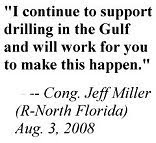
Former congressman Bob Sikes managed to eliminate that provision for the part of the island that is now called Okaloosa Island. Current congressman Jeff Miller has indicated in the past a willingness to sponsor such legislation for the rest of the island.

The lawyers and politicians entangled in the ongoing Pensacola Beach tax suit could do their clients and constituents a very large favor by approaching him again. A true settlement of the tax dispute would be in everyone's interests.

Sunday, February 05, 2006

Bleak Sundays in February

The other day in an item about the Navarre Beach tax case, we were, perhaps, too circumspect when we slipped in two links to the on-going PBS serial drama of Bleak House.

Let's be more specific: There are few better ways to spend your Sunday evenings this month than watching this drama. As Stephanie Zacharek of Salon.com (subscription or free for an ad-watch) says:
Now more than ever, we need Masterpiece Theatre's "Bleak House."

In the past few weeks I've had numerous conversations with people, some of whom haven't looked at Masterpiece Theatre in years, who suddenly found themselves hooked on this British-made Charles Dickens adaptation, currently airing on PBS. (The series began with a two-hour opener on Jan. 22 and will continue through the month of February, ending on the 26th.) That's what happened to me: I turned the show on, never having read the book, and almost immediately slipped into its world.

Many of us have become used to the experience, pleasurable in its own right, of sitting down with a fat DVD box set (a season's worth of a novelistic TV series like "Alias" or "Lost," for instance) and watching a complete arc in a few greedy stretches. It can be fun to whiz through some six months' worth of shows at a clip -- akin to the act of reading pages as quickly as you can turn them. But the downside is that you lose any sense of anticipation between episodes. Cliffhangers become nothing more than puddles to jump. By the time you've even formulated the question "Who shot JR?" (and made a quick trip to the fridge), you can have the answer.

"Bleak House" will be available on DVD on Feb. 28, almost immediately after the series completes its TV run. But nearly everyone I know who has begun to watch the show prefers to see it the old-fashioned way, on successive Sunday nights, as it airs -- a way of approaching Dickens' work that's not far off from the way his earliest reading public would await each installment of his newspaper serials. Dickens' biographer Edgar Johnson has written about how American fans waited at the docks in New York, shouting out to the crew of an incoming ship, "Is Little Nell dead?"

* * *
This "Bleak House" is peopled with a vast assortment of characters, all beautifully cast * * * . There's Miss Flite, played by Pauline Collins, a dithery elderly woman who spends her days at the Court of Chancery following the proceedings in the Jarndyce v. Jarndyce case, and her evenings caring tenderly for the various caged birds who share her small room; Mr. Guppy (Burn Gorman), an oily and ambitious young law clerk who bears an unnerving resemblance to the young Willem Dafoe (and who, after being rebuffed by Esther, can surely be up to no good); and Ada Clare (Carey Mulligan) and Richard Carstone (Patrick Kennedy), John Jarndyce's two young wards, who potentially have much to gain from the Jarndyce v. Jarndyce lawsuit but who also, as their guardian keeps warning them, have much to lose. Carstone is likable but ridiculous (he can't settle on a profession, largely because he assumes he'll never need one), and Ada -- Esther has been brought to Bleak House as her companion -- is pretty, openhearted and bland. We don't want anything truly disastrous to befall these two, yet we're left wondering, as the case becomes more and more tangled, is there enough good to go around?

* * *
Dickens was also a man of surprises, as any master of the serial form would have to be. * * * After watching Episode 2 of "Bleak House," I now think I have some idea of where the story is going, and of at least some of the secrets that Lady Dedlock is suffering with. But I'm sure, in places at least, I'll be proved wrong. For these next four Sundays, I'll be turning the pages, figuratively speaking, with many other viewers, and on Feb. 26, I'll close the cover at last.

And then, instead of feeling confident that I already know the story backward and forward, I anticipate reading the novel for real -- alone, as we always are with a book, and yet not alone at all.
Watch the serial. Then buy the book. You can thank us later.

Area Blogs Update

Extend a welcoming handshake to the newest Pensacola area blog, Living on the Gulf Coast, which summarizes interesting news stories from Pensacola and along the Northwest Florida coast. If it sometimes seems a little like News of the Weird, we have only ourselves to blame.

LGC joins the following local area blogs, which we also index along the right side of our home page.
  • Barrier Island Girl
  • Daily photos, bits 'o poetry, and occasional hilarity from the "Erma Bombeck of Pensacola Beach."

  • Chumuckla Now
  • A group blog from the "hamlet" of Chumukla. Not much going on right now. They must be hibernating.

  • Dome of a Home
  • Valerie and Mark Sigler's storm-proof dome home is the focus of this Pensacola Beach web site.

  • Greg's Page O' "Why Bother?" (Pensacola)
  • This is the blog version of Greg's more permanent web site, known as "Greg's Page O' Fun". If your boss is watching, you can look busy and smart by displaying Greg's WorkHelp 1 and WorkHelp 2 on your monitor screen. Lots of impressive-looking footnotes! The only thing missing is the text that goes with them.

  • KentCockson.com (PNJ)
  • The 'official unofficial' blog by Gannett Corporation's Pensacola News Journal editor Kent Cockson.

  • Living on the Gulf Coast
  • Just started. Let's see how it grows.

  • No High Rises.com
  • Dedicated to fighting the good fight on Pensacola Beach, win, lose, or slow 'em down a lot.

  • Panhandling
  • Described (and edited) as mostly entirely a personal journal" this blog covers the Florida Panhandle from "Arts" through "Nerds" to "Wine." Also, it's guarded by two handsome slug-a-beds.

  • Pensacola Beach Preservation and Historical Society
  • Same as No High Rises.com, with additional news.

  • Pensacola Beach Today
  • With help from participating beach residents, in time this can become the successor to the now defunct www.pbrla.com. Send 'em news, views, and on-site reports about SRIA meetings.

  • Save Five Flags
  • Photos, newsletters, a message board, and even an interactive history quiz about the Five Flags Motel on Pensacola Beach.

  • Why Now? (Cinco Bayou)
    From nearby Cinco Bayou, this is an "On-line Opinion Magazine featuring annoyed rumblings from the leading edge of the Baby Boom firmly tied to a reality-based world." Bryan has disclosed he formerly worked for a spooky federal agency or two. He knows whereof he speaks -- and listens.
If we've missed anyone let us know in the comments section or by email.

Saturday, February 04, 2006

Cribbing for the Quiz

Check out Why Now? He did his homework. So, if you need help, crib his research for answers to the Cartoon Quiz.

Friday, February 03, 2006

Cartoon Quiz

Amardeep Singh, a Lehigh University English professor, asks the question: "Are we really in the midst of a major diplomatic incident over cartoons?"

It sure looks like it. But maybe not. There is a theory floating around The Internets that what's really going on is someone is giving us an on-going test throughout the year on the subject of "self-evident truths" our Founding Fathers proclaimed. (If you haven't heard that rumor, it's because we just started it.)

Today's pop quiz is part of that continuing test. This quiz focuses on Freedom of Speech and Press. Is it a valued liberty we should cherish? Or, is it an inhibition to effective government that has outlived its usefulness in a "Post 9-11 world," as someone might put it.

Put away your books and notes, children. Here's the quiz. For each of the two questions, circle the one correct answer on your monitor with a crayon.

'Toon "A"

1. It is claimed that the cartoon image labeled "Toon A" is of the Prophet Muhammed, himself. The cartoonist is trying to make fun of Muslim terrorists who claim to act in his name when they slaughter people.
a) The little bomb on Muhammed's head makes a good, patriotic point. Therefore, the cartoonist is only excercising his free speech rights. Leave him alone.

b) The cartoon is a blasphemy of one of the world's great religions and its publication is causing millions to riot around the world, putting our troops and other innocents in great danger. Therefore, the Government should have prohibited it from being published.

c) Since this cartoon depicts Muhammed, it is a graven idol. To publish it would be a sin against the First Commandment and therefore the Government should punish any who publishes it. Chop off their arms.

d) Some would agree the cartoonist was making a good point. Some would disagree. The majority should decide whether it can be published.

e) None of the above.

'Toon "B"
2. The cartoonist who drew "Toon B" claims he was making fun of Donald Rumsfeld's assertion that injuries suffered by our troops in Iraq have made them "battle hardened." His immediate subordinates at the Pentagon, however, objected in a letter to the newspaper publisher that this cartoon is "a callous depiction of those who have volunteered to defend this nation, and, as a result, have suffered traumatic and life-altering wounds."
a) This cartoon is deeply offensive and it hurts our country. It should never have been published without prior approval of military leaders at the Pentagon.

b) The image of the soldier is horrible and it will hurt the morale of our troops. Therefore, the Pentagon is within its rights to ban it from being seen on any domestic or foreign military base.

c) This cartoon is critical of Bush administration policies and, therefore, traitorous. The Government should be able to prohibit publication of all cartoons like this in the future and punish anyone who circulates them. Chop off their arms.

d)
Some would agree the cartoonist was making a good point. Some would disagree. The majority should decide whether it can be published.

e) None of the above.


Answers
1. e
2. e

Court Rejects Beach Tax Appeal

"Unreason and injustice at the top, unreason and injustice at the heart and at the bottom, unreason and injustice from beginning to end — if it ever has an end — how should poor Rick, always hovering near it, pluck reason out of it? He no more gathers grapes from thorns, or figs from thistles, than older men did, in old times.”
-- Charles Dickens, Bleak House
The Pensacola News Journal is reporting today that the Florida Supreme Court has dismissed without comment the last appeal of Navarre Beach leaseholders against imposition of county real estate taxes.

The end of the bitter 5-year battle between Navarre Beach leaseholders and Santa Rosa County came with a whimper, not a bang. In a one-sentence order, the Supreme Court simply declined to review the case. This allows last year's First District Court of Appeals ruling to stand. That opinion is archived on the web site of the Navarre Beach Leaseholders Assn..

As Gannett's Tallassee reporter writes:
[T]he end of the legal challenge... means 800 leaseholders now owe about $2 million in 2001 taxes. In all likelihood, it also means more than 1,700 Navarre leaseholders now will have to pay more than $19 million in taxes assessed through 2005.
It's a matter of some concern what effect draining nearly $20 million from local residents may have on Santa Rosa County's economy and real estate market. The decision also darkens the clouds over similar lawsuits by Pensacola Beach leaseholders who are challenging Escambia County's parallel effort to impose taxes.

Some are saying that even if the tax is upheld, residents and business who can prove they relied on past promises of tax exemption when they bought beach property still may have a breach of contract suit against the state or county.

If the lawyers get creative enough, maybe the county should rename the beach Pensacola Bleak House.

Thursday, February 02, 2006

Childers Conviction Upheld

In 77 pages of judicial opinions, a majority of the 15 judges of Florida's First District Court of Appeals in Tallahassee have upheld the conviction of Pensacola's former political powerhouse, W.D. Childers. If the decision becomes final, the court will be sending the case back to the trial judge for imposition of an order compelling Childers to pay $1 million in "victim restitution" to Escambia County.

Childers was for many years dean of the state senate where he effectively held the purse strings. After being term-limited, he won a seat as Escambia County commissioner and quickly became a dominating force on the board.

The First District's "en banc" (full court) decision and dissenting views are available in legalese here (pdf format). Veteran Associated Press reporter Bill Kaczor has the details in people-speak here:
Former Florida Senate President W.D. Childers lost an appeal Thursday of his bribery conviction related to a Pensacola land deal while he was serving as an Escambia County commissioner.

He was convicted after a fellow commissioner, who later committed suicide by drinking antifreeze, testified Childers offered him a cooking pot filled with cash to vote for the $4.1 million purchase of a defunct soccer complex in 2001.

The 1st District Court of Appeal also ruled Childers can be required to pay restitution of up to $1 million - the amount Escambia County lost when it resold the soccer complex.

It was a rare decision by all 15 appellate judges. Most cases are decided by three-judge panels.

There's more. As Bill succinctly explains, the court --
split different ways on three key issues, voting 11-4 to affirm Childers' conviction, 10-1 to reverse a trial judge who had denied restitution... and 11-4 that the case qualified for a full-court review because it was exceptionally important.
In other words, the judges were more divided over how many of them should sit in judgment than what that judgment should be.

It's unusual to see an appellate court wash its dirty laundry in public like this. What makes it doubly weird is that if a run-of-the-mine three-judge panel had decided the case, Childers apparently would have won. Moreover, since the prosecution's star witness Willie Junior, is no longer alive Childers likely could have walked away altogether.

Chief Judge Charles J. Kahn somewhat testily disclosed early in his dissenting opinion that he was "the author of the original panel opinion in this case." He and one or both of the other judges would have reversed Childers' conviction on a point of evidence and ordered a retrial. Because the entire 15-member court took the case "en banc," however, Childers' conviction has been upheld.

Although they didn't say so immediately, W.D.'s lawyers almost certainly will seek a further appeal to the State Supreme Court. There, two of the larger issues will be whether the
intermediate appeals court properly decided the case en banc and whether Escambia County qualifies as a "victim" when someone bribes its county commissioners to over-pay for county property purchases.

Program for the Pig Pile


Josh Marshall's widely-read Talking Points Memo now provides a Grande Ole Docket listing "trial dates, court appearances and sentencing hearings for players in the current array of national political scandals." It's quite a pig pile of the indicted and convicted.

Aw, Isn't That Sweet?


Last night, the SRIA board and General Manager Buck Lee kissed and made up. Lee gets a 1-year contract renewal and a 5 percent pay raise.

Currently, Lee is paid $82,628 a year and $700 per month for travel expenses, plus benefits.

To his credit, board member Vernon Prather led a charge to up the annual raises awarded to staff, who've really been doing the heavy lifting. The across-the-board 4 percent raise still falls one percent short of Buck's increase. Wild-eyed optimists consider that for the SRIA, at least it might be a small step toward that terra incognito of equal pay for equal work.

No word, though, on the Hummer.

Wednesday, February 01, 2006

Bucking Buck Lee

Today's daily, the Pensacola News Journal, finally catches up on the old news that Santa Rosa Island Authority general manager Buck Lee received poor performance reviews from staff in advance of his employment contract renewal negotiations. But reporter Lynette Wilson adds a little spit and polish to the story by characterizing the reviews as "mixed." Then, she sticks the whole subject away in a dark closet, with no details showing.
The Island Authority board is expected to consider renewing, modifying or terminating its contract with Lee when it meets today.

Lee's current contract expires in May.

All Island Authority department heads and a random sample of other employees evaluated Lee's performance in two categories: leadership and employee relationships, and employee goal setting and performance monitoring.
Mixed reviews? Listen, when underpaid subordinates with no job security who live paycheck-to- paycheck tell you the boss is something less than a demigod, you know either he's terrible or they've lost their minds.

Lee's defense sounds a lot like the defendant who murders his parents and then throws himself on the mercy of the court because he's an orphan:
Lee said that in a perfect world, he would have had time to learn about the various departments and settle into his job. Instead, in the aftermath of Ivan, he was trying to get the road between Navarre and Pensacola beaches reopened; the island ready for the Blue Angels air show in early July; businesses up and running; and residents back into their homes as fast as possible, he said.
We didn't notice anyone in a shirt and tie out there shoveling debris off Highway 399 or tearing out the sodden wallboard in residents' homes. If Buck was busy doing all of that, it must have been after hours. On overtime, you might say.

There's a reason -- several of them, in fact -- why the weekly Independent News designated Buck Lee one of the Losers of 2005. The IN has been on his tail since shortly after he was hired in May, 2005. Last month the weekly reported:
Except for one department head that gave Lee all 4's (above average), the others gave him average to below average ratings. He scored real low in guiding day-to-day business decisions and implementing effective ways to monitor and evaluate customer concerns and issues.
The Island Authority knew when it hired Lee that he didn't have the education or management experience to run the SRIA. They were counting on his "policy experience" as a former county commissioner. Now, it's learning what voters know all too well about many of our local politicians: Buck Lee's biggest concern seems to be Buck Lee.

He isn't very smart about hiding it, either:
Meanwhile, Lee is pushing an exhorbitant lease renewal fee policy equal to 50% of market value for select small businesses who didn't lawyer-up or cross the palms of the good ol' boys years ago. This is an issue in which everyone on the beach has a major stake, as we've pointed out before.

Some are predicting the SRIA board will wimp out and renew Lee's contract today, but without a raise. If the board had any gumption, it would put him on notice of a re-review in three or six months, tell him to dump the Hummer, and begin advertising now for a potential replacement.

Debbie Norton for General Manager, anyone?

You've Got Male!

Kate at the Tampa group blog Sticks of Fire is passing along this gem:
"The St. Petersburg Times is looking for tales of online love gone bad. We’ve all heard stories about that self-described 'big man on campus' who’s really a middle-aged man with hives. Turn your heartbreak into hilarity and send it in email form to jbarry@sptimes.com"