Showing posts with label oil drilling. Show all posts

Thursday, May 13, 2010

Crude Possibilities - Thursday May 13 Gulf Oil Leak Update

1. 3-Day Coastal Oil Slick Projection.

Wind and water current will continue to be favorable for Pensacola Beach over the next three days, according to the latest projections by L.S.U.'s Coastal Studies Institute. Not so much for coastal points west of here, though. CLICK HERE or on the map, above, for a closeup.

Scientists at LSU and other research facilities that study the Gulf Coast are telling us that southeast-to-northwest winds and water currents are the norm for Pensacola Beach throughout Spring and Summer. While there will be exceptions on occasion, they generally are brief. So, if BP's Deepwater Horizion well gusher can be capped soon -- a possibility that still seems remote -- there is a rational basis in fact for hoping that we will escape the worst of the oily sludge.

2. Crude possibilities.

One scientist, who asked for anonymity because he does not want to be misunderstood as speaking for a well-known Gulf Coast employer, told us this week that much of the leaking oil appears to be "very buoyant" and "very light" in weight. It shows signs of "fragmenting," he says, into smaller pools and slicks.

"For a sandy beach like yours," he said, "this would not present much of a clean-up problem. It's worse for marshes with fine grained soils and cohesive particles that have the ability to retain that kind of oil for a long time."

"Over time, you probably will get occasional tarballs -- the flat, hard kind of heavy tar -- washing up on the beach," he forecast. "But that's nothing new."

He pointed out that over the decades occasional tarballs have washed up on Pensacola Beach before. Most of them are thought to be from long-forgotten tanker spills or small leaks from in-shore drilling rigs elsewhere in the Gulf. "Winter storms and of course hurricanes over time can transport the heavier crude patties almost anywhere."

When we asked about Escambia County's proposed plan to scrape the beach and build a landward berm in advance of any oil arriving, this expert said he considered it "unconscionable." He thought is was a waste of money and potentially harmful to the beach ecology. Scrape the beach afterwards if the worst should happen, he advises, but don't go throwing away money now on a worse-than-useless defense.

3. Eye Candy.

Today's New York Times has a report straight from Dauphin Island, Alabama. Reporter Shaila Dewan is there, bemused at the contrast between barefoot bathers enjoying the sun and surf and "National Guard troops and scores of laborers in hazmat gear and gloves" patrolling the beach and fortifying the island. They're there "for the coming war on oil," armed with what one resident calls "eye candy" -- hopelessly inadequate booms, hay bales, and skimmers.

Although 35 pounds of tarballs have been collected this week on Dauphin Island, the slick itself is still well offshore and out of sight:
At this time, it is perfectly possible to enjoy the beach, which is being kept unbelievably clean by the Tyvek battalions, so numerous that there was not enough trash to go around and their nearly empty garbage bags streamed behind them in the wind. But no one knows how long the oil will stay away, nor at what moment the Tyveks will suddenly drive past in four-wheelers towing trailers of hay, or wade into the water with strings of what look like pompoms and affix them to metal posts to catch incoming oil.
Even the normal beach trash is so sparse, Dewan writes, that "nearly empty garbage bags" stream behind the hazmat battalions.

Dauphin Island residents seem as divided as Pensacola Beach islanders. Some are grateful for the flurry of preparatory activity, others deeply skeptical.

David Probst... approached a television satellite truck Tuesday evening in hopes of showing off a small paper bag full of tarballs he had collected.

Mr. Probst opined that the floating booms, hay bales, and skimmer booms — strings of pompom-like material that trail through the water and are supposed to collect oil — were nothing more than “eye candy” whose weaknesses would be exposed as soon as a sustained south wind came along, pushing the disaster right onto Dauphin Island’s doorstep.


4. "Red Flag" Drilling Days.

On the beach everybody knows what a red flag day is: stop playing in the water for your own safety and that of others. Turns out, based on yesterday's congressional committee hearings, there were plenty of red flags waving in BP's face before the April 20 Deepwater well blowout -- but it proceeded with drilling activities, anyway.

WaPo summarizes:
A House energy panel investigation has found that the blowout preventer that failed to stop a huge oil spill in the Gulf of Mexico had a dead battery in its control pod, leaks in its hydraulic system, a "useless" test version of a key component and a cutting tool that wasn't strong enough to shear through steel joints in the well pipe and stop the flow of oil.

In a devastating review of the blowout preventer, which BP said was supposed to be "fail-safe," Rep. Bart Stupak (D-Mich.), chairman of the House Energy and Commerce Committee's subcommittee on oversight, said Wednesday that documents and interviews show that the device was anything but.
* * *
In Washington, Stupak said the committee investigators had uncovered a document prepared in 2001 by Transocean, the drilling rig operator, that said there were 260 "failure modes" that could require removal of the blowout preventer.

"How can a device that has 260 failure modes be considered fail-safe?" Stupak asked.
* * *
Committee Chairman Henry A. Waxman (D-Calif.), who said the committee has collected more than 100,000 pages of documents, focused on the cementing job by Halliburton. He said statements and documents indicated that a test performed on the work about five or six hours before the explosion showed other dangerous flaws.

Waxman said James Dupree, BP's senior vice president for the Gulf of Mexico, told committee staffers Monday that the test result was "not satisfactory" and "inconclusive." Waxman said the test showed wide discrepancies in pressure between the drill pipe and the kill and choke lines in the blowout preventer. Dupree told committee staffers that the pressure readings should have been the same.

At the hearing, Halliburton's chief health, safety and environmental officer, Tim Probert, conceded in questioning that the pressure readings "would be a significant red flag."
5. The Color of Research Money.

Yesterday, we mentioned the inevitably ugly stampede of hungry academic researchers trying to belly-up to the money trough they hope will soon be spilling out of the BP oil disaster. Today, the PNJ editorial board does its best to clear a place at the table for Florida universities by calling on Governor Charlie Crist to "knock some heads in Tallahassee and raise some cane with BP to get Florida's universities fully engaged."

By "fully engaged" the newspaper means Crist "could make some of the $25 million BP fronted to the state available for the effort, and then he should politely ask BP for more cash."

It's a very old joke that the most exciting words in science are not, "Eureka, I have found it" but "Your research grant has been approved.'" Scholars follow the money, as Phillip Mauser once said.

We have no doubt that some, possibly even many, of the Florida academics the PNJ wants to receive BP money have only the best of intentions. But where were they when Congress and the Florida state legislature were busy passing drill-baby-drill bills?

Where was the scientific curiosity in the Florida university system then? Some professors, surely, must have been researching questions like, "What would an oil well blowout do to the cycle of life a mile below the surface of the Gulf of Mexico?;" or "What innovations in drilling safety have been overlooked by the oil industry in the past three decades?;" or "How can a deep sea oil well blowout be rapidly shut off?"

As far as we're concerned, if anyone was seriously examining these or related questions, they're the ones who deserve to go to the head of the grant-money breadline. It shouldn't matter where they live or work -- in or out of "Florida's universities" or, for that matter, the state as a whole.

The issues are too important to the public at large to be treated like so much pork in the Florida educational funding barrel.

What we should be aiming for is superior, independent, and courageous research that won't disappear from public view behind some corporate claim to copyright or trade secrets, or be watered down to the taste of this year's partisan political fashion or to hike corporate profits.

6. White House Oil Slick Plan.

Speaking of money and research, the White House yesterday publicly released a $118 million supplemental budget request to take account of the BP oil spill. As Reuters reports, "the bulk" of the money is expected to be paid by BP Corp. and a one percent hike in oil drilling fees paid by the oil industry.

In addition to substantial funds to pay for U.S. Coast Guard services, fishermen and other coastal workers' unemployment, and Gulf Coast economic recovery monies, the budget request includes --
  • $29 million additional appropriation request "for the Secretary of the Interior for additional inspections, enforcement, studies and other activities that may not qualify as recoverable from the responsible parties or the Oil Spill Liability Trust Fund;"
  • $5 million for the National Oceanic and Atmospheric Administration for activities that support the response to the Deepwater Horizon oil spill, but may not qualify as recoverable from the responsible parties or the Oil Spill Liability Trust Fund; and
  • $2 million to the FDA to monitor and respond to the environmental impact of the oil on seafood.
The full text of the detailed supplementary request is here. A Fact Sheet summary is here.
Details of the plan.

Oops! Title change 5-14 am

BP's Deepwater Oil Gusher Video

Yesterday, British petroleum released the first video which gives a good look of the oil leak that threatens all life in the Gulf of Mexico. Rachel Maddow narrates and adds context, including news about yesterday's congressional hearings and commentary:


Visit msnbc.com for breaking news, world news, and news about the economy

Wednesday, May 05, 2010

Categorial Surprise

WaPo, buried on page 4:

The Interior Department exempted BP's calamitous Gulf of Mexico drilling operation from a detailed environmental impact analysis last year, according to government documents, after three reviews of the area concluded that a massive oil spill was unlikely.

The decision by the department's Minerals Management Service (MMS) to give BP's lease at Deepwater Horizon a "categorical exclusion" from the National Environmental Policy Act (NEPA) on April 6, 2009 -- and BP's lobbying efforts just 11 days before the explosion to expand those exemptions -- show that neither federal regulators nor the company anticipated an accident of the scale of the one unfolding in the gulf.
* * *
While the MMS assessed the environmental impact of drilling in the central and western Gulf of Mexico on three occasions in 2007 -- including a specific evaluation of BP's Lease 206 at Deepwater Horizon -- in each case it played down the prospect of a major blowout.

In one assessment, the agency estimated that "a large oil spill" from a platform would not exceed a total of 1,500 barrels and that a "deepwater spill," occurring "offshore of the inner Continental shelf," would not reach the coast. In another assessment, it defined the most likely large spill as totaling 4,600 barrels and forecast that it would largely dissipate within 10 days and would be unlikely to make landfall.

In recognition of BP's predictive skills, MMS gave it a safety award last year. Then, the agency probably invited BP to get back in bed with it.

Tuesday, May 04, 2010

Tuesday BP Oil Spill Update: Temporary Reprieve


1. Temporary reprieve.

Just last Friday, we were expecting the oil by the first of this week. But weather forecasters have been saying for the past day that "favorable winds and waves" could forestall a Florida landfall of the BP oil slick "for a few more days or longer."

Presently, local TV weather forecasts in Mobile and Pensacola estimate the earliest Perdido Key may see tarballs or ribbons of oil is late Thursday or Friday. The PNJ is carrying an AP dispatch that says --
So far only oil sheens have reached into some coastal waters, and the oil’s slow progress despite an uncapped seafloor gusher was allowing crews and volunteers to lay boom in front of shorelines. That effort was stymied by choppy seas into the weekend but the calmer weather should help.
The later the better.

2. Many Questions, No Answers.


BP and the Florida Department of Environmental Quality held a "standing-room-only" meeting last night for Pensacola Beach residents and business leaseholders. The venue was the always-accommodating Community Church (United Church of Christ). Another smaller gathering was held on Navarre Beach.

On Pensacola Beach, things didn't go well, the PNJ reports. Although the meeting was billed as "informational," as it turned out there were lots of questions and no real information. This exchange pretty well sums it up:
"This meeting was a whole lot of 'I don't knows,' " said Brittany Cook, 23, who attended the Pensacola Beach meeting.

[DEP assist director Darryl] Boudreau didn't dispute that.

"Some questions I can answer," he said. "Some I can't. Some nobody can."

Last night, WEAR-TV showed a number of our beach friends and acquaintances pitching fits at the BP and DEP spokes-people, to no apparent effect. But that's okay. In a week or two they'll be able to pitch tarballs.

3. Oil Spill Liability.

There's been a lot of talk from the President Obama on down to the lowliest congressmen and senators in Washington, D. C. about holding BP "accountable" for the catastrophic river of oil slowly sloshing around the Gulf Coast. BP CEO Tony Hayward repeated the same apparent assurances countless times over the last two weeks, as he did yesterday on National Public Radio:
"We will absolutely be paying for the cleanup operation. There is no doubt about that. It's our responsibility — we accept it fully," he added.
Never mind that in the same breath Hayward implicates others, although it does make him sound as if he's saying, "It's really someone else's fault." There's something else that rings hollow about these assurances.

The tone and context of what Hayward is saying -- and, for that matter, the same could be said about many of our own "drill, baby, drill" congressmen and senators -- is that BP will make everyone "whole" for the losses the catastrophic oil leak has caused. Turn on any TV and you'll see Gulf Coast commercial fishermen, boat captains, tourist business owners, restauranteurs, and homeowners near vulnerable wetlands in places like Plaquemine Parish, Louisiana, expecting BP to honor its word.

Not so fast. It seems to us the assurances of BP and its hired help in Congress are as slippery as their oil slicks. They echo corporate-friendly legalese drawn straight out of the Oil Pollution Act of 1990.

The Act is summarized here and here. The full text is here. Recent amendments to the act, making it more industry-friendly, are discussed here. A relatively recent, and long, student-written law review commentary explaining some of the ways the oil industry hopes to evade the act or have it declared unconstitutional is here.

Essentially, the act fixes an industry-wide cap, or limit, on the total damages to be paid to the entire universe of claimants in any one incident. That legal cap looks a lot tighter than any oil well plug BP ever used.

Attorney Abigail Field writes that the maximum BP can be stuck for is $75 million, "a sum that's orders of magnitude below the losses" likely to be suffered across the Gulf Coast.
BP will face unlimited damages under the 1990 law [only] if the accident was caused by BP's "gross negligence," or by BP's violations of federal safety, operational or construction regulations.
So, when you read the assurances of some spokesperson for BP, or one of the congressmen and senators they have in their pocket, or a state DEP official who says BP is the "responsible party," be sure to look carefully to see if anyone is admitting that BP was "grossly negligent." We know a corporation that would probably bet you $ 35 billion dollars it'll never happen.

4. Senator Bill Nelson.

On CNN yesterday, Bill Nelson (D-FL), said it was "baloney" to believe that BP willingly will pay more than a pittance to compensate for the all damage its Deepwater Horizon well has caused. That's why he's offering new legislation next week to amend the law.
Even as lawmakers rush to put together legislative responses to the spill, none appeared to be trying halt drilling in the gulf altogether. Instead, they are likely to focus on increasing inspections, oversight and safety requirements on offshore rigs. There could also be broad support for measures to halt new deep-water exploration and ensure that oil companies will foot the bill for cleanup.

Florida Democrat Bill Nelson , who has been one of the most vocal opponents of new offshore drilling, has introduced legislation to do both. One bill would halt new exploratory wells such as the exploded Deepwater Horizon, until an investigation of the current disaster is complete. Another would dramatically raise the cap on an oil company’s liability for economic damages in a spill from $75 million to $10 billion.
It will be a challenge to draft legislation that would effectively, and within the constraints of the Constitution, accomplish what Nelson proposes. It also will be a huge task to marshal the bill through the thoroughly dysfunctional U.S. Senate.

But Nelson has been a stalwart opponent of drilling in the Gulf. At least until Obama cut the legs out from under him, he was effective, too. If anyone can do it, we're guessing Bill Nelson can.

Sunday, May 02, 2010

River of Oil to Rush Around All of Florida

A Pensacola Beach resident writes to ask if there could be any truth to this prediction from University of Florida Professor Y. Peter Sheng, as reported a few days ago in the Ocala Star-Banner:
The oil slick that's growing south of the Louisiana coast could get caught in what's called the “Loop Current,” which flows through the Florida Straits and becomes the Gulf Stream.

The Gulf Stream runs up the eastern coast of Florida. Sheng said he believes it is entirely possible, even probable, that this will happen, thus impacting the beaches from Miami to Jacksonville. The Loop Current is about 35 miles south of the slick, which currently is 125 miles wide and 40 miles long.

“I would say the east coast of Florida has the higher probability (of being impacted by the oil spill),” said Sheng, adding his opinion is based on NOAA's ocean current forecast and wind direction.
Our correspondent's question and the professor's prediction triggered a faint memory. Sadly, the answer appears to be 'yes' it could happen. Funny enough, it's a decade-old news item involving Great Britain that offers substantiation.

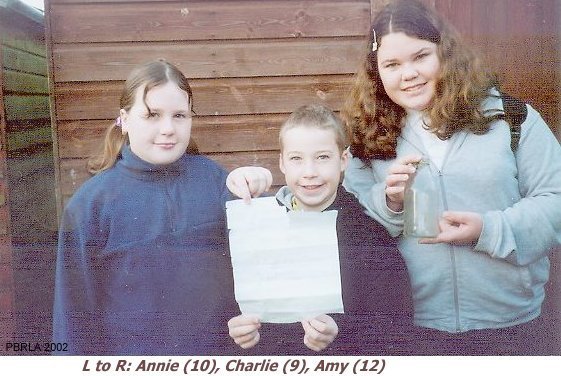
Way back in 2005 we reported on this blog that a photo had been recovered from the detritus of hurricane evacuations. It was a small treasure that somehow had survived two hurricanes. The whole story is worth reading. ["Message in a Bottle"].

The short of it is, sometime in the late 1990's two boys at Pensacola Beach Elementary School stuffed a message in a bottle one day, with their teacher's name on it, and dropped it into the Gulf of Mexico just beyond the breaking waves. The bottle was found by two young girls and a boy on Camber Beach in Southwestern England a year or two later.

The girls' mother -- ironically, an environmental worker of some sort -- sent an email to the beach residents' association of the time and sent along a picture of the three kids holding the bottle. Today, of course, the two boys would be men. The British adolescents would be adults. But the message in the bottle from Pensacola Beach remains somewhere in England.

If a message in a bottle can navigate south through the Gulf of Mexico, around the Florida Keys, and across the Atlantic, it's no stretch to imagine BP's river of oil eventually will follow the same path.

Friday, April 30, 2010

'Worst Case' Oil Spill Scenario

UPDATED BELOW
Ben Raines in today's Mobile Register:
The worst-case scenario for the broken and leaking well gushing oil into the Gulf of Mexico would be the loss of the wellhead currently restricting the flow to 5,000 barrels -- or 210,000 gallons per day.

If the wellhead is lost, oil could leave the well at a much greater rate, perhaps up to 150,000 barrels -- or more than 6 million gallons per day -- based on government data showing daily production at another deepwater Gulf well.

By comparison, the Exxon Valdez spill was 11 million gallons total. The Gulf spill could end up dumping the equivalent of 4 Exxon Valdez spills per week. [emphasis added]
That is a prospect so utterly appalling it leaves one stunned. To say nothing of this:
Thursday, federal officials said they were preparing for the worst-case scenario but didn't elaborate.
What kind of "preparation" could anyone make against the prospect of 6 million gallons of petroleum pollution a day bearing down on the Gulf Coast each and every day for two or three months until a new hole is drilled and the black crude river shut off? Abandon the coast?

A beach friend we were talking to today says this entire BP mess reminds her of nothing so much as 9-11. Because, she says, "It changes everything."

UPDATE
4-30 pm

National Public Radio is carrying the "worst case scenario" story, too. It is so painfully obvious the feds aren't "elaborating" on their plans because they don't have any.

We're not being critical, mind you. No one has a clue what to do right now with the consequences of "drill, baby, drill." Much less does anyone know what to do if 6 million gallons of crude a day begin gushing into the Gulf.

Meanwhile, Bryan at Why Now? reports newly "Independent" governor Charlie Crist has officially declared an "emergency" for the Florida Panhandle. North Escambia.com tells us what little that means.

UPDATE 2
4-30 PM

CBS has the BP oil leak, by the numbers.

Beach Perspectives on the Oil Spill Catastrophe

So far as we can see today, the only oil leak booms on Pensacola Beach are floating near the southwestern shoreline of Little Sabine Bay (click here or on the above photo). We can't be sure whether they were put in place anticipating the massive BP Deepwater Horizon oil spill reaching here, or are serving another purpose.

A New Orleans reporter, by the suitably sonorous name of Cain Burdeau, early this morning filed a report about the 'river of oil' bearing down on Louisiana today. ["Some Oil Begins to Ooze Ashore"]. Along the way, he mentions the marine weather forecast and how it impacts the delta:
The National Weather Service predicted winds, high tides and waves through Sunday that could push oil deep into the inlets, ponds and lakes that line the boot of southeast Louisiana. Seas of 6 to 7 feet were pushing tides several feet above normal toward the coast, compounded by thunderstorms expected in the area Friday.
* * *
Crews are unable to skim oil from the surface or burn it off for the next couple of days because of the weathe
r, Coast Guard Rear Adm. Sally Brice-O'Hara said on ABC's "Good Morning America."

Waves may also wash over booms strung out just off shorelines to stop the oil, said Tom McKenzie, a spokesman for U.S. Fish and Wildlife Service, which is hoping booms will keep oil off the Chandeleur Islands, part of a national wildlife refuge.

That same wind, for now at least, also is pushing the oil somewhat away from Pensacola Beach. Click here or on the photo to the left and you can see the familiar flag at Fort Pickens. At mid-day, a moderately strong southeast breeze was whipping it generally northwestward.

A number of beach residents we spoke with this morning are surprisingly sanguine about the oil spill. "I don't think it will reach us," one friend told us. "The winds are keeping it away," another said, "but I really feel for Louisiana."

Out at the westernmost point of Santa Rosa Island, beyond the point where Union-held Fort Pickens stares sternly northward toward the Confederate mainland, a handful of vacationers and locals are enjoying a cloudy but mild day at the beach, sheltered from the southeast breeze by the fort's old seawall (see below right).

Not everyone with a connection to the beach is as confident as the residents we spoke with. Last evening, we found ourselves in Gulf Breeze at a well known recreation center. In a corner near the entrance, a television reporter was announcing the latest alarming oil-leak news. A trim tennis player who looked to be in his in early 40's shook his head disgustedly and turned away muttering, "Looks like I'll never sell another house on Pensacola Beach."

The truth is, although Louisiana is not quite two hundred miles west of Pensacola Beach, we will be deeply affected -- and for a very long time -- by the BP oil spill, whether the tar balls reach us soon or never. So, indeed, will be the rest of the nation.

Louisiana's delta is the spawning ground for shore birds, sea life creatures of every description -- and countless plant and insect species upon which they depend. Millions of Americans depend upon all of that for their livelihood. Their misfortune can only worsen the national jobless recession.

Moreover, the entire nation depends upon the unique Louisiana wetlands to put food on the family table. Losing half the world's blue fin tuna, and a very high percentage of other sea-life dependent food sources, will be a severe blow to the overall economy.

As the Pensacola Journal perceptively editorializes today, "risk is not just the calculated numerical possibility of such an accident happening." Nor, we might add, is it measured, like hurricanes so often are, by whether it happens to hit us right here.

It is the calculated possibility of such an event happening — multiplied by the extent of the damage that could result if the event did occur. That's the risk we should focus on.

And when the potential extent of the damage is unacceptable? It should be clear that the risk is unacceptable.
What makes the BP oil spill so much more catastrophic than almost any other disaster you can conceive is the "potential extent of the damage." That "extent" reaches well beyond Louisiana -- and Pensacola Beach, for that matter. It will have a severe impact on the entire nation.

As McClatchy News reports --
Oil from a ruptured drilling rig could harm all kinds of marine life in the Gulf of Mexico, from the Atlantic tarpon and bluefin tuna that have key spawning areas nearby to endangered sea turtles, commercial fisheries, migrating song birds and marine mammals.
Bluefin tuna, tarpon, red snapper, dolphins, sea turtles, shrimp, oysters, shore birds -- merely to glance at the top of a long list of wildlife life about to be extinguished -- do not respect state boundaries. They occupy and depend upon a healthy ecology that does not stop at the water's edge of the Chandeleur Islands, or Santa Rosa Island for that matter. Nor more so than the shrimp you buy in the grocery store or the shore birds that are nesting this year on Pensacola Beach.

All Americans will be deeply and directly affected by the BP oil spill, however far the oil itself may or may not reach, and whatever state's shorelines it may or may not pollute.
minor edit 4-30 pm

Friday Morning Gulf Oil Spill Update

"I am frightened. This is a very, very big thing."

NOAA update: Yesterday, the Deepwater Horizon oil spill was declared a "spill of national significance." You knew that already, but what you may not know is the official federal definition:
"[A] spill that, due to its severity, size, location, actual or potential impact on the public health and welfare or the environment, or the necessary response effort, is so complex that it requires extraordinary coordination of federal, state, local, and responsible party resources to contain and clean up the discharge."
BBC News: The Louisiana coast, where oil began washing ashore last night, is the most directly threatened.

McClatchy News: The dire effects of the spill, however, reach well beyond Louisiana, and likely will adversely impact fish, fowl, shellfish, mammals, and the food chain throughout the United States. "Louisiana, after Alaska, is the second largest seafood producing state" in the nation, McClatchy quotes Ralph Portier as saying. Portier is a microbiology professor at Louisiana State University "who has worked around the world cleaning up oil spills."
"Every crevice, creek, bayou, bay, where water flows in and out of coastal grasses — that's the habitat for all these coastal nurseries. If we lose it or it's impacted, we have a real long-term effect," Portier said.
Timing of the oil spill "couldn't be worse for a number of fish," said Jerald Ault, a professor of marine biology at the University of Miami's Rosenstiel School of Marine and Atmospheric Science.
Atlantic tarpon, an important sport fish in Florida, spawn from now to mid May in the Gulf and they'll be "right in the highway where this stuff is going to come through." The young are especially vulnerable to toxics from the oil spill, and the fishery already is in a precarious state, Ault said.

The overfished Atlantic bluefin tuna return from vast distances to spawn in an area very close to the spill, where the water is warm and full of nutrients flowing from the Mississippi River. The same area also supports the shrimp industry and many other fish.

McClatchy News also reports "Florida is almost certain to see effects from the spill... ." While there is a "good chance" the west coast of the Florida peninsula will be spared, Manatee County's natural resources director Charlie Hunsicker predicts, "Unfortunately, the Florida Panhandle and Keys, and eventually the Atlantic Ocean, are very much in danger."

The Florida Keys! It's over 700 miles from Pensacola to Key West!

The Pensacola News Journal reports this morning that "Coastlines and waterways near Pensacola were being hardened against an oily attack Thursday as contract crews strung and anchored floating oil barriers." However, "Buck Lee, Santa Rosa Island Authority director, said crews have not yet brought any protective equipment to the Pensacola Beach."

"Hopefully, within the next seven days, they'll get it up this way," he said.

The Journal seemingly missed it, but a thin, orange plastic boom line already has been strung across the "Project Greenshores" estuary at the north end of Three-Mile Bridge. (Click on photo at left and then squint.)

Dept. of Proper Names
04-30 am
Bob Marshall of the Times-Picayune writes that everyone should stop using the word "spill" to describe this oily catastrophe. Instead, he proposes "river":
It's a river of oil flowing from the bottom of the Gulf at the rate of 210,000 gallons a day that officials say could be running for two months or more. If that prediction holds, much of the state's southeastern coast will become a world-watched environmental battleground that hasn't been seen in the United States since the Exxon Valdez ran aground in Alaska 21 years ago.

Thursday, April 29, 2010

Earth: 'Where We Make Our Stand'

For some reason, this seems timely:

Setting Fire to the Gulf Oil Spill

The limited usefulness of the "oil burn-off" tried late yesterday is underscored by this short film, from the U.S. Environmental Protection Agency. To be frank, it looks not much bigger than one of our own backyard barbecues. We wear an apron that says, "Dinner will be ready when the smoke alarm goes off."

Mr. Oil Spill

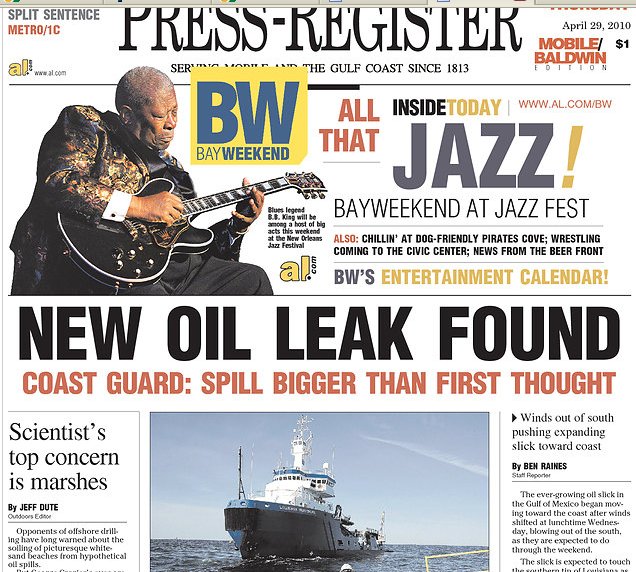
You couldn't tell it from the on-line version, but the dead tree Pensacola News Journal this morning trumpets the front page news that Jeff Miller, the incumbent Republican congressman from Northwest Florida, is doubling down in favor of Gulf oil drilling. Click the article image to read his latest, post-Deepwater statement.

Reality... inconvenient facts .... tens of thousands of his constituents who depend upon tourism.... the millions of Americans who enjoy our sugar-white beaches... the fish and fauna throughout the central and eastern Gulf of Mexico... All can be damned as far as "Oil Spill" Miller is concerned. He'll continue working, as he has promised so often he would, to make sure the unique sandy beaches of Northwest Florida eventually are befouled by a massive oil spill.

The pathetic man we have sent to Congress these past eight years has been publicly sucking up to the oil industry for so long, now, he can no longer help himself. It's become more than a habit with Miller. It's his raison d'être for being in Congress.

Even the ongoing BP Deepwater disaster, which now threatens to rival the scandalous Exxon Valdez oil spill, can't shake Miller's allegiance to Big Oil. Our local congressman continues to 'work hard' to bring oil drilling platforms as close as possible to Pensacola Beach.

"Drill, baby, drill" was his mantra before anyone in the lower 48 ever heard of Sarah Palin. He can't very well change now, he must be thinking; his record is too deeply engraved in the public consciousness. Jeff Miller has, you might say, oil all over his hands.

Miller went so far four years ago as to try to introduce oil drilling platforms directly off-shore of Destin, Fort Walton Beach, and Pensacola Beach. This would have put oil company platforms directly in the path of jets and trainers from Naval Air Station, Eglin AFB, and Hurlburt.

The Defense Department quietly took Miller to the woodshed. After that, Miller changed his tune ever so slightly to add, 'drill everywhere' except where it would "impact the military mission."

You need to know that background to fully appreciate the editorial in today's PNJ ["All In on Risk"]. It is a doleful warning to all the "drill, baby, drill" politicians in Florida who, like Miller, routinely promote drilling with the single exception of the "military mission":
For centuries, the white sandy beaches of what we call home have been a wonder of Mother Nature. Now, that white sand, unparalleled in all the world, is in jeopardy.

About 100 miles due south of Pensacola is a massive oil slick, the result of an oil rig explosion off the Louisiana coast two weeks ago. The blast killed 11 and has sent hundreds of thousands of gallons of oil into Gulf of Mexico waters.
* * *
The April 20 explosion on the Transocean Deepwater Horizon oil rig mocks the promise of safe drilling. It mocks the promise of clean drilling. It mocks any who have tried to portray drilling for oil in the Gulf to be as easy as pumping gas into the family car.
* * *
Oil truly is, we are finding out, dirty money.

And we hope it convinces our state legislative delegation, which has opposed drilling almost apologetically, mumbling about the perils of interfering with the military’s mission instead of standing up for the Panhandle’s already battered environment.
Then, in a pointed message to the Republican-dominated Florida legislature as well as Mr. Miller, the editorial adds:
Gentlemen, it’s also about the environment and tourism. Not just the military. What the explosion and the expanding oil slick have done is reveal that to hide behind “drill baby drill” is folly and that Florida will have to make a choice: intolerable risk to our beaches and environment, or oil money.

It can’t have both. Oil spills don’t leave us a Plan B. So make no mistake: If the Florida Legislature allows drilling in our coastal waters, then all of us are, in the language of the gambler, "all in" for the risk.

All of us.

The commercial fisherman. The hotel owner. The parents of the family who love beach
cookouts. The divers. The natives. The tourists. The people who love Pensacola for its beauty.

All of us. All in. [italics added]
Miller and his drill-happy cohorts can gamble all they want with their own lives property in landlocked Washington D.C. and Tallahassee. But to continue tossing the "drill, baby, drill" dice means endangering the lives and livelihood of all the rest of us who live along coastal Florida or want to visit our beaches. If the Deepwater oil spill disaster proves nothing else, it is that these politicians -- no more than dissembling oil corporations like BP, trapped in their own lies -- have no moral, ethical, or economic right to put our lives and property at risk.

Miller quite obviously doesn't get it. So we should be sure to send him another message at the polls this year.

Thursday Gulf Oil Leak Update

Mobile Register

"A massive oil spill in the Gulf of Mexico is even worse than officials believed and the federal government is offering to help industry giant BP contain the slick that is threatening parts of the U.S. shoreline, the Coast Guard said.

"A new leak discovered in a blown-out well a mile underwater means five times as much oil is spewing into the water — an estimate BP disputes. The time may have come for the defense department and other public agencies to offer up 'technologies that may surpass abilities of the private sector' to get the mess under control, Coast Guard Rear Adm. Mary Landry said at a news conference late Wednesday."-- AP, via Atlanta Constitution, Apr. 29l

* * * * *
"A third leak had also been discovered at the site, Adm Landry said. * * * One fire-fighting expert told the BBC the disaster might become the "biggest oil spill in the world."

If US Coast Guard estimates are correct, the slick could match the 11m gallons spilt from the Exxon Valdez within less than two months." -- BBC News, Apr. 29

* * * * *
"The oil well spewing crude into the Gulf of Mexico didn't have a remote-control shut-off switch used in two other major oil-producing nations as last-resort protection against underwater spills.
* * *
"The U.S. considered requiring a remote-controlled shut-off mechanism several years ago, but drilling companies questioned its cost and effectiveness, according to the agency overseeing offshore drilling. The agency, the Interior Department's Minerals Management Service, says it decided the remote device wasn't needed because rigs had other back-up plans to cut off a well.
* * *
"Industry critics cite the lack of the remote control as a sign U.S. drilling policy has been too lax. 'What we see, going back two decades, is an oil industry that has had way too much sway with federal regulations,' said Dan McLaughlin, a spokesman for Democratic Florida Sen. Bill Nelson. 'We are seeing our worst nightmare coming true.'

"U.S. regulators have considered mandating the use of remote-control acoustic switches or other back-up equipment at least since 2000. After a drilling ship accidentally released oil, the Minerals Management Service issued a safety notice that said a back-up system is 'an essential component of a deepwater drilling system.'" --Wall Street Journal, Apr. 29

* * * * *

"Emergency workers in the United States have set fire to a small portion of an oil spill that has been leaking crude into the Gulf of Mexico since Friday. Crews are struggling to contain the spill before it reaches coastline as early as Friday.

"Boat crews used the burn technique on a small patch of oil in the center of the slick, which officials say is continuing to grow and encroach on U.S. coastline. An airplane survey conducted late Wednesday showed the western edge of the slick is now some 25 kilometers from the Louisiana coastline." -- Voice of America News, Apr. 29

* * * * *
"As a massive oil slick approached the fragile Louisiana coast, officials prepared Thursday for an environmental disaster which threatens a slow and painful death for waterfowl, wildlife and their wetland habitat.
* * *
Any oil spill is devastating. But experts say the US Gulf Coast -- which houses 40 percent of the nation's wetlands and a multi-billion-dollar fishing industry -- is particularly vulnerable. And the concern is multiplied by the fact nobody knows when oil will stop spewing from an offshore well destroyed last week following an explosion in the Gulf of Mexico.

"'It's not like a bunch of volunteers can go (drive) down and mop up the beach,'" said LuAnn White, director of Tulane University's Center for Applied Environmental Public Health. 'There are just miles and miles of coastal wetlands there that can only be reached by boat. And they're very delicate.'" -- AFP International News, Apr. 29

* * * * *
"Escambia County commissioners held a special session Wednesday afternoon to discuss local preparations. * * * They were told that local emergency crews should await further instruction from the federal agencies, which have jurisdiction over offshore areas.

"'Basically, we're in a monitoring stage right now,' said John Dosh, head of the Escambia County Emergency Operations Center.

"Commissioners Gene Valentino and Grover Robinson IV, whose districts include Perdido Key and Pensacola Beach, expressed frustration that local officials are forced to take the back seat to federal response crews."-- Pensacola News Journal, Apr. 29

* * * * *
"In the northern Gulf... wind tends to drive the currents. This time of year, prevailing winds in the Gulf tend to be from the east, which would keep the slick away from Florida.

"But it's not unusual to get southwest winds; if we get several days of these winds, the slick could come here. The winds have been from the north recently, keeping the slick out to sea.

"The major worry right now is for the marshes, reefs and other habitats in Louisiana. But if the slick heads to Florida, it likely would hit Northwest Florida beaches first." -- Pensacola News Journal, Apr. 29

New, Much Larger Oil Leak

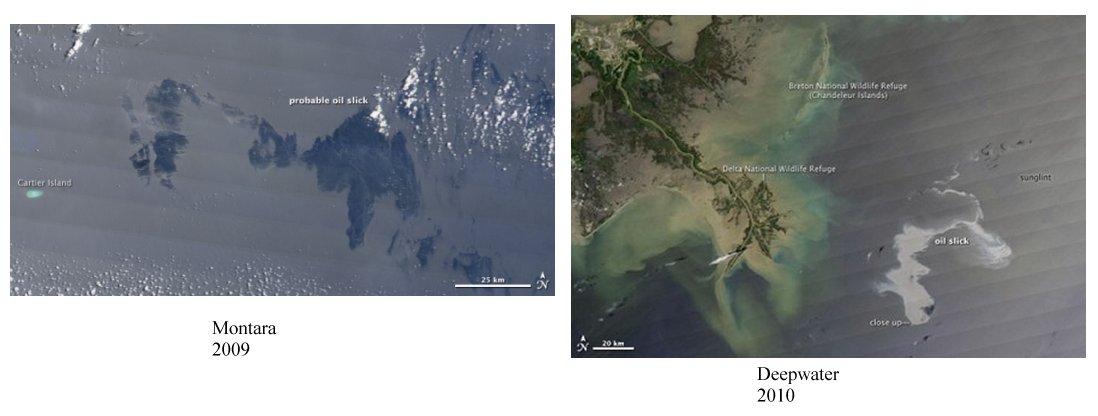
In yet another parallel to the Montara deep well oil spill in Australia last year, the National Oceanic and Atmospheric Administration announced overnight that BP's Deepwater Horizon well is leaking five times as much oil as the oil corporation previously admitted.

From today's New Orleans Times-Picayune:
As a sheen of oil moved closer to the Louisiana coast Wednesday, officials with the National Oceanic and Atmospheric Administration revised their estimates of the amount of oil that has been leaking from the oil well from 1,000 barrels a day to up to 5,000 barrels a day, or about 210,000 gallons.

BP officials also discovered a new leak in the twisted pipelines that were severed when the Deepwater Horizon oil rig sank into the Gulf of Mexico last week. But Doug Suttles, chief operating officer with BP Exploration and Production, said this does not change the overall amount of oil believed to be coming from the well.
* * *
As winds shifted to the southeast Wednesday, forecasts showed for the first time that the outer bands of the oil slick spilling from a deep well in the Gulf of Mexico will reach the southern fringes of the Louisiana coast by late Friday.

Forecasts called for continued winds from the southeast through the weekend and also unusually high tides, meaning oil could continue to move into the fragile Mississippi River delta region for days.

According to New York Times reporters Campbell Robertson and Leslie Kaufman, when Suttles insists that BP considers there is no discrepancy in the volume of leaking oil, it's because, "The new, far larger estimate of the leakage rate... was within a range of estimates given the inexact science of determining the rate of a leak so far below the ocean’s surface."

In other words, to BP oil officials 5,000 barrels of leaking crude per day is the same as 1,000 barrels a day. Newer New Math? Or, the usual corporate dissembling? Confusion -- and quite probably misinformation-- rages among the various news reports coming out of the Gulf of Mexico.

As happened in Australia, as well, separating fact from corporate fiction is a tough task for journalists when the site of the disaster remains at sea. As has happened before, however, the true magnitude of the leak will only begin to become apparent when the oil leak begins to come ashore.

WWL-TV explains with visuals:


edited and updated 4-29 am

Wednesday, April 28, 2010

Pensacola First Response To Oily Armaggedon

"Most people around here have no idea what is about to happen. It will be a major, major disaster."
-- U.S. Park Service Ranger, Ft. Pickens, Santa Rosa Island
(Apr. 28, 2010)

As of this writing, it has not yet been reported that the U.S. Coast Guard has managed to set alight any of the pools of oil floating offshore in Louisiana near the site of the Deepwater disastrous oil spill. The effort can do little to stem the tide of oil heading shoreward, anyway.

At most, only "a few thousand gallons" can be set on fire at any one time. After the fires die away, toxic residue will remain in the water for months or even years, and eventually wash ashore or sink to smother sea life.

Prevailing winds are expected to shift as soon as late this afternoon. That may make corralling small clumps of floating oil and setting them afire even more difficult, if not impossible. As a midday report on the Pensacola News Journal web site reports, "Shifting winds this afternoon are expected to push a massive sheen of oil closer to the Florida coast in coming days."

Locally, the U.S. Park Service has gone to "Cat 2" status. The alert status is equivalent to a strong hurricane endangering mariners that falls just below "major" hurricane status. Booms are being unloaded and placed along particularly sensitive shorelines near Ft. Pickens and Perdido Key.

Park employees tell us, however, that the booms are largely a mere palliative. "They really can't do much if anything to protect the sea life or the Gulf environment," one ranger who asked for anonymity told us today. "It's for public relations as much as anything."

Chasidy Fisher Hobbs of the respected, very mainstream "Emerald Coastkeepers, Inc.," sent out an email this afternoon that's gone as viral as any email can. Here it is, more or less formatted as received:
THERE IS SOMETHING VERY WRONG WITH AN INDUSTRY WHOSE ONLY ALTERNATIVE TO CLEANING UP A MESS IS TO BURN IT!!

Here are a few things I have learned this morning: We can only hope that this terrible tragedy moves our country closer to energy independence with alternative energy sources.

1. BP contractors are not accepting help from any volunteers and do not expect to;

2. Apparently BP contractors at Pensacola NAS have a plan to keep the oil just offshore and then collect it in a terminal containment boom for removal;

3. It has been deemed impossible to block the pass due to fluctuating currents;

4. Trained personnel have been brought in to our area and have begun booming off sensitive areas around the pass;

5. A central operations unit is being set up in Mobile to coordinate efforts in this area should the burning of the oil prove folly.

We may not be able to help remove oil today, but we can all help to keep rigs out of Florida waters. Thanks to one your Directors, Derek Cosson (ProgressivePensacola.com) you can help with a few simple clicks.

There is now a form letter on our website so you can send a message to Florida legislators letting them know that we do not want rigs in State waters. Please take 1 minute to send a message: http://www.emeraldcoastkeeper.org/2010/04/27/327/>

Then, pass the link on and get as many folks to send the message as you can.

Oil Leak Precedent 'Down Under'

As the Pensacola News Journal was editorially wringing its hands the other day over the Deepwater Horizon oil platform disaster, it perspicaciously looked to recent precedent Down Under:
[L]ate last year, one of the most modern drilling rigs in the world blew out in the Timor Sea near Australia. Over the more than two months it took to plug the gushing leak, millions of gallons of oil had spread over thousands of miles of ocean.Well, proponents said, the rules they have to follow over there aren't as tight as the rules drillers have to follow here.

Better oversight makes for safer drilling, they said. A serious accident on a rig in the Gulf of Mexico is unlikely, and the potential for a big spill is small.Then, despite the better, safer rules and tougher oversight, another modern rig blew up last week just 52 miles off the coast of Louisiana. A spokesman for the company that owns the rig called it "one of the more advanced rigs out there."
Just a couple of months ago, another Florida newspaper was looking into the same oil spill precedent. "Could Oil Spill Disaster Happen in Fla?" the Orlando Sentinel wondered. "Aussie rig debacle offers lessons."

Both newspapers were referring to the Montara Oil Spill disaster which began last August and which wasn't contained until early November. The heavy leakage went on for almost three months!

The parallels are striking. As with the Deepwater Horizon platform in the Gulf of Mexico, the oil leak in the Timor Sea was initially reported by the petroleum corporation in charge as just a 'minor' spill.

A brief Reuters news report quoted company officials at the time as saying --
About 40 barrels of crude oil were leaked, along with an unspecified amount of condensate and natural gas from Montara, one of three oil and gas fields that the company is involved with in the southern Timor Sea, it said in a statement.

Chief Executive Anon Sirisaengtaksin told Reuters it would take time for the company to assess the situation and decide whether it would start commercial operations in November 2009 as planned.

"There is no environmental impact. We have measures to prevent that, and we will take specialists to look after it," he added.

Reality (you should not be surprised to learn) turned out quite otherwise from what the corporation's CEO claimed. Truth discourages profits, apparently. Such is the corporate culture today.

In reality, the Timor Sea well was leaking four to five thousand barrels a day. There, as satellite photos showed, the Montara oil leak soon grew to encompass an area equivalent to a whole province or state. Just as the ongoing Deepwater Horizon leak now is said to be as large as the island of Jamaica.

The Montara oil spill now "is considered one of Australia's worst oil disasters." There are differences between the two disasters, no doubt. But there also appear to be a great many similarities, from the apparent cause of an opening fire to the oil corporation's false assurances they were using all the latest in safety technology.

While it is too early to measure the long-term damage done by the Deepwater Horizon oil leak, it seems almost certain that the environmental consequences will be almost as devastating as in Australia.

The Australian government has yet to complete its investigative report, once promised for this month. But news reports suggest a deeply troubling, chronic opposition to safety by the oil company and inattention by Australia's regulatory oversight agency.

That echoes habitual complaints heard along the Gulf Coast for well over a decade that oil company opposition to safety rules, and less than rigorous MMS enforcement, has been endangering the public as well as drilling platform workers -- just as the Associated Press reported a week ago and the New York Times reiterated yesterday.

Yesterday, the Pubic Radio International news program "The World," heard on many educational radio stations, aired an enlightening discussion about the Montara situation with an Australian reporter who's been covering the story Down Under. You can hear the podcast by clicking here.

Wednesday Gulf Oil Leak Update

UPDATED BELOW
"A joint government and industry task force has been unable to stop crude oil from streaming out of a broken pipe attached to a well 5,000 feet below sea level."
-- New York Times, Apr. 28, 2010

"As efforts failed Tuesday to contain the flow of tens of thousands of gallons of oil leaking from an exploded well deep in the Gulf of Mexico, emergency response teams are considering a controlled burn-off of the oil on the water's surface as early as today."

-- New Orleans Times Picayune, Apr. 28, 2010

"Efforts to close a well spewing oil in the Gulf of Mexico are failing so the Coast Guard is considering lighting the mess on fire."
-- Associated Press, Apr. 28, 2010

"A US Coast Guard official says if leaks from an oil well in the Gulf of Mexico are not stemmed soon, they could cause one of the worst spills in US history."
-- BBC News, Apr. 28, 2010

"Construction has begun on a collection dome that will be deployed to the sea floor to collect and funnel oil as it escapes from the well, a method that has never been tried this deep before. The first rig to be used for drilling a relief or cut-off well arrived last night, several more are planned – a relief well would take several months to complete."

"'A lot of it is in God's hands at this time, depending on weather patterns,' Gov. Charlie Crist said Tuesday afternoon after getting a firsthand view of the sheet of oil from a Coast Guard airplane."
-- Pensacola News Journal, Apr. 28, 2010

"The Escambia County Commission has scheduled a special emergency meeting [in Pensacola] for 3:00 this afternoon to discuss any Escambia County response to the Deepwater Horizon oil spill in the Gulf of Mexico."

"The stretch of northern Gulf coastline likely to be affected -- beginning in Alabama and stretching toward Louisiana -- is called 'the fertile crescent' by federal researchers. It is considered the most productive section of the Gulf, fringed by marshes, seagrass beds and oyster reefs. It produces the lion's share of the Gulf's seafood and is the nursing ground for most of its fish, shrimp and crabs, according to federal research."
--Mobile Register, Apr. 27, 2010

"Had the rig, Deepwater Horizon, been drilling in Florida's state waters, the results would probably have been more dire, oceanographers say. * * * 'If the rig had been as close as 3 miles away — the limit proposed by state legislative leaders this year — 'the most likely scenario would be for the sea breezes to bring all the problems to the coast... .'"

"The oil rig fire and spill spurred Sen. Bill Nelson, D-Fla., to ask the Department of Interior to look into the explosion and investigate worker safety, inspections, technology and industry practices used in offshore drilling and gas production during the last 10 years."
-- Panama City Herald, Apr. 28, 2010

Dept. of Video Amplification
Updated 4-28 pm
A reader writes in to recommend this summary of the latest oil spill clean-up effort, from Newsy.com:

Words of One Syllable Dept.

"The same Republican led House that last year voted to open Florida waters to offshore drilling on Tuesday continued killing Democratic attempts to expand a popular solar energy rebate program."
-- Pensacola News Journal, Apr. 27, 2010

Oil Spill Forecast

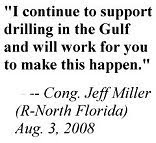
"I continue to support drilling in the Gulf and will work for you to make this happen."
-- Cong. Jeff Miller (R-Chumukla), Aug. 3, 2008

Tuesday, April 27, 2010

Deepwater Disaster Headed for Pensacola Beach

"Drill, drill, drill"
-- Sarah Palin, 2008 Vice-presidential debate

The explosion and collapse last week of the Deepwater Horizon oil platform off the coast of Louisiana is a major environmental disaster for the entire central Gulf Coast. Oil continues to leak into Gulf waters from a broken drill pipe at a rate of about 42,000 gallons, or one th0usand barrels of oil, daily.

As of yesterday, it appears the leading eastern edge of the oil slick is just 89 miles from Pensacola Beach. (Click on map, above.) The Deepwater Horizon rig is new and outfitted with the latest in oil industry safety devices, including a "blowout preventer, a 450-ton device... that is intended to prevent spills of this kind."

It doesn't work. The "improved technology" solution oil industry lobbyists have been touting as added reason to drill in the Gulf simply failed. No surprise there. Shades of the levy-builders at the Corps of Engineers.

Submersible submarines now are being deployed to see if they can repair or shut off the leak manually. The best-case scenario is that it will take two to four weeks to cap the deep water well. The worst case scenario is that the oil well blows a bigger leak and it takes "several months" to stem all the spillage. ABC News reports that if the well itself opens, "100 times more crude could spew into the water."

Either way, it will take decades to repair the damage to nearby ecosystems and beaches. And for many life forms that depend upon them -- from bivalves to beach business owners -- the damage may be permanent. Let there be no mistake about it: this disaster is man-made.

To be sure, there have been a few far-sighted, dedicated, and brave souls like Carolyn Esther McCormick and Enid Siskin. For many years, they have been warning us that the Gulf of Mexico was already "stressed" and "bringing rigs up to a line or an arbitrary distance on a map won’t stop damage that will be caused by drilling to Florida’s coastal communities."

Rather than listen, learn, and act on the irrefutable proof they offered, too many among us even right here in Northwest Florida applauded -- and voted for -- political pollyannas like Sarah Palin and Northwest Florida Congressman Jeff Miller when they urged "drill, baby, drill." Even President Obama recently caved under the public pressure.

Either Obama doesn't have the courage of his own convictions or he was cursed by spectacularly poor timing in making one of his infamous "compromise" proposals to achieve a chimerical "bipartisan" solution. Either way, he was wrong and he ought to admit it.

But he won't. No more than Palin or Miller will own up to their misjudgments. As happens too frequently in American politics, politicians who are proven by subsequent events to have been flat wrong rarely suffer the consequences.

Palin will continue to rake in her millions as a red-meat speaker for the right wing. Miller likely will win reelection -- aided, no doubt, by many of the same business-men and -women who are about to be ruined by the very policies he promotes. Obama already has vowed to expand oil and gas drilling in the Gulf, despite the ongoing disastrous results.

Short of a new law requiring that every proponent of expanded oil drilling off the shore of Pensacola Beach eat the tarballs that will soon be washing ashore thanks to the policies they advocated, they will all escape the consequences.

If we raised children like we coddle wrong-headed politicians, we would have a society full of sociopaths..... Oh, wait. Maybe we already do.

Thursday, April 22, 2010

Earth Day Oil Pollution

MSNBC, April 22, 2010:
"The oil rig that exploded, caught fire and then sank 36 hours later could lead to a major oil spill, officials said Thursday... ."
That should kill all proposals to drill for oil and gas off Pensacola Beach. Unless, of course, the oil spill washes up on our beach, anyway.

Or, given that Dave Murzin and Greg Evers still 'represent' this area, probably not.