Monday, November 14, 2005

Disgraceful

"The establishment of the writ of habeas corpus, the prohibition of ex post facto laws, and of Titles of Nobility ... are perhaps greater securities to liberty and republicanism than any [the Constitution] contains."
-- Alexander Hamilton, Federalist Paper No. 84, 1788
Any U.S. senator of any political party who votes to abolish habeas corpus for suspected "enemy combatants" is a disgrace to the Founding Fathers, the U.S. Constitution, the nation, and the ideal of "liberty and justice for all."

Full stop.

'Gulf Coast Watchers'

Majikthise today is calling attention to the new Internet project called Gulf Coast Reconstruction Watch.
Through much of the Gulf Coast coast, there's now an eery silence. The hurricanes have left, the flood waters have receded, and the TV cameras are nearly all gone.

But for the people of the hurricane-ravaged South, the struggle for their region's future has just begun.

While residents are focused on picking up the pieces a handful of powerful interests -- well-connected contractors, unscrupulous developers, and ambitious politicians -- are cutting deals, making plans and seeking to capitalize on the disaster.

But who's watching them? We are.

Today, the Institute for Southern Studies and Southern Exposure have launched an urgent new project to watch-dog what's happening in the Southern Gulf, and promote a more democratic and accountable future: Gulf Coast Reconstruction Watch.
It seems almost any reader can help. The Institute invites you to --
The Institute for Southern Studies is based in Durham, N.C.. For more than thirty years it has had an "established a national reputation as an essential resource for grassroots activists, community leaders, scholars, policy makers and others working to bring lasting social and economic change to the region."

'Slow Rolling' in Mississippi

Does this sound familiar, Floridians? From the Dallas Morning News:
"Nobody has gotten anything," Mr. LePage said as he watched workers carry out once-beloved items from his home. "We're totally dissatisfied with the progress on the insurance. Anything to keep from paying."

Nearly three months after Katrina, frustrations are mounting for residents whose homes and possessions were laid waste by the storm. Like the LePages, most want to get on with their lives, but they've had difficulty reaching anything more than a recording at their insurance companies. They've had trouble getting meetings with adjusters, and they've yet to see money paid out on claims.

Many believe the insurance companies are quibbling over damage claims that should be paid, and lawsuits are mounting as a result.

"Here we are still waiting," said Mr. LePage's daughter Laura Ann, whose New Orleans East home was flooded with about three feet of water. "You can't do anything. You're just on hold, really."

Dicky Scrubbs, the Mississippi lawyer representing thousands of Katrina claimants, told the Morning News, "The delays are no accident. Insurers are practicing a technique known as 'slow rolling,' procrastinating in making payments in hopes that claimants grow tired, desolate and more likely to accept what is offered."
"They do this limbo thing. Let it cool down, let these people get desperate. These people have no jobs, no insurance," said Mr. Scruggs, who is fighting his own battle with insurers over the loss of his Mississippi home to Katrina. "The insurance companies vacillate on making any commitment at all, hoping it'll all die down and the news channel will change subjects. This isn't their first rodeo."
A Biloxi evacuee we've met, who is now living in Gulf Breeze, tells anyone who will listen that his insurance company is refusing to pay.

"I evacuated to higher ground just a couple of blacks away," he says. "I actually saw my house ripped apart by wind. Three hours later, the flooding water moved what was left off the foundation. Now, the insurance company is saying it was all flood damage, no wind. They've refused to pay more than two thousand dollars."

One wonders what he would think to learn that his insurance company probably is making money off his misery. According to the Dallas newspaper:
Douglas Heller, executive director of the National Flood Insurance Program, says delays actually make money for the insurance industry.

"A month long delay in claims for 50 destroyed homes could bring in more than $30,000 in investment income to the underwriter," he said. Also, the "longer the delay, the more likely homeowners will settle for less."
To date, "only about 5,000 of the 225,000 possible claims have been settled for both Hurricane Katrina and Rita."

Sunday, November 13, 2005

Tropical Storm Alphabets

With a little more than two weeks left in the official hurricane season, and a month and half to the new year, the Associated Press is reporting a new "tropical depression... formed in the southeast Caribbean Sea" late Sunday evening. It is expected to become "Tropical Storm Gamma" on Monday.
Tropical Depression 27 formed late Sunday, and was expected to be south of Jamaica by the end of the week, over Caribbean waters still warm enough to feed a major hurricane, said hurricane specialist Stacy Stewart.

It is not expected to threaten the United States.

After running out of English-language names for 2005 tropical storms, the National Hurricane Center has been borrowing from the Greek alphabet. We've already used two Greek letters.

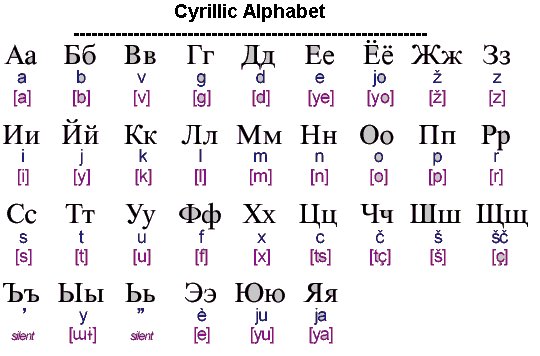
Whatever will we do if we use up all the Greek letters, too? One option is to turn to the Cyrillic alphabet.

How do you say, "Hurricane Б"?

edited for typos 11-14-5

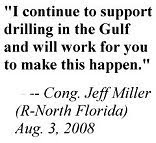
Miller Snubbed Over Drilling Stance

The Pensacola News Journal today issues a big 'Thank You' to those members of the Florida congressional delegation -- our two U.S. senators and a dozen Democratic congressmen -- who successfully opposed the Bush administration's proposal to drill in over half of the Gulf of Mexico's "Area 181" south of Pensacola.

Specifically not included was Jeff Miller (R-Chumuckla) and 12 of his oily Republican colleagues from Florida. Miller betrayed the beaches by promoting Big Oil ahead of his own constituents' interests.

Mystery at Citizens Property Insurance

One of the many enduring mysteries at Citizens Property Insurance is why Bob Ricker is still the head of it.
Bob Ricker, December 2003: "I am committed to managing Citizens like a true insurance company... . "

Bob Ricker, November 2005: "Citizens Executive Director Bob Ricker... says he was unaware of many of the personal and financial conflicts his hire carried aboard."
Thanks to Paige St. John and other reporters who have kept Citizens Property Insurance under the microscope, we've known that people Ricker hired and supervised directly are accused of taking bribes and that others he supervised were busy feathering their own nests while hurricane claims went unattended.

Today, we learn that the adjusting companies he employed worked without written contracts while they ripped off Citizens Property with padded bills:
Pay stubs and invoices document that [claims adjusting contractor] Quantum billed Citizens as much as $950 a day for adjusters who in turn received as little as $238 a day. In addition, Quantum billed Citizens for seven days a week of expenses but paid those adjusters only for five or six days.

"Citizens was aware, and they did nothing about it," said Roosevelt Johnson, who was among the veteran adjusters surprised to learn Quantum billed Citizens about three times what he was paid for his work.
Can it be that "managing Citizens like a true insurance company" means screwing nearly everybody -- except the corporate executives themselves?

There's more in the Ft. Myers News-Press.

Saturday, November 12, 2005

Trashing The Trash Baskets

Friday morning we shared a true tale about management orders to postal workers that caused the removal of waskebaskets from the post-Ivan temporary post office box facility at the Harbortown shopping center in Gulf Breeze -- the better to be sure we didn't throw away junk mail as we left.

Later that same day, two things of interest happened:
  • A reader, Bryan, added a comment to the blog article reporting, "The main post office in Fort Walton has also removed all trash cans from the lobby." (Just scroll down to the end of this article to read Bryan's note.) He wonders if some sort of stealthy national policy is underfoot to boost the fortunes of commercial solicitors by forcing junk mail down our throats; and

  • National Public Radio covered the same topic Friday evening by interviewing Michael Fitzgerald, one of what is now being called "The St. Petersburg Seven" -- mail carriers who have been threatened with job termination because they obeyed a few customer requests that their junk mail be stopped. You can listen to the interview on NPR's web site.
What we want to know is, have other post offices in the U.S. been removing their trash baskets? Please check yours and let us know.

Homeless Headline

Every now and then, faced with copy that describes the undescribable, a hapless headline writer simply will give up and quote from some desperate remark in the body of the story. It happened today in the Miami Herald, with the following headline:

'This Is Really Depressing'
Here's the intro:
The catastrophic collection of hurricanes that bullied the South over the last two seasons and rang up nearly $28 billion in damage threatens to create a new class of homeless -- a diaspora of already-struggling people who were displaced by the storm, then displaced in the effort to rebuild.

These are people made homeless by the madness of seven hurricanes in 15 months, people who had houses and apartments and condos before the first storm made landfall last August.

Faced with a punishing real estate market, the bulldozing of already-limited affordable housing and a complicated disaster-aid network that is overwhelmed by the massive scope of the storms, they may never return to a home. And about three weeks into rebuilding after Hurricane Wilma, South Florida becomes the newest region faced with the uncertainty of losing some of its poorest residents to homelessness.

''By the winter, we expect to see a new population of homeless. These are low-wage workers, the people who are suffering the most that somehow slip though the cracks,'' said Sheila Crowley, president of the National Low Income Housing Coalition. ``We are worried the numbers will grow.''
There's more. Individual stories of the working poor who are now but a step away from living in a cardboard box.

The newspaper is right: It's really depressing. Click the headline.

Speaking of Veterans Day...

Speaking of Veterans Day, as we were yesterday, Florida Blues points out that George W. Bush spent it stretching the truth and outright lying.

It's all about The Stovepipe, as Seymour Hersh reported two years ago -- and explained more succinctly in a companion Q & A here. Here's an excerpt:
Q. AMY DAVIDSON: Your story in the magazine this week is called “The Stovepipe.” Why?

A. SEYMOUR M. HERSH: Well, inside the military, “stovepiping” is slang for the practice of taking a piece of intelligence or a request that should be pushed through the chain of command—checked at levels and sent from one level to another—and bringing it straight to the highest authority. One of the things that people in the intelligence community have learned over the years is that early reports are often wrong. And so, before you respond to the first piece of information you have, you analyze it, you vet it, you study it, and then you make a decision about what you’re going to do with it. Stovepiping allows them to cheat the process. When you stovepipe stuff, you leave yourself open to the worst kinds of results.

Q. Is that what happened when the Bush Administration was building its case against Iraq?

A. One basic problem is that the Bush Administration changed the process in a very dramatic way. They worked it so that the raw intelligence, the reports that they wanted to hear, got to the top right away. The pro-war hawks rigged the system so that negative information about Iraq, no matter where it came from—and in many cases, we now know, much of it came from defectors who were relayed through the Iraqi National Congress, the group run by Ahmad Chalabi—was stovepiped directly to the leadership without any assessment. And so you had a situation in the Pentagon, and in the State Department, in the office of Under-Secretary John Bolton, and in the Vice-President’s office, too, in which the professionals were cut out of the process. That’s how you get to a position where Secretary of State Colin Powell can show up at the United Nations, as he did in February, and make a series of very boisterous claims about Iraq, most of which now appear to be wrong.
Even the Washington Post is onto Bush, now.

Late Edition
(Added 11-12-05 at 6:28 pm)

Josh Marshall's Talking Points Memo gives a point-by-point explanation of Mr. Bush's latest mendacity, followed by this trenchant conclusion:
In the president's new angle that his critics are trying to 'rewrite history', those critics might want to point out that his charge would be more timely after he stopped putting so much effort into obstructing any independent inquiry that could allow an accurate first draft of the history to be written. In any case, he must sense now that he's blowing into a fierce wind. The judgement of history hangs over this guy like a sharp, heavy knife. His desperation betrays him. He knows it too.

Friday, November 11, 2005

Blogging Veterans Day

"On the eleventh hour of the eleventh day of the eleventh month in 1918 the guns fell silent. The Great War, The War to End All Wars, was over...for a couple of decades."
It's Veterans Day and across the state, Florida blogs are busy celebrating it, some with remembrances of veterans in the family, others with ideas for what to do to show your appreciation, and still others by honoring the values veterans fought and died for. There's even a pretty good joke one student invented.
  • Sticks of Fire has some good suggestions for what to do on Veterans Day. At the top of the list: "Many assisted-living facilities are stocked full of elderly veterans who would love some company. Bring books or magazines to read to them or just sit and talk."

  • For good reason, Pure Florida is spending the day remembering "a shy kid who loved little horses." It's definitely worth a read.

  • Out In Left Field is taking her dad to lunch. (Let's hope she passes along some of his veteran's memories.)

  • Bark Bark, Woof Woof salutes his father, uncle, cousin, and other veterans who "gave up a part of their lives and futures in service to our nation." He's also wondering at the "mad karmic coincidence" of yesterday's U.S Senate vote to suspend the constitutional right of habeas corpus for those imprisoned at Guantanamo. Are we "exporting so much freedom and democracy to places like Iraq and Afghanistan that we have to give up some of it here?" he asks.

  • Deep Something is thinking similar thoughts about Senate majority leader Bill Frist's indifference to news concerning the CIA's secret torture sites around the world.

  • Why Now? today is remembering the origins of Veterans Day:
    The red poppies of Flanders fields became a symbol of that war and the veterans that returned from it. Known as Remembrance Day in much of the world, the poppies will be in evidence. * * * First called Armistice Day in the United States, the name was changed to Veterans Day, and its purpose changed to honoring those who are serving, or have served in the military.
  • The Cinco Bayou web site generously concedes "Not all Republicans hate veterans" and for proof he links to Fort Walton Beach's Colonel George "Bud" Day's web site known as Class Act Group -- still fighting for promised veterans' benefits that the Bush administration refuses to grant.

  • Tiny Little Dots and T. Rex's Guide to Life disagree. Republicans do hate veterans, they say. To prove the point, he and Tiny Little Dots both link to news that --
    On Tuesday — three days before Veterans Day — House Veterans’ Affairs Committee Chairman Steve Buyer (R-IN) announced that for the first time in at least 55 years, 'veterans service organizations will no longer have the opportunity to present testimony before a joint hearing of the House and Senate Veterans’ Affairs Committees.'
    * * *
    The Disabled American Veterans ... issued a scathing release calling the move 'an insult to all who have fought, sacrificed and died to defend the Constitution.'

  • Discourse Net is sharing "a very funny joke" that one of his students made up. As with most jokes, timing is everything. To achieve the proper effect be sure to go to the main page today while the joke is still at the top. (Later visitors will have to use the permalink and use a forearm or something to hide the punchline for a moment.)

  • Not so funny is this scary news from It's Recess Time: "President George W. Bush and the current administration have now borrowed more money from foreign governments and banks than the previous 42 U.S. presidents combined... ."

Junking Junk Mail

"Who is the post office working for - the customers or the advertising industry?"
-- Ed Vaughan, a St. Petersburg Beach condo resident

After Hurricane Ivan swept away most Pensacola Beach mail boxes, and most housing units with them, the U.S. Postal Service rented a large room in nearby Gulf Breeze and set up a bank of individual mail boxes. Too soon, we were being inundated with second class bulk leaflets and unsolicited offers to buy our property, make a loan, or issue credit cards to our dogs and cats -- what most of us refer to as "junk mail."

Originally, the Postal Service sensibly had installed a large wastebasket near the door. But it disappeared after only a few days. The reason?

"Someone in management noticed beach residents were tossing out all the bulk mail as they left the building," postal workers explained, "so they took the wastebasket away."

It turns out this may reflect a national Postal Service policy. In St. Petersburg, seven veteran mail carriers were abruptly fired last September, we learn today, "for failing to deliver bulk mail advertising to a handful of customers on their routes who had specifically asked them not to."

Reporter Tom Zucco has the full story here.

Thursday, November 10, 2005

Solving the Citizens Squeeze

"Citizens' consultants used statewide exposure information to calculate premiums for ZIP code areas, resulting in recommendations for a statewide average 80 percent hike and as high as 253 percent in parts of Pensacola."

-- Paige St. John, Tallahassee Democrat Nov. 10, 2005

The news all week out of Tallahassee has been about battle lines forming over how to repair Florida's broken property insurance system. Citizens Property Insurance Co. is planning statewide back-to-back double-digit rate increases this year and next.

As Mary Ellen Klas of the Miami Herald neatly summarizes it, "Citizens Property Insurance officials announced Wednesday that they will ask their board to raise Citizens' rates an average of 15.9 percent beginning in February, followed by an average increase of 48.4 percent later in the year."

Paige St. John offers a detailed explanation:

Claims from Hurricane Wilma threaten to wipe out reserves in the state-run Citizens Property Insurance, and all Florida homeowners could have to make up the difference through extra charges on insurance premiums.

The company's losses are estimated at $1.4 billion, according to figures released Wednesday. If that cost is passed on to private insurance companies and their customers, it would mean homeowners with a $2,000 annual premium would pay $220 more.

It would be the second time in as many years Citizens reserves were wiped out because of hurricane claims. Florida homeowners already are paying a surcharge to make up for last year's losses.

Citizens is the insurer of last resort for people who can't get insurance elsewhere, usually because they're in high-risk locations such as coastal areas.

Some think it's unfair to impose uniform statewide premium increases. They would prefer to redistribute the burden according to risk levels, as measured (somewhat crudely) by zip codes:
Citizens' consultants used statewide exposure information to calculate premiums for ZIP code areas, resulting in recommendations for a statewide average 80 percent hike and as high as 253 percent in parts of Pensacola.

Others, notably current Governor Jeb Bush and would-be governor Tom Gallagher, who's currently the state's Chief Financial Officer, are suggesting that Florida should dip into what seems to be a bubble of sales tax revenues from the increased sale of repair contracts and construction materials.

Still others, like Florida State Senate President Tom Lee, scoff that using any one-time increase in sales tax revenues won't solve the root problem. He told reporter St. John:

"The problem is: Citizens is not actuarially sound... . We've had a pay-me-now, pay-me-later system for a long time, and we've chosen pay-me-later. And it's caught up with us ... that's not a sustainable public policy."

In today's Miami Herald, state house minority leader Rep. Dan Gelber (D-Miami Beach) attacks the problem free of any ideological baggage or immediately evident personal ambitions. Citizens Property Insurance, he says, "was created on the premise that if 'free market' principles were applied wholesale to Florida's insurance market, Citizens would merely fill in any temporary voids until private insurers could be lured back when the market stabilized."

The reality, he says, is "our insurance market never stabilized. And even though insurance companies have received repeated approvals from Tallahassee to charge consumers higher rates, they are still fleeing the state."

It is time for Tallahassee to open its eyes to the utter dysfunction of Florida's windstorm market and provide real reform that will stabilize insurance rates and allow our residents to affordably insure their most valued possession: their home. We need a plan that will provide real relief to homeowners and bring stability to the insurance market. Here is just such an idea.

Florida should revamp its Hurricane Catastrophe Fund (CAT) to enable it to provide insurance directly to homeowners. Currently, the CAT fund can only be tapped by insurers to help mitigate losses. Under our plan, the CAT fund would become Florida's Hurricane Insurance Fund, and actually provide hurricane wind-damage coverage to all Florida homeowners who need it.

This plan would allow the CAT Fund to work just like conventional insurers: by stockpiling reserves and investing them so there is an adequate cushion to pay hurricane claims in bad years. It could even buy reinsurance from other insurers, so it wouldn't have to absorb a claim's entire loss. And it could borrow money if it needed to pay claims.
As Gelber acknowledges, his proposal is not new. Most recently, as we noted elsewhere, it was revived by a politically influential association of Florida insurance sales agents. Yet, some Republicans still "reflexively dismissed it as socialism," Gelber says.

Ideological name-calling is not going to get us closer to a practical, long-term solution to Florida's hurricane insurance problem. If it works, who cares if it's called "socialism" or "compassionate capitalism" or, for that matter, "overly ripe bananas"?

Giving expanded casualty-insurance authority to the separate Florida Insurance Catastrophe Fund is simply common sense. The CAT fund, itself initially modeled on the National Flood Insurance Program, has a sound administrative track record. Indeed, it is being seen by industry professionals as a useful model for a reformed national catastrophe insurance plan.

What Floridians need and want, as Gelber urges, is "a common-sense, nonpartisan approach" that "takes into account the harsh, permanent realities of Florida's windstorm market." Politically correct band-aids just won't do when the next ferocious hurricane season rolls around. No more than a thin blue sheet of plastic will protect your ruined house while you're still wrestling with last year's insurance claim adjuster.

Clarion Rezoning Approved

As predicted yesterday, the full SRIA board approved a zoning change for the Clarion Suites site on Pensacola Beach. The only surprise was that the board was unanimous. You'd think at least one or two board members would have held out for a better deal in the public's interest.

Will opponents continue to contest the decision at the county level? Certainly, it seems futile. Some years ago, then-lively island residents groups like the Pensacola Beach Residents & Leaseholders Assn. and Pro-Island, Inc. thought so. They mostly prioritized their finite resources by letting the SRIA and county government crap up the central commercial core and hotel districts on Pensacola Beach all they wanted. Island citizenry efforts to preserve the unique qualities of Pensacola Beach were concentrated, more or less, on the residential neighborhoods where building heights apply and lower density is required.

The problem is that as the high rises grow taller and the shadows grow longer and density increases in the commercial core, its boundaries tend to creep closer to residential areas. This arms developers with the same argument that Clarion made so effectively to the SRIA: You've already let the surrounding area where we're located go to hell, so why stop now?

Development creep is not only a paradox, it's also inevitable. But that doesn't mean the fight isn't worth it. Often enough, neighborhood preservation groups cheerfully will acknowledge that they're fighting a battle they expect eventually will be lost. They console themselves with the knowledge that if they didn't fight, ugly over-building would happen a lot faster and more frequently.

Ninety percent of life, as the saying goes, is just showing up. The same might be said for neighborhood preservation efforts.

Wednesday, November 09, 2005

SRIA To OK New High Rise

Lynette Wilson, a PNJ reporter newly assigned to the beach, is reporting that the Santa Rosa Island Authority's development committee will be recommending approval of a high rise hotel to replace the Clarion Suites Resort. The SRIA board meets to consider the proposal tonight, starting at 5:30 p.m.

A relatively new web site, Pensacola Beach Preservation and Historical Society, is calling for opponents to speak out against the proposal. It's been urging opponents to call or email SRIA board members and signing a petition that's been circulating on the net. Today, the web site says:
There will be a hearing for rezoning the Clarion to high density on November 9th at 5:30 at the SRIA, according to the sign at the Clarion property on the beach. We need to amass people to attend to let the SRIA know how serious we are about not allowing development run amuck. This is it folks. We can't let up now. We need many people to be there and let the SRIA know how serious we are about keeping our beach a small family oriented community and vacation destination.
Another locally-oriented blog, No More High Rises, has an easy-to-sign computer petition against the proposed rezoning.

Tuesday, November 08, 2005

An Empty Grab Bag

Florida Politics today is calling attention to the St. Petersburg Times' report about state CFO Tom Gallagher's "grab bag" of ideas to rescue insurance companies hit by the past year's hurricane claims.

"The odds that the changes would make insurance cheaper for property owners any time soon," says the Times, "are slim to none."